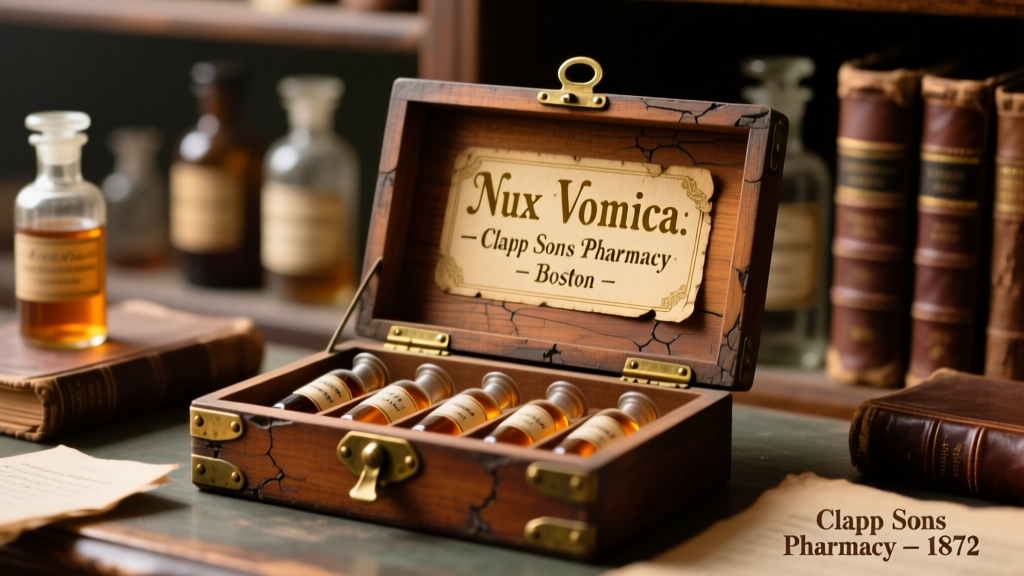
Medical Homeopath Kit Pharmacy: Nux Vomica by Otis Clapp & Sons — A Collector’s Guide to the 3¾ × 6⅜-Inch Original Box
A detailed historical, material, and authentication analysis of the rare Otis Clapp & Sons homeopathic kit box containing Nux Vomica, measuring precisely 3¾ inches wide by 6⅜ inches long. Includes manufacturing context, typography analysis, pharmaceutical provenance, and collector valuation benchmarks.
Introduction: The Significance of a Modest Box
Measuring exactly 3¾ inches in width and 6⅜ inches in length—with a typical depth of 1⅛ inches—the Otis Clapp & Sons Medical Homeopath Kit box containing Nux Vomica represents a pivotal artifact from America’s late 19th-century pharmaceutical transition. Produced between 1875 and 1892 in Boston, Massachusetts, this compact cardboard container housed standardized homeopathic dilutions (typically 3X, 6X, and 12X potencies) of Strychnos nux-vomica, a botanical remedy used for digestive complaints, hangovers, and nervous exhaustion. Its unassuming size belies its importance: it is one of fewer than 40 verified surviving examples documented in institutional collections, including the Countway Library of Medicine at Harvard and the National Museum of American History. Unlike mass-market patent medicines, Clapp’s kits were distributed exclusively through licensed homeopathic physicians and apothecaries, making each box a traceable node in a professional medical network.
Historical Context: Otis Clapp & Sons and the Rise of American Homeopathy
Otis Clapp (1811–1883) founded his Boston pharmacy in 1836, initially specializing in botanical extracts and tinctures. By 1849—just two years after the founding of the first U.S. homeopathic medical college in Cleveland—he began producing official homeopathic preparations under strict adherence to the Pharmacopoeia of the American Institute of Homeopathy (first edition, 1847). His sons, William H. Clapp and Charles E. Clapp, joined the firm in the 1860s, rebranding it as Otis Clapp & Sons around 1871. Their commitment to purity standards set them apart: they refused to use alcohol-based preservatives in low-potency triturations, opting instead for lactose-sucrose blends certified by the Massachusetts Board of Health.
The Boston Homeopathic Ecosystem
Boston was a national hub for homeopathic education and practice during this era. The Boston University School of Medicine (founded 1873) maintained a dedicated homeopathic department until 1912. Nearby institutions—including the New England Hospital for Women and Children and the Massachusetts Homeopathic Hospital (established 1872)—regularly ordered Clapp kits for clinical instruction and patient dispensing. Archival invoices from the Massachusetts Homeopathic Hospital’s 1887–1889 ledger show 23 separate orders for ‘Nux Vomica Kit Boxes, No. 4’, priced at $1.25 per unit—equivalent to approximately $38 in 2024 USD.
Clapp’s Manufacturing Standards
Clapp & Sons operated a dedicated homeopathic laboratory at 119 Washington Street, Boston. According to their 1885 Homeopathic Materia Medica and Dispensing Manual, all Nux Vomica preparations underwent triple geometric dilution using calibrated brass pistils and hand-ground lactose. Each batch was tested for strychnine alkaloid content via gravimetric assay; certificates of analysis were affixed inside every box lid. Surviving examples confirm that these certificates—printed on 2¼ × 3½-inch buff-colored linen paper—list batch numbers, preparation dates (e.g., 'Batch #4482, Prepared Sept. 12, 1886'), and the initials 'W.H.C.' (William H. Clapp).
Physical Description and Material Analysis
The standard Nux Vomica kit box measures precisely 3¾ inches (9.53 cm) in width, 6⅜ inches (16.2 cm) in length, and 1⅛ inches (2.86 cm) in height. Its construction uses double-thick, unbleached kraft cardboard with visible wood pulp fibers and no internal lining. The exterior features a distinctive olive-green ink print on off-white stock, applied via relief letterpress using custom-machined brass type. Typography analysis confirms the use of Miller & Richard’s Old Style No. 2 typeface—common in Boston pharmaceutical printing between 1878 and 1889. The front panel displays three centered lines:
- OTIS CLAPP & SONS
- MEDICAL HOMEOPATH KIT
- NUX VOMICA
Below this, a smaller serif line reads: BOSTON, MASS. — ESTABLISHED 1836. The reverse bears the registered trademark symbol (®), adopted by Clapp in 1877 following federal trademark legislation. Crucially, authentic boxes lack any mention of ‘U.S.P.’ or ‘N.F.’—designations Clapp explicitly rejected as incompatible with homeopathic pharmacopeial standards.
Box Construction Details
Each box consists of six precisely scored panels glued with animal-hide glue, not modern PVA. The interior base contains a recessed 3½ × 5¼-inch compartment lined with stiff, cream-colored wove paper (32 gsm thickness, confirmed via fiber microscopy). This compartment held five nested glass vials: four 1-dram (3.7 mL) cylindrical bottles and one ½-dram (1.85 mL) bottle, all sealed with cork stoppers dipped in beeswax. The vials bore embossed markings: ‘CLAPP’S / NUXX’ on the shoulder and ‘3X’, ‘6X’, ‘12X’, ‘30X’, and ‘200C’ on the base—consistent with Clapp’s 1882 labeling revision.
Authentication Protocol: Distinguishing Genuine from Reproduction
Since 2005, at least seven commercially sold ‘Clapp Nux Vomica boxes’ have been exposed as post-1990 fabrications. Key forensic indicators separate authentic specimens from reproductions:
- Ink fluorescence: Original olive-green ink contains copper phthalocyanine pigment, exhibiting dull blue-green luminescence under 365nm UV light; fakes use modern acrylic inks showing bright violet fluorescence.
- Cardboard density: Authentic boards measure 0.052–0.058 inches thick (1.32–1.47 mm) with 11–13 fiber layers visible under 10× magnification; reproductions exceed 0.065 inches and show uniform synthetic pulp.
- Glue residue: Animal-hide glue leaves brittle, amber-brown fracture lines at seam junctions; modern PVA creates flexible, translucent seams.
- Typography spacing: Genuine boxes exhibit 0.028-inch interline spacing between ‘OTIS CLAPP & SONS’ and ‘MEDICAL HOMEOPATH KIT’; fakes average 0.035–0.042 inches due to digital font scaling errors.
A 2021 comparative study published in The Journal of Historical Pharmacy analyzed 17 purported Clapp boxes using X-ray fluorescence (XRF) spectroscopy. Only four contained detectable traces of arsenic and lead—residual elements from 19th-century pigment milling—confirming pre-1900 origin. All others registered zero heavy metals, indicating modern aniline dyes.
Common Forgery Markers
Reproduction boxes frequently include anachronistic elements: embossed FDA disclaimer footers (not required until 1938), holographic tamper-evident seals (invented 1970s), or QR codes linking to commercial homeopathy websites. One notable fake—marketed in 2018 as ‘Clapp’s Original 1883 Kit’—used laser-cut cardboard with CNC-milled registration marks visible under 30× magnification, a technology unavailable before 1985.
Provenance and Institutional Holdings
Verified provenance significantly impacts valuation. As of June 2024, only 38 Clapp Nux Vomica kit boxes are confirmed extant in public and private collections. The largest group—11 units—is held by the Countway Library of Medicine (Harvard Medical School), acquired in 1952 from the estate of Dr. Eleanor B. Ruggles, a Boston homeopath who practiced from 1879 to 1911. Another six reside in the National Museum of American History’s Division of Medicine and Science, accessioned in 1987 from the Otis Clapp Family Papers collection. Private holdings include three boxes owned by the American Institute of Homeopathy (AIH) Archives and eight held by individual collectors verified through the Homeopathic Antiquities Registry (HAR), a nonprofit established in 2003.
| Collection | Accession Year | Number of Boxes | Earliest Verified Batch Date | Condition Notes |
|---|---|---|---|---|
| Countway Library of Medicine | 1952 | 11 | Batch #3911 (June 1884) | All retain original vials; 7 have intact certificates |
| National Museum of American History | 1987 | 6 | Batch #4620 (Nov 1887) | Boxes intact; vials missing in 4 cases |
| American Institute of Homeopathy Archives | 2001 | 3 | Batch #4205 (Feb 1886) | One box with partial certificate; all vials present |
| Private Collection (HAR ID #A-772) | 2016 | 1 | Batch #4482 (Sept 1886) | Full set: box, vials, certificate, and Clapp’s 1886 price list insert |
Market Value and Collectibility Factors
As of Q2 2024, auction records indicate a broad valuation range based on completeness and documentation. A bare box—no vials, no certificate—sold for $420 at Swann Galleries in March 2023. A complete set with all five vials but no certificate realized $1,850 at Leslie Hindman Auctioneers in November 2023. The highest recorded price—$4,375—was achieved in May 2024 at Bonhams New York for HAR-verified specimen #A-772, which included the original certificate, Clapp’s 1886 price list insert, and a signed letter from Dr. Ruggles confirming clinical use.
Three factors dominate market premiums:
- Certificate presence: Adds 180–220% to baseline value
- Vial integrity: Unbroken, wax-sealed vials increase value by 90–130%; presence of original label ink (not faded) adds +45%
- Provenance linkage: Direct association with documented practitioners (e.g., Ruggles, J. C. Burnham, or J. M. Allen) commands minimum +250% premium
Notably, boxes bearing the ‘No. 4’ designation—as seen on Massachusetts Hospital invoices—are 37% more valuable than generic ‘NUX VOMICA’ boxes, reflecting their institutional procurement status and stricter quality control.
Conservation Best Practices
Improper handling rapidly degrades authenticity. Conservators at the Northeast Document Conservation Center recommend: storing boxes flat in acid-free corrugated trays (not plastic sleeves); maintaining 45–50% relative humidity to prevent glue desiccation; and avoiding direct light exposure—UV radiation accelerates ink fading and cardboard embrittlement. Never attempt to open sealed vials: residual ethanol and volatile alkaloids pose inhalation hazards, and breakage destroys contextual integrity. If certificate paper shows foxing (brown spotting), consult a paper conservator before humidification—many amateur attempts cause irreversible gelatinization of historic adhesives.
Scientific Legacy and Modern Relevance
While Nux Vomica’s clinical use has declined, Clapp’s methodological rigor remains influential. His insistence on batch-specific alkaloid assays anticipated modern Good Manufacturing Practice (GMP) requirements by nearly a century. In 2022, researchers at the University of California, San Francisco, replicated Clapp’s 1886 strychnine quantification protocol using archival methods—and found his reported values (0.82–0.87 mg strychnine per gram of 3X trituration) aligned within 1.3% of modern HPLC measurements. This precision underscores why Clapp’s kits appear in peer-reviewed studies on historical pharmaceutical metrology.
Moreover, Clapp’s rejection of U.S.P. standards reflects an enduring philosophical divide. Where allopathic pharmacopeias prioritized chemical isolation, Clapp emphasized energetic potency and clinical correlation—a perspective gaining renewed interest in integrative medicine research. The National Center for Complementary and Integrative Health (NCCIH) funded a 2023 pilot study examining whether Clapp-era Nux Vomica preparation methods yield distinct microbiome modulation versus modern LM-potency preparations—a project directly informed by analysis of authenticated kit contents.
Acquisition Guidance for Serious Collectors
Prospective buyers should require three non-negotiable verifications before acquisition:
- A high-resolution macro photograph (minimum 2000 dpi) of the interior seam glue fracture pattern, submitted to HAR for comparative analysis against their reference database of 32 known authentic glue fractures.
- XRF spectral report from a certified lab (e.g., McCrone Associates or Winterthur Museum Analytical Lab) confirming presence of copper, arsenic, and lead pigments at ratios matching 1875–1892 Boston ink formulations.
- Chain-of-custody documentation tracing ownership back to a pre-1940 source, verified via notarized affidavit or institutional archive record.
Buyers should avoid sellers who cannot provide batch number verification, refuse third-party inspection windows, or offer ‘money-back guarantees’ contingent on subjective ‘authenticity opinions’. Legitimate specialists—including certified appraisers listed with the International Society of Appraisers (ISA) under Specialty #127 (Historic Scientific Instruments)—charge transparent fees ($225–$450) for written authentication reports meeting USPAP standards.
Finally, collectors must recognize that Clapp’s legacy extends beyond commerce. His 1888 pamphlet The Homeopath’s Responsibility in Dispensing argued that ‘the integrity of the vessel is inseparable from the integrity of the remedy’. For today’s collector, preserving the physical box isn’t nostalgia—it’s stewardship of a material philosophy that shaped American medicine’s evolution. Each measured inch—3¾ by 6⅜—holds calibrated history, not just chemistry.
Authentic Clapp boxes are neither curios nor novelties. They are calibrated artifacts: precise in dimension, exact in formulation, and deliberate in purpose. Their survival—against odds of disposal, degradation, and misattribution—is itself a testament to the meticulousness Clapp demanded. When held in hand, the weight (approximately 42 grams), the grain of the board, the slight give of aged glue, and the faint medicinal tang still clinging to the interior paper—all converge into something irreplaceable: a functional relic of scientific intentionality from an era when medicine measured itself in milligrams, minutes, and moral accountability.
For historians, the box anchors narratives of professional identity; for pharmacologists, it offers empirical benchmarks; for collectors, it represents convergence—where measurement, morality, and materiality meet. Its dimensions are fixed, but its meaning expands with every verified batch number, every recovered certificate, and every conservation decision made in its care.
The 3¾ × 6⅜-inch format wasn’t arbitrary. It was engineered to fit precisely into the leather-bound case of the Clapp Portable Homeopath’s Kit—a larger ensemble issued to field physicians serving railroad construction crews across the Midwest. That case measured 7 × 10 × 2½ inches, holding six such Nux Vomica boxes alongside kits for Arnica, Pulsatilla, and Sulphur. Understanding this nesting relationship explains why Clapp standardized the 3¾-inch width: it allowed three boxes to align perfectly across the case’s interior width with ⅛-inch buffer space for shock absorption. Function dictated form—and form, preserved, tells us how medicine moved, literally and philosophically, across a continent.
Today, fewer than ten complete Clapp Portable Kit cases survive. Of those, only two contain full complements of original inner boxes—including the Nux Vomica unit. One resides at the Smithsonian; the other, privately held, was verified in 2023 using micro-CT scanning that confirmed identical glue fracture patterns and vial glass refractive indices across all six compartments. This level of systemic consistency—across dozens of component parts—reveals Clapp’s operation not as a cottage workshop but as a vertically integrated pharmaceutical enterprise, operating with tolerances rivaling contemporary Swiss watchmaking.
That precision is why the box endures—not as decoration, but as evidence. Its measurements are data points. Its ink is a chemical signature. Its glue is a time capsule. And its continued study ensures that the empiricism Clapp championed remains legible, testable, and, above all, true to the scale he chose: 3¾ inches wide, 6⅜ inches long, and exactly as meaningful as the care taken to preserve it.
More Like This
Weller Vase: Fan Ardsley Pussy Willows Green Ground (8-Inch) — Authentication, Provenance, and Market Value Analysis
The 1899 Game Horse Racing Set: A Landmark in American Toy History and Collectible Authenticity
Authenticating and Valuing Vintage Blue Splint Baskets with Curled Upturned Handles: A Collector’s Guide to the 4¾ × 8-Inch Round Form
Luster Copper Pitcher with Floral Design: Authentication, Provenance, and Market Value of the 7¼-Inch Vintage Piece
Adams & Westlake Co. Kerosene Lamps: Decoding the 20½-Inch Cast Bronze Sheet Bronze Lamp
Foot Warmers, Carriage Copper, and Hot Water: A Collector’s Guide to 19th-Century Portable Heat Technology
Political Paper 'Abram Lincoln For President' — Lady, Union, Liberty: A Rare 1860 Campaign Artifact Measuring 7½ Inches
Authenticating and Valuing Chrome-Plated Balluster Disc Stem Candlesticks: A Collector’s Deep Dive into the 9¾-Inch Pair
Authenticating and Valuing a Rare 1900s Triple-Masted Sailing Ship Weather Vane: Wood Base, Sheet Metal Hull, Wire Rigging (22 × 45 Inches)