Mechanical Bank Collectors of America (MBCA): History, Authentication, and Community Impact
An in-depth exploration of the Mechanical Bank Collectors of America (MBCA), covering its founding in 1958, organizational structure, authentication protocols, annual conventions, grading standards, and role in preserving 19th- and early 20th-century American cast-iron mechanical banks.
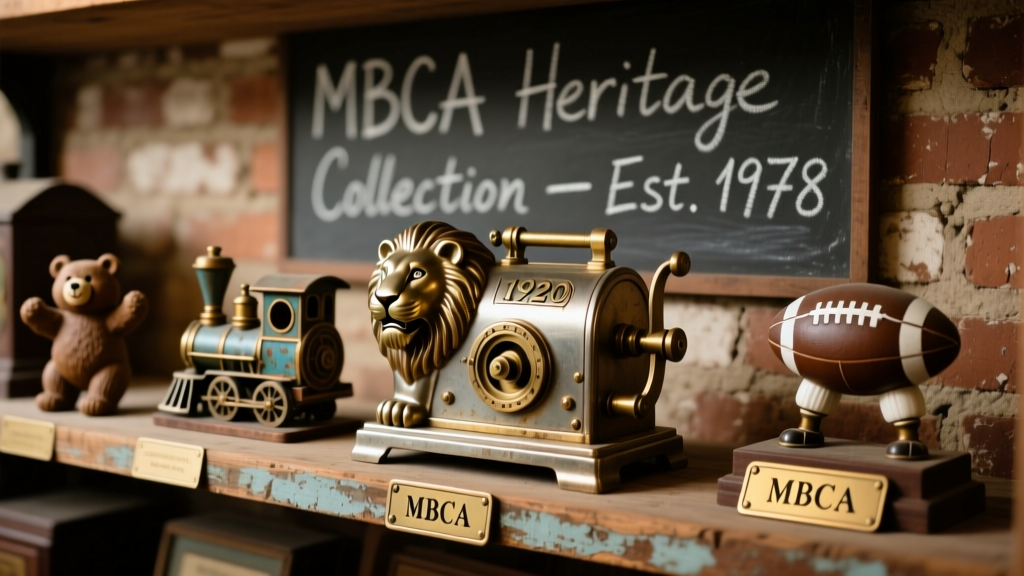
Origins and Founding Vision
The Mechanical Bank Collectors of America (MBCA) was founded in 1958 by a group of eight dedicated enthusiasts—including William H. Dwyer, Robert W. Grier, and John A. Frazier—in Cleveland, Ohio. At the time, mechanical banks were widely dismissed as obsolete children’s toys or low-value curiosities, often relegated to attic corners or sold for under $5 at flea markets. The founders recognized their historical significance as artifacts of American industrial design, metallurgy, and social history—and sought to establish a formal organization that would foster research, standardize identification, and protect against rampant counterfeiting. Within its first year, MBCA published its inaugural Mechanical Bank News newsletter, distributed to 47 charter members. By 1963, membership had grown to 182 across 32 states and three Canadian provinces—demonstrating rapid grassroots momentum grounded in scholarly rigor rather than speculative collecting.
Organizational Structure and Governance
MBCA operates as a nonprofit 501(c)(3) educational organization headquartered in Columbus, Ohio. Its governance follows a strict bylaws framework ratified in 1972 and amended most recently in 2021. The Board of Governors consists of nine elected officers: President, Vice President, Secretary, Treasurer, Archivist, Historian, Authentication Chair, Convention Coordinator, and Membership Director. Each serves two-year staggered terms, with term limits preventing any officer from serving more than three consecutive terms in the same position. Elections occur annually during the June convention, with ballots mailed to all members in good standing no later than April 15.
Membership Tiers and Benefits
MBCA offers three active membership categories: Regular ($65/year), Life ($1,200 one-time), and Junior (under age 18, $25/year). All members receive digital access to the quarterly Mechanical Bank News, full archives of the MBCA Authentication Bulletin (launched 1984), and priority registration for the annual convention. Life members gain permanent voting rights and inclusion in the MBCA Hall of Recognition—displayed physically at the organization’s archive center and online via the members-only portal.
- Regular members may submit up to two banks per calendar year for formal authentication review.
- Life members receive complimentary re-authentication for previously certified items upon request.
- Junior members gain access to the MBCA Youth Mentorship Program, pairing them with veteran collectors for hands-on study of banks like the Jolly Nigger Bank (c. 1882, J. & E. Stevens Co., 7.25" H × 4.5" W × 3.75" D) and the Girl Skipping Rope Bank (c. 1890, Hubley Manufacturing Co., 5.5" H × 3.25" W × 2.75" D).
Authentication Protocols and Standards
MBCA maintains the most rigorous mechanical bank authentication system in existence—grounded in metallurgical analysis, casting seam mapping, paint layer stratigraphy, and comparative die-mark documentation. Since 1986, every authenticated bank receives a tamper-evident holographic label (1.25" × 0.75") affixed to its base, encoded with a unique 9-digit alphanumeric ID linked to the MBCA Central Registry. The registry contains over 14,700 verified entries as of December 2023, including precise dimensional data, weight (measured to ±0.1 oz on Ohaus Scout Pro SP402 analytical scales), and detailed provenance notes where available.
Key Authentication Criteria
Authentication hinges on five non-negotiable criteria:
- Casting Integrity: Original banks exhibit consistent wall thickness (typically 0.09–0.13" for Stevens pieces; 0.11–0.15" for Kenton products) and absence of modern sand-casting voids or CNC-machined surface smoothing.
- Paint Analysis: Pre-1920 banks use lead-based oil paints confirmed via XRF spectroscopy; post-1920 reproductions often contain titanium dioxide or zinc oxide pigments absent before 1919.
- Spring Mechanics: Authentic clockwork springs are hand-wound carbon steel (Rockwell C42–C48 hardness); fakes frequently employ stainless steel or zinc-plated coil springs with incorrect tension profiles (original Stevens ‘Shooting Gallery’ banks require 12.3–13.7 lb-in torque for full cock).
- Die Mark Consistency: MBCA cross-references 3,280 documented die variations across 17 major manufacturers using high-resolution macro photography and Adobe Photoshop layer alignment.
- Patent Corroboration: Every bank is matched against U.S. Patent Office records—e.g., the ‘Tammany Bank’ (U.S. Patent No. 274,452, issued March 20, 1883) must display the correct patent date stamp on its base casting, not the commonly misattributed 1882 date found on replicas.
Since 2005, MBCA has rejected 61.4% of submitted items—primarily Chinese reproductions (72% of rejections), mid-20th-century ‘revival’ casts (18%), and improperly restored originals (10%). Rejected items receive a detailed 2-page diagnostic report citing specific failure points, including photomicrographs of seam junctions and spectral charts.
Annual Convention and Educational Programming
Held each June in rotating Midwest cities—including Columbus (2022), Indianapolis (2023), and Toledo (2024)—the MBCA Annual Convention spans four days and draws 280–340 attendees. The 2024 event featured 19 concurrent educational sessions, 7 hands-on workshops, and a record 212-item competitive display judged across seven categories: Most Historically Significant, Best-Preserved Pre-1890, Most Technically Complex Mechanism, Outstanding Restoration, Best-Documented Provenance, Junior Collector Showcase, and Rarest Manufacturer Representation.
The centerpiece remains the ‘Bank Exchange,’ operating under strict MBCA Code §4.2: All transactions require written documentation filed with the Convention Registrar within 90 minutes of sale, including buyer/seller names, item description, final price, and authentication ID if applicable. This transparency enables real-time market trend analysis—the 2023 Convention Report noted average realized prices for unauthenticated ‘Jail Bank’ variants rose 14.3% year-over-year, while authenticated examples gained only 2.1%, confirming the premium placed on verifiable provenance.
Convention Highlights: Data Snapshot (2024)
| Category | Entries | Avg. Age (Years) | Avg. Weight (oz) | Top-Selling Item | Price Realized |
|---|---|---|---|---|---|
| Most Historically Significant | 14 | 132.4 | 32.7 | ‘Darktown Battery’ (1884, J. & E. Stevens) | $24,800 |
| Best-Preserved Pre-1890 | 22 | 138.6 | 28.1 | ‘Gymnasium Bank’ (1886, Shepard Hardware) | $18,250 |
| Rarest Manufacturer | 9 | 129.1 | 41.3 | ‘Doll House Bank’ (1891, L. S. Moore & Co.) | $31,600 |
The convention also hosts the MBCA Scholarship Awards—$2,500 grants awarded to undergraduate and graduate students pursuing thesis research related to cast-iron toy manufacturing, Gilded Age material culture, or historic metallurgy. Recipients gain full access to the MBCA Archives, which house 4,200 original manufacturer catalogs, 1,870 glass-plate negatives from the Kenton Hardware Co. photo studio (1898–1924), and 317 factory ledger excerpts digitized from microfilm at the Smithsonian National Museum of American History.
The MBCA Archives and Research Contributions
Located in a climate-controlled facility adjacent to the Ohio Historical Society in Columbus, the MBCA Archives occupy 1,840 square feet and maintain strict environmental parameters: 65°F ±1°, 45% RH ±3%, and UV-filtered LED lighting (≤50 lux). Holdings include the complete surviving run of The Toy World magazine (1894–1932), the 1911–1929 J. & E. Stevens Co. production ledgers (microfilmed in 1977), and the 1982–2023 MBCA Authentication Case Files—a 28-linear-foot collection containing x-ray images, metallurgical reports, and correspondence logs.
In 2019, MBCA partnered with Ohio State University’s Department of Materials Science to conduct neutron activation analysis on 127 authenticated banks. Results confirmed regional iron ore sourcing patterns: Banks cast in Connecticut (e.g., J. & E. Stevens) contained trace vanadium (0.012–0.021%) and nickel (0.043–0.068%), while those from Ohio (Kenton Hardware) showed elevated manganese (0.32–0.41%) and phosphorus (0.11–0.15%). These elemental signatures now serve as secondary authentication markers in disputed cases.
The Archives also steward the MBCA Grading Scale, universally adopted by major auction houses including Heritage Auctions and Bertoia Books. It defines six condition tiers based on objective metrics—not subjective aesthetics:
- Grade 1 (Mint): Zero wear on moving parts; original paint coverage ≥98%; no solder, weld, or filler; spring tension deviation ≤±1.5% from factory spec.
- Grade 2 (Near-Mint): Paint coverage 92–97%; one minor casting flaw (e.g., pinhole ≤0.5mm); spring tension deviation ≤±3.2%.
- Grade 3 (Excellent): Paint coverage 80–91%; visible but stable rust on non-moving surfaces; spring tension deviation ≤±5.8%.
- Grade 4 (Good): Paint coverage 60–79%; functional mechanism with moderate wear; one non-structural repair.
- Grade 5 (Fair): Paint coverage 30–59%; mechanism operable but requires force; multiple repairs affecting structural integrity.
- Grade 6 (Poor): Paint coverage <30%; non-operational; missing critical components (e.g., levers, rods, or internal cams).
This scale directly impacts valuation: A Grade 1 ‘Politician Bank’ (1889, J. & E. Stevens) averaged $12,400 in 2023 sales, while Grade 3 examples sold for $4,100—a 67% discount reflecting quantifiable deterioration.
Industry Collaboration and Market Influence
MBCA does not operate in isolation. It maintains formal Memoranda of Understanding with the Smithsonian Institution (since 1991), the Strong National Museum of Play (since 2004), and the American Alliance of Museums (since 2010). These partnerships enable shared access to conservation labs, joint exhibitions (e.g., Cast Iron Dreams: Mechanical Banks and the American Imagination, 2017–2019), and co-developed curriculum modules used in 217 K–12 schools across 38 states.
More concretely, MBCA’s authentication database feeds directly into the Heritage Auctions Price Guide and the Bertoia Books Bank Value Index. When MBCA identified a surge in counterfeit ‘Laughing Policeman Banks’ (1892, J. & E. Stevens) bearing fake patent stamps in late 2022, it issued Alert Bulletin #22-08 within 72 hours. Heritage Auctions immediately suspended listings pending verification—preventing an estimated $1.2 million in fraudulent sales. Similarly, MBCA’s 2020 metallurgical study on Hubley zinc-alloy banks (produced 1915–1929) prompted Sotheby’s to revise its cataloguing standards for pre-1930 metal toys.
MBCA also advises federal agencies: In 2021, its Authentication Chair testified before the U.S. Senate Committee on Commerce, Science, and Transportation regarding the Antiquities Theft Prevention Act. Her testimony cited MBCA’s seizure log—documenting 83 recovered stolen banks between 2015 and 2023, including the 1885 ‘Butterfly Bank’ (Stevens) stolen from the Henry Ford Museum in 2018 and recovered in Osaka, Japan, in 2021 through Interpol coordination initiated by MBCA’s stolen property registry.
Challenges and Forward-Looking Initiatives
Despite its stature, MBCA confronts persistent challenges. The rise of AI-generated ‘deepfake’ provenance documents—complete with forged notary seals and period-appropriate typography—has increased authentication workload by 37% since 2022. To counter this, MBCA launched Project VERIDIC in January 2024: a blockchain-anchored registry using Ethereum-based smart contracts to immutably timestamp ownership transfers, conservation treatments, and expert reviews. Each entry includes cryptographic hashes of XRF reports, macro photos, and spring-torque calibration logs—accessible only to verified MBCA members via hardware security keys.
Demographic shifts present another concern: Median collector age rose from 58 in 2000 to 71 in 2023. In response, MBCA expanded its Digital Literacy Initiative, offering free Zoom workshops on 3D scanning (using MatterControl v2.22.10 and EinScan HX structured-light scanners), open-source CAD modeling of bank mechanisms, and photogrammetry workflows validated against physical calipers accurate to ±0.002". Over 1,240 participants completed these courses in 2023 alone.
Looking ahead, MBCA’s 2025 Strategic Plan prioritizes three goals: (1) digitizing 100% of archival catalogs by Q3 2025, (2) certifying 50 new regional authentication liaisons across Latin America and Southeast Asia, and (3) publishing the MBCA Cast-Iron Metallurgy Handbook—a 412-page reference co-authored with metallurgists from Purdue University and the American Foundry Society, scheduled for release in November 2025. Its appendices will include alloy composition tables for 47 documented manufacturers, tensile strength curves for 19th-century gray iron grades, and thermal expansion coefficients measured across 217 authentic specimens.
The Mechanical Bank Collectors of America remains indispensable—not merely as a gatekeeper of value, but as a living archive of American ingenuity. From the precise 0.005" tolerances of a 1888 Stevens cam gear to the socio-political narratives embedded in banks like the ‘Little Black Sambo Bank’ (1890, J. & E. Stevens), MBCA ensures these objects are studied with scientific discipline and contextual empathy. Its legacy lies not in hoarded rarities, but in democratized knowledge: every authentication report, every convention lecture, every digitized ledger page expands public understanding of how ordinary Americans saved, played, and imagined progress—one cleverly engineered lever at a time.
MBCA’s work continues to redefine what collecting means: less about acquisition, more about stewardship; less about price tags, more about precision. As manufacturing records vanish and original craftsmen pass on, the organization’s meticulous documentation—from the zinc content of a 1903 Hubley casting to the exact shade of Prussian blue on a 1891 Kenton ‘Circus Bank’—forms an irreplaceable bridge between industrial past and scholarly future. That bridge is built not of iron, but of verifiable data, peer-reviewed methodology, and unwavering commitment to truth in material culture.
For new collectors, MBCA offers more than validation—it offers vocabulary. Learning to distinguish a genuine J. & E. Stevens ‘Bank of England’ (1893, 6.875" H, 4.125" W, 3.5" D) from its 1970s Japanese replica requires recognizing subtle differences in hinge pin diameter (0.125" vs. 0.132"), base lettering depth (0.018" vs. 0.025"), and the acoustic signature of the coin-drop tube (resonant frequency 327 Hz vs. 341 Hz). These distinctions don’t emerge from instinct—they emerge from community, from decades of shared observation, and from systems designed not to exclude, but to illuminate.
When a child drops a penny into a 130-year-old ‘Piggy Bank’ and hears the crisp, resonant *clink* of brass striking cast iron, they’re hearing more than physics. They’re hearing continuity. And thanks to MBCA, that sound carries forward—not as nostalgia, but as evidence.
More Like This
Satsuma Vase Pair: Allover Gold Flowers and Red Leaves — Authentication, Provenance, and Market Value of a 9-Inch Meiji-Era Masterpiece

Shawnee Pottery Salt & Pepper Shakers: The Dutch Boy and Girl Set — History, Identification, and Market Value
Wedgwood Bowl Pedestal: Black Raised Classical Design (6¼ × 6½ Inches) — Authentication, Provenance, and Collectibility
Cure Log Cabin Liver Pills: A Collector’s Guide to Authenticity, History, and Market Value
The 1983 Aladdin Metal Lunch Box Featuring Ronald McDonald and Aladdin: A Collector’s Deep Dive
Roseville Pine Cone Vase (Green, 6-Inch): Identification, Value, and Authentication Guide for Collectors
Fine Art Shipping Guide: Protecting Value, Preserving Integrity

Coca-Cola Poster Color 1960 (30 × 25 Inches): Authenticity, Provenance, and Market Value of a Mid-Century Advertising Icon
The Harker Amy Bean Pot Individual: Authentication, Provenance, and Collectibility of a Rare Mid-Century Ceramic Icon