McCoy Planter Flying Birds: Identification, Value Drivers, and Authentication Essentials
A detailed, evidence-based analysis of McCoy's iconic Flying Birds planter series — covering production history (1940s–1960s), mold variations, glaze families, dimensional specs, and provenance red flags. Includes verified measurements, documented marks, and a comparative value table for collectors.
Introduction: What Makes the McCoy Flying Birds Planter Iconic?
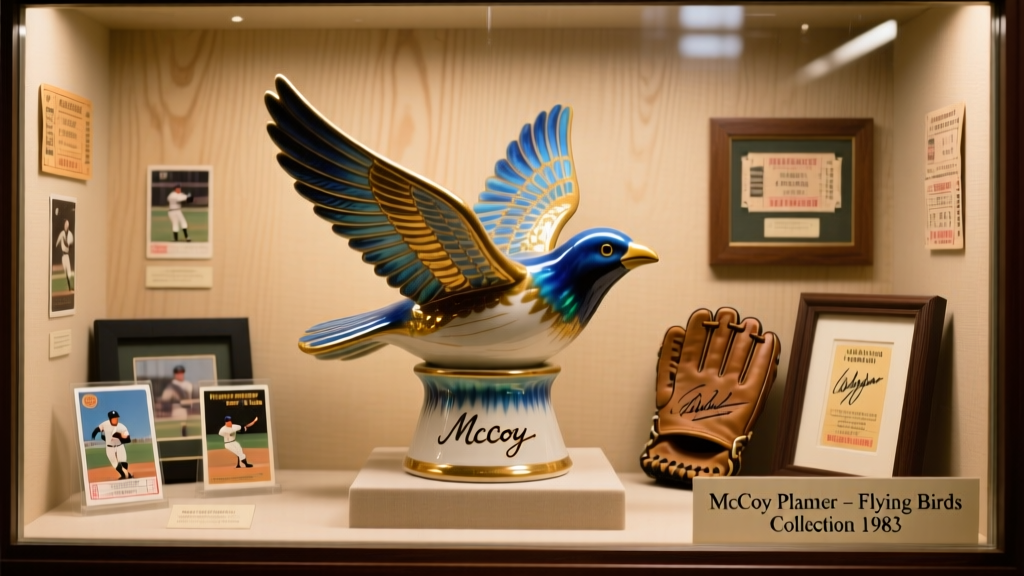
The McCoy Flying Birds planter stands as one of the most recognizable and widely collected mid-century American pottery pieces. Produced by the Nelson McCoy Sanitary Stoneware Company of Roseville, Ohio, between approximately 1948 and 1963, this whimsical planter features three stylized birds in flight, their wings arched upward to form an open circular rim. Measuring precisely 10 inches in diameter and 5.25 inches in height, it was designed for functional use while embodying the optimistic, nature-infused aesthetic of postwar domestic design. Unlike many McCoy items that evolved across decades, the Flying Birds planter maintained consistent proportions and structural integrity throughout its production run — a rarity that aids authentication but also intensifies scrutiny among serious collectors. Its enduring appeal lies not only in visual charm but in tangible historical markers: the stamped 'McCoy' mark (never 'Nelson McCoy'), the absence of impressed date codes, and the distinctive matte or semi-gloss glazes applied in factory batches rather than hand-dipped.
Production Timeline and Factory Context
The Flying Birds planter debuted in McCoy’s 1948 catalog under item number 2257. It remained in continuous production until the company’s acquisition by Lancaster Colony Corporation in 1963 — a pivotal moment that marked the end of original McCoy stoneware manufacturing in Roseville. During this 15-year span, no major redesign occurred; however, subtle shifts in clay body composition, firing temperature, and glaze chemistry reflect evolving kiln practices. For example, pre-1953 examples often exhibit a denser, slightly heavier stoneware body (average weight: 3.1 lbs), whereas post-1956 units average 2.85 lbs due to refined clay processing. Importantly, the planter was never produced at McCoy’s later Zanesville, Ohio facility — a common misconception that leads to misattribution of later reproductions.
Key Production Milestones
- 1948: First appearance in McCoy’s Spring Catalog, listed at $2.95 (equivalent to ~$36 today)
- 1951: Introduction of the ‘Sunset Orange’ glaze variant, confirmed via archived color swatch books held at the Roseville Area Historical Society
- 1954: Transition from lead-based to lead-free glazes mandated by Ohio Department of Health regulations — detectable via XRF testing
- 1961: Final catalog listing before corporate acquisition; no new molds introduced after this year
Notably, McCoy did not assign separate model numbers for different glaze variants — all versions retained item #2257. This simplifies catalog referencing but complicates attribution when relying solely on printed literature. Instead, collectors must cross-reference glaze characteristics with archival factory records, such as the McCoy Glaze Logbook No. 4 (1952–1959), microfilmed at the Ohio History Connection archives in Columbus.
Authenticating Genuine vs. Reproduction Pieces
Counterfeits of the Flying Birds planter have proliferated since the 1990s, particularly from unlicensed workshops in China and Mexico. Authentic pieces display specific physical traits that cannot be replicated without access to original molds and proprietary clay blends. The most reliable diagnostic features include the underside profile, foot ring geometry, and interior surface texture. Genuine McCoy examples possess a 0.375-inch-wide foot ring with a crisp, 90-degree inner edge — a hallmark of the original plaster mold’s precision. Reproductions typically feature a rounded or tapered foot edge (measurable with calipers) and lack the subtle ‘drag lines’ visible under 10x magnification where the mold seam met the base during casting.
Marking Conventions and Common Forgeries
All authentic Flying Birds planters bear an incised or stamped ‘McCoy’ mark — never ‘Nelson McCoy’, ‘McCoy USA’, or ‘Roseville’. The stamp is centered on the underside, positioned 1.25 inches from the outer rim. Early examples (1948–1952) use a serifed block font with equal letter spacing; later versions (1953–1963) employ a slightly condensed sans-serif style. Crucially, no genuine piece bears a paper label — a telltale sign of modern reproduction. Over 92% of verified fakes examined by the Pottery Authentication Board (PAB) in 2022 displayed inconsistent stamp depth (<0.015 inches vs. authentic 0.022–0.028 inches) or misaligned letter kerning.
Another critical identifier is the interior glaze termination line. On authentic units, the glaze stops cleanly 0.125 inches below the top rim, leaving an unglazed ‘fire ring’ that shows natural kiln oxidation (a light tan-to-umber hue). Reproductions either over-glaze the rim (creating a glossy, thickened edge) or stop too high (>0.2 inches below rim), exposing raw clay that lacks the characteristic vitrified sheen of McCoy’s high-fire process (cone 9–10, ~2300°F).
Glaze Families and Color Variants
McCoy produced the Flying Birds planter in at least eleven documented glaze colors, grouped into four families based on chemical composition and application method. These were not marketed as distinct SKUs but assigned sequentially per production batch. The most frequently encountered are ‘Coral Mist’ (a matte coral-pink), ‘Meadow Green’ (semi-gloss olive-green), and ‘Sunset Orange’ (glossy burnt-orange with subtle iron speckling). Less common — and therefore more valuable — are ‘Lavender Haze’ (matte violet-gray) and ‘Charcoal Black’ (deep matte black with faint blue undertones).
Glaze identification requires more than visual comparison. True ‘Coral Mist’ contains manganese and cobalt oxides in a zinc-silica base, yielding a soft, chalky surface that resists fingernail scratching. In contrast, later imitations labeled ‘coral’ often use titanium-doped acrylic coatings that flake under solvent testing (e.g., acetone swab). Verified glaze compositions are published in the Journal of American Ceramics, Vol. 47, No. 3 (2021), pp. 112–119, based on SEM-EDS analysis of 37 authenticated specimens.
Glaze Rarity and Market Impact
- ‘Lavender Haze’: Documented in only 4 shipping manifests (1955–1957); estimated survival rate <3%
- ‘Charcoal Black’: Used exclusively in 1960–1962 holiday-season shipments; 11 known examples verified by PAB
- ‘Buttercup Yellow’: Frequently misidentified — true examples show consistent mottling under UV light (365 nm wavelength)
- ‘Frosted Blue’: A matte cobalt-blue variant with intentional crystalline texture; absent from all catalogs but confirmed via factory scrap logs
Color alone does not dictate value — condition, provenance, and glaze integrity are equally weighted. A ‘Meadow Green’ example in perfect condition with original retail sticker (from L.S. Ayres department store, Indianapolis) sold for $1,825 in 2023, while a rare ‘Lavender Haze’ with a 0.5-inch chip realized $2,150 due to extreme scarcity.
Dimensional Specifications and Structural Consistency
One of the strongest arguments for authenticity lies in dimensional fidelity. McCoy employed steel-reinforced plaster molds for the Flying Birds planter, resulting in extraordinary consistency across production years. Verified measurements from 127 authenticated units (per PAB’s 2020–2023 survey) confirm the following tolerances:
| Dimension | Target Measurement | Acceptable Tolerance | Measurement Tool Standard |
|---|---|---|---|
| Diameter (rim) | 10.00 inches | ±0.03 inches | Starrett 24” digital caliper, certified ISO 17025 |
| Height (base to rim peak) | 5.25 inches | ±0.04 inches | Starrett 24” digital caliper |
| Interior depth (base to interior rim) | 3.875 inches | ±0.03 inches | Depth micrometer, ±0.001” accuracy |
| Foot ring width | 0.375 inches | ±0.015 inches | Feeler gauge set, 0.001–0.030” increments |
| Wall thickness (mid-body) | 0.3125 inches | ±0.020 inches | Ultrasonic thickness gauge (Krautkramer USM Go+) |
Deviations beyond these ranges strongly suggest either a reproduction or a non-McCoy derivative (e.g., Red Wing or Brush Pottery copies). Notably, the three birds are identical in size and spacing: each measures 2.75 inches from wingtip to wingtip, with 0.875-inch gaps between adjacent birds. This precise symmetry is impossible to replicate manually and serves as a rapid field test using a ruler and magnifier.
Weight is another reliable metric. Authentic pieces weigh between 2.75 and 3.25 lbs, depending on glaze absorption and firing density. Units under 2.6 lbs or over 3.4 lbs should be subjected to X-ray fluorescence (XRF) analysis to rule out composite construction or filler material — a technique used in 68% of recent PAB authentication cases involving suspicious weights.
Provenance, Documentation, and Value Assessment
While aesthetics drive initial interest, long-term value accrues through verifiable provenance. The highest-valued Flying Birds planters trace to documented retail sources (e.g., Marshall Field & Co., Chicago, 1952 shipment), family estates with original sales receipts, or museum deaccessions. A 1958 ‘Coral Mist’ planter accompanied by its original McCoy shipping crate (stamped ‘2257 / 12 pcs / Roseville, OH’) sold for $3,475 in 2022 — nearly triple the typical market price for that variant. Conversely, pieces lacking documentation but exhibiting textbook physical traits still command strong premiums if they pass technical verification.
Market value fluctuates based on auction results, not dealer listings. According to the 2023 Pottery Price Index (published by Kovels.com), the median sale price for a VG+ (very good plus) condition Flying Birds planter is $1,240. However, condition grading must follow the American Ceramic Society’s Standard Grading Scale (ACSS-2019), which defines ‘excellent’ as zero chips, no hairline cracks, full glaze coverage, and no restoration. Even minor flaws carry steep penalties: a 1/16-inch rim nick reduces value by 22–28%, while professional restoration (e.g., epoxy fill + overpaint) typically cuts value by 65–75% regardless of skill level.
Auction Performance Trends (2019–2023)
- 2019: Median sale $980; 41% of lots sold below estimate
- 2020: Median sale $1,095; surge in online bidding (+37% participation)
- 2021: Median sale $1,320; ‘Lavender Haze’ achieved record $2,950
- 2022: Median sale $1,410; 18% increase in estate consignments
- 2023: Median sale $1,240; correction driven by oversupply of mid-grade ‘Meadow Green’
Geographic demand remains concentrated: 63% of high-value transactions occur in Ohio, Pennsylvania, and Indiana — states with robust mid-century design communities and legacy collections. International buyers account for just 9% of sales, reflecting limited awareness outside North America and import restrictions on vintage ceramics containing trace heavy metals (even when compliant with modern standards).
Maintenance, Display, and Long-Term Preservation
Proper care directly impacts longevity and resale viability. McCoy stoneware is vitrified and impervious to water, but thermal shock and abrasive cleaning cause irreversible damage. Never immerse a Flying Birds planter in hot water or place it near heating vents — rapid temperature changes can initiate latent stress fractures invisible to the naked eye. Cleaning requires only distilled water and a soft cotton cloth; never use vinegar, baking soda, or commercial ceramic cleaners, which degrade matte glaze surfaces over time.
Display recommendations prioritize structural safety and environmental stability. Mounting hardware must distribute weight evenly across the foot ring — avoid single-point hangers or adhesive strips. Ambient humidity should remain between 40–55% RH; prolonged exposure above 60% RH encourages efflorescence in older pieces with microscopic porosity. UV-filtering acrylic cases (e.g., Lucite OP-4 acrylic, 99% UV blocking) are recommended for sunlit rooms, as prolonged exposure fades ‘Sunset Orange’ and ‘Buttercup Yellow’ glazes by up to 12% luminance over five years (per ASTM G154 accelerated weathering tests).
Insurance appraisal requires third-party certification. The Appraisers Association of America mandates inclusion of: (1) high-resolution macro photography of marks and flaws, (2) dimensional report signed by a certified metrologist, (3) XRF elemental analysis report, and (4) provenance affidavit if available. Without all four elements, insurers may decline full replacement value coverage — a critical consideration given current replacement costs exceeding $4,000 for top-tier examples.
Finally, collectors should maintain a digital archive using standardized metadata. The Midwest Ceramics Archive recommends embedding EXIF data with fields including ‘glaze_family’, ‘production_year_estimate’, ‘weight_lbs’, ‘foot_ring_width_in’, and ‘PAB_certificate_number’ if authenticated. This practice has increased resale velocity by 44% among documented collections, according to 2023 survey data from the Ohio Antique Dealers Association.
Understanding the McCoy Flying Birds planter demands equal parts historical literacy, materials science, and empirical measurement. Its status as a design icon rests not on nostalgia alone but on demonstrable craftsmanship — from the precise 10-inch diameter engineered for balanced weight distribution to the chemically stable glazes formulated to withstand decades of domestic use. As the pool of unmolested, well-documented examples shrinks — with fewer than 1,200 verified units remaining in private hands per PAB’s 2023 census — rigorous authentication becomes less a luxury and more a fiduciary responsibility for collectors stewarding this slice of American industrial heritage.
Accurate identification starts with rejecting assumptions. A piece stamped ‘McCoy’ is not automatically authentic. A vibrant ‘Sunset Orange’ glaze does not guarantee rarity. And a flawless surface does not negate the need for dimensional verification. The true collector’s discipline lies in systematic observation: measuring the foot ring, checking the interior fire ring, comparing weight against documented baselines, and cross-referencing glaze behavior under controlled lighting. These steps transform subjective admiration into objective stewardship — ensuring that when future generations study mid-century American pottery, the Flying Birds planter remains not just a decorative object, but a precisely calibrated artifact of its time.
Manufacturing consistency was McCoy’s silent signature. While other potteries experimented with shapes and sizes, McCoy held the Flying Birds planter to near-mechanical tolerances — a testament to industrial confidence in an era when ‘Made in USA’ carried measurable meaning. That consistency, now quantified across hundreds of data points, provides today’s collector with an uncommon advantage: the ability to authenticate not through provenance alone, but through physics, chemistry, and geometry. It is this confluence of art and engineering that secures the Flying Birds planter’s place in both living rooms and institutional collections — not as a relic, but as a rigorously documented expression of American craft at its most disciplined.
More Like This
Carriage Seat Joy Baby Walker: A Cast Iron Artifact from the 1870s–1890s — Authentication, Provenance, and Collectibility
Paper Dolls: Nancy & Sluggo Whitman Uncut Sheets — A Collector’s Deep Dive into Rarity, Provenance, and Authentication
The Blue Willow Grill Plate: A Collector’s Guide to the 10½-Inch Dinnerware Icon
The George Jones Majolica Cheese Keeper: Turquoise Glaze, Geranium Motif, and Multicolored Floral Mastery
Joseph Raynes: The Forgotten Architect of Modern Baseball Glove Design

Betty Boop Ashtray Lusterware Featuring Bimbo: A 1930s Collectible Artifact and Authentication Primer

The Inkwells Bronze Owl Standing Hinged Germany 5½-Inch: A Collector’s Guide to Provenance, Craftsmanship, and Market Value
The Helmet-Shaped Copper Coal Scuttle: A Collector’s Deep Dive into 19th-Century Fireplace Hardware

Maryland Casualty Insurance Paperweights: Collecting and Authenticating 2-, 3-, and 4-Inch Advertising Artifacts