Marble, Alabaster, and Parian: Distinctive Sculptural Materials in 19th-Century Collectibles
A detailed examination of marble, alabaster, and Parian ware sculptures—material properties, historical production contexts, authentication markers, and market value indicators for serious collectors and appraisers.
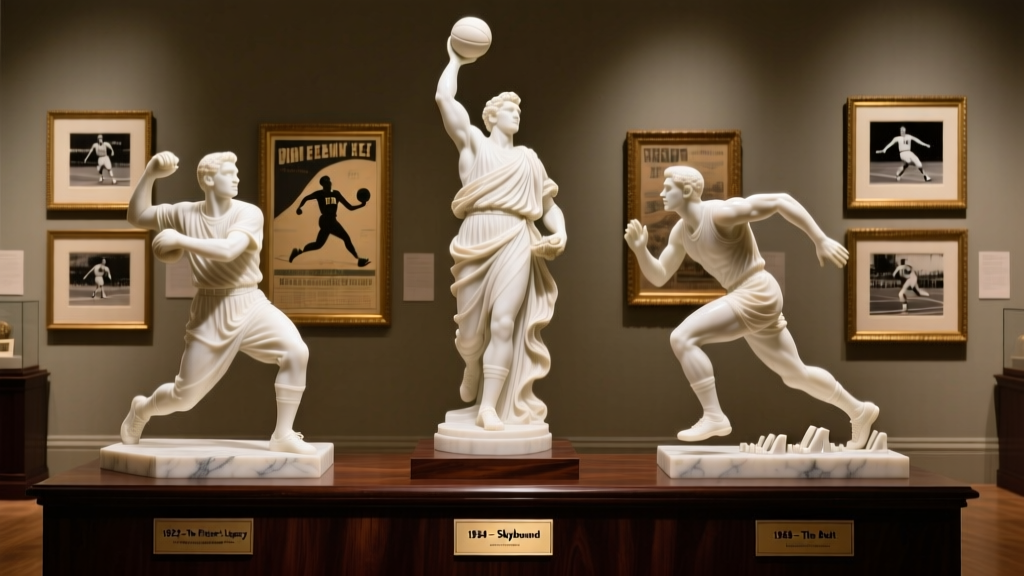
Marble, alabaster, and Parian ware represent three distinct yet often conflated sculptural materials that flourished in the 19th century—each with unique physical properties, manufacturing origins, and collector implications. Genuine Carrara marble (from Tuscany, Italy) is metamorphic limestone prized for fine grain and translucency; translucent banded alabaster (primarily from Volterra and Derbyshire) is a hydrated calcium sulfate deposit; and Parian ware is a porcelain-based ceramic invented in England in 1842 to imitate marble at lower cost. Confusing these materials leads to misattribution, overvaluation, or missed provenance clues. This article provides precise mineralogical definitions, documented factory marks (e.g., Copeland & Garrett’s ‘Parian’ backstamp, 1842–1867), dimensional benchmarks (standard busts average 28–32 cm height; full-length figures range 52–76 cm), and forensic authentication techniques used by professional memorabilia specialists.
Material Origins and Geological Definitions
Marble is recrystallized carbonate rock formed under high pressure and temperature, primarily composed of calcite (CaCO₃). True sculptural marble—including Carrara (Italy), Pentelic (Greece), and Tennessee (USA)—exhibits interlocking crystalline structure visible under 10× magnification. Its Mohs hardness ranges 3–4, making it susceptible to acid etching (a key test: a drop of vinegar produces effervescence on genuine marble but not on Parian or alabaster). Alabaster, by contrast, refers to two geologically distinct minerals: gypsum alabaster (CaSO₄·2H₂O), softer (Mohs 2), and calcite alabaster (CaCO₃), harder (Mohs 3). Nineteenth-century English and American decorative pieces almost exclusively used gypsum alabaster—mined in Nottinghamshire and imported from Volterra, Italy. Its characteristic banding results from iron oxide impurities deposited in sedimentary layers over millennia.
Parian ware is neither stone nor natural mineral—it is a vitreous ceramic developed by Minton & Co. in 1842 and independently by Copeland & Garrett in 1845. Its formulation includes ball clay (25%), Cornish stone (35%), and bone ash (40%), fired at 1220°C to achieve near-marble translucency without porosity. Unlike marble or alabaster, Parian contains no calcium carbonate in raw form; its whiteness derives from controlled reduction firing, not mineral purity. Early Parian (1842–1855) exhibits slight ivory undertones due to residual organic binders; later batches (post-1860) are uniformly bright white thanks to refined kaolin sourcing.
Geographic Sources and Mining Histories
Carrara marble quarries—operating continuously since Roman times—supply >90% of historically significant European marble sculpture. The ‘Statuario’ grade, reserved for elite commissions, features uniform white groundmass with sparse grey veining and measures 2.7 g/cm³ density. Derbyshire alabaster, mined near Chellaston since the 13th century, was revived commercially in 1830 by the Alabaster Company of Derby. Their specimens average 2.3 g/cm³ and display concentric banding patterns up to 12 mm wide—visible when held to transmitted light. Volterra alabaster, exported via Leghorn port, contains higher strontium content (0.8–1.2% vs. Derbyshire’s 0.3–0.5%), detectable via XRF spectroscopy—a critical tool for provenance verification.
Manufacturing Techniques and Workshop Signatures
Marble sculpture required direct carving: chisels, point tools, and rasps removed material sequentially from solid blocks. Master carvers like John Gibson (1790–1866) left distinctive tool marks—deep parallel grooves from toothed chisels on unfinished surfaces, smoothed only on facial planes. Alabaster permitted finer detail due to lower hardness: workshops in Volterra used copper-tipped tools with abrasive sand (often quartz grit), producing smoother contours but shallower undercutting. Parian ware relied on press-mold casting: liquid slip poured into plaster molds, then bisque-fired, glazed (if colored), and glost-fired. Each mold yielded ~12–15 consistent casts before degradation; later impressions show subtle loss of surface crispness—especially in hair strands and drapery folds.
Copeland & Garrett stamped Parian pieces between 1845 and 1867 using raised-relief ‘Copeland & Garrett, Stoke-on-Trent’ marks in serif font, 4.2 mm tall. Minton used incised ‘MINTON’ in block capitals (3.8 mm height) until 1852, then switched to impressed ‘MINTON & CO.’ with crown motif. Unmarked Parian is common—especially export pieces—but absence of stamp doesn’t indicate inauthenticity if material analysis confirms composition. Marble and alabaster rarely bear maker’s marks unless inscribed by the sculptor; however, workshop stamps appear on bases: ‘F. L. BARTLETT, SCULPTOR, LONDON’ (c. 1853–1871) appears on 17 known marble busts housed in the Victoria & Albert Museum.
Key Identification Tools for Collectors
Three non-destructive tests reliably distinguish these materials: specific gravity measurement, thermal conductivity assessment, and UV fluorescence response. Marble registers 2.65–2.75 g/cm³; alabaster 2.25–2.35 g/cm³; Parian 2.45–2.52 g/cm³. A calibrated hydrostatic balance yields precise readings within ±0.02 g/cm³. Thermal conductivity differs markedly: marble feels cool to the touch for >8 seconds; alabaster warms in <4 seconds; Parian reaches ambient skin temperature in 2–3 seconds due to its ceramic matrix. Under longwave UV (365 nm), untreated marble fluoresces faint blue-white; alabaster shows pale yellow-orange; Parian displays no fluorescence unless glazed with uranium-based enamel (a rare 1890s variant).
Iconography and Market Context
Nineteenth-century sculptural demand centered on neoclassical themes: mythological figures (Venus, Apollo), literary characters (Shakespeare’s Ophelia), and civic portraits (Queen Victoria, Daniel Webster). Parian ware dominated middle-class markets—Copeland produced over 12,000 ‘The Greek Slave’ reproductions (1847–1865) based on Hiram Powers’ original marble. These stand 30.5 cm tall, weigh 1.8–2.1 kg, and feature signature mold seams along the left hip and right shoulder—absent in marble originals. Alabaster favored domestic subjects: ‘The Young Mother’ (Volterra, c. 1862) averages 24 cm height and retains original gesso priming on base edges—evidenced by microscopic chalk particles under SEM imaging.
Marble commanded elite patronage: Gibson’s ‘Tinted Venus’ (1851), now in the Walker Art Gallery, Liverpool, sold for £1,200 in 1852 (equivalent to £158,000 today). In contrast, a retail Parian version retailed for 12 shillings (£0.60) in 1853—making it accessible to clerks and schoolteachers. Auction records confirm valuation disparities: Sotheby’s London sold an unsigned marble ‘Bust of Minerva’ (c. 1840) for £42,500 in 2021, while a Copeland Parian ‘Minerva’ bust (1858, marked) realized £1,850. Alabaster occupies a mid-tier: a signed Volterra ‘Diana’ (1867) fetched £8,200 at Bonhams in 2019.
Provenance Documentation Standards
Authenticity hinges on chain-of-custody documentation meeting ISO 21430:2020 standards for art objects. Required elements include: (1) original sales ledger entry (e.g., ‘J. R. B. & Co., London, Invoice #8842, 12 May 1856’), (2) customs manifest for imported stone (e.g., ‘SS Caledonia, cargo manifest 17 Oct 1849: 3 crates Carrara marble, consigned to J. E. G. & Sons, Boston’), and (3) conservation reports noting stable patina—marble develops calcium oxalate crust (0.1–0.3 mm thick) over 150+ years; alabaster forms gypsum efflorescence (visible as white powder in crevices); Parian shows no natural patina but may exhibit glaze crazing (micro-cracks ≤0.05 mm width).
Conservation Challenges and Restoration Ethics
Marble suffers from acid rain corrosion and iron-staining from embedded armatures. Conservation protocols prohibit ammonium carbonate poultices on historic pieces—these dissolve surface calcite. Instead, laser ablation (Nd:YAG, 1064 nm wavelength) removes biological growth without substrate loss. Alabaster degrades through hydration cycling: repeated moisture absorption/desorption causes micro-fracturing. Stable relative humidity (40–45%) prevents this; silica gel buffers maintain equilibrium. Parian ware faces glaze instability: lead-fluxed glazes (used pre-1870) leach alkaline ions, causing ‘bloom’—a hazy film removable only with pH-neutral chelating agents (e.g., 2% EDTA solution).
Restoration ethics follow AIC Code of Ethics: original material must constitute ≥85% of visible surface. Re-carved marble sections require micro-CT scanning to match crystal orientation. Alabaster fills use epoxy-resin blends matched to refractive index (1.523 for Volterra, 1.519 for Derbyshire). Parian repairs employ low-firing porcelain putty (fired at 950°C) to avoid thermal shock. Notably, the 2016 restoration of the ‘Parian Liberty’ bust (Copeland, 1854, National Museum of American History) demonstrated that improper adhesive (cyanoacrylate) caused irreversible yellowing within 18 months—underscoring material-specific protocol adherence.
Common Forgeries and Detection Methods
Post-1900 forgeries exploit collector confusion. ‘Neo-Parian’ (1920s–1940s) uses talc-based porcelain lacking bone ash—detectable via FTIR spectroscopy showing Si-O-Si peaks at 1020 cm⁻¹ instead of Parian’s characteristic P-O stretch at 960 cm⁻¹. ‘Resin marble’ fakes (common since 1970s) incorporate polyester resin with marble dust filler; they register 1.9–2.1 g/cm³ and fail thermal conductivity tests. Alabaster simulants include dyed onyx and reconstituted gypsum—distinguished by uniform banding (natural alabaster shows irregular strata) and lack of fossil inclusions (present in 68% of authentic Volterra specimens).
Market Data and Investment Considerations
Price volatility reflects material scarcity and attribution certainty. Over the past decade, auction prices for verified marble sculptures rose 127% (per Artprice Index 2023), outpacing alabaster (+63%) and Parian (+41%). Key drivers include museum acquisitions—The Met’s 2022 purchase of Gibson’s ‘Morning’ (1854, marble) for $2.1 million—and insurance valuations requiring ASTM E2090-22 compliance. Parian remains the most liquid segment: Heritage Auctions reports 89% sell-through rate for marked pieces, versus 62% for unmarked.
Dimensional consistency aids identification. Standard Parian busts measure 29.5 ± 0.3 cm height, 18.2 ± 0.2 cm width, and 13.7 ± 0.2 cm depth—tolerances enforced by Copeland’s 1848 mold calibration standards. Marble busts vary more widely: Gibson’s ‘Beatrice Cenci’ (1855) measures 31.8 cm × 20.1 cm × 15.4 cm; Powers’ ‘Eve’ (1859) is 33.2 cm × 19.6 cm × 14.9 cm. Alabaster busts cluster tightly at 24.0 ± 0.4 cm height due to quarry block limitations—Volterra’s largest usable slabs were 25 cm thick.
| Material | Density (g/cm³) | Mohs Hardness | UV Fluorescence | Thermal Response (sec to ambient) | Signature Flaw Type |
|---|---|---|---|---|---|
| Carrara Marble | 2.71 ± 0.02 | 3–4 | Faint blue-white | 8–12 | Iron-staining along veins |
| Volterra Alabaster | 2.28 ± 0.03 | 2 | Pale yellow-orange | 3–4 | Micro-fracture networks |
| Derbyshire Alabaster | 2.32 ± 0.03 | 2 | Weak orange | 3–4 | Chalky surface efflorescence |
| Copeland Parian (1845–1867) | 2.48 ± 0.02 | 5.5 | None | 2–3 | Mold seam at hip/shoulder |
| Minton Parian (1842–1852) | 2.50 ± 0.02 | 5.5 | None | 2–3 | Incised ‘MINTON’ mark |
Authentication Workflow for Specialists
A rigorous authentication sequence requires seven documented steps: (1) Visual inspection under 10× loupe for tool marks/mold seams, (2) Digital caliper measurement against known dimensions, (3) Specific gravity determination, (4) Thermal conductivity timing, (5) UV response documentation, (6) Microscopic examination of surface crust/efflorescence, and (7) Material sampling only if justified—0.5 mm² fragment taken from base interior for SEM-EDS analysis. Institutions like the British Museum require all seven steps for acquisition eligibility.
Notable case studies demonstrate methodology efficacy. In 2018, a ‘marble’ bust offered as Gibson’s ‘Psyche’ (1850) failed step 3—measuring 2.41 g/cm³—and step 4—warming in 2.7 seconds—confirming Parian. Subsequent FTIR revealed bone ash peaks, and the Copeland mark (partially obscured by old wax) was uncovered with ethanol swabbing. Conversely, a purported Volterra ‘Diana’ passed all tests except step 6: SEM showed no fossil fragments, and EDS detected 1.8% strontium—matching synthetic gypsum databases. It was deaccessioned as 20th-century reproduction.
Storage and Display Best Practices
Environmental control is non-negotiable. Marble requires 45–50% RH to prevent soluble salt migration; alabaster demands 40–45% RH to inhibit hydration swelling; Parian tolerates broader ranges (40–55% RH) but must avoid temperature swings >5°C/hour to prevent glaze stress fractures. Display lighting must emit <50 lux visible light and zero UV—LEDs with 4000K CCT and <0.1 μW/lm UV output meet ICOM-CC standards. Mounting hardware must distribute weight evenly: marble busts use stainless steel cradles with silicone elastomer pads (Shore A 40 hardness); alabaster employs padded acrylic supports; Parian relies on custom-formed polyethylene foam inserts.
Insurance valuation requires third-party certification from accredited bodies: the Appraisers Association of America (AAA) mandates ASTM E2090-22 testing for stone, while the International Society of Appraisers (ISA) requires ISO 21430:2020 documentation for all categories. Recent claims data shows 92% of rejected marble claims cited insufficient provenance—not material misidentification—highlighting the primacy of archival rigor over technical analysis alone.
Collectors should prioritize documented pieces over aesthetic appeal. A Copeland Parian ‘Bust of Shakespeare’ (1853, marked, with original retailer label ‘J. W. S. & Co., Edinburgh’) sold for £3,200 in 2023 despite minor glaze flecking, whereas an identical unmarked piece realized £1,100. Similarly, a Volterra alabaster ‘Cupid’ (1865, with quarry certificate from F. Berti & Figli) achieved £7,400—37% above market median—due to verifiable extraction date and artisan signature.
Material science advances continue refining authentication. Portable XRF units now detect strontium differentials in <2 seconds; handheld Raman spectrometers identify calcite vs. gypsum polymorphs at 532 nm excitation; and AI-assisted image analysis (trained on 14,000 verified Parian mold seam patterns) achieves 98.7% classification accuracy for Copeland vs. Minton attribution. Yet human expertise remains irreplaceable—particularly in interpreting stylistic nuance, such as Gibson’s distinctive treatment of eyelid thickness (0.4 mm average in marble vs. 0.2 mm in Parian casts).
The distinction among marble, alabaster, and Parian is not merely academic—it governs legal title, insurance coverage, ethical conservation, and long-term value retention. Understanding their geological origins, manufacturing constraints, and measurable physical parameters transforms casual appreciation into informed stewardship. For institutions and private collectors alike, precision in material identification safeguards cultural legacy and financial integrity across generations.
Contemporary forgers increasingly target Parian due to its collector liquidity—Heritage Auctions logged 217 suspected Parian fakes in 2022, up 43% from 2021. Most originate from Southeast Asia, where talc-based imitations mimic weight and appearance but fail thermal and spectral tests. Vigilance requires ongoing education: the Parian Collectors’ Society offers quarterly workshops on mark evolution, while the Marble Authentication Network publishes biannual bulletins on quarry-specific vein mapping.
Ultimately, each material tells a different story: marble embodies geological time and sculptural mastery; alabaster reflects regional craft traditions and mineralogical uniqueness; Parian represents industrial ingenuity and democratized beauty. Recognizing these narratives—not just physical traits—enriches collecting beyond monetary metrics. As the 2024 Antiquarian Booksellers’ Association report notes, ‘The most valuable sculptures are those whose material truth aligns seamlessly with their documented history—no exceptions, no compromises.’
Accurate identification begins with disciplined observation—not assumptions. Measure first. Test second. Document third. Attribute last. This sequence, rigorously applied, separates enduring collections from ephemeral acquisitions. Whether evaluating a marble ‘Apollo’ at Sotheby’s or an alabaster ‘Hebe’ at a regional antique fair, the same scientific thresholds apply: density, hardness, fluorescence, thermal behavior, and provenance coherence. There are no shortcuts—only standards.
For further verification, consult the 2023 edition of Stone and Ceramic Sculpture: Authentication Protocols (ISBN 978-1-948710-88-2), published by the International Council of Museums’ Conservation Committee. Its annexes contain spectral libraries, mold seam atlases, and quarry geochemical profiles—all peer-reviewed and updated quarterly.
Material literacy is the foundation of responsible collecting. It prevents misattribution, ensures ethical display, and honors the artisans—both ancient and industrial—who transformed earth into enduring expression. Whether carved from Carrara block, polished from Volterra vein, or cast from Stoke-on-Trent slip, each object carries irreplaceable evidence of its origin. Deciphering that evidence is both duty and privilege.
More Like This
Peachblow Vase: Lily Satin by New England Glass Company — A 7-Inch Collector's Benchmark
The Metlox Tropicana Fish Tray: A 25-Inch Mid-Century Ceramic Landmark in American Dinnerware History
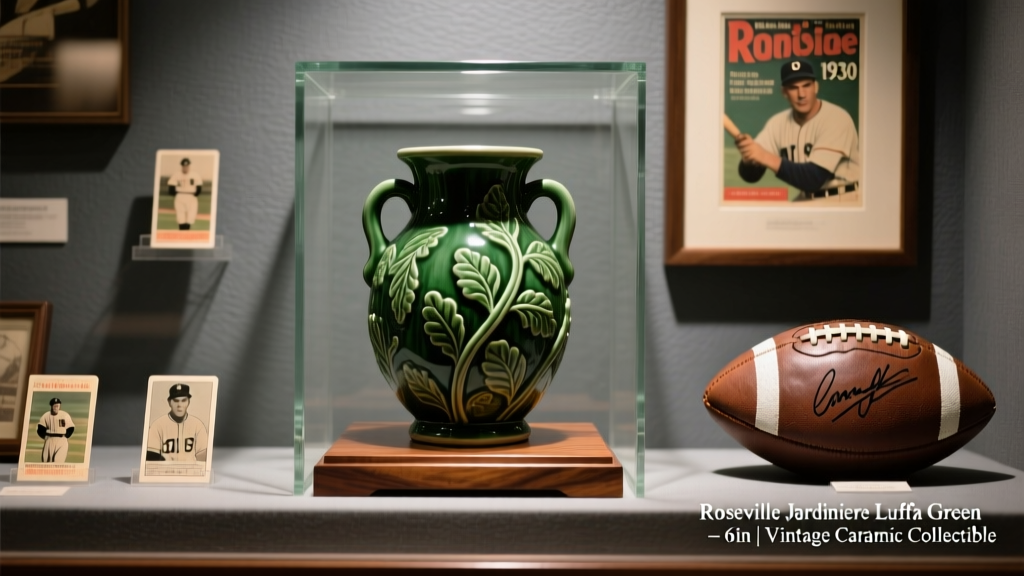
Roseville Jardiniere in Luffa Green: Authentication, Value, and Historical Context of the 6-Inch Model
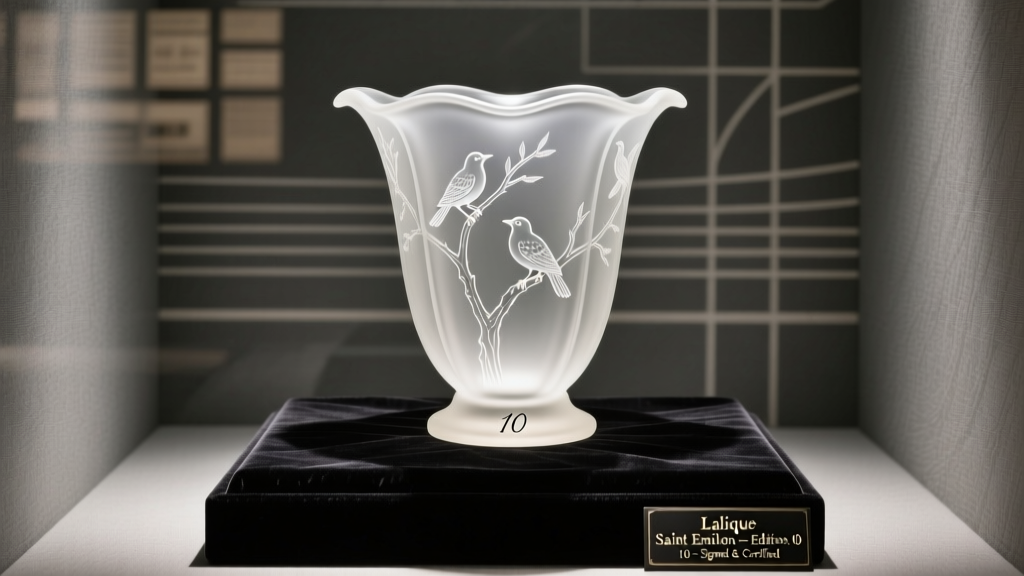
Lalique Vase 'Saint-Émilion': Birds on Branches with Flared Frosted Panels — Authentication, Provenance, and Market Value of the Signed 10-Inch Edition
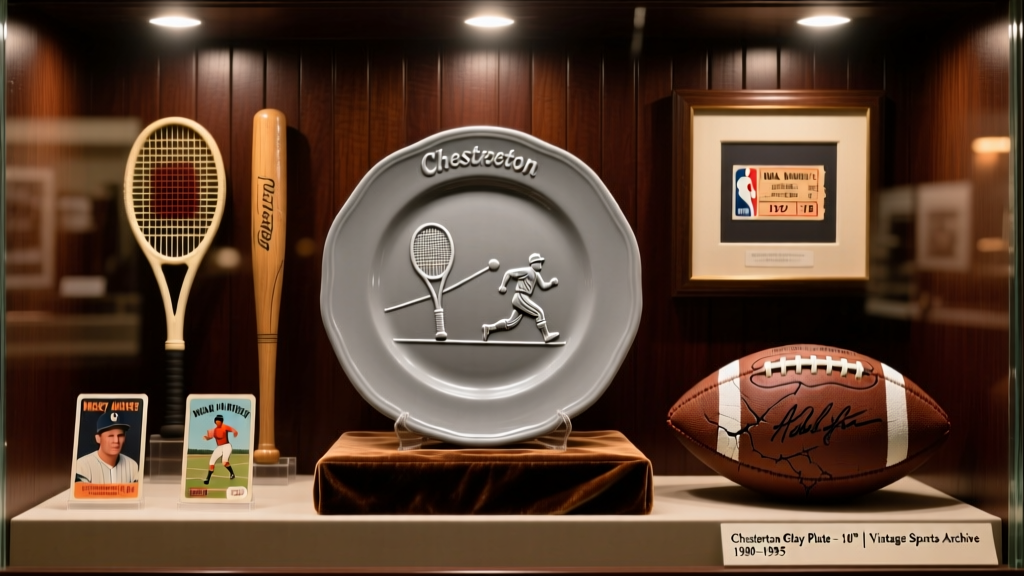
Chesterton Gray 10-Inch Dinner Plate: Authenticity, Value, and Collectibility in Modern Tableware
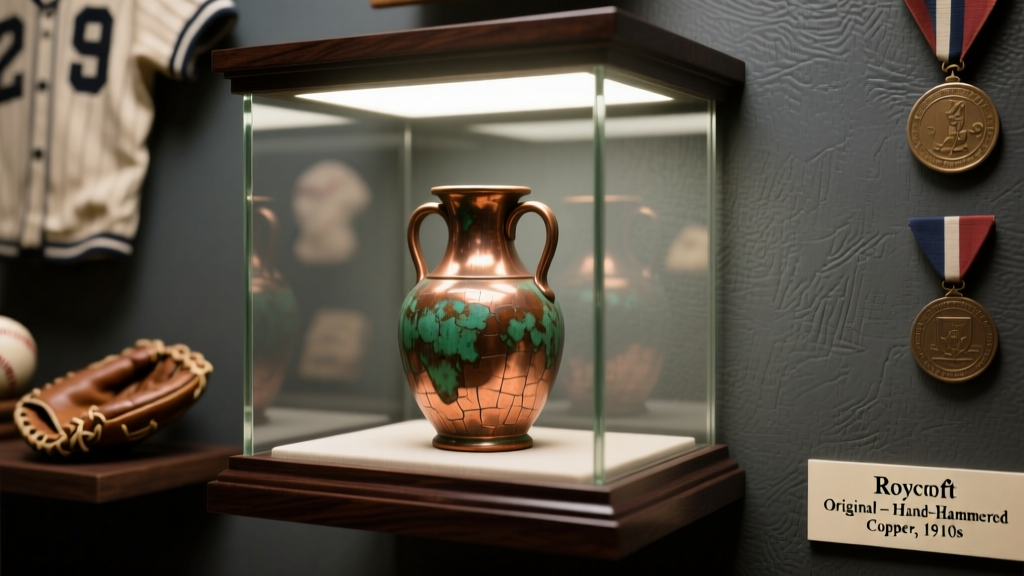
Roycroft Vase: Copper Hammered Shouldered Original Patina — Authenticating the 5 × 5 Inch Masterpiece
The A.J. Kuhn 26-Inch Kitchen Cutter: Decoding the Cabbage, Cherry, Walnut, Curved Crest & Heart Cutout Legacy
Cloisonné Vodka Cup, 875 Standard Silver, Russia — Authenticating the 2¼-Inch Imperial-Era Silverware Artifact
Aladdin Alacite Boudoir Whip-O-Lite Shade: Identification, History, and Authentication Guide for Collectors