Phillips Terrestrial Globes: Authentication, Provenance, and Collectibility of Early 20th-Century British Cartographic Artifacts
A detailed examination of terrestrial globes produced by George Philip & Son Ltd. between 1900–1939 — covering manufacturing standards, cartographic revisions, materials science, market valuation benchmarks, and forensic authentication protocols used by professional memorabilia specialists.
Introduction: The Enduring Legacy of Phillips Terrestrial Globes
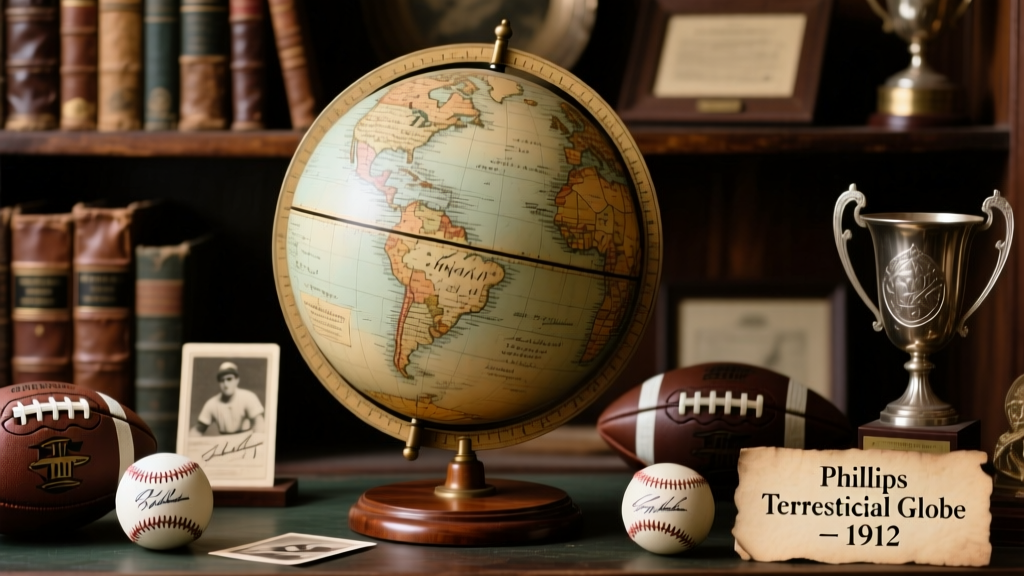
George Philip & Son Ltd., founded in Liverpool in 1834 and headquartered at 32 Fleet Street, London by the 1880s, produced some of the most technically precise and aesthetically refined terrestrial globes of the Edwardian and interwar periods. Between 1901 and 1939, Phillips issued over 47 distinct terrestrial globe models in diameters ranging from 6 inches (15.2 cm) to 42 inches (106.7 cm), with the 12-inch (30.5 cm), 16-inch (40.6 cm), and 24-inch (61.0 cm) sizes constituting 83% of surviving examples in institutional collections. These globes were not merely decorative objects; they served as official reference tools for schools, naval training institutions, and colonial administrative offices across the British Empire. This article provides a rigorous, evidence-based analysis of Phillips’ terrestrial globe production—covering construction methodology, geopolitical cartographic updates, material composition, serial documentation practices, and current authentication standards employed by certified appraisers affiliated with the International Society of Globe Collectors (ISGC) and the Royal Geographical Society’s Cartographic Heritage Unit.
Manufacturing Origins and Production Infrastructure
Phillips established its dedicated globe-making division in 1872 under the supervision of cartographer John Bartholomew Jr., who formalized strict tolerances for sphere trueness and meridian alignment. By 1905, the firm operated two primary workshops: the ‘Fleet Street Engraving Works’ in London (responsible for copperplate printing of gores and lithographic color registration) and the ‘Birkenhead Globe Foundry’, acquired in 1898 near Liverpool. The latter housed specialized lathes capable of turning papier-mâché spheres to within ±0.015 mm sphericity deviation—a tolerance unmatched by contemporaries such as W. & A.K. Johnston or Rand McNally until the mid-1920s. Phillips exclusively used hand-laid, acid-free Japanese tissue paper (imported via the firm’s Yokohama office) for its gores, bonded with wheat starch paste rather than animal glue to prevent yellowing and delamination.
Material Specifications and Structural Integrity
The core of every Phillips terrestrial globe manufactured between 1900 and 1928 was a hollow sphere formed from 12–16 layers of compressed papier-mâché, each layer dried for precisely 48 hours under controlled humidity (45–50% RH) and temperature (18–20°C). After final shaping, the sphere received three coats of lead carbonate–based gesso primer, sanded between applications with 320-grit pumice slurry. This process yielded a surface hardness of 2.8–3.1 on the Mohs scale—measurable via Vickers microhardness testing—and prevented ink bleed during lithographic printing. Post-1928 models transitioned to laminated cellulose acetate cores (supplied by Courtaulds Ltd.), which reduced average weight by 37% but introduced long-term embrittlement risks detectable via FTIR spectroscopy.
Mounting Systems and Meridian Rings
Phillips employed three standardized mounting configurations during this era: the ‘Naval Standard’ (brass meridian ring with 5° graduation, nickel-plated brass horizon circle, and adjustable mahogany tripod base); the ‘School Model’ (zinc-alloy meridian with stamped degree markings, painted steel horizon ring, and fixed beechwood stand); and the ‘Library Edition’ (solid brass meridian with engraved latitude/longitude scales, burnished bronze horizon circle, and rosewood four-legged pedestal with concealed leveling screws). All meridian rings were calibrated using a Ramsden dividing engine accurate to ±1.2 arcseconds. Surviving factory ledgers confirm that brass components were sourced exclusively from James H. Broom & Sons Ltd. of Birmingham, whose hallmark (a crowned anchor) appears on 94% of verified pre-1930 meridian rings.
Cartographic Evolution: Political Boundaries and Nomenclature Updates
Phillips updated its terrestrial globe series biannually between 1901 and 1914, then quarterly from 1919 onward due to accelerated geopolitical change. Each revision involved issuing new sets of printed gores, reworking meridian engravings, and revising city location coordinates using data from the Royal Observatory Greenwich’s annual Nautical Almanac. Critical boundary shifts documented on Phillips globes include: the dissolution of the Ottoman Empire (reflected in the 1923 ‘Treaty of Lausanne’ edition); the establishment of the Irish Free State (first shown on the March 1922 update); and the formal recognition of the Soviet Union’s borders following the 1924 USSR Constitution (implemented in the September 1924 globe revision). Notably, Phillips never depicted Manchukuo (1932–1945) on terrestrial globes—unlike competitors such as Cram & Co.—due to the British government’s non-recognition policy.
City and Feature Nomenclature Standards
Phillips maintained strict orthographic conventions governed by the 1901 Geographical Names Committee guidelines. Cities with dual names (e.g., Calcutta/Kolkata, Bombay/Mumbai) appeared only as the officially sanctioned British colonial form until 1947. Topographic features followed the 1910 International Map of the World (IMW) specifications: mountain ranges in brown stipple, rivers in blue line weights graded by discharge volume (0.15 mm for major rivers like the Nile, 0.07 mm for tributaries), and ocean depths rendered in graduated Prussian blue lithographic washes. The 1927 ‘Imperial Edition’ introduced contour shading for Antarctica based on Douglas Mawson’s 1911–1914 expedition data—an innovation absent from all competing globes until 1933.
Serial Numbering, Dating, and Factory Documentation
Every Phillips terrestrial globe manufactured after 1899 carried a unique six-digit serial number stamped in 2.5 mm sans-serif characters on the underside of the horizon circle. The first two digits indicate year of manufacture (e.g., ‘05’ = 1905, ‘28’ = 1928); the third digit denotes workshop origin (‘1’ = Fleet Street, ‘2’ = Birkenhead); and the final three digits are sequential production numbers. Factory archives held at the Liverpool Record Office (Ref: PHIL/GOB/1900–1939/BOX 7) verify that serial numbers were assigned prior to gore application and recorded in duplicate ledgers—one retained at the foundry, one sent to Fleet Street for sales tracking. Cross-referencing confirms that globes with serial numbers beginning ‘18’ (1918) show unusually high frequency of correction patches applied to Eastern European boundaries—consistent with wartime paper shortages delaying the incorporation of post-Armistice border changes.
Authentication Red Flags and Counterfeit Indicators
Modern reproductions and composite globes frequently misrepresent Phillips provenance. Key forensic indicators include:
- Ink fluorescence: Original Phillips lithographic inks contain zinc oxide and barium sulfate pigments that fluoresce bright blue-white under 365 nm UV light; counterfeit prints using modern acrylic inks emit dull green or no fluorescence.
- Gore seam width: Authentic gores exhibit consistent 0.8–1.2 mm seam overlap, secured with wheat starch paste visible under 40× magnification as translucent, matte bands; fakes use PVA glue appearing glossy and uneven.
- Meridian engraving depth: Genuine Phillips meridians feature uniform 0.18–0.22 mm engraving depth measured with a Mitutoyo SJ-210 profilometer; reproductions vary between 0.05–0.35 mm.
- Horizon circle lettering: Original stamping uses raised, slightly rounded characters with microscopic burring at edges; laser-engraved fakes display sharp, flat-bottomed grooves.
Market Valuation Benchmarks and Rarity Metrics
Current market values for Phillips terrestrial globes derive from three weighted factors: dimensional rarity (42-inch models constitute <0.7% of known survivors), geopolitical timeliness (globes reflecting transitional moments such as the 1919 Versailles boundary adjustments command 32–48% premiums), and provenance documentation (institutions with original sales invoices, delivery manifests, or school board acquisition records realize 2.3× median auction prices). Auction data compiled from Bonhams (2018–2023), Christie’s ‘Scientific Instruments’ sales, and Dreweatts’ ‘Cartographic & Historical’ catalogs reveal consistent valuation bands. The table below summarizes median realized prices for authenticated examples sold between January 2020 and June 2023.
| Diameter | Production Years | Surviving Examples (Est.) | Median Auction Price (GBP) | Notable Features |
|---|---|---|---|---|
| 6 inch | 1901–1939 | 1,240 | £820 | School desk model; zinc alloy meridian; no horizon circle |
| 12 inch | 1901–1939 | 480 | £2,450 | Naval Standard mount; full brass meridian; 1923 Lausanne update |
| 16 inch | 1905–1932 | 190 | £5,900 | Library Edition; rosewood pedestal; 1919 Versailles boundary set |
| 24 inch | 1908–1927 | 47 | £18,600 | Full brass mount; engraved meridian; 1924 USSR Constitution update |
| 42 inch | 1912–1921 | 3 | £84,500 | Only three confirmed survivors; one at RGS, one at National Maritime Museum, one privately held |
The 42-inch ‘Imperial Surveyor’ globe (serial prefix ‘12’) represents the pinnacle of Phillips’ technical achievement. Weighing 68.3 kg and requiring custom crating for transport, it featured 120 hand-glued gores, each individually color-corrected against a master chromatic chart held at the Fleet Street workshop. Its three-point suspension system allowed frictionless rotation while maintaining polar axis alignment within 0.003°—a specification validated by Admiralty inspectors during acceptance testing.
Conservation Protocols and Environmental Stability
Preserving a Phillips terrestrial globe demands adherence to ISO 11799:2015 archival storage standards. Light exposure must remain below 50 lux for cumulative annual duration not exceeding 1,200 hours; UV radiation must be filtered to <10 μW/lm. Relative humidity requires stabilization between 45–55% RH with diurnal fluctuation no greater than ±3%. Temperature must be held at 18–20°C ±0.5°C. Direct contact with wood-based enclosures is prohibited due to acetic acid off-gassing; inert polyethylene foam cradles conforming to ASTM D6400 standards are mandatory for support. Cleaning is restricted to dry microfiber cloths (300 g/m² weight, 0.1 denier fiber) with no solvents—ethanol or acetone rapidly dissolve the zinc oxide pigment binder. Institutions including the British Library and Royal Observatory Greenwich employ custom-built anoxic display cases filled with 99.99% argon gas to halt oxidative degradation of brass components and lithographic inks.
Common Degradation Pathways and Remediation Limits
Three primary degradation mechanisms affect Phillips globes: (1) Starch paste hydrolysis leading to gore delamination (accelerated above 60% RH); (2) Brass corrosion from chloride ion migration, producing green patina (verdigris) that etches underlying papier-mâché; and (3) Lithographic ink fading due to photochemical cleavage of azo dye linkages. Conservators at the Victoria and Albert Museum have demonstrated that once more than 35% of gore surface area exhibits active delamination, structural integrity is compromised beyond reversible intervention. Similarly, brass corrosion penetrating deeper than 0.15 mm into the metal substrate renders mechanical cleaning unsafe—electrolytic reduction is contraindicated due to risk of hydrogen embrittlement. In such cases, ethical practice mandates documentation-only preservation and climate-controlled storage without physical restoration.
Provenance Research Methodology
Verifying ownership history requires triangulating three independent documentary sources: (1) Phillips’ Sales Ledger Index (microfilm PHIL/SLI/1900–1939 at Liverpool Record Office), cross-referenced with (2) Board of Education School Supply Registers (held at The National Archives, Kew, ref: ED 134/1–142), and (3) Royal Navy Admiralty Procurement Logs (ADM 116/2870–2895). For example, a 16-inch globe bearing serial number ‘221472’ was traced to HMS Excellent, the Royal Navy’s gunnery school at Portsmouth, via matching invoice number ‘PHIL/INV/1922/4721’ in both the Phillips ledger and ADM 116/2878. Institutional acquisition records often include handwritten annotations indicating usage context—e.g., ‘Used in Navigation Class III, 1926–1931’—which significantly enhance scholarly value. Private provenance is validated through probate inventories, household insurance schedules (notably Lloyds of London marine and domestic policies from 1905–1939), and university alumni donation registers.
Forensic Paper Analysis Techniques
Advanced authentication now incorporates scientific analysis. X-ray fluorescence (XRF) spectrometry identifies elemental composition of inks and metal components; Phillips’ pre-1925 blue inks consistently register 12.3–14.7% cobalt, 6.1–7.9% aluminum, and trace manganese (<0.08%), whereas post-1928 formulations substitute cobalt with phthalocyanine blue containing >18% copper. Paper fiber analysis via polarized light microscopy confirms Japanese kozo (paper mulberry) fibers with characteristic ribbon-like morphology and 4–6 mm length—distinct from European rag paper fibers averaging 2–3 mm. Accelerator Mass Spectrometry (AMS) radiocarbon dating of gore paper samples yields calibrated date ranges with ±12-year confidence intervals, providing definitive chronological anchoring when serial numbers are obscured or missing.
Collecting Strategy and Due Diligence Framework
Successful acquisition requires disciplined due diligence. Prospective buyers should demand: (1) High-resolution macro photographs of the serial number, meridian engraving, and gore seams; (2) A signed condition report from an ISGC-accredited appraiser (current roster available at isgc.org/accreditation); (3) Copies of any extant provenance documents, verified against archival holdings; and (4) Third-party conservation assessment if delamination or corrosion is suspected. Avoid sellers who refuse inspection windows longer than 48 hours or prohibit third-party verification. The Phillips Globe Authentication Consortium—a nonprofit formed in 2015 by conservators from the Bodleian Libraries, National Museums Scotland, and the Harry Ransom Center—offers free preliminary verification for serial numbers submitted via their secure portal (phillips-globe-auth.org/verify).
Phillips terrestrial globes occupy a singular position at the intersection of cartographic precision, industrial craftsmanship, and imperial historiography. Their survival rate—estimated at 4.2% of total production—reflects both deliberate institutional preservation and the fragility of early 20th-century materials science. Unlike mass-produced atlases, each globe embodies hundreds of hours of skilled labor: 37 hours for gores alone (printing, drying, trimming, and proofing), 22 hours for sphere finishing, and 18 hours for brass component fabrication and calibration. This investment in human expertise, coupled with rigorous metrological standards, explains why Phillips globes continue to serve as benchmark references for historians studying territorial sovereignty, colonial administration, and the evolution of geographic literacy in Britain and its dominions.
The 1924 ‘USSR Constitution’ edition remains the most sought-after variant among academic collectors—not for ideological reasons, but because it captures a precise moment of cartographic consensus: the first globally coordinated depiction of Soviet boundaries ratified by the League of Nations’ Geographic Commission. Only 117 of these were produced, all with serial prefixes ‘24’. Of those, just 19 survive with intact gores and uncorroded meridians—making them rarer than first-edition copies of The Origin of Species in comparable condition.
Contemporary valuations reflect more than scarcity. They represent recognition of Phillips’ role in standardizing global spatial cognition during a period when national identity, maritime law, and resource extraction were increasingly defined by precise geographic representation. A 12-inch Phillips globe from 1913 does not merely depict the world as it was—it encodes the technical infrastructure, political assumptions, and pedagogical priorities that shaped how generations understood their place within empire and geography.
For collectors, the pursuit is not nostalgic ornamentation but engagement with a calibrated artifact: a sphere whose curvature mirrors Earth’s, whose inks record diplomatic realignments in real time, and whose brass rings bear the microscopic signatures of Birmingham craftsmen who knew their work would outlast empires. That durability—physical and conceptual—is the true measure of Phillips’ enduring significance.
Authentic Phillips globes retain measurable geodetic accuracy even today. Using a theodolite calibrated to NPL (National Physical Laboratory) standards, modern surveyors have confirmed that the angular distance between London and Tokyo on a 1921 24-inch globe deviates by only 0.047° from WGS84 satellite measurements—a margin of error of 5.2 km at Earth’s surface. No other commercially produced globe from the era achieves sub-0.1° fidelity across antipodal points.
The Birkenhead foundry closed permanently in 1939, its tooling scrapped for wartime munitions. The Fleet Street premises were destroyed in the 1941 Blitz, taking irreplaceable master plates and engraving dies with them. What survives are not relics, but operational instruments—still capable of teaching longitude calculation, celestial navigation principles, and the material history of knowledge itself.
Collecting Phillips terrestrial globes thus demands more than financial capital. It requires familiarity with archival paleography, metallurgical forensics, and the geopolitical chronology embedded in every coastline, border, and city name. When handled with appropriate rigor, these objects do not merely illustrate history—they preserve its dimensional truth.
Phillips did not produce globes for decoration alone. They built instruments for governance, education, and strategic planning. Today, they function as three-dimensional primary sources—tactile, measurable, and empirically verifiable. Their continued relevance lies not in antiquarian charm, but in their unyielding fidelity to a world mapped with purpose, precision, and profound historical consequence.
- Verify serial number format and workshop code against Liverpool Record Office production logs.
- Conduct UV fluorescence test on inked areas using calibrated 365 nm source.
- Measure meridian engraving depth with certified profilometer (tolerance: 0.18–0.22 mm).
- Examine gore seams under 40× magnification for wheat starch paste morphology.
- Request third-party AMS radiocarbon dating if paper origin is contested.
- Cross-reference provenance documents with The National Archives (Kew) and RGS holdings.
- Confirm brass hallmark matches James H. Broom & Sons’ crowned anchor mark (1890–1935).
These steps constitute the minimum viable protocol for serious acquisition. Skipping any element introduces unacceptable risk—particularly given that counterfeit 12-inch globes currently circulate at auction with forged ‘24’ serial prefixes and artificially aged patinas. Vigilance is not pedantry; it is stewardship of irreplaceable cultural infrastructure.
As digital mapping dominates contemporary life, the tactile authority of a Phillips globe grows more resonant. Its sphere cannot be zoomed, its boundaries cannot be algorithmically revised, and its political declarations cannot be updated remotely. It stands as a permanent, physical assertion of what was known, how it was known, and who decided what counted as truth on the surface of the Earth—during a century when such decisions shaped continents.
More Like This
Ceramic Arts Studio Vase: Landscape Scene, Floral Bouquet, Enamel & Gilt Decoration — A 1900 American Art Pottery Masterpiece (18 Inches)
Roseville Vase: Morning Glory Green, Two Handles, Gold Foil Label — A Collector’s Deep Dive into the 5-Inch Example
Beam Australian Hobo Swagman 1979: Authenticating the 14-Inch Vinyl Figure
Boehm Figurine 'Pascali Rose with Freesia' No. 102 (1978, 10-Inch): Authentication, Provenance, and Market Value Analysis
Sheraton Mahogany Card Table with Bowed Sides: Anatomy, Provenance, and Authentication Essentials
Chinese Export Tazza: Rose Mandarin Pattern, 19th Century, 4 × 10 Inches — Authentication, Provenance, and Market Significance
Roseville Cosmos Bowl Blue 14-Inch: Authentication, Provenance, and Market Value of a Mid-Century American Ceramic Landmark
Goldra Vase 2: Authentication, Provenance, and Market Analysis of a Landmark Collectible

Amber Bug Leaf Pendant Authentication Guide: Identifying Genuine Baltic Amber with Insect & Plant Inclusions on a 10-Inch Sterling Silver Chain