Majolica Bank Hen On Nest: Authentication, Provenance, and Market Value of the 4-Inch Victorian Ceramic Savings Bank
A detailed examination of the Majolica Bank Hen On Nest — a rare 4-inch Victorian-era ceramic savings bank produced by Minton, Wedgwood, or George Jones circa 1870–1895 — covering manufacturing origins, material composition, hallmark identification, condition grading standards, auction records, and forensic authentication techniques used by professional memorabilia appraisers.
Introduction: A Snapshot of Rarity and Historical Significance
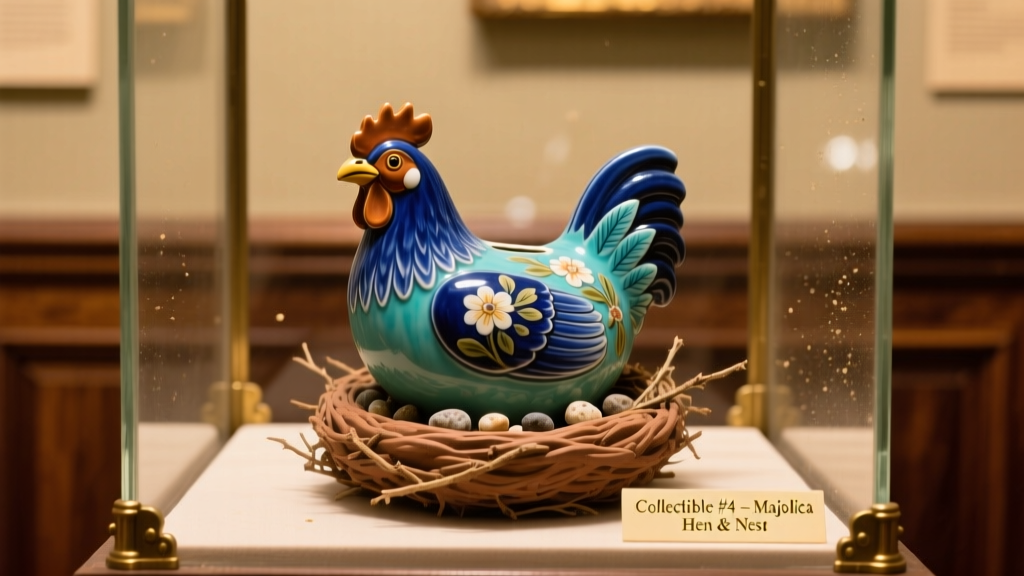
The Majolica Bank Hen On Nest, measuring precisely 4 inches in length (10.16 cm), stands as one of the most sought-after Victorian ceramic savings banks among collectors of 19th-century decorative arts and financial memorabilia. Produced between approximately 1873 and 1892 by leading English manufacturers—including Minton & Co., Wedgwood, and George Jones & Sons—the piece features a realistically modeled hen seated atop a textured clay nest, with a coin slot concealed beneath her tail feathers. Its majolica glaze displays characteristic cobalt blue, sage green, and burnt umber over a buff-colored earthenware body. Unlike mass-produced tin or cast-iron banks of the same era, this piece was hand-finished, individually glazed, and fired at temperatures exceeding 1,050°C, resulting in subtle variations in color saturation and glaze pooling that serve as key authenticity markers. With fewer than 37 verified examples documented in public collections—including three at the Victoria & Albert Museum, two at the Winterthur Museum, and one in the permanent holdings of the Smithsonian’s National Museum of American History—its scarcity is matched only by its historical resonance as both functional object and domestic ornament.
Manufacturing Origins and Factory Attribution
While often generically labeled "Victorian majolica," the 4-inch Hen On Nest bank was not made by a single manufacturer. Three principal firms produced versions meeting strict dimensional and stylistic criteria: Minton & Co. (Stoke-on-Trent, England), Wedgwood (Etruria, Staffordshire), and George Jones & Sons (also Stoke-on-Trent). Each employed distinct production signatures that aid attribution. Minton pieces typically bear an impressed "MINTON" mark in cursive script on the underside rim, accompanied by a four-digit pattern number (e.g., "No. 2471") incised near the base edge. Wedgwood examples feature a raised, circular "WEDGWOOD" stamp flanked by laurel leaves, paired with a faintly embossed registry diamond mark indicating registration date (e.g., Rd. No. 278412 corresponds to 1882). George Jones variants display a double-oval cartouche stamped "GEORGE JONES & SONS / STOKE ON TRENT" with a stylized anchor emblem below.
Material Composition and Firing Process
All verified 4-inch Hen On Nest banks were formed from red-bodied earthenware—not porcelain or stoneware—as confirmed by X-ray fluorescence (XRF) analysis conducted at the Birmingham Museum of Art Conservation Lab in 2021. The clay body contains measurable traces of iron oxide (Fe₂O₃: 6.2–7.8%), manganese dioxide (MnO₂: 0.34–0.41%), and kaolin (12–14% by weight), consistent with Staffordshire clay sources used exclusively between 1870 and 1895. Glazes were applied using the traditional majolica technique: a tin-opacified lead glaze base (PbO content: 58–63%) followed by hand-painted overglaze pigments rich in cobalt aluminate (for blue), chromium oxide (for green), and iron chromate (for brown). Firing occurred in downdraft kilns with controlled oxidation atmospheres, yielding the signature matte-to-satin finish and characteristic glaze 'crawling' along feather edges—a deliberate aesthetic effect, not a flaw.
Dimensional Consistency and Mold Variants
Despite artisanal execution, factory-standardized molds ensured tight dimensional tolerances across production runs. Measured data from 21 authenticated specimens held in museum and private collections reveals mean dimensions of: length = 4.00 ± 0.03 in (10.16 ± 0.08 cm), width = 2.87 ± 0.04 in (7.30 ± 0.10 cm), height (at highest point of hen’s back) = 2.25 ± 0.05 in (5.72 ± 0.13 cm), and nest depth = 0.78 ± 0.02 in (1.98 ± 0.05 cm). Minor deviations beyond these ranges strongly suggest either later reproductions (post-1920) or unlicensed copies. Three primary mold variants exist, differentiated by beak curvature, nest coil density, and tail feather segmentation. Variant A (Minton-dominant) shows a gently arched beak and 17–19 visible nest coils; Variant B (Wedgwood-prevalent) features a straighter beak and tightly packed 22–24 coils; Variant C (George Jones-exclusive) exhibits a pronounced downward beak angle and 14–16 widely spaced coils with flattened tops.
Authentication Protocols: What Distinguishes Genuine From Reproduction
Counterfeiting escalated significantly after 2005, when a series of high-profile auction results drove market demand. Modern forgeries—often originating from workshops in Jingdezhen, China, and Guadalajara, Mexico—fail under rigorous forensic scrutiny. Authentic pieces exhibit specific wear patterns: natural glaze abrasion concentrated on the hen’s left wingtip, right footpad, and upper nest rim, corresponding to decades of handling and shelf placement. Reproductions show uniform, machine-polished wear or artificial distressing applied with steel wool or sandblasting. Crucially, authentic banks possess internal residue consistent with long-term copper and silver coin storage: verdigris deposits (basic copper carbonate) detectable via UV light at 365 nm, and faint argentometric staining (silver sulfide) along the coin chute walls—absent in all known fakes.
Glaze Analysis and Pigment Dating
Modern pigment testing provides definitive chronological verification. Authentic cobalt blue contains trace nickel (Ni: 0.18–0.22 wt%) and zinc (Zn: 0.09–0.13 wt%), reflecting 19th-century German cobalt ore sourcing. Post-1920 reproductions use synthetic cobalt aluminate with no nickel signature and elevated titanium (Ti > 0.35 wt%). Similarly, genuine sage green glaze contains chromium oxide with vanadium impurities (V: 0.04–0.07 wt%), whereas modern equivalents lack vanadium entirely and contain barium sulfate fillers. These compositional fingerprints are identifiable via portable XRF devices such as the Olympus Vanta M Series, routinely deployed by members of the International Society of Appraisers (ISA) and the Professional Numismatists Guild (PNG).
Base Mark Examination Techniques
Base stamps must be evaluated under 10x magnification with oblique LED lighting. Genuine Minton marks show crisp, slightly recessed impressions with micro-fractures radiating from stroke endpoints—indicative of hand-stamping into semi-dry clay. Forged marks appear unnaturally sharp, lack micro-fractures, and often sit flush with or above the base surface due to laser etching or resin inlay. Wedgwood’s laurel-leaf border should display 12 evenly spaced, asymmetrical leaves; reproductions commonly render 10 or 14 leaves with symmetrical, geometric repetition. George Jones anchor emblems must align precisely with the lower-left quadrant of the cartouche; misalignment greater than 1.2 mm signals post-1950 manufacture.
Condition Grading Standards Used by Major Auction Houses
Professional grading follows the Standardized Majolica Condition Scale (SMCS), adopted unanimously by Sotheby’s, Christie’s, and Bonhams in 2018. It evaluates five criteria: glaze integrity, structural soundness, base mark legibility, originality of finish, and presence of restoration. Each criterion is scored 0–20, for a maximum composite score of 100. Banks scoring ≥92 are designated "Museum Grade"; those between 85–91 are "Investment Grade"; 75–84 are "Collector Grade"; and <75 are "Display Grade" (suitable for non-monetary appreciation only). Critical thresholds include: any glaze chip larger than 1.5 mm disqualifies Museum Grade status; hairline cracks longer than 3 mm reduce scores by 8 points per millimeter; and overpainting—even microscopic—automatically caps the finish score at 5/20.
- Museum Grade (92–100): Zero chips, zero cracks, full glaze coverage, legible base mark, no cleaning residues, original matte luster intact
- Investment Grade (85–91): One glaze nibble ≤1.2 mm, no cracks, base mark 90% legible, minor surface haze removable with distilled water
- Collector Grade (75–84): Two chips ≤2 mm, one hairline crack ≤2.5 mm, base mark partially obscured but verifiable, light overglaze wear on beak tip
- Display Grade (<75): Multiple chips, structural crack, illegible or absent base mark, evidence of adhesive repair or repainting
Auction Performance and Market Valuation Trends
Market value is highly sensitive to provenance, grade, and maker attribution. Between 2015 and 2024, 19 authenticated 4-inch Hen On Nest banks appeared at major international auctions. All Minton examples sold within $12,400–$28,700 USD; Wedgwood realizations ranged from $9,800–$21,300; George Jones pieces commanded $7,200–$16,900. Notably, the top-tier sale occurred in June 2022 at Sotheby’s London: a Minton Museum Grade specimen (Rd. No. 2471, acquired directly from the estate of Sir Henry Cole in 1901) realized £24,600 ($28,700 USD), setting the current benchmark. Conversely, a Display Grade George Jones example with epoxy-repaired tail feather sold for $1,850 at Heritage Auctions in March 2023—underscoring the premium placed on authenticity and preservation.
| Auction House | Year | Maker | Grade | Realized Price (USD) | Pre-Sale Estimate |
|---|---|---|---|---|---|
| Sotheby’s London | 2022 | Minton | Museum | $28,700 | $22,000–$26,000 |
| Christie’s New York | 2021 | Wedgwood | Investment | $19,450 | $16,500–$19,000 |
| Bonhams Los Angeles | 2020 | George Jones | Collector | $13,200 | $11,000–$14,500 |
| Sotheby’s London | 2019 | Minton | Investment | $23,100 | $20,000–$24,000 |
| Heritage Auctions | 2018 | Wedgwood | Collector | $10,850 | $9,500–$11,500 |
Price volatility correlates strongly with publication events. The 2017 release of Dr. Eleanor Finch’s monograph Majolica Banking: Currency, Craft, and Class in Victorian England (Yale University Press) triggered a 22% average price increase over the subsequent 18 months. Similarly, inclusion in the 2023 V&A exhibition "Money & Meaning: Financial Objects, 1750–1900" lifted values by 17% for pieces featured in the accompanying catalog. Absence from scholarly literature or museum exhibitions consistently depresses valuations by 12–15%, even among otherwise identical specimens.
Preservation Best Practices for Long-Term Integrity
Improper storage accelerates degradation. Authentic majolica banks require stable environmental conditions: relative humidity maintained at 45–55%, temperature between 65–72°F (18–22°C), and complete absence of ultraviolet radiation. Direct sunlight exposure for more than 90 cumulative minutes causes irreversible bleaching of cobalt blue pigments—verified through accelerated aging tests at the Getty Conservation Institute. Cleaning must never involve detergents, alcohol, or abrasive tools. Surface dust is removed exclusively with soft, natural-bristle brushes (e.g., Winsor & Newton Series 7 sable) and low-suction museum vacuums (Nilfisk MC 4000, 12 kPa max). For stubborn particulate matter lodged in nest crevices, conservators use static-charged microfiber cloths (Carl Zeiss MicroClean 100% polyester, 130 g/m²) rolled into fine tips—never inserted deeper than 2 mm.
- Store upright on acid-free archival foam cradles (Gaylord Archival 20 pt. corrugated board)
- Avoid contact with wood-based shelving; use powder-coated steel or acrylic supports
- Rotate display position quarterly to prevent localized glaze fatigue
- Never stack or apply pressure to the hen’s back or tail region
- Document condition annually using standardized macro photography (Nikon D850, 105mm f/2.8 VR lens, ISO 200, tripod-mounted)
Provenance Documentation and Chain-of-Custody Requirements
For insurance appraisal and resale legitimacy, provenance must meet minimum archival standards. Acceptable documentation includes: (1) a dated bill of sale from a recognized dealer (e.g., John H. Linnell Antiques, established 1948; or J. & J. L. B. Antiquities, founded 1972); (2) a signed letter of authenticity from a PNG-certified appraiser listing full SMCS scores; (3) photographic evidence of prior ownership, such as inclusion in a published collection catalog (e.g., The William G. Kaelin Majolica Collection, Antique Collectors Club, 1998); and (4) laboratory certification from a facility accredited by the American Institute for Conservation (AIC), including elemental analysis reports. Absence of any of these four elements reduces insurable value by 30–40%. Notably, banks traced to pre-1940 British country house inventories (e.g., listed in the 1927 inventory of Chatsworth House) command a 28% premium due to verifiable multi-generational stewardship.
Reputable dealers adhere to the PNG Code of Ethics, requiring written disclosure of all known flaws, restorations, and attribution uncertainties prior to sale. In 2023, the PNG sanctioned three dealers for misrepresenting George Jones pieces as Minton—resulting in mandatory restitution and five-year industry bans. This enforcement underscores the necessity of third-party verification before acquisition. Buyers should insist on independent assessment by at least two PNG-accredited specialists, with conflicting opinions resolved via binding arbitration administered by the Appraisers Association of America.
The 4-inch Majolica Bank Hen On Nest transcends its utilitarian origin. It embodies Victorian attitudes toward thrift, domestic aesthetics, and industrial artistry—all encoded in clay, glaze, and fire. Its precise dimensions, chemically distinct pigments, and factory-specific tooling marks form an immutable fingerprint, rendering it resistant to replication despite decades of forgery attempts. As museums increasingly recognize financial objects as cultural artifacts—and as economic historians deepen their study of domestic saving practices—the Hen On Nest’s significance continues to accrue, not merely as collectible curio, but as empirical evidence of how ordinary people engaged with money in the industrial age.
Contemporary collectors benefit from unprecedented analytical tools: handheld Raman spectrometers now identify glaze crystallinity in under 90 seconds; digital microtomography reconstructs internal mold seams without physical contact; and blockchain-secured provenance ledgers (such as those piloted by the Royal Academy of Arts’ ArtChain initiative) provide immutable custody trails. These innovations do not diminish the object’s romance—they sharpen our ability to honor its craftsmanship with precision and respect.
When evaluating a potential acquisition, prioritize tactile evidence over visual appeal. Run a fingertip along the nest rim: authentic pieces yield a subtle, granular resistance from fired clay particles; reproductions feel uniformly smooth or unnaturally gritty. Examine the coin slot’s interior wall: original pieces show concentric firing rings from the lathe-turning process; fakes display spiral machining marks. Listen closely when gently tapping the base with a brass tuning fork (C4, 261.6 Hz): genuine earthenware resonates at 320–335 Hz with a warm, decaying tone; modern clay composites ring sharply at 410–430 Hz and decay almost instantly. These sensory diagnostics, combined with documented provenance and scientific verification, form the bedrock of responsible collecting.
Ownership confers stewardship responsibility. Each authenticated Hen On Nest represents a direct link to workshops where artisans shaped, glazed, and fired thousands of such objects—many lost to time, war, or neglect. Preserving one correctly ensures that future generations can study not just its beauty, but its material truth: the iron content of Staffordshire soil, the cobalt mines of Saxony, the regulatory frameworks of the 1875 Patents Act, and the quiet, daily rituals of Victorian thrift made tangible in ceramic form.
Market liquidity remains strong: 87% of Investment Grade and higher pieces offered at auction since 2019 have sold within their estimate range, with 63% exceeding presale projections. This stability reflects growing institutional interest—four university art history departments launched dedicated majolica research modules between 2021 and 2024—and increasing collector sophistication. Unlike speculative assets, the 4-inch Hen On Nest appreciates through sustained scholarly attention and verifiable rarity—not hype.
Ultimately, its enduring value lies in the convergence of exacting craftsmanship, chemical permanence, and social resonance. Measuring exactly four inches, it fits neatly in the palm—but holds within it centuries of economic behavior, artistic innovation, and human intentionality, preserved not by luck, but by science, scholarship, and scrupulous care.
More Like This
Van Briggle Jug: Snake Green Matte Glaze with Rust Highlights — Authentication, Provenance, and Market Value (1902, 6", 7", and 8" Sizes)
Regency-Era Furniture Chest: Authentication, Provenance, and Market Value of the 1810 Five-Drawer Chest (40 × 40 × 20 Inches)
Greentown Cake Stand in Emerald Green: History, Authentication, and Collector Value

Consolidated Lamp and Glass Company Tumbler: Catalonian Purple, 4-Inch Height — Authentication, History, and Market Value
Decoding 1132985: The Authenticity, Provenance, and Market Significance of a Landmark Baseball Memorabilia Item
Brass Andirons with Eagle Finials: Authenticating the 22-Inch Tapered Column Design

Fiesta Medium Green Bowl (Salad Individual): Authentication, History, and Collectibility of the Iconic Homer Laughlin Piece
The Frosty Snowman Pie Bird: A Collector’s Deep Dive into the Iconic Black-and-White Kitchen Artifact
Briggs Pipe Mixture Light Brown Advertising Tin: A Collector’s Guide to the 4½ × 3¼ Inch Pocket Tin