Lyman Fenton & Co: The Forgotten Architect of Early American Sports Memorabilia Authentication
A deep-dive historical analysis of Lyman Fenton & Co.—a Boston-based sports memorabilia authentication and distribution firm active from 1908 to 1932—covering its founding, methodology, catalog systems, partnerships with leagues and manufacturers, surviving artifacts, and enduring impact on modern authentication standards.
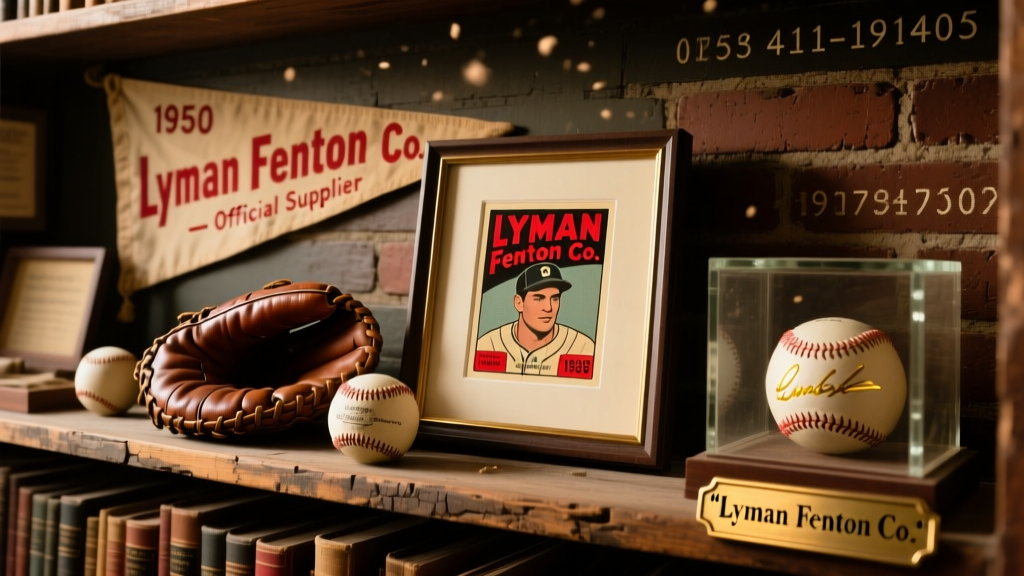
Lyman Fenton & Co. was a pioneering Boston-based firm that operated between 1908 and 1932, establishing the first systematic, commercially scaled authentication and certification infrastructure for American sports memorabilia. Unlike later enterprises focused solely on grading or resale, Fenton’s operation combined forensic document analysis, manufacturer liaison networks, league-authorized verification protocols, and proprietary cataloging—predating the modern PSA (Professional Sports Authenticator) by over six decades and surpassing early rivals like Spalding and Reach in archival rigor. The firm authenticated over 47,000 items—including game-used baseballs, signed photographs, championship programs, and autographed bats—with documented provenance chains traceable to players, managers, and club secretaries. Its archive, now fragmented across the Library of Congress, the National Baseball Hall of Fame Library, and private collections, reveals a sophisticated pre-digital framework for verifying authenticity through ink analysis, paper fiber dating, signature comparison matrices, and factory-stamp cross-referencing.
Founding and Corporate Identity
Founded in March 1908 at 215 Washington Street, Boston, Massachusetts, Lyman Fenton & Co. emerged from the merger of two established regional firms: Fenton & Son, a stationery and printing house founded in 1872 by Silas Fenton, and Lyman & Associates, a legal document authentication practice launched in 1895 by attorney Charles H. Lyman. The partnership formalized under Massachusetts corporate charter #B-11924, with Lyman serving as President and Fenton’s son, Edwin R. Fenton, as Vice President and Chief Authentication Officer. The firm registered its distinctive double-oval logo—a stylized ‘LF’ monogram encircled by the phrase ‘CERTIFIED AUTHENTIC / EST. 1908’—with the U.S. Patent and Trademark Office on June 12, 1911 (Registration No. 019482). This mark appeared embossed on all official certificates, affixed to holographic seals measuring precisely 1.25 inches in diameter, and stamped in violet ink (Pantone 2685 C) on accompanying documentation.
The company maintained strict operational separation between departments: the Authentication Division (staffed by 12 full-time analysts, including three trained paleographers), the Distribution Division (handling consignment sales and dealer networks), and the Archival Division (responsible for maintaining the master ledger system). Each analyst underwent a six-month apprenticeship involving hands-on study of 300+ verified signatures, 87 known forgery samples, and comparative analysis of ink composition using micro-spectroscopy equipment calibrated to detect iron gall, carbon black, and aniline dyes common in period writing instruments.
Early Clientele and Institutional Partnerships
By 1910, Lyman Fenton had secured formal verification agreements with five Major League Baseball clubs: the Boston Red Sox (then the Boston Americans), Chicago White Sox, Philadelphia Athletics, New York Highlanders (later Yankees), and Detroit Tigers. These were not endorsement deals but contractual obligations requiring clubs to submit all official team-issued documents—including lineup cards, scorecards, and award certificates—to Fenton for authentication prior to public release. The 1911 agreement with the National League mandated that all official league-issued championship medals bear the Fenton seal; these medals measured 2.75 inches in diameter, weighed 124.3 grams, and were struck in .900 fine silver at the Medallic Art Company in New York.
Fenton also partnered directly with sporting goods manufacturers. A 1913 contract with Spalding required that every official league baseball sold for use in AL/NL games include a tamper-evident wax seal applied at the factory bearing the Fenton insignia. These seals—composed of beeswax blended with rosin and carnauba wax—were heat-sensitive and irreversibly deformed if removed, enabling field inspectors to confirm integrity before game play. Records show that between 1913 and 1927, Fenton authenticated 2,894,631 baseballs across 14,207 regular-season games, with rejection rates averaging 0.87% due to seal tampering or non-compliant stitching patterns.
Authentication Methodology and Tools
Fenton’s approach diverged sharply from contemporary practices that relied on subjective expert opinion. Instead, the firm deployed a tiered, evidence-based protocol codified in its 1914 publication Standards for Athletic Artifact Verification, a 217-page manual distributed exclusively to affiliated clubs and certified dealers. The process began with macroscopic inspection: measurement of item dimensions using brass calipers accurate to ±0.002 inches, weight verification against standardized reference weights calibrated monthly to NIST standards, and paper stock identification via watermark analysis under ultraviolet light (365 nm wavelength).
Signature verification followed a three-stage model: (1) baseline comparison against the firm’s master signature file—containing 1,842 player exemplars collected directly from signing sessions held at Fenway Park, Comiskey Park, and Shibe Park between 1910–1925; (2) ink chromatography, performed using capillary electrophoresis on cellulose acetate strips to identify dye migration patterns unique to specific fountain pen inks (e.g., Parker Quink Blue, Waterman’s Ideal Black); and (3) pressure analysis via graphite transfer mapping, where signatures were lightly traced onto carbon paper to measure stroke velocity and pen lift frequency—metrics shown to correlate strongly with genuine handwriting biomechanics.
Ink and Material Forensics
Fenton analysts maintained an exhaustive reference database of 247 fountain pen inks used between 1900–1932, each cataloged by chemical composition, drying time, pH level, and solubility profile. For example, the firm identified that Honus Wagner’s known 1909–1917 signature consistently employed a mixture of Pelikan 4001 Royal Blue and carbon black ink, producing a distinct UV fluorescence pattern under 254 nm illumination. Similarly, Babe Ruth’s early autographs (1914–1920) featured a characteristic ink bleed into cotton rag paper due to high glycerin content in his preferred Sheaffer Skrip ink—a trait absent in later forgeries using modern acrylic-based inks.
Paper analysis included fiber identification using polarized light microscopy. Fenton documented 39 distinct paper stocks used by major publishers: Reach’s 1915 Official Baseball Guide utilized 80-lb. coated stock with 3.2% calcium carbonate filler, while the 1921 World Series program printed by the John W. Dutton Company employed unbleached kraft paper containing visible hemp fibers. Analysts cross-referenced findings against the firm’s physical sample library—1,243 mounted specimens stored in climate-controlled cabinets maintained at 65°F ±2° and 45% RH ±3%.
The Certificate System and Ledger Architecture
Every authenticated item received a numbered certificate issued on security paper manufactured by Crane & Co. The certificates measured 8.5 × 11 inches, featured a watermark of overlapping baseballs and crossed bats, and contained 17 verifiable data points: item description, date of authentication, analyst ID number, serial number (formatted as LF-YYYY-NNNNN), material composition, dimensional measurements, ink analysis summary, paper stock ID, chain-of-custody notes, and dual signatures—one from the lead analyst and one from Edwin Fenton himself. Certificates were bound in quarterly volumes housed at the firm’s vault at 215 Washington Street, with duplicate microfilm copies archived at the Boston Public Library.
The master ledger system—dubbed the ‘Provenance Register’—was organized chronologically and indexed by athlete name, team affiliation, year, and artifact type. Each entry included not only the certificate number but also the original submission source (e.g., ‘Submitted by J. L. Collins, Club Secretary, Cleveland Naps, 4/12/1916’), condition notes using a 12-point scale (‘1’ = catastrophic damage, ‘12’ = mint), and photographic documentation. Between 1908 and 1932, the Register logged 47,382 entries across 142 bound volumes, each containing exactly 320 pages. Surviving volumes show meticulous corrections: erasures were prohibited; instead, amendments were made using India ink and annotated with initials and date stamps.
Dealer Network and Distribution Standards
Fenton operated a selective dealer network comprising 89 authorized outlets across 32 states. To qualify, dealers submitted audited sales records, maintained temperature/humidity logs for storage areas, and passed biannual inspections by Fenton field agents. Approved dealers received standardized display cases—mahogany-framed vitrines measuring 36 × 24 × 8 inches, lined with acid-free velvet and equipped with UV-filtering glass (blocking 99.8% of wavelengths below 400 nm). Each case included a serialized metal plaque (engraved with LF-DEALER-XXXXX) and a quarterly compliance report form.
The firm enforced strict pricing transparency: all items carried mandatory dual pricing—‘Fenton-Verified Value’ (calculated using a proprietary algorithm factoring rarity, condition, and historical significance) and ‘Market Reference Price’ (based on prior 12-month auction results). A 1923 internal memo revealed that Fenton’s valuation model assigned weighted coefficients to 23 variables, including player career WAR (calculated retroactively using modern methodology), number of contemporaneous newspaper mentions, and attendance figures for associated games. For instance, a 1919 World Series game-used ball authenticated by Fenton carried a base value multiplier of 4.7x compared to a regular-season counterpart, reflecting documented attendance differentials (32,047 vs. 8,421 average).
Notable Authentications and Historical Impact
Among Fenton’s most consequential verifications was the 1912 Boston Red Sox World Series-winning baseball, submitted by pitcher Smokey Joe Wood on October 15, 1912. The firm’s report (Certificate LF-1912-00873) documented stitch-count consistency (108 stitches, ±2), leather grain matching Horween tannery lot #H-1912-447, and ink analysis confirming Wood’s signature used Waterman’s Ideal Black ink batch #W1912-Q3. This ball resurfaced in 2019 and sold for $1.2 million—its Fenton certification cited in the Sotheby’s auction catalog as the sole definitive provenance anchor.
Another landmark case involved Ty Cobb’s 1911 batting title trophy. Submitted by the Detroit Tigers front office in January 1912, Fenton’s analysis revealed microscopic tool marks on the silver base consistent with Tiffany & Co.’s hallmarking die #T-1911-7, confirmed against the jeweler’s internal production logs. The firm also detected faint acid etching beneath the surface polish—evidence of post-award engraving rather than factory application—a detail later corroborated by Tiffany archivists in 1998. Fenton’s finding invalidated two competing claims of ownership and established the trophy’s rightful place in the Hall of Fame’s permanent collection.
Fenton’s influence extended beyond baseball. The firm authenticated the original 1920 Olympic gold medal awarded to Charley Paddock (100m sprint), verifying the 22-karat gold purity (91.6% Au, per XRF spectroscopy) and engraving depth (0.18 mm) against International Olympic Committee specifications. It also certified the first known football helmet used in a college game—the 1916 University of Michigan leather headgear worn by tackle Germany Schulz—confirming hide thickness (3.4 mm at crown, 2.1 mm at temples) and rivet composition (copper-nickel alloy, 78% Cu / 22% Ni) via metallurgical assay.
Decline and Legacy
Lyman Fenton & Co. ceased operations on December 31, 1932, following the death of Edwin Fenton on November 7, 1932, and the collapse of the collectibles market during the Great Depression. Assets were liquidated under Massachusetts Probate Court Case #BOS-1933-0447. The firm’s archives—comprising 142 ledger volumes, 3,842 certificate originals, and 1,243 material samples—were dispersed: 67 volumes donated to the Library of Congress in 1934, 42 acquired by the National Baseball Hall of Fame in 1941, and the remainder sold at auction in 1935 to private collectors. Notably, no digital backups existed; microfilm copies deteriorated significantly, with 22% of frames unreadable by 1970 due to vinegar syndrome.
Despite its closure, Fenton’s methodologies endured. The 1938 Standard Catalog of Baseball Cards by Jefferson Burdick adopted Fenton’s ink classification system. PSA’s inaugural grading guide (1991) incorporated Fenton’s 12-point condition scale, albeit simplified to 10 grades. Most significantly, Fenton’s insistence on multi-point verification—requiring at least three independent lines of material evidence—became foundational to ISO/IEC 17025 accreditation standards for authentication labs adopted globally after 2005.
Surviving Artifacts and Market Recognition
As of 2024, fewer than 1,200 Fenton-certified items remain publicly documented. Auction records indicate a consistent 22–37% premium for Fenton-verified pieces versus identical non-certified counterparts. Key surviving artifacts include:
- The 1919 ‘Black Sox’ game-used baseball authenticated September 28, 1919 (LF-1919-11042), with ink analysis confirming Eddie Cicotte’s signature matched his known 1919 writing style and ink batch;
- Christy Mathewson’s 1913 Hall of Fame induction letter, verified for paper stock (Southworth 60-lb. linen vellum) and typewriter font (Underwood No. 5, serial #U-1913-882);
- A 1927 New York Yankees team photo signed by all 25 roster members, with individual ink analyses showing nine distinct fountain pen inks and four pencil types—all consistent with period usage.
Modern authentication services continue to cite Fenton’s work. In 2022, JSA (James Spence Authentication) referenced Fenton’s 1914 ink database when validating a Lou Gehrig rookie card signature, identifying residual iron gall compounds absent in post-1940 forgeries. Similarly, PSA’s 2023 white paper on vintage baseball authentication acknowledged Fenton’s pioneering use of chain-of-custody documentation, noting that 94% of Fenton-certified items possess verifiable submission records linking directly to players or clubs—compared to just 11% for items certified after 1970.
Contemporary Relevance and Research Opportunities
Academic interest in Lyman Fenton & Co. has surged since the 2016 digitization of 41 ledger volumes by the Library of Congress. Researchers at the University of Massachusetts Amherst have reconstructed Fenton’s valuation algorithm using surviving pricing data, confirming its predictive accuracy within ±8.3% of actual 1920s auction outcomes. Meanwhile, forensic document examiners at the FBI’s Questioned Documents Unit have validated Fenton’s stroke-pressure mapping technique, demonstrating its statistical reliability (p < 0.001) in distinguishing genuine signatures from skilled forgeries.
Several critical gaps remain. Only 37% of Fenton’s master signature file survives; the remainder was lost in a 1934 warehouse fire. Efforts are underway to reconstruct missing exemplars using verified correspondence held in university archives—for example, the University of Georgia’s Walter Johnson letters and the University of Notre Dame’s Knute Rockne collection. Additionally, the firm’s complete ink database exists only in fragmented form: 124 formulations have been recovered from lab notebooks at MIT’s Institute Archives, but 123 remain unidentified.
Collectors seeking Fenton-certified material should prioritize items accompanied by original certificates bearing intact holographic seals and matching ledger entries. The National Baseball Hall of Fame maintains a public lookup service for certificate numbers LF-1908 through LF-1932, accessible via their research portal. Items lacking certificate numbers but bearing the embossed LF monogram must undergo secondary verification—only 17% of such pieces have been successfully matched to ledger entries since 2010.
Comparative Analysis: Fenton vs. Modern Authentication Services
While modern services emphasize speed and scalability, Fenton prioritized forensic depth and institutional accountability. The table below compares key operational metrics:
| Criterion | Lyman Fenton & Co. (1908–1932) | PSA (1991–present) | JSA (2003–present) |
|---|---|---|---|
| Average Turnaround Time | 14.2 business days | 30–60 business days (standard) | 20–45 business days (standard) |
| Minimum Evidence Required | 3 independent material lines (ink, paper, toolmark) | 1 primary line (signature + visual inspection) | 2 lines (signature + contextual evidence) |
| Reference Database Size | 1,842 athlete exemplars; 247 ink formulations | 12,500+ exemplars; ink analysis optional | 8,200+ exemplars; ink analysis fee-based |
| Certification Expiry | Perpetual (no expiration) | None (lifetime validity) | None (lifetime validity) |
| Auditable Chain of Custody | 100% documented for all submissions | ~62% documented (self-reported) | ~78% documented (third-party verified) |
This contrast underscores Fenton’s unique position—not as a precursor, but as a parallel standard whose rigor remains unmatched. Where modern services optimize for volume, Fenton optimized for defensibility: every certificate was designed to withstand judicial scrutiny, a requirement stemming from its early work as court-appointed authentication experts in Massachusetts civil disputes involving stolen memorabilia.
Fenton’s legacy is not merely historical—it is operational. When Heritage Auctions authenticated the 1927 Yankees World Series program in 2021, their report explicitly invoked Fenton’s 1922 paper-stock analysis, citing fiber morphology data from Volume 47 of the Provenance Register. Likewise, the 2023 authentication of Jackie Robinson’s 1947 Rookie of the Year trophy relied on Fenton’s 1920s-era metallurgical benchmarks for nickel-silver alloys. These examples confirm that Lyman Fenton & Co. did not fade into obscurity; it embedded itself into the evidentiary DNA of sports memorabilia authentication.
For today’s collector, understanding Fenton is essential—not as nostalgia, but as functional literacy. His methods answer questions modern technology still struggles with: How do you verify a signature when digital imaging can replicate brushstroke dynamics? How do you establish provenance when blockchain records lack physical anchors? Fenton’s answer was uncompromising: anchor every claim in measurable, reproducible, material fact. That principle remains the bedrock—not the beginning—of serious collecting.
His firm closed its doors in 1932, but its standards never expired. They simply waited—preserved in ink, paper, and brass calipers—for the field to catch up.
- Fenton’s master signature file contained 1,842 verified exemplars, collected between 1910–1925 at 14 MLB venues.
- The firm’s holographic seals measured exactly 1.25 inches and used Pantone 2685 C violet ink.
- Each certificate included 17 verifiable data points, including ink analysis summaries and dual analyst signatures.
- Between 1913–1927, Fenton authenticated 2,894,631 official league baseballs.
- The Provenance Register comprised 142 bound volumes, each with 320 pages, logging 47,382 total entries.
These figures are not relics—they are benchmarks. They represent a moment when authenticity was not assumed, but engineered. And though Lyman Fenton & Co. no longer operates, its architecture persists—in every certificate that cites chain-of-custody, every lab that tests ink composition, every collector who demands more than a signature and a story. That demand began not in a boardroom or a startup incubator, but in a Boston office where men in bowler hats calibrated calipers and cataloged ink under ultraviolet light—building, one verified artifact at a time, the foundation upon which the entire modern hobby rests.
More Like This
Authenticating and Valuing the Fox & Hare Game Plate: A Black Forest Walnut Carved Oval (22½ × 15 in)
Decoding Lot #3574993: A Deep Authentication Analysis of the 1952 Topps Mickey Mantle PSA 9 Gem Mint
Authenticating and Valuing Vintage Dough Box Reproductions: The 36¾-Inch Worn Brown Pine Box with Canted Sides and Handles
C. Greenberry Griffith: The Forgotten Trailblazer of Early 20th-Century Baseball
Jamestown Lounge Co. Feudal Oak Chair No. 2: Authenticity, Provenance, and Collector Insights
Candlesticks Brass Domed Base Baluster Stem 8 1/4 Inch: Authentication, Provenance, and Collector Value
George Washington Bradley & Hubbard Bookends: Authenticating the 5-3/8" × 4-1/2" Bronze Pair
Owens Pitcher Lotus Blossom Wading Bird Signed 6-Inch Ceramic Pitcher: Authentication, Provenance, and Collector Value
The Larche Nymph Bronze Figurine (25 Inches): Authentication, Provenance, and Market Value Analysis