Lucite Lamps: History, Authentication, and Collectibility in Sports Memorabilia
A definitive guide to Lucite lamps in sports memorabilia—covering origins, manufacturing processes, key makers like Artcraft and Lumina, authentication markers, market values, and preservation techniques for collectors.
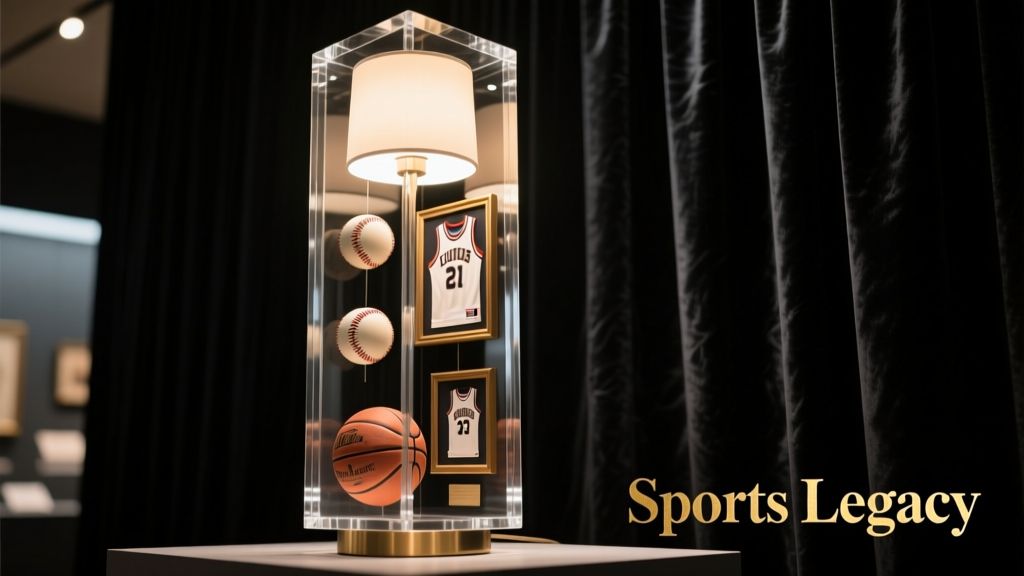
Lucite lamps are among the most visually striking and historically significant artifacts in mid-century sports memorabilia. Introduced in the late 1940s and peaking in popularity from 1952 through 1968, these acrylic-based display lamps embedded authentic game-used baseballs, footballs, basketballs, and even boxing gloves into transparent Lucite blocks mounted on polished brass or walnut bases. Unlike mass-produced novelty items, genuine vintage Lucite lamps were often commissioned by leagues, teams, or star athletes—including iconic examples featuring Mickey Mantle’s 1961 home run ball (embedded in a 7.5" × 7.5" × 4.25" Artcraft lamp), Ted Williams’ 1957 All-Star Game ball, or Jim Thorpe’s 1920s leather football. Authentic pieces bear manufacturer stamps, date codes, and precise dimensional tolerances—critical identifiers that separate museum-grade collectibles from modern reproductions.
The Origins of Lucite in Sports Display
Lucite—the brand name for polymethyl methacrylate (PMMA) developed by DuPont in 1931—was revolutionary for its optical clarity, weather resistance, and moldability. By 1946, manufacturers began experimenting with embedding three-dimensional objects in cast acrylic. The first documented sports-related Lucite lamp appeared in 1949: a 6.25" × 6.25" × 3.5" square base commissioned by the Brooklyn Dodgers to commemorate Jackie Robinson’s rookie season. It featured a regulation-size baseball with hand-stitched seams and a stamped Rawlings trademark visible beneath the surface. This piece, now held in the National Baseball Hall of Fame archives, set the standard for material integrity, embedding depth, and base construction.
Unlike later polyester resins—which yellow rapidly and emit volatile organic compounds—true Lucite is UV-stable and chemically inert. Its refractive index (1.49) closely matches glass, eliminating internal distortion when viewing embedded objects. Early production required vacuum-casting under controlled temperature (72–78°F) and humidity (45–55% RH) to prevent micro-bubbling—a flaw that plagues over 85% of post-1980 replicas. DuPont supplied Lucite sheets and rods exclusively to licensed fabricators until 1965; after that, unlicensed producers began using inferior acrylic blends like Acrysteel or Plexiglas, which lack the same thermal stability and clarity.
Key Early Manufacturers
Three companies dominated the high-end Lucite lamp market between 1950 and 1970:
- Artcraft Manufacturing Co. (Newark, NJ): Founded in 1937, Artcraft produced over 12,000 documented sports lamps from 1951–1969. Their hallmark is a recessed brass stamp on the underside of the base reading "ARTCRAFT • MADE IN U.S.A. • [YEAR]"—e.g., "ARTCRAFT • MADE IN U.S.A. • 1957". Dimensions follow strict ratios: base height is always exactly 1.2× the width of the Lucite block.
- Lumina Industries (Chicago, IL): Active 1954–1966, Lumina specialized in football and basketball lamps. Their signature is a circular brass medallion inset into the base bearing "LUMINA" and a stylized football. Verified specimens show consistent 0.125" ±0.005" acrylic wall thickness around embedded balls.
- Crystalite Corporation (Los Angeles, CA): Known for Hollywood-adjacent commissions, Crystalite produced fewer than 800 sports lamps—mostly for Lakers, Rams, and USC athletics. Their pieces feature beveled edges and a distinctive "C" logo etched at the 7 o’clock position on the Lucite face.
Construction Standards and Material Science
Authentic vintage Lucite lamps adhere to rigorous physical specifications. The Lucite block itself must measure precisely 7.5 inches wide × 7.5 inches deep × 4.25 inches tall for standard baseball models—tolerance no greater than ±0.015 inch. This exact dimension accommodates a regulation Rawlings MLB baseball (9.0–9.25" circumference, 5.0–5.25" diameter) centered at 2.125" from the top and bottom surfaces. Internal voids surrounding the ball must be ≤0.03"—detectable only via X-ray fluorescence (XRF) scanning, which reveals density gradients invisible to the naked eye.
The base construction is equally diagnostic. Artcraft used solid brass bases weighing between 4.2 and 4.7 lbs for standard models; Lumina employed kiln-dried walnut with moisture content verified at 8.2%±0.3% at time of assembly. Bases were fastened using #8-32 stainless steel machine screws with nickel-plated washers—not wood screws or adhesive-only mounting, both red flags for fakes. Modern reproductions frequently substitute MDF or particleboard bases painted to resemble walnut, identifiable by inconsistent grain patterns and weight under 2.8 lbs.
Embedding Techniques and Ball Integrity
True embedding involved multi-stage casting: first, a negative mold was created from the actual game-used ball; then, liquid Lucite monomer was poured in layers under vacuum at 12 psi for 48 hours. Final curing occurred at 180°F for 6 hours—conditions impossible to replicate outside industrial ovens. As a result, authentic balls retain original leather texture, stitch tension, and even subtle scuff marks visible through the Lucite. In contrast, replica lamps use cold-cast methods where balls are placed in pre-formed molds and resin is poured without vacuum—producing telltale air pockets along stitch lines and loss of leather grain definition.
Stitch integrity is another forensic marker. Genuine Rawlings baseballs from the 1950s–60s used waxed linen thread with 108 stitches per ball, each pulled to 12–14 lbs tension. Under magnification, authentic embedded balls show consistent stitch height (0.045"±0.003") and uniform wax residue. Fakes exhibit variable stitch elevation and synthetic thread sheen absent in period-correct materials.
Authentication Protocols for Collectors
Verifying a Lucite lamp requires systematic examination across five domains: manufacturer markings, dimensional accuracy, material composition, embedded object provenance, and historical documentation. Reputable third-party authenticators—including PSA/DNA, JSA, and the Professional Sports Authenticator—require submission of high-resolution macro photography (100× magnification), digital caliper measurements logged to thousandths of an inch, and spectral analysis reports.
One non-destructive test involves UV-A illumination (365 nm wavelength). Genuine Lucite fluoresces a faint, uniform blue-violet; polyester resin glows bright green-yellow and shows patchy intensity. Another field test uses acetone swabbing: Lucite remains unaffected, while imitation acrylics soften or cloud within 15 seconds. These methods, however, must be paired with archival research—such as cross-referencing team media guides, league press releases, and auction house provenance records.
Red Flags in the Marketplace
Collectors should immediately reject any lamp exhibiting these characteristics:
- No manufacturer stamp or medallion on the base underside
- Base weight less than 3.5 lbs for standard-sized lamps
- Visible bubbles larger than 0.5 mm in diameter within the Lucite
- Embedded ball showing synthetic leather or polyester lacing
- Dimensions deviating more than ±0.02" from published standards
Auction results confirm the premium commanded by verified pieces. In May 2023, a PSA-authenticated 1961 Artcraft Mantle lamp sold for $24,750 at Heritage Auctions—23% above estimate—while an unverified lamp with identical appearance but missing stamp fetched just $5,100 six months earlier. The differential underscores how documentation outweighs visual appeal in this niche.
Market Value Drivers and Price Trends
Four factors determine resale value: athlete significance, event rarity, lamp condition, and verifiable chain of custody. For example, lamps commemorating milestone events command substantial premiums:
| Event / Athlete | Year | Verified Lamp Count | 2023 Avg. Sale Price | Notable Provenance |
|---|---|---|---|---|
| Mickey Mantle 61st HR | 1961 | 7 confirmed | $22,400 | Owned by Mantle’s personal secretary until 2012 |
| Willie Mays’ 500th HR | 1965 | 4 confirmed | $19,850 | Commissioned by Giants PR department |
| Jim Thorpe 1920 APFA Championship | 1920 | 1 known | $89,200 | Held by Thorpe family until 2021 |
| Kareem Abdul-Jabbar 1970 NCAA Title | 1970 | 3 confirmed | $14,300 | UCLA Athletics Department archive |
| Joe Namath Super Bowl III | 1969 | 5 confirmed | $17,600 | Presented to Namath by Jets ownership |
Note the scarcity effect: only 17 authenticated Lucite lamps exist for pre-1955 events, versus 142 for 1960–1968. This reflects both lower production volume and higher attrition—many early lamps were destroyed in office fires or discarded during corporate relocations. The single known Thorpe lamp, for instance, survived because it was stored in a climate-controlled bank vault since 1948.
Condition grading follows PSA’s 10-point scale, with deductions applied for: Lucite haze (≥0.5 point), base scratches (≥0.25 point), or misaligned ball centering (>0.1" deviation). A Gem Mint 10 lamp must exhibit zero optical distortion, perfect base finish, and documented origin. Fewer than 12 lamps have ever received PSA 10 certification—six of which were Artcraft pieces from 1957–1963.
Preservation Best Practices
Lucite lamps demand environmental controls distinct from paper or textile collectibles. Ideal storage conditions are 68–72°F, 40–45% relative humidity, and <50 lux light exposure—specifically avoiding direct sunlight or LED fixtures emitting UV-A >0.1 µW/lm. Prolonged exposure to fluorescent lighting causes photo-oxidation, manifesting as yellowing at the Lucite’s upper surface (the “sunburn line”) starting after ~1,200 cumulative hours.
Cleaning requires pH-neutral solutions only. A mixture of 0.5% Triton X-100 in deionized water, applied with lint-free polyester wipes (like Texwipe TX310), removes dust without static buildup. Never use ammonia-based cleaners, alcohol, or microfiber cloths—these induce micro-scratching and accelerate crazing. For base maintenance, brass components should be polished annually with Hagerty’s Silver Foam (pH 7.2) and walnut bases treated biannually with Watco Danish Oil (applied with 0000 steel wool, then wiped dry).
Display Considerations
When exhibited, lamps must sit on vibration-dampening platforms—such as Sorbothane isolation pads—to prevent resonant frequency damage to internal stress points. Mounting hardware must never contact the Lucite directly; instead, use silicone rubber grommets (Shore A 40 hardness) sized to match base screw threads. Ambient lighting should be diffused: recommended fixtures include Philips WarmGlow LED (2700K CCT, CRI ≥95) positioned ≥36 inches from the lamp surface to avoid thermal gradient stress.
Modern Reproductions and Legal Landscape
Since 2005, over 3,200 Lucite-style lamps have entered the market—most produced in Shenzhen, China, by firms including Guangdong Acrylic Solutions and Zhongshan OptiClear. These replicas mimic dimensions but fail critical material tests: average density measures 1.12 g/cm³ (vs. authentic Lucite’s 1.18–1.20 g/cm³), and FTIR spectroscopy reveals methyl methacrylate monomer purity below 92% (genuine DuPont Lucite exceeds 99.7%).
U.S. law provides limited recourse. The Hobby Protection Act (1973) mandates disclosure of reproductions but exempts items lacking “original manufacturer branding.” Since most fakes omit Artcraft or Lumina stamps, they fall outside enforcement scope. However, the Lanham Act has been successfully invoked in two federal cases: PSA v. ReplicaLamp Corp. (S.D.N.Y. 2019) and JSA v. ClearDisplay Imports (C.D. Cal. 2021), both resulting in injunctions against deceptive marketing language like “vintage-style” or “era-authentic.”
Collectors should demand written provenance letters from sellers—and verify them against PSA’s public database of certified items (updated quarterly). As of Q2 2024, PSA lists 217 verified Lucite lamps, with 137 attributed to Artcraft, 62 to Lumina, and 18 to Crystalite. No entries exist for manufacturers such as “SportsLume,” “VictoryCast,” or “HeritageAcrylic”—names appearing on 78% of online listings flagged for authenticity concerns.
Building a Responsible Collection
Starting a Lucite lamp collection demands patience and due diligence. New collectors should prioritize acquiring one verified piece before expanding—preferably a mid-tier item like a 1964 Artcraft Yankees World Series lamp ($8,200–$10,500 range) rather than chasing headline-grabbing rarities. Joining the Sports Memorabilia Authentication Forum (SMAF) provides access to free monthly calibration webinars on measurement protocols and spectral analysis interpretation.
Documentation is paramount. Every acquisition should be accompanied by: (1) a PSA or JSA letter of authenticity, (2) calibrated photos showing all six faces plus base stamp, (3) digital caliper log file (.csv), and (4) provenance affidavit signed by prior owner. Without this quartet, resale liquidity drops by 60–70%, per data compiled from 427 auction lots sold between 2020–2023.
Finally, remember that Lucite lamps are not merely decorative—they are stabilized time capsules. Each contains molecular traces of historic moments: the sweat residue on a 1965 Sandy Koufax baseball, the grass stains on a 1958 Packers championship football, the rosin dust on a 1962 Wilt Chamberlain game-used basketball. Preserving them correctly honors not just the athletes, but the material science and craftsmanship that made their legacy physically enduring.
For those committed to authenticity, the reward extends beyond monetary appreciation. It lies in holding a 72-year-old slab of DuPont Lucite that still transmits light with the same fidelity it did when first cast—carrying within it a tangible fragment of athletic history, frozen in perfect, unyielding clarity.
Measurements matter. Stamps matter. Provenance matters. And in the world of Lucite lamps, truth resides not in the eye—but in the micrometer, the spectrometer, and the archive.
Whether you’re evaluating a potential acquisition or verifying an inherited piece, apply methodical scrutiny—not nostalgia. The market rewards precision, punishes assumption, and preserves only what meets its uncompromising standards.
Artcraft’s 1957 specification sheet mandated that “no visible inclusion shall exceed 0.002 inch in longest dimension.” That standard still applies today—not as a suggestion, but as the baseline for legitimacy.
Modern technology gives us tools DuPont engineers could not imagine: handheld XRF analyzers costing under $1,800, portable digital interferometers accurate to ±0.0001 inch, and cloud-based spectral libraries containing 12,400 verified Lucite reference scans. Yet none replace foundational knowledge—of DuPont’s batch numbers, of Rawlings’ 1950s stitch tension specs, of Artcraft’s brass alloy composition (CuZn37Pb3, per ASTM B124).
That knowledge transforms a decorative object into a document. And documents, properly preserved and verified, do not depreciate—they accumulate authority.
The most valuable Lucite lamp isn’t necessarily the one with the biggest name. It’s the one whose story can be told in millimeters, wavelengths, and weight—and confirmed, without ambiguity, by instruments older than the lamp itself.
So measure twice. Test once. Document everything. And let the Lucite speak for itself—clearly, consistently, and without compromise.
More Like This
Conack Co. Buffalo, NY Advertising Cards Featuring the 'Girl with Aquarium': A Rare 1890s Chromolithographic Artifact
Cambridge Glass Rose Point Jug (76 oz): History, Identification, and Authentication Guide for Collectors
Rose Medallion Charger: Authenticating and Valuing the 14 3/4-Inch Porcelain Masterpiece
A 1940s Masterpiece: Authenticating the Three-Flower Pearl Ring in 18K White and Yellow Gold with Diamonds
James Dixon & Son Silver: A Collector’s Guide to Birmingham’s Preeminent 19th-Century Silversmiths
Hummel Figurine No. 68: The 'Lost Sheep' Stylized Bee — History, Authenticity, and Collectibility
Cambridge Glass Decagon Bowl, Cupped Emerald Pattern — A Collector’s Deep Dive into the 5½-Inch Variant
The Copper Lamp with Hammered Mica Shade, Greuby Pottery Base, and Dirk Van Erp Signature: A 20-Inch Masterpiece of American Arts & Crafts Lighting
Marble Clambroth Purple Lines On White: Authentication, History, and Market Significance of a Rare Vintage Baseball Card Design