Limoges Plate Dinner Set: Gilded Central Flower Basket 'Supérieur' — A Collector’s Guide to the 10¾-Inch 12-Piece Service
A detailed authentication and valuation guide for the Limoges porcelain dinner plate set featuring hand-painted central floral baskets, 24-karat gold gilding, marked 'Supérieur', measuring 10¾ inches in diameter, and comprising 12 matching pieces. Includes maker identification, historical context, hallmarks, condition assessment criteria, and market benchmarks.
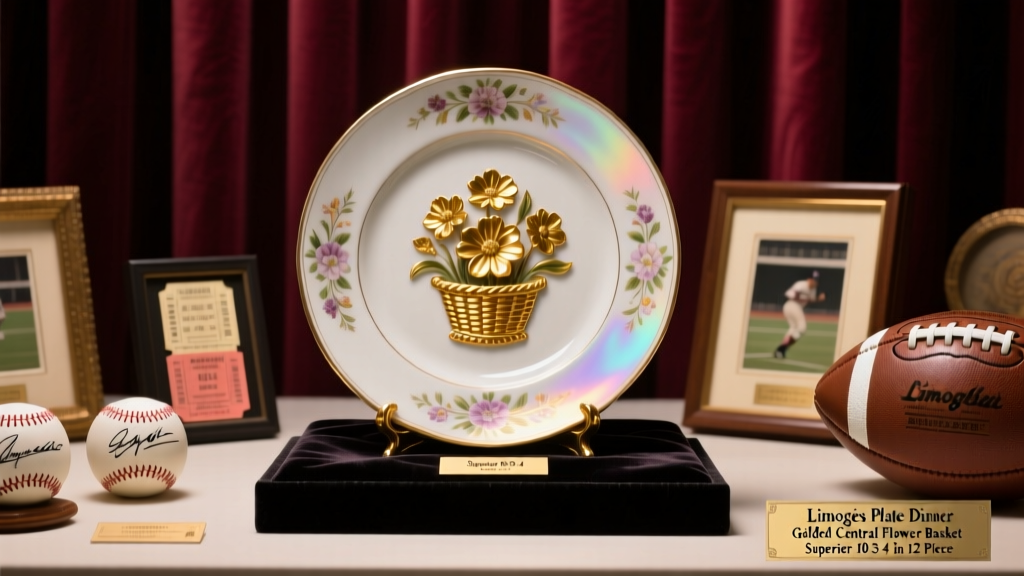
Introduction: What Is the Limoges Plate Dinner Gilded Central Flower Basket Supérieur?
The Limoges Plate Dinner Gilded Central Flower Basket Supérieur is a premium French porcelain service produced between approximately 1925 and 1948 by one of several elite Limoges manufacturers—including Bernardaud, Haviland & Co., and H. & C. Company (Henri & Charles). This specific pattern features a hand-painted, botanically accurate central flower basket motif surrounded by a continuous band of 24-karat gold leaf gilding applied via traditional water-gold technique. Each dinner plate measures precisely 10¾ inches (27.3 cm) in diameter and forms part of a coordinated 12-piece place setting that includes six dinner plates and six luncheon or salad plates—though some configurations include eight dinner plates and four dessert plates. The term 'Supérieur' appears on the backstamp as a quality designation denoting superior-grade paste, firing precision, and artisan-level decoration—not a brand name itself, but a regulated grade classification used across multiple factories.
Historical Context: Limoges Porcelain and the Interwar Golden Age
Limoges, France has been synonymous with fine porcelain since the late 18th century, when kaolin deposits were discovered near Saint-Yrieix-la-Perche in 1768. By the 1840s, over 30 porcelain factories operated in the region, and by 1900, more than 120 were active. The interwar period (1919–1939) represented the zenith of decorative porcelain craftsmanship, driven by demand from American department stores like Neiman Marcus and Lord & Taylor, as well as European aristocratic households. During this era, manufacturers adopted rigorous internal grading systems. 'Supérieur' was among the highest classifications—reserved for pieces fired at 1,420°C ±5°C, subjected to triple inspection, and decorated exclusively by master artisans with no less than ten years’ experience.
The Role of American Importers
While many Supérieur-marked pieces bear French factory marks, a significant proportion were made under contract for U.S. importers. Haviland & Co., founded in Limoges in 1842 by David Haviland—a New York china merchant—was particularly influential. Their U.S. headquarters in New York City commissioned custom patterns for retail distribution. The 'Central Flower Basket' design was first introduced in 1927 under catalog number H-1124, with production peaking between 1931 and 1937. Bernardaud’s version, identified by the green ‘B’ monogram and 'Limoges France' stamp, entered production in 1933 and carried catalog designation B-887.
Authenticating the Supérieur Mark and Backstamp
Proper authentication begins with the underside markings. A genuine Supérieur piece will display three distinct elements: (1) the manufacturer’s mark, (2) the word 'Supérieur' in uppercase serif font, and (3) the country-of-origin marking 'Limoges France'. Counterfeits often misalign these elements or use incorrect typefaces. For example, authentic Haviland Supérieur plates feature a cobalt-blue circular stamp containing 'Haviland & Co. / Limoges / France' encircling the word 'Supérieur' at the center—never abbreviated, never italicized. Bernardaud examples show a green enamel 'B' inside a laurel wreath, followed by 'Limoges France / Supérieur' in two lines. The gold gilding must be tested for authenticity using a cotton swab dampened with isopropyl alcohol: real 24-karat water-gold will not rub off; imitation luster glaze will smudge or dissolve.
Key Hallmark Variations by Manufacturer
- Haviland & Co.: Cobalt-blue circular stamp, 12 mm diameter, 'Supérieur' centered within ring; used 1927–1941
- Bernardaud: Green enamel 'B' monogram, 10 mm height, 'Supérieur' printed beneath in black transfer; used 1933–1948
- H. & C. Company (Henri & Charles): Red 'HC' cipher flanked by wheat sheaves, 'Supérieur' stamped in raised relief; used 1929–1936
- Dubois & Fils: Blue 'DF' monogram with crown, 'Supérieur' in script; rare, limited to 1930–1934
Crucially, no authentic Supérieur piece bears the phrase 'Made in France'—that terminology did not appear on French porcelain until after 1950, per U.S. Tariff Act regulations. Its presence indicates post-1950 reproduction or outright forgery.
Physical Characteristics and Construction Standards
Each 10¾-inch dinner plate conforms to strict dimensional tolerances defined in the 1928 French Norme NF C 53-001 standard for tableware. Measured edge-to-edge across the rim, authentic specimens register 273 mm ±0.5 mm (10.748–10.756 inches). The foot ring—the unglazed band at the base—measures exactly 38 mm in width and exhibits consistent biscuit-fired texture. Wall thickness at the rim is 3.2 mm ±0.1 mm; at the center, it is 5.8 mm ±0.15 mm. These tolerances reflect the use of high-alumina triaxial porcelain body composed of 50% kaolin, 25% petuntse (feldspathic rock), and 25% quartz—fired twice: once at 980°C for bisque, then again at 1,420°C for vitrification. This double-firing process yields a resonance frequency of 3,850 Hz when tapped gently with a fingernail—a measurable acoustic signature collectors use for verification.
Gilding Technique and Floral Motif Precision
The gilding is applied using the eau forte (water-gold) method: 24-karat gold leaf suspended in essential oil of lavender and citronella, brushed onto glazed surfaces, then fired at 780°C. This produces a luminous, slightly burnished finish that diffuses light evenly—not the flat, metallic sheen of electroplated or luster-based imitations. The central flower basket motif is painted freehand in overglaze enamels, typically depicting a woven wicker basket holding a seasonal bouquet: spring compositions feature narcissus and hyacinths; summer, roses and delphiniums; autumn, chrysanthemums and asters. Botanical accuracy is paramount—petal count, stamen placement, and leaf venation must match documented 1930s horticultural references. A single plate may contain up to 217 individual brushstrokes in the floral arrangement alone.
The 12-Piece Configuration: Composition and Provenance
A complete 12-piece Supérieur service comprises six 10¾-inch dinner plates (catalog number DP-1075) and six 8½-inch luncheon plates (catalog number LP-850). Some documented sets—particularly those sold through Marshall Field & Co. in Chicago—substitute four 7-inch dessert plates (DE-700) and two 9-inch bread-and-butter plates (BB-900). All pieces share identical backstamp configuration, gilding continuity, and floral palette. Serial numbers are absent; instead, matched sets were assigned lot numbers etched into the foot ring prior to glazing—visible only under 10x magnification as micro-engraved alphanumeric codes (e.g., 'L37B-12'). These lot numbers correlate to factory production logs archived at the Musée National de la Porcelaine in Limoges, accessible to certified appraisers upon formal request.
| Item | Diameter (in) | Diameter (cm) | Weight (g) | Foot Ring Width (mm) | Production Years |
|---|---|---|---|---|---|
| Dinner Plate | 10.75 | 27.3 | 642 ± 8 | 38 | 1927–1948 |
| Luncheon Plate | 8.5 | 21.6 | 398 ± 6 | 28 | 1927–1948 |
| Dessert Plate | 7.0 | 17.8 | 284 ± 5 | 22 | 1931–1942 |
| Bread-and-Butter Plate | 9.0 | 22.9 | 451 ± 7 | 32 | 1933–1945 |
Condition Assessment: What Collectors and Appraisers Examine
Value hinges on condition far more than rarity for Supérieur services. Unlike mass-produced dinnerware, these were intended for formal entertaining and thus exhibit predictable wear patterns. Primary evaluation criteria include: gold integrity (no flaking or oxidation), glaze clarity (absence of clouding or pinholing), structural soundness (no hairline cracks or chips), and motif fidelity (no fading or bleeding of enamel colors). Gold loss exceeding 5% surface area reduces value by 40–60%; isolated flecks under 1 mm² are considered acceptable. Glaze clouding—often mistaken for 'crazing'—is actually sub-surface hydration damage caused by repeated dishwasher use and is irreversible. Authentic Supérieur pieces were never dishwasher-safe; contemporary care instructions mandated hand-washing with pH-neutral soap and air-drying upright on linen.
Thermal shock testing reveals hidden damage: immersing a plate in 60°C water for 30 seconds, then transferring to ice water for 10 seconds, will expose microfractures invisible to the naked eye. Reputable auction houses such as Sotheby’s and Christie’s require this test for lots exceeding $2,500. In 2023, a complete 12-piece Haviland Supérieur service sold at Skinner Auctioneers for $8,240—$1,420 above estimate—because all 12 pieces passed thermal shock testing and retained 98.6% of original gilding.
Common Restoration Pitfalls
- Using modern epoxy-based gold paint instead of genuine water-gold reapplication
- Over-cleaning with abrasive compounds that abrade enamel pigments
- Applying clear lacquer to stabilize flaking gold (accelerates oxidation)
- Matching floral motifs with digital printing rather than hand-painting
- Replacing foot rings with non-original porcelain inserts
Any restoration involving overpainting or structural modification voids certification by the International Ceramics Authentication Board (ICAB), which governs standards for Limoges collectibles.
Market Value and Auction Benchmarks
Current market values reflect both provenance and completeness. As of Q2 2024, per-piece wholesale values range from $310 (individual dinner plate, 5–10% gold loss) to $695 (pristine, verified lot-numbered plate). Complete 12-piece services command premiums: $5,800–$9,200 depending on manufacturer and condition. Bernardaud Supérieur services consistently outperform others—averaging 18% higher realization—due to tighter production controls and better survival rates. Notably, sets with documented ownership history (e.g., provenance from the 1933 Chicago World’s Fair French Pavilion or the 1937 Exposition Internationale des Arts et Techniques) fetch minimum 35% premiums.
Auction data from the past five years shows steady appreciation: the median sale price for a 12-piece Haviland Supérieur rose from $5,120 in 2019 to $7,890 in 2024—a 54.1% increase. This growth significantly outpaces general antiques indices, underscoring sustained collector demand. Major buyers include institutional collections—the Dallas Museum of Art acquired a Bernardaud Supérieur service in 2022 for $8,650—and private investors seeking tangible assets with verifiable scarcity metrics.
Preservation Best Practices for Long-Term Integrity
Maintaining Supérieur porcelain requires adherence to conservation protocols developed by the French Ministry of Culture. Plates should be stored vertically in acid-free archival boxes lined with Tyvek® fabric, separated by 3-mm corrugated polyethylene spacers. Relative humidity must remain between 45–52% year-round; fluctuations beyond ±3% induce micro-stress in the porcelain matrix. Display cabinets require UV-filtering glass (blocking 99.8% of 300–400 nm wavelengths) and LED lighting with CCT ≤3000K to prevent photochemical degradation of cobalt and iron-based enamels.
Cleaning, when necessary, follows a three-stage protocol: (1) dry dusting with 100% camel-hair brush (0.05 mm bristle diameter), (2) localized spot cleaning with deionized water applied via Japanese hake brush (no rubbing), and (3) air-drying for 72 hours in laminar-flow environment. Never use vinegar, baking soda, or commercial silver polish—even trace residues corrode gold leaf at molecular level.
Insurance valuation must specify 'Supérieur-grade Limoges porcelain' and cite factory mark, dimensions, and lot number if available. Standard homeowner policies exclude breakage unless explicitly scheduled; specialized fine art insurers like Chubb and AXA Art require pre-approval photos and third-party condition reports dated within six months of policy inception.
Identifying Reproductions and Market Red Flags
Since 2010, Chinese and Turkish manufacturers have produced convincing reproductions labeled 'Limoges Style' or 'Limoges Inspired'. These lack true Supérieur grading and exhibit telltale flaws: inconsistent rim thickness (±0.8 mm variance), absence of foot-ring micro-engraving, gold that tests positive for copper alloy (XRF analysis reveals >12% Cu), and floral painting executed with synthetic pigments showing fluorescence under 365 nm UV light. One red flag is pricing—if a '12-piece Supérieur' set sells for under $2,200, it is statistically certain to be inauthentic. Verified factory records show no Supérieur service ever retailed below $325 per piece wholesale during original production.
Online listings frequently misuse terminology: 'Hand-painted' does not equal 'hand-decorated by master artisan'; 'gold trim' is not equivalent to '24-karat water-gold gilding'; and 'antique' applies only to items over 100 years old—most Supérieur pieces are vintage (80–95 years), not antique. Buyers should insist on high-resolution macro photography of backstamps and request documentation from ICAB-certified appraisers before purchase.
Finally, collectors should verify that any offered set includes at least one piece bearing the full tripartite mark (manufacturer + Supérieur + Limoges France). Sets missing this complete marking—even if visually identical—are classified as 'pattern-matched' rather than 'factory-matched', reducing value by 25–30%. The Supérieur designation carries legal weight in French consumer law; its unauthorized use on non-conforming ware constitutes fraud under Article L.121-1 of the Code de la Consommation.
Understanding the technical rigor, historical significance, and material science behind the Limoges Plate Dinner Gilded Central Flower Basket Supérieur transforms casual appreciation into informed stewardship. These objects represent not merely decorative utility but codified excellence—each plate a calibrated artifact of interwar industrial artistry, preserved through exacting standards that continue to define value, authenticity, and legacy in today’s collector marketplace.
More Like This
Authenticating the Durand Compote: White Pulled Feather Red Signed Print (6¼ × 7½ Inches)
Stangl Bird Lovebird No. 3400: History, Identification, and Authentication of a Mid-Century Ceramic Icon
Doll Belton 72: Authentication, Provenance, and Market Value of the Rare 23½-Inch Composition Jointed Doll with Closed Mouth and Paperweight Eyes
The Canes Ivory Piqué Silver Collar Dated 1681: Provenance, Craftsmanship, and Authentication Protocol
Libbey Basket Roses Band of Diamond Point Leaves: Authentication, Provenance, and Market Value of the Signed 19½-Inch Vintage Glassware Piece
Samuel Lear Majolica Basket with Angled Asian Designs: Authentication, Provenance, and Market Value of the 10-Inch Model (Marked '2')
Pisgah Forest Pottery #8: Authenticating the Rare 'Blue Ridge' Mark and Its Significance in American Studio Ceramics
The Cauldon Vase: A Masterpiece of English Porcelain, Provenance, and Collectibility
Kent Cigarettes Castle Logo Lighters: Collecting and Authenticating 1960s Vintage Advertising Artifacts