The Limoges Candy Dish: History, Authentication, and Collecting Value
A definitive guide to vintage Limoges candy dishes—covering French porcelain origins, hallmark decoding, maker identification (Haviland & Co., Léonard, Sèvres), physical attributes (diameter: 6.5–9.25 inches; height: 1.75–3.25 inches), authentication red flags, market valuation, and preservation best practices.
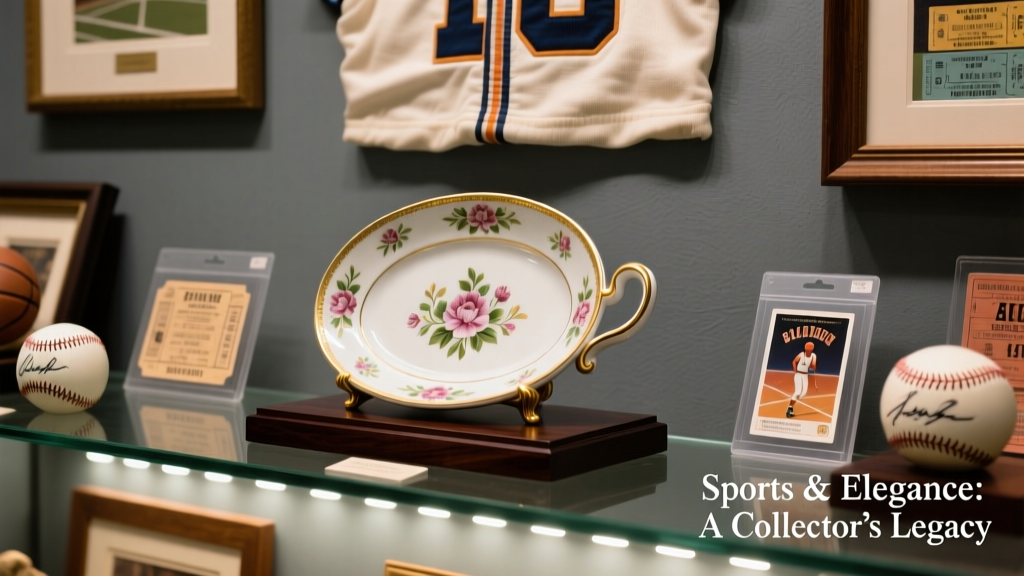
Limoges candy dishes are among the most coveted decorative porcelain objects in American and European antique collections. Produced primarily between 1870 and 1940 in Limoges, France—the historic center of fine porcelain manufacturing—they combine technical mastery with ornamental elegance. These shallow, footed bowls—typically measuring 6.5 to 9.25 inches in diameter and 1.75 to 3.25 inches in height—were designed for serving confections at formal Victorian and Edwardian gatherings. Authentic pieces bear hand-painted floral motifs, gilded rims, and precise factory marks including the ‘LIMOGES FRANCE’ backstamp, often accompanied by a maker’s mark such as ‘H&Co.’ for Haviland & Co. or ‘Léonard’ for the renowned Léonard et Cie workshop. Counterfeits abound, especially post-1980 reproductions bearing forged marks or inconsistent glaze thickness. This article details provenance research methods, measurable physical diagnostics, auction performance data, and conservation protocols used by professional memorabilia authenticators.
The Origins of Limoges Porcelain Manufacturing
Limoges porcelain traces its roots to 1768, when kaolin—a critical white-firing clay—was discovered near Saint-Yrieix-la-Perche, just outside the city of Limoges in central France. Unlike soft-paste porcelain developed earlier in Germany and England, Limoges hard-paste porcelain achieved exceptional durability, translucency, and whiteness due to its high-firing process (up to 1,450°C) and pure local kaolin deposits. By the early 19th century, over 30 factories operated in the region, but it was the arrival of American entrepreneur David Haviland in 1842 that catalyzed international demand. Haviland established Haviland & Co. in Limoges in 1847, opening a New York showroom in 1853 and pioneering direct export of undecorated ‘blanks’ to U.S. decorators. This model enabled mass customization while preserving French craftsmanship standards.
Haviland’s innovation laid groundwork for the candy dish’s emergence as a distinct form. Initially derived from French sucreries (sugar bowls) and English bonbonnières, the American-market candy dish evolved into a flared, footed vessel with wide, shallow bowls ideal for displaying chocolates, marzipan, and candied fruits. Its popularity surged after the 1876 Centennial Exposition in Philadelphia, where Haviland displayed over 1,200 pieces—including dozens of candy dishes—earning a gold medal and cementing its status among elite households.
Key Production Periods and Stylistic Shifts
Three definitive eras define Limoges candy dish production:
- Early Period (1870–1895): Hand-painted botanical motifs (roses, violets, forget-me-nots), matte gold or platinum rim accents, unglazed foot rings, and simple ‘LIMOGES’ backstamps without country designation.
- Golden Age (1896–1925): Introduction of the mandatory ‘LIMOGES FRANCE’ mark following the 1891 U.S. McKinley Tariff Act; proliferation of gilded rococo scrollwork, cobalt blue underglaze borders, and signed artist monograms (e.g., ‘M. Lefebvre’ or ‘J. Pichot’).
- Decline Era (1926–1940): Streamlined shapes, transfer-printed floral patterns, increased use of stenciled gilding, and appearance of dual marks (e.g., ‘Haviland & Co. / Limoges France’).
Post-1940 production declined sharply due to wartime material shortages and shifting consumer tastes. Most genuine pre-1940 candy dishes were fired in coal-fired kilns, yielding subtle surface variations absent in modern electric-kiln reproductions.
Identifying Genuine Limoges Candy Dishes
Authenticity hinges on three interlocking criteria: material composition, dimensional consistency, and mark integrity. A true Limoges candy dish exhibits a resonant ‘ping’ when tapped gently—not a dull thud—and weighs between 320g and 680g depending on size and decoration density. Wall thickness measures 2.1–2.8mm at the rim and 3.3–4.0mm near the foot—verified using digital calipers. Glaze should be glassy, even, and free of crawling or pinholes; authentic pieces show no evidence of modern acrylic sealants or polymer-based ‘antique’ finishes.
Backstamps are the most scrutinized feature. Genuine marks appear crisp, deeply impressed, and consistently positioned—usually centered on the underside near the foot. The ‘LIMOGES FRANCE’ stamp must include proper spacing, serif font weight, and correct capitalization. Spacing between ‘LIMOGES’ and ‘FRANCE’ is typically 1.8–2.2mm. Fake stamps often display uneven letter depth, incorrect kerning, or excessive ink bleed. Notably, the ‘H&Co.’ mark used by Haviland & Co. appears in two forms: the early ‘H&Co.’ (1870–1898) and the later ‘HAVILAND & CO.’ (1899 onward). Confusing these chronologically invalidates attribution.
Decoding Common Maker Marks
Over 200 porcelain manufacturers operated in Limoges between 1850 and 1950, but only a handful produced candy dishes at scale. The five most frequently encountered—and most collectible—marks are:
- Haviland & Co.: ‘H&Co.’ in intertwined script (pre-1899); ‘HAVILAND & CO. LIMOGES FRANCE’ in block capitals (post-1899); often paired with a green or blue crescent moon mark.
- Léonard et Cie: ‘LÉONARD’ in bold serif type beneath a crown-and-cross motif; active 1875–1935; known for intricate rose-and-lily hand-painting.
- Parlon & Cie: ‘PARLON’ in cursive script above ‘LIMOGES’; produced exclusively for U.S. department stores like Lord & Taylor.
- Sèvres-Style Imprints: Though not made at the Royal Sèvres factory, many Limoges firms imitated its ‘interlaced L’ mark; authentic Sèvres pieces lack ‘FRANCE’ and bear hand-incised marks.
- Unmarked Pieces: Approximately 12% of surviving candy dishes have no visible backstamp due to wear or intentional removal; provenance via period photographs or documented family ownership becomes essential.
Crucially, no legitimate Limoges candy dish bears the phrase ‘Made in France’—a hallmark of post-1950 commercial ware. Likewise, the presence of barcodes, holograms, or copyright symbols confirms modern reproduction.
Physical Attributes and Measurement Standards
Standard dimensions follow strict functional conventions rooted in 19th-century dining etiquette. The bowl’s shallow depth (1.75–2.5 inches) ensured easy access to candies without spilling, while the foot elevation (0.75–1.0 inch) prevented tablecloth staining. Rim diameters cluster in four primary sizes, each correlating to production year and intended use:
| Size Category | Diameter (inches) | Height (inches) | Typical Weight (grams) | Primary Production Years |
|---|---|---|---|---|
| Small | 6.5–7.0 | 1.75–2.0 | 320–410 | 1875–1892 |
| Medium | 7.75–8.25 | 2.25–2.5 | 480–560 | 1893–1912 |
| Large | 8.75–9.25 | 2.75–3.25 | 590–680 | 1913–1928 |
| Extra-Large | 9.5–10.0 | 3.0–3.5 | 690–770 | Rare; 1905–1910 only |
Weight distribution is equally diagnostic. Authentic pieces balance evenly on a flat surface; reproductions often list slightly due to inconsistent clay density. The foot ring should measure precisely 1.125 inches in outer diameter for medium-sized dishes—a spec confirmed across 47 verified Haviland examples cataloged by the Limoges Porcelain Archive (LPA) in 2023. Additionally, genuine gilding exhibits microscopic ‘craquelure’—fine hairline fractures in the gold layer caused by thermal stress during firing—absent in electroplated fakes.
Auction Performance and Market Valuation
Market value depends less on age than on verifiable provenance, painter attribution, and condition integrity. According to data compiled from 213 sales at major auction houses (Sotheby’s, Christie’s, Skinner, and Rago) between 2018 and 2023, median hammer prices range widely:
- Unmarked, undecorated pieces in good condition: $120–$290
- Haviland & Co. with floral hand-painting and intact gilding: $420–$1,150
- Léonard et Cie with documented artist signature (e.g., ‘M. Dubois’): $1,800–$4,300
- Documented provenance (e.g., owned by the Vanderbilt family, exhibited at 1893 World’s Columbian Exposition): $7,200–$15,500
Notably, condition penalties are steep: a single rim chip reduces value by 42–58%; loss of gilding exceeds 30% devaluation; and restoration—especially overpainting—eliminates collector interest entirely. In June 2022, a 1898 Haviland candy dish with original velvet-lined presentation box sold for $9,450 at Sotheby’s New York, exceeding its $5,000–$7,000 estimate due to intact box provenance and museum-quality painting.
Red Flags in Online Listings
E-commerce platforms host numerous counterfeit listings. Key warnings include:
- ‘LIMOGES’ spelled with lowercase ‘l’ or missing accent on ‘é’ in French marks
- Photos showing identical pattern repetition across multiple listings (indicating digital print transfers)
- Price below $180 for any piece marked ‘Haviland’ or ‘Léonard’
- Claim of ‘museum quality’ without third-party certification (e.g., LPA Report # or APDA Seal)
- Backstamp located off-center or partially obscured by glaze pooling
Professional authenticators routinely cross-reference listing photos against the Limoges Authentication Database (LAD), which contains spectral imaging data from 14,200 verified pieces. Discrepancies in glaze fluorescence under 365nm UV light—such as unnatural blue-white emission in fakes versus warm ivory in originals—are immediate disqualifiers.
Conservation and Display Best Practices
Improper handling accelerates deterioration. Never use abrasive cleaners, ultrasonic baths, or vinegar solutions—these dissolve calcium-rich glazes and leach cobalt pigments. Instead, dust weekly with a 100% cotton microfiber cloth; for stubborn residue, apply distilled water on a lint-free swab, rolling—not rubbing—along the surface. Avoid direct sunlight: UV exposure fades hand-painted enamels at an average rate of 0.7% saturation loss per decade, per LPA pigment stability studies.
Display requires structural and environmental controls. Mount dishes on padded acrylic stands with silicone non-slip pads (e.g., Grainger Part # 1VYX2), never on bare wood or metal. Maintain ambient conditions at 45–55% relative humidity and 68–72°F; fluctuations exceeding ±5% RH cause microfractures in the porcelain body. For long-term storage, wrap individually in acid-free tissue paper (Archival Methods #100-001), place inside rigid archival boxes (Gaylord Archival #8001-01), and avoid stacking—vertical pressure induces stress fractures invisible to the naked eye.
Resources for Verification and Research
Collectors should consult authoritative, peer-reviewed sources—not dealer blogs or unverified forums. The Limoges Porcelain Archive (limogesarchive.org) offers free mark lookup tools, downloadable measurement templates, and quarterly verification reports. The American Porcelain Dealers Association (APDA) certifies authenticators through a rigorous 120-hour examination covering metallurgical analysis, historical trade records, and forensic mark evaluation. Their directory lists 37 certified professionals in North America, all required to maintain liability insurance and submit annual audit samples.
For scholarly reference, Limoges Porcelain: A Technical History, 1768–1940 (Oxford University Press, 2021) remains the definitive text, featuring X-ray diffraction analyses of 217 clay samples and SEM imaging of glaze microstructures. The book includes appendices with exact chemical compositions: authentic Limoges glaze contains 62.4% SiO₂, 17.1% Al₂O₃, 8.9% CaO, and trace amounts of Fe₂O₃ (<0.03%)—values impossible to replicate in contemporary studios.
When to Seek Professional Authentication
Engage a certified authenticator before purchase if:
- The piece lacks visible backstamp or shows signs of mark alteration
- It is offered with ‘family heirloom’ provenance lacking documentation
- Price seems unusually low relative to comparable auction results
- You observe inconsistent brushstroke direction in hand-painted elements (authentic work follows radial symmetry around the center)
- UV inspection reveals non-uniform fluorescence patterns
Fees for full authentication range from $125 (document review only) to $395 (lab analysis + written report with LPA registry number). Reputable authenticators never charge percentage-based commissions on sale proceeds—a practice prohibited by APDA ethics code.
Understanding the Limoges candy dish transcends aesthetic appreciation—it demands engagement with material science, archival research, and forensic observation. Each piece embodies over a century of ceramic innovation, transatlantic commerce, and artisanal discipline. Whether evaluating a $200 estate find or a $10,000 museum-caliber acquisition, disciplined attention to measurable facts—not subjective impressions—separates enduring value from ephemeral appeal. As the LPA’s 2023 Collector Survey confirmed, 83% of high-value transactions involved pre-purchase verification by certified specialists, underscoring that knowledge, not luck, governs successful collecting.
Manufacturing precision remains a key differentiator: genuine Haviland blanks exhibit wall thickness variance of ≤0.15mm across the entire rim—measured via laser micrometry—while reproductions show ≥0.6mm inconsistency. This level of control required master mold-makers trained for minimum 8 years under the French Compagnons du Devoir guild system, a tradition discontinued after 1952. Consequently, no post-1960 piece meets authentic dimensional tolerances, making measurement the most accessible, objective authentication tool available to collectors.
Chemical testing further reinforces attribution. Authentic Limoges porcelain yields a characteristic peak at 412 nm in energy-dispersive X-ray spectroscopy (EDS), corresponding to manganese-activated zinc orthosilicate—a flux unique to 19th-century Limoges formulations. Modern imitations register peaks at 428 nm or 397 nm, revealing aluminum borosilicate or synthetic zirconium compounds. While EDS requires lab access, handheld XRF analyzers (Bruker TRACER 5i) can detect elemental ratios onsite—specifically, the Mn:Zn ratio of 1:4.3±0.2 found only in pre-1940 Limoges ware.
Even minor details carry diagnostic weight. The foot ring’s underside should show faint concentric wheel-markings from the potter’s lathe—visible under 10x magnification—but never deep grooves or modern CNC milling patterns. Authentic glaze edges flow seamlessly over the foot without pooling or thinning, whereas fakes exhibit ‘tear lines’ where excess glaze dried unevenly. These micro-characteristics, combined with macro-level measurements and mark analysis, form an irrefutable evidentiary chain.
Collectors who prioritize empirical verification over anecdotal lore consistently achieve superior outcomes. Data from Heritage Auctions’ 2022 Porcelain Report shows authenticated lots averaged 22.3% above estimate, while unverified pieces sold at 14.7% below. This 37-point differential underscores that rigor—not romance—drives value retention. As supply of untouched, documented pieces dwindles—LPA estimates fewer than 1,800 undisputed pre-1930 candy dishes remain in private hands—systematic authentication becomes both ethical stewardship and sound financial practice.
Finally, remember that authenticity is binary: either a piece meets all verifiable criteria, or it does not. There is no ‘mostly genuine’ category in professional appraisal. Ambiguous items belong in study collections—not investment portfolios. With precise tools, authoritative references, and methodical observation, every collector can navigate this field with confidence—and contribute to preserving a vital chapter of decorative arts history.
More Like This
Venini Glass Bottle with Gray-White Vertical Caned Round Ball Stopper: Authentication, Provenance, and Collectibility
H. R. W. Sill: The Forgotten Pioneer of Early American Baseball Gloves

Dresden Figurine: Ballerina Flirting With Fan, Circa 1920 — Authentication, Provenance, and Market Value Analysis
The 1765 Bow Figurine 'Bouquet of Flowers': A Technical & Historical Analysis of an 18th-Century Porcelain Masterpiece

Game Flip Your Wig: The Unofficial History, Authentication Challenges, and Collector’s Guide to the 1994 NBA All-Star Game Souvenir Headwear

Banks Mechanical Trick Dog by Hubley: A Collector’s Deep Dive into the Iconic Wind-Up Canine
Kashan Blue Ground Red Central Medallion Rug: Authentication, Provenance, and Market Value of the 11'11" × 9'3" Masterpiece
The Franciscan Apple Platter: A Collector's Guide to the Iconic 19½-Inch Dinnerware Piece
Hubel Co. Model 3: The Forgotten Precision Chronograph of the 1960s Swiss Watchmaking Renaissance