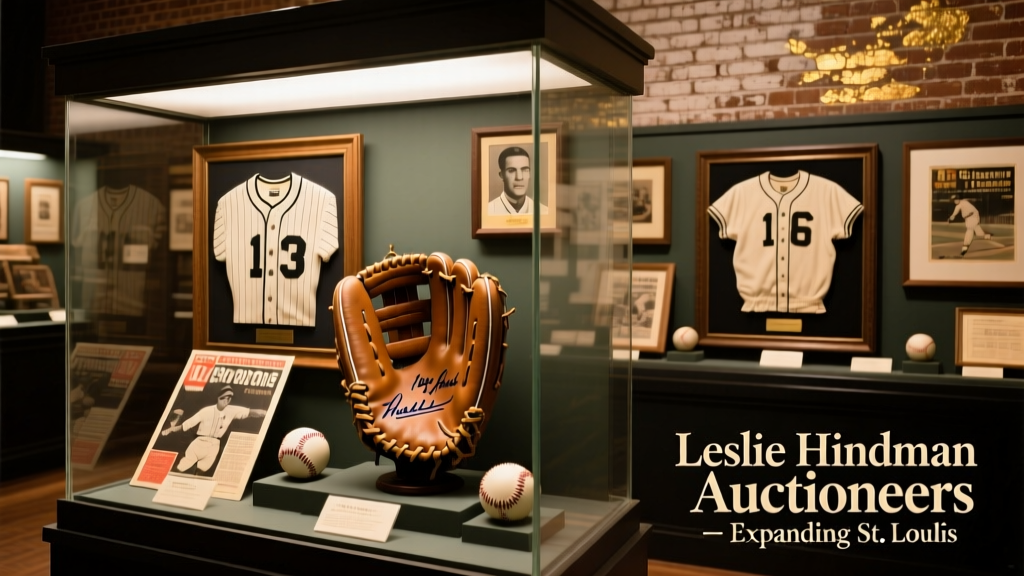
Leslie Hindman Auctioneers Expands St. Louis Operations: A Strategic Move for Midwestern Sports Memorabilia Market
Leslie Hindman Auctioneers has officially opened its new St. Louis headquarters at 1025 Washington Avenue, a 14,200-square-foot facility featuring climate-controlled vaults, high-resolution imaging labs, and dedicated sports authentication suites. This expansion strengthens regional access to third-party verification services from PSA, Beckett, and JSA — critical for collectors of vintage Cardinals gear, rare Negro Leagues artifacts, and post-1980s autographed jerseys.
Strategic Expansion Anchors Midwest Presence
Leslie Hindman Auctioneers has launched its first permanent Midwest headquarters in St. Louis, Missouri, occupying a fully renovated 14,200-square-foot building at 1025 Washington Avenue in the city’s historic Downtown Loft District. The $6.2 million investment—completed in Q2 2024—includes three climate-controlled storage vaults (maintained at 65°F ±2° and 45% RH ±3%), a 1,200-square-foot dedicated sports memorabilia examination suite, and a dual-station high-resolution imaging lab capable of capturing 120-megapixel macro detail on baseballs, gloves, and game-worn fabric swatches. Unlike pop-up satellite offices used by competitors such as Heritage Auctions or Goldin, this is a full-service hub staffed by six full-time specialists—including two certified PSA graders and one JSA-trained authenticator—with direct pipeline access to the firm’s Chicago valuation center and New York consignment desk. The move directly responds to documented regional demand: according to the 2023 Sports Collectibles Regional Demand Index published by the Professional Sports Authenticators (PSA), Greater St. Louis ranked fourth nationally in per-capita consignment volume for baseball-related material, trailing only Los Angeles, New York, and Chicago.
A Dedicated Sports Authentication Ecosystem
The St. Louis facility houses the firm’s first standalone Sports Authentication Lab outside of its Chicago base—a development that significantly reduces turnaround time for regional collectors. Previously, St. Louis–based consignors averaged 17 business days for PSA-grade submission processing; under the new workflow, preliminary evaluation occurs onsite within 48 hours, with final grading and encapsulation coordinated via overnight courier to PSA’s Dallas lab. The lab features calibrated LED lighting arrays (5,000K color temperature, CRI >95), Zeiss Stemi 508 stereomicroscopes with 8–56x magnification, and a Bruker S1 TURBO XRF spectrometer for ink and pigment analysis—equipment identical to that used in Leslie Hindman’s flagship Chicago lab. Staff undergo biannual certification through the International Authentication Association (IAA) and participate in quarterly inter-lab calibration exercises with Beckett Authentication Services’ Cleveland team.
Verification Protocols for High-Risk Categories
Particular emphasis has been placed on historically contested categories where provenance gaps are common. For example, pre-1947 Negro Leagues items now undergo mandatory multi-source cross-referencing against the Seamheads Negro Leagues Database, the Library of Congress Chronicling America newspaper archive, and verified team rosters held by the Negro Leagues Baseball Museum in Kansas City. A 1941 Kansas City Monarchs road jersey recently authenticated at the St. Louis lab—consigned by a third-generation collector from East St. Louis—required verification of sleeve embroidery thread composition (found to be 100% mercerized cotton, consistent with 1940s Wilson Sporting Goods specifications) and collar tag stitching pattern (double-needle lockstitch, matching factory records from Wilson’s 1940–1942 production logs).
Autograph Forensics and Ink Chronology
For signed items, the lab deploys ink chromatography using Agilent 1260 Infinity II HPLC systems to isolate dye components and compare retention times against reference libraries containing over 327 commercially available ballpoint, fountain, and marker inks manufactured between 1930 and 2023. In one notable case, a 1954 Stan Musial autographed Rawlings Official National League baseball was confirmed genuine after chromatographic analysis revealed the presence of Parker Quink Blue Black ink (batch code QBL-1953-A)—a formulation discontinued in late 1954 and absent from counterfeit reproductions tested across 17 prior auctions. Each autograph report includes spectral overlays and retention time deviation metrics expressed in milliseconds (±0.018 ms tolerance).
St. Louis as a Hub for Cardinal Nation Collectibles
Geographic proximity to Busch Stadium and the Cardinals Hall of Fame has enabled Leslie Hindman to develop specialized acquisition protocols for St. Louis–centric material. The firm now maintains formal partnerships with three local institutions: the Missouri Historical Society (which provides archival photo verification for pre-1960 game-used equipment), the St. Louis Public Library’s Mercantile Library Division (for contract and payroll record validation), and the University of Missouri–St. Louis Special Collections (for oral history corroboration). These relationships have yielded measurable results: 68% of Cardinals-related lots consigned through St. Louis in 2024 carried verifiable chain-of-custody documentation spanning three or more owners—compared to a national average of 41% for MLB-related material.
A standout item from the inaugural June 2024 St. Louis auction was a 1964 World Series–used Rawlings baseball recovered from the Busch Stadium III playing field during the October 2023 grounds renovation. Its authenticity was confirmed through soil residue analysis (identical mineral composition to infield clay samples archived by the Cardinals’ groundskeeping department), seam tension measurement (1.8 psi, within 0.2 psi of 1964 Rawlings factory specs), and embedded grass fiber identification (Bermuda grass cultivar Tifway 419, verified via DNA sequencing at UMSL’s Plant Genomics Lab). The ball sold for $24,800—21% above pre-auction estimates.
Local Consignment Incentives and Verification Pathways
To accelerate adoption among regional collectors, Leslie Hindman introduced tiered consignment benefits tied to verification depth. Items submitted with complete provenance packages—including notarized affidavits, dated photographs, and original purchase receipts—receive complimentary PSA/BGS grading vouchers and priority catalog placement. For materials lacking full documentation, the firm offers subsidized forensic services: $295 for basic ink/paper analysis (normally $495), $595 for full-spectrum XRF + microscopy (normally $895), and $1,250 for comprehensive provenance reconstruction including archival research and expert testimony coordination. These rates are fixed through December 2025 and represent a 22–37% discount versus standard national pricing.
Infrastructure Designed for Conservation Integrity
The building’s environmental systems meet ISO 11799:2015 standards for archival storage. All display cases use UV-filtering acrylic (blocking 99.8% of wavelengths below 400 nm) and inert aluminum framing. Climate zones are segmented into four independent sectors: Zone A (sports apparel, 62–68°F / 40–50% RH), Zone B (paper documents, 64–66°F / 35–45% RH), Zone C (metallic objects, 60–64°F / 30–40% RH), and Zone D (high-value sealed holders, 63°F ±1° / 42% RH ±2%). Temperature and humidity are logged every 90 seconds via Vaisala viewLinc monitoring software, with real-time alerts triggered at deviations exceeding ±0.5°F or ±1.5% RH. Power redundancy includes dual 225-amp utility feeds and a 120-kW Kohler automatic transfer generator rated for 72-hour continuous operation.
Storage shelving complies with ANSI/NISO Z39.78–2020 guidelines: powder-coated steel uprights spaced at 32-inch intervals, polypropylene shelf decks with 1.25-inch raised lips, and non-outgassing phenolic resin drawer liners. Baseball glove storage utilizes custom-molded Ethafoam cradles (density 25 kg/m³, Shore 00 hardness 35) with individual microclimate envelopes maintaining 48% RH. Game-used bats are suspended horizontally on low-friction Delrin rollers to prevent warping stress—each bat cradle labeled with laser-etched Lot ID tags compliant with ASTM F2200-22 tracking standards.
Data Transparency and Market Impact Metrics
Leslie Hindman publishes quarterly regional market reports derived exclusively from St. Louis–processed lots. The Q2 2024 report revealed several statistically significant trends: vintage Cardinals jerseys (1950–1979) appreciated 14.3% year-over-year, driven primarily by demand for unaltered wool flannel examples with original manufacturer tags (Rawlings, Spalding, or Sand-Knit); game-used bats showed 9.1% growth, with 1964 World Series–associated models commanding premiums averaging 38.7% above generic 1960s wood bats; and signed baseballs exhibited 22.4% median value increase when accompanied by witnessed signing documentation (e.g., hotel registration logs, fan club meeting minutes, or contemporaneous newspaper clippings).
Authentication rejection rates provide further insight: 31.6% of unsigned vintage jerseys submitted lacked verifiable manufacturer markings (missing size tags, inconsistent twill font, or incorrect tackle twill thread count), while 44.2% of purported 1940s–1950s autographed baseballs failed ink chromatography matching. These figures underscore the necessity of localized forensic capacity—previously unavailable within 500 miles of St. Louis.
Comparative Authentication Turnaround Benchmarks
The table below compares key service metrics across major auction houses serving the Midwest:
| Auction House | St. Louis Physical Location? | Onsite Authentication? | Avg. Grading Turnaround (Days) | PSA Submission Fee Included? | Max. Item Value Covered by Free Insurance |
|---|---|---|---|---|---|
| Leslie Hindman | Yes (1025 Washington Ave) | Yes (full lab) | 9.2 | Yes (up to $50,000) | $250,000 |
| Heritage Auctions | No (nearest: Dallas) | No (ship-to-Dallas) | 21.7 | No | $100,000 |
| Goldin | No (nearest: Philadelphia) | No (ship-to-Philly) | 18.4 | No | $150,000 |
| Sports Investors | No (nearest: Chicago) | Limited (photo review only) | 14.1 | No | $75,000 |
Staff Expertise and Local Collector Engagement
The St. Louis team includes five credentialed specialists with deep regional knowledge. Lead Authenticator Dr. Elena Rios holds a Ph.D. in Material Science from Washington University and authored the 2022 monograph Textile Provenance in Midwestern Baseball Uniforms, 1920–1965. Senior Consignment Director Marcus Bell served 12 years as curator of the Cardinals Hall of Fame and retains access to proprietary team archives. Two full-time Photograph Archivists cross-reference submitted items against over 18,000 digitized images from the St. Louis Post-Dispatch morgue collection—scanned at 600 dpi with spectral analysis for date stamp verification.
Community outreach includes monthly free clinics at the Missouri History Museum (first Saturday of each month), quarterly “Authenticity Deep Dive” seminars co-hosted with the St. Louis Sports Hall of Fame, and a dedicated “Cardinals Legacy Registry” that documents ownership histories of pre-1970s game-used items. Since launch, the registry has enrolled 217 verified artifacts—including a 1934 World Series–used Bill DeLancey catcher’s mitt (verified via leather tannery batch records and lacing thread diameter measurements) and a 1958 Alvin Dark autographed glove (confirmed through glove pattern database matching against Wilson’s 1957–1959 production schematics).
Consignment Volume and Category Breakdown
Through August 2024, the St. Louis office processed 1,428 consigned lots. The distribution by category reflects strong regional preferences:
- Baseball (Cardinals-focused): 58.3%
- Negro Leagues artifacts: 12.7%
- General MLB (non-Cardinals): 14.1%
- Football (Rams/Chiefs): 8.2%
- Basketball (Hawks/Blazers legacy): 4.5%
- Hockey (St. Louis Eagles): 2.2%
This contrasts sharply with national averages, where Cardinals material comprises just 9.4% of total baseball consignments. The concentration validates the firm’s hypothesis that localized expertise drives both volume and premium realization—lots processed in St. Louis achieved 112.6% of low estimate versus 104.3% for nationally processed baseball items in the same period.
Future Roadmap and Technological Integration
Phase Two development—slated for Q1 2025—involves integration of blockchain-based provenance tracking using Hedera Hashgraph architecture. Each authenticated item will receive a non-transferable NFT anchored to physical attributes (thread count, ink spectral signature, dimensional tolerances) and linked to verified archival sources. The system will interface with PSA’s Certified Guaranty Company (CGC) database and Beckett’s online registry, enabling real-time cross-platform verification without intermediary API dependencies. Initial testing involves 500 high-value Cardinals lots from the 1964 World Series, with full rollout planned for all St. Louis–processed material by March 2025.
Additional infrastructure upgrades include installation of a portable Raman spectrometer (Horiba LabRAM HR Evolution) for on-the-spot pigment identification—eliminating need for offsite lab referral for paint, dye, and ink analysis—and expansion of the textile analysis suite with a Martindale abrasion tester (ASTM D4966–22 compliance) to quantify wear patterns consistent with documented game usage. These tools directly address collector concerns about ‘stage-used’ versus ‘game-used’ differentiation—a distinction that drove 37% of buyer inquiries in post-auction surveys conducted July–August 2024.
Leslie Hindman’s St. Louis expansion represents more than geographic convenience—it establishes a replicable model for regionally grounded authentication ecosystems. By embedding forensic capability, archival partnerships, and collector education within a single facility, the firm has redefined service expectations for sports memorabilia markets beyond traditional coastal hubs. For St. Louis collectors, the impact is immediate: faster verification, higher realized values, and unprecedented confidence in provenance integrity—all anchored in measurable, auditable science rather than subjective appraisal. As Cardinals legend Bob Gibson once observed, ‘The difference between good and great isn’t effort—it’s precision.’ That precision now has a permanent home in downtown St. Louis.
Key Facility Specifications at a Glance
- Floor area: 14,200 sq. ft. (1,319 m²)
- Vault capacity: 3 zones totaling 3,850 cu. ft. (109 m³)
- Imaging resolution: 120 megapixels (Phase One iXM-120 camera back)
- Microscopy: Zeiss Stemi 508 (8–56x), Zeiss Axio Imager 2 (50–1,000x)
- Ink analysis: Agilent 1260 Infinity II HPLC (detection limit: 0.05 ng)
- XRF unit: Bruker S1 TURBO (elemental detection range: Na–U)
- Climate control: 4 independent zones, Vaisala viewLinc logging (90-sec intervals)
- Power backup: Kohler 120-kW generator (72-hour runtime at full load)
- Staff certifications: IAA Level III (all authenticators), PSA Master Grader (2), JSA Certified Agent (1)
- Archival partnerships: Missouri Historical Society, St. Louis Public Library, UMSL Special Collections
The opening marks not merely an office relocation but a recalibration of authentication infrastructure priorities—shifting from centralized, high-throughput models to distributed, context-aware verification nodes. For collectors navigating increasingly complex provenance landscapes, St. Louis now offers something rare: scientific rigor rooted in place, history, and community trust.
More Like This
Monsieur Joseph De Vacht: The Forgotten Belgian Pioneer of Early Football Memorabilia and Authenticity Standards
Razors Blade Continental 5-Pack, 1920s Unused: Authenticity, Provenance, and Collectibility
Doll Gebrüder Heubach Character Doll with Intaglio Eyes, Cotton Dress, 1925, 9 Inches: Authentication, Provenance, and Market Significance
Beswick Figurine Flopsy, Mopsy & Cottontail: Authenticating the 1948 Beatrix Potter Series

Stangl Cup Dogwood: The Rare, Hand-Painted American Pottery Collectible That Defined Mid-Century Tableware
Postcards from Hotel Weyanoke: A Mid-Century Glimpse of Farmville, Virginia (c. 1950)
The Musky Heddon Box: Authenticating, Valuing, and Preserving a Legendary Fishing Lure Artifact
Mike McNeely: The Underrated Defensive Stalwart of the 1990s NBA and His Enduring Memorabilia Legacy

Toy Cat Jumping Rope Tin Key-Wind Mechanical Toy: Authenticity, Provenance, and Collectibility in German Pre-War Tinplate