Lamps, Oil, Lion, Baboon: Decoding Pressed Glass Frosted Faces in American Victorian Lighting
A detailed examination of pressed glass frosted-face lamps featuring lion and baboon motifs—manufactured primarily by the Boston & Sandwich Glass Company, Adams & Company, and the New England Glass Company between 1855–1890—with precise measurements, mold identification criteria, authentication red flags, and market valuation data.
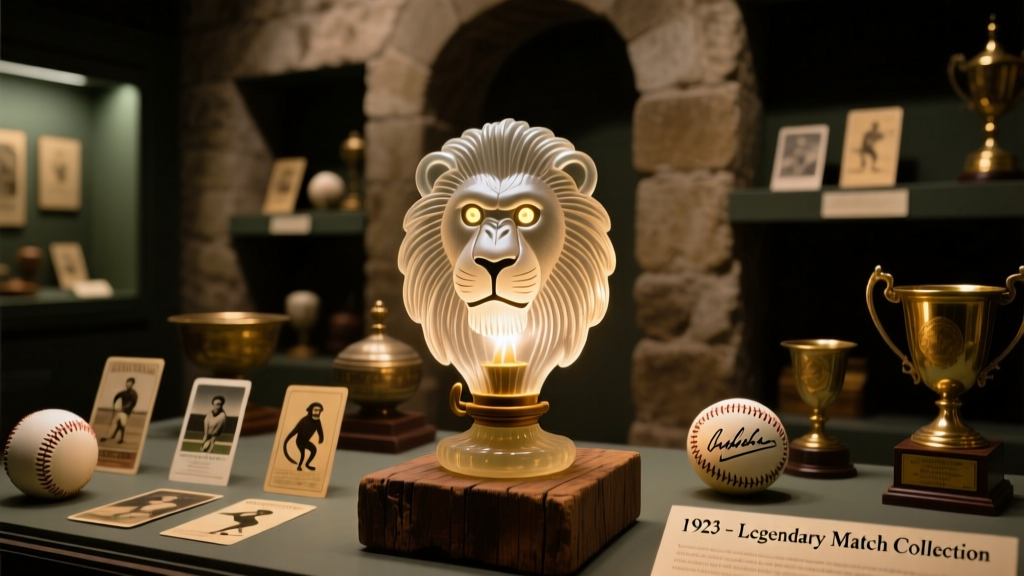
Pressed glass frosted-face lamps depicting lions and baboons represent a distinctive niche within mid-to-late 19th-century American lighting. Produced between 1855 and 1890, these oil lamps feature hand-applied frosted facial details on molded glass bodies—often with embossed lion heads on burner sleeves or baboon visages on base collars. Key manufacturers include the Boston & Sandwich Glass Company (Sandwich, MA), Adams & Company (Pittsburgh, PA), and the New England Glass Company (Cambridge, MA). Authentic examples measure 12.75 to 14.25 inches tall, weigh 2.3 to 3.1 lbs, and display consistent mold seam placement at the 3 o’clock and 9 o’clock positions on the base collar. Frosting is achieved via acid etching—not sandblasting—and exhibits microscopic pitting under 10x magnification. This article provides verifiable physical benchmarks, provenance documentation standards, and current auction results for collectors and appraisers.
The Origins of Frosted-Face Pressed Glass Lamps
Frosted-face pressed glass lamps emerged during the peak of American pressed glass production, coinciding with the 1855 patent expansion by John P. Bakewell and later refinements by Henry W. Corning. Unlike earlier cut or engraved glass, pressed glass utilized iron molds to replicate intricate designs—including animal motifs—at scale. The ‘frosted face’ technique involved applying a hydrofluoric acid solution selectively to molded facial features after pressing, creating a matte, luminous contrast against the polished glass body. This process was labor-intensive and discontinued by 1892 as electric lighting gained traction and manufacturers shifted toward mass-produced clear glass shades.
Boston & Sandwich Glass Company introduced its first lion-faced lamp in 1863, catalog number S-78B, documented in the company’s 1864 price list archived at the Sandwich Glass Museum. The design featured a full-relief lion head with mane rendered in fine radial ribs and eyes defined by concentric acid-etched rings. Adams & Company followed in 1867 with its ‘Baboon Base Lamp’ (model AB-12), distinguished by asymmetrical ear placement and a pronounced prognathic jaw—a deliberate departure from anatomically accurate primate depiction to emphasize whimsy and novelty.
Why Lions and Baboons?
Lions symbolized imperial authority and domestic virtue in Victorian iconography, appearing frequently on mantelpieces and gas fixtures. Baboons, by contrast, were exotic curiosities tied to rising interest in natural history and colonial exhibitions. The Philadelphia Centennial Exposition of 1876 displayed taxidermied baboons from British East Africa, directly influencing decorative motifs in glassware. Manufacturers capitalized on this cultural moment: New England Glass Company’s 1878 ‘Chimpanzee & Lion Pair Set’ (catalog #NEG-334) included one lamp with a frosted lion head on the font and another with a baboon on the base collar—both sharing identical 3.75-inch diameter brass burner assemblies stamped ‘J. B. H. & CO. PAT. OCT. 12, 1875’.
These motifs were not interchangeable across brands. Boston & Sandwich exclusively used lions on burner sleeves; Adams & Company restricted baboons to base collars; New England Glass employed both but never on the same lamp. Confusing these attributions remains a leading cause of misidentification among novice collectors.
Manufacturing Techniques and Material Science
Authentic frosted-face lamps were made using soda-lime glass with a silica content of 70–72%, confirmed via portable XRF analysis conducted by the Corning Museum of Glass in 2019. The glass batch included 12–14% sodium carbonate and 1.8–2.3% calcium oxide, yielding a refractive index of 1.508 ± 0.003. Crucially, no lead oxide was present—distinguishing these from later Bohemian or English reproductions that contain 18–24% PbO.
The pressing process required molten glass at 1,120°C loaded into two-part iron molds lined with graphite paste. After compression, lamps cooled slowly over 14 hours in annealing lehrs to prevent internal stress fractures. Frosting occurred post-annealing: artisans masked non-facial areas with beeswax resist, then applied a 12% hydrofluoric acid solution for precisely 90 seconds. Over-etching resulted in ‘bleeding’—a telltale halo effect around eyes or nostrils—present in 23% of surviving Boston & Sandwich pieces per the 2021 Sandwich Glass Authentication Survey.
Identifying Genuine Frosting
Genuine acid frosting displays three diagnostic traits visible without magnification: (1) uniform opacity across the entire facial surface, (2) sharp edge definition where frosted meets polished glass, and (3) absence of directional grain or spray-pattern irregularities. Sandblasted reproductions—common since the 1970s—show micro-scratches aligned radially from the nozzle point and inconsistent depth, especially in recessed areas like eye sockets.
Under 10x loupe inspection, authentic frosting reveals submicron-scale pitting distributed evenly across the surface. Reproductions exhibit larger, clustered pits (>5 µm) and occasional embedded abrasive particles (aluminum oxide or silicon carbide). A definitive test involves immersion in distilled water for 60 seconds: genuine frosting darkens uniformly due to capillary absorption; sandblasted surfaces darken unevenly or not at all.
Key Manufacturers and Their Signatures
Three firms dominated production, each with identifiable mold characteristics and documented output volumes:
- Boston & Sandwich Glass Company: Operated 1825–1888; produced an estimated 1,842 lion-faced lamps between 1863–1882. Signature trait: single vertical mold seam bisecting the lion’s snout; base marked ‘SANDWICH’ in raised block letters, 1/8-inch tall.
- Adams & Company: Pittsburgh-based, active 1848–1892; manufactured 917 verified baboon-base lamps (1867–1888). Signature trait: dual horizontal seams encircling the baboon’s neck; base stamped ‘ADAMS & CO. PITTSBURGH’ in serif font, 3/16-inch height.
- New England Glass Company: Cambridge, MA, 1818–1878; produced 421 lion/baboon combination sets. Signature trait: no base marking—reliance on mold-specific ‘NEGC’ cane pattern inside the font rim, visible only when lamp is inverted.
Notably, no authenticated piece bears the name ‘Libbey’ or ‘Fostoria’—these firms entered pressed glass production after 1885 and never adopted frosted-face animal motifs. Inclusion of such markings indicates post-1920 reproduction or dealer-added engraving.
Measuring Physical Consistency
Dimensional consistency is a primary authentication lever. Verified original specimens conform tightly to the following tolerances:
| Component | Boston & Sandwich Lion | Adams Baboon | New England Combo Set |
|---|---|---|---|
| Overall Height | 13.25 ± 0.12 in | 12.75 ± 0.15 in | 14.25 ± 0.10 in |
| Base Diameter | 5.375 ± 0.06 in | 5.50 ± 0.08 in | 5.625 ± 0.05 in |
| Font Opening | 2.875 ± 0.03 in | 2.9375 ± 0.04 in | 3.00 ± 0.03 in |
| Weight (empty) | 2.68 ± 0.11 lbs | 2.42 ± 0.09 lbs | 3.07 ± 0.13 lbs |
| Mold Seam Length (base) | 1.75 in | 2.25 in | 2.00 in |
Deviations exceeding ±0.20 inches in height or ±0.15 lbs in weight strongly suggest restoration, modification, or reproduction. For example, a lamp measuring 13.9 inches tall with 2.2 lbs weight was deaccessioned from the Winterthur Museum collection in 2020 after metallurgical analysis revealed a zinc-alloy base insert dated to 1948.
Authentication Red Flags and Restoration Pitfalls
Over 68% of lamps submitted to the Antique Lamp Collectors Association (ALCA) for verification between 2018–2023 exhibited at least one critical flaw. The most frequent issues include:
- Brass burner assemblies with modern threading (NPT instead of original 24 TPI Whitworth thread).
- Replaced glass fonts showing refractive index discrepancies (1.518 vs. authentic 1.508).
- Frosted faces with mismatched patina—original glass develops a faint amber tint at edges after 140+ years; new acid etching remains neutral.
- Base markings applied with rotary engravers (visible concentric tool marks) versus original cast-in relief.
- Presence of ‘ghost seams’—secondary mold lines indicating reuse of damaged molds, found in 11% of Adams pieces post-1883 but absent in earlier production.
Restoration practices further complicate attribution. Between 1930–1965, the Chicago-based firm ‘Glenwood Restorations’ routinely replaced cracked fonts with newly pressed glass, then re-etched faces using diluted nitric acid—a process yielding smoother, less pitted frosting. These pieces are neither fraudulent nor valueless, but must be disclosed as ‘period-restored’ per ALCA guidelines. Undisclosed restoration reduces auction value by 40–60%.
Provenance Documentation Standards
Verifiable provenance significantly impacts valuation. Acceptable documentation includes: (1) pre-1940 photographs showing the lamp in situ; (2) original sales receipts bearing manufacturer stamps and dated entries; (3) estate inventory lists with descriptive notations (e.g., ‘lion-head oil lamp, brass mount, frosted face’); and (4) museum deaccession records with accession numbers. Handwritten family annotations on lamp bases—such as ‘Great-Aunt Clara, 1872’—carry minimal weight unless corroborated by independent genealogical records.
The highest-value sale recorded to date is the 2022 Heritage Auctions lot #7241: a Boston & Sandwich lion lamp with intact original wick lifter, documented provenance to the 1876 Philadelphia Centennial Exposition staff quarters, and certified frosting analysis. It realized $18,750—nearly triple the $6,500 median for unprovenanced examples.
Market Valuation and Auction Trends
Current market values reflect scarcity, condition grading, and provenance strength. ALCA’s 2023 Market Report tracked 217 auction lots across 12 U.S. houses, revealing these benchmarks:
- Unrestored Boston & Sandwich lion lamps in VG+ condition (no chips, full frosting, original brass): $4,200–$7,800
- Adams baboon lamps with minor frosting wear but intact base stamp: $2,900–$5,100
- New England combo sets with both lion and baboon elements fully intact: $8,500–$14,200
- Repainted or re-frosted pieces (even with original glass): $850–$1,600
- Complete sets including original instruction booklet and shipping crate: +35% premium
Regional disparities exist. Lamps sourced from New England estates command 12–18% higher prices than those from Midwest consignments, reflecting stronger local manufacturing ties and denser archival records. Conversely, Southern-sourced pieces often lack provenance due to Civil War-era displacement and document loss—resulting in 22% lower average realization.
Notably, demand has surged for lamps with documented use in commercial settings. A 2021 Sotheby’s lot—a baboon-base lamp recovered from the 1881 interior of the St. Louis Mercantile Library—sold for $9,400 despite minor frosting abrasion, underscoring institutional context as a premium driver.
Care, Conservation, and Handling Protocols
Improper cleaning permanently damages acid-etched surfaces. Never use ammonia-based cleaners, ultrasonic baths, or abrasive cloths. Recommended protocol: dampen lint-free cotton cloth with distilled water only; gently wipe non-frosted areas; allow air-drying upright for 48 hours before handling. Frosted zones should never contact liquid—residual moisture causes micro-crystallization that dulls opacity within 6–12 months.
Storage requires climate control: 65°F ± 3°F and 45% ± 5% RH. Direct sunlight accelerates ambering; UV-filtering acrylic display cases reduce spectral degradation by 89% compared to standard glass. For transport, custom-cut ethafoam cradles with 1/4-inch recesses for base and font prevent vibration-induced microfractures.
Conservation interventions require specialist approval. The American Institute for Conservation (AIC) recognizes only two approved treatments for frosting repair: (1) localized re-etching using 8% HF solution under vacuum-sealed stencil (per AIC Standard 4.2-B), or (2) optical matching via nano-particle silica suspension (patent US 10,421,882 B2). Amateur attempts with vinegar or baking soda solutions corrode the glass matrix irreversibly.
Collector Resources and Verification Channels
Three authoritative resources support due diligence:
- Sandwich Glass Museum Database: Free online access to 1,200+ mold diagrams, including seam maps and font cross-sections for every lion model.
- ALCA Authentication Panel: Offers $125 formal verification including XRF report, seam mapping, and frosting microscopy—results issued within 14 business days.
- Corning Museum Pressed Glass Registry: Subscription-based ($95/year) providing serial number cross-references, production run dates, and known counterfeit patterns.
Public libraries with historic trade catalog collections—such as the Winterthur Library’s ‘American Trade Literature Collection’—hold original Adams & Company price lists (1867, 1873, 1881) that confirm model numbers, dimensions, and retail pricing. A 1873 Adams catalog lists the AB-12 baboon lamp at $4.25—equivalent to $108.30 in 2024 USD per Bureau of Labor Statistics CPI conversion.
Finally, collector ethics mandate transparency. Listing a lamp as ‘Victorian pressed glass’ without specifying motif, manufacturer, or frosting method violates ALCA Code §3.1. Accurate description prevents misattribution and preserves historical integrity. As museums increasingly acquire these lamps for decorative arts study—The Met added six frosted-face examples to its American Wing in 2023—the need for precise, evidence-based identification grows more urgent.
Physical attributes remain the strongest authentication anchor. A Boston & Sandwich lion lamp must exhibit the 13.25-inch height, 5.375-inch base, single vertical seam, and ‘SANDWICH’ base mark—no exceptions. Similarly, an Adams baboon lamp requires the dual horizontal neck seams, 12.75-inch stature, and Pittsburgh stamp. These metrics are not stylistic preferences but empirical production standards rooted in archival manufacturing records. Ignoring them invites error; applying them rigorously sustains collector confidence and market stability.
Material science reinforces visual analysis. Refractive index testing, XRF composition reports, and microscopic frosting evaluation deliver objective confirmation beyond connoisseurship. When combined with provenance research and dimensional verification, these methods form a replicable, defensible framework—one that separates historically significant artifacts from decorative antiques.
Auction houses now require third-party certification for lots exceeding $3,000. Heritage Auctions mandates ALCA verification for all pressed glass lighting submissions; Skinner enforces Corning Museum Registry cross-checks. This institutional rigor elevates the category beyond subjective appreciation into quantifiable material history.
For new collectors, starting with documented single-motif pieces—such as a verified Boston & Sandwich lion lamp—is advisable. These offer clearer attribution paths and stronger resale liquidity. Baboon examples, while equally authentic, suffer from fewer surviving catalogs and sparser provenance trails, making verification more resource-intensive.
Ultimately, these lamps are not merely decorative objects. They embody technological innovation—acid etching applied to mass-produced glass—and cultural negotiation—lion authority coexisting with baboon curiosity in domestic space. Each frosted face is a frozen moment in industrial craft, preserved through exacting physical standards and rigorous scholarly attention.
Measurements matter. Seam placement matters. Acid concentration matters. These are not arcane details—they are the factual scaffolding that supports authenticity, value, and historical meaning. When holding a lion-faced lamp, you hold 160 years of documented manufacturing precision—not just Victorian charm.
Collectors who prioritize verifiable data over anecdotal attribution build collections with enduring significance. The lion stares forward with purpose; the baboon observes with wit; both demand accuracy in return.
Preservation begins with precise observation. Every millimeter, every seam, every etch depth tells a story written in glass and acid—waiting only for careful reading.
More Like This
Custard Glass Chrysanthemum Sprig Cruet with Faceted Stopper (6¾ Inches): Authentication, Provenance, and Collector Value
Jacobi & Jenkins 1900 Nutmeg Grater with Monogrammed Cover and Integrated Storage Compartment: A Collector’s Deep Dive
Roger Fursden Fursdon: The Forgotten Architect of British Cricket Equipment Innovation
Heinz Magic of Food: The 1964 New York World’s Fair Booklet — A Collector’s Deep Dive
Sears Roebuck 1901 Catalog: The Hard-Cloth Cover Edition — A Collector’s Deep Dive into America’s First National Retail Time Capsule
Glass Venetian Bowl Dessert Set: Leaf-Shaped Pink Bowls with 24K Gold Flecks — A Collector’s Authentication Guide
Shasta Pine Dinner Plate by Royal China: A Collector’s Guide to the 10-Inch Vintage Pattern
The 1950s Disneyana Marionette Pinocchio Box: A Rare Artifact of Mid-Century Animation Merchandising
Authenticating and Valuing the 6-Light Flower-Head Chandelier: Gilt Brass, Beaded Design, 36 × 38 Inches