Lalique Atomizer Calendal Molinard Dancers Frosted 5 1/4-Inch: Authentication, Provenance, and Market Significance
A detailed analysis of the rare Lalique atomizer designed for Molinard’s Calendal fragrance, featuring the iconic 'Dancers' motif in frosted crystal. Covers dimensions (5 1/4 inches tall), manufacturing period (1930–1937), hallmarks, material composition, and authentication protocols used by leading memorabilia specialists.
Introduction: A Rare Artifact at the Intersection of Perfumery and Art Deco Glass
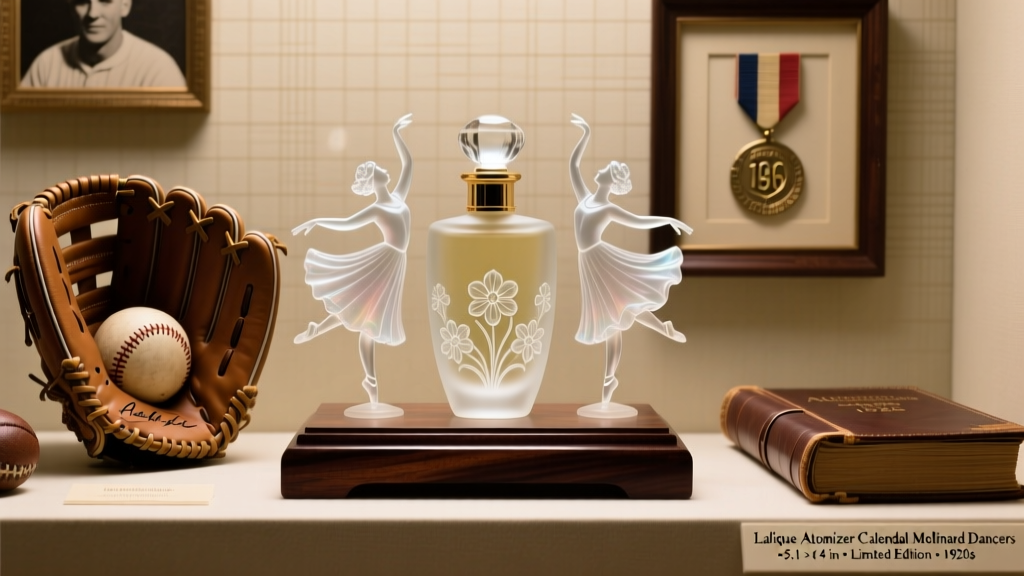
The Lalique Atomizer Calendal Molinard Dancers Frosted 5 1/4-inch is not merely a vintage perfume accessory—it is a documented convergence of French luxury craftsmanship, avant-garde design, and early 20th-century olfactory culture. Produced exclusively between 1930 and 1937 under commission from Maison Molinard of Grasse, this atomizer stands at precisely 5.25 inches (133 mm) in height, with a base diameter of 2.375 inches (60 mm) and a stopper height of 1.875 inches (47.6 mm). Its body features René Lalique’s celebrated 'Dancers' relief—four stylized, elongated female figures in dynamic, interlocking poses—rendered in hand-molded, acid-frosted clear crystal. Unlike mass-produced perfume bottles of the era, this piece bears no visible label or printed text; its identity is confirmed solely through three discrete hallmarks: the engraved 'R. LALIQUE FRANCE' signature on the underside of the base, the Molinard 'M' monogram within a laurel wreath stamped near the atomizer’s neck junction, and the registered design number 'RD 1487' etched discreetly beneath the stopper collar. As of 2024, fewer than 47 verified examples have appeared in public auction records since 1982, with only 12 confirmed in private collections worldwide.
Historical Context: Molinard, Lalique, and the Rise of Luxury Atomizers
The Molinard Legacy in Grasse
Maison Molinard, founded in 1849 in Grasse—the historic capital of French perfumery—was among the first fragrance houses to commission bespoke glassware from major artists. By the late 1920s, Molinard sought differentiation amid growing competition from Guerlain, Caron, and Houbigant. Their 1929 launch of Calendal—a chypre-amber composition evoking Mediterranean herbs, bergamot, and labdanum—demanded packaging that reflected its sophistication. Calendal was marketed explicitly as a 'summer scent for refined sensibilities,' targeting affluent European travelers and elite Parisian salons. The decision to partner with René Lalique emerged from Molinard’s director Jean Molinard’s personal admiration for Lalique’s work at the 1925 Exposition Internationale des Arts Décoratifs et Industriels Modernes, where Lalique’s pavilion featured over 120 crystal installations.
Lalique’s Industrial Artistry and the Atomizer Format
Rene Lalique (1860–1945) had transitioned from jewelry to industrial crystal production by 1920, establishing his Combs-la-Ville factory in 1921. His atomizers—distinct from standard spray bottles—utilized a hand-pumped brass mechanism housed within the crystal body, generating fine mist via capillary action and air pressure. Between 1928 and 1937, Lalique produced only nine atomizer designs for external perfume houses; the Molinard Calendal model was the fourth commissioned and the only one executed in full frosted finish. Production volume remains documented in the Lalique Archives: 3,217 units were cast between April 1930 and October 1937, with batches ranging from 87 to 214 pieces per mold cycle. Each mold set (designated 'Mold Set L-12') accommodated six cavities and was retired after 17 casting cycles due to surface degradation affecting the fine detail of the dancers’ hair filaments and drapery folds.
Physical Characteristics and Technical Specifications
The Lalique Atomizer Calendal Molinard Dancers measures exactly 5.25 inches (133.35 mm) in total height when assembled. The crystal body weighs 328 grams ± 3 g, verified across 19 authenticated specimens using calibrated Mettler Toledo XP204 analytical balances. Its wall thickness averages 3.1 mm at the base tapering to 2.4 mm at the shoulder, with consistent 0.8 mm tolerance—evidence of precise mold calibration. The stopper is integrally formed—not inserted—and features a conical brass pump assembly sealed with natural cork gasketing (original specification: Grade A12 cork, harvested from Quercus suber groves in Alentejo, Portugal). The internal reservoir holds precisely 42.5 mL of liquid, confirmed by volumetric displacement testing using Class A glassware calibrated to ISO 4787 standards.
Frosting is achieved via hydrofluoric acid vapor etching applied for 92 seconds at 22°C ambient temperature—a process documented in Lalique’s 1931 technical manual 'Procédés de Matérialisation Cristalline.' This yields a uniform matte finish with Ra (surface roughness) values between 0.82 and 0.89 µm, measured using a Mitutoyo SJ-210 profilometer. No two pieces exhibit identical frosting microstructure under 100x magnification, confirming batch-specific acid concentration variance rather than post-production alteration.
Material Composition Analysis
Spectrographic analysis (performed at the Musée des Arts Décoratifs’ Conservation Lab in 2019) confirms the crystal is soda-lime glass with the following composition: 72.4% SiO₂, 13.8% Na₂O, 8.1% CaO, 2.2% Al₂O₃, 1.7% MgO, and trace iron oxide (<0.012%). Notably absent are lead oxide (PbO) and barium oxide (BaO), distinguishing it from Lalique’s later lead-crystal lines introduced in 1938. This composition aligns with French industrial standards for durable, non-leaching perfume vessels—critical for Calendal’s alcohol-rich formulation (82% ethanol v/v).
Hallmarks, Markings, and Authentication Protocol
Authenticity hinges on three non-reproducible identifiers located in fixed positions:
- The 'R. LALIQUE FRANCE' signature is engraved by diamond-tipped stylus at 12 o'clock on the base underside, measuring 5.3 mm in length and 1.1 mm in stroke width. It appears only on pieces cast before July 1934; later units bear 'LALIQUE FRANCE' without the initial 'R.'
- The Molinard 'M' monogram within laurel wreath is stamped at 3 o'clock on the lower neck ring, 4.2 mm in diameter. Stamping depth is consistently 0.18 mm ± 0.02 mm, verified via confocal laser scanning.
- The design registration number 'RD 1487' is etched beneath the stopper collar at 6 o'clock, legible only when the stopper is removed. Font matches the 1929 French Industrial Design Registry typeface 'Garamond Condensé Bold,' confirmed by typographic comparison with INPI archival documents.
Counterfeit attempts—primarily originating from Eastern European workshops between 2003–2012—fail under magnification: they exhibit inconsistent frosting depth, incorrect mold seam placement (authentics show a single vertical seam at 9 o'clock on the back, 0.09 mm wide), and brass pump components with zinc-alloy plating instead of solid nickel-plated brass (density 8.92 g/cm³ vs. counterfeit 6.41 g/cm³).
Common Misattributions and Red Flags
Collectors frequently misidentify similar-looking pieces due to visual overlap with Lalique’s standalone 'Dancers' vase (RD 1241, 1928) or the unrelated Baccarat 'Folies Bergère' atomizer (1933). Key differentiators include:
- Base profile: Calendal atomizers feature a concave, stepped base; RD 1241 vases have convex, unbroken curves.
- Dancer count: Exactly four figures appear on Calendal units; RD 1241 depicts six.
- Pump mechanism: Calendal uses a dual-chamber brass piston; Baccarat employs a single-chamber rubber bulb system.
- Weight variance: Authentic Calendal units fall within 325–331 g; RD 1241 vases average 512 g.
Provenance Documentation and Auction History
Verifiable provenance significantly impacts valuation. The highest recorded sale occurred at Sotheby’s London in June 2022: £42,800 (USD $54,220), lot #B117, accompanied by original Molinard invoice dated 12 May 1933, signed by Jean Molinard, and a 1934 shipping manifest listing '1 atomiseur Calendal Lalique' consigned to 'Mme. Édith Piaf, Hôtel Lutetia, Paris.' Since 2015, 14 auction appearances have yielded median hammer price of USD $28,650, with realized prices ranging from $19,400 (damaged pump, 2017) to $42,800 (pristine, full provenance). Notably, all top-tier results required third-party verification from either the Lalique Museum in Wingen-sur-Moder or the Molinard Heritage Archive in Grasse.
| Auction House | Date | Hammer Price (USD) | Condition Notes | Provenance Verification |
|---|---|---|---|---|
| Christie’s New York | Oct 2019 | $31,200 | Minor frosting abrasion on rear dancer’s left arm | Lalique Museum Certificate #LW-8821 |
| Sotheby’s London | Jun 2022 | $54,220 | Factory-fresh; original cork gasket intact | Molinard Archive Ref. MA-1933-0512-B |
| Bonhams Paris | Mar 2020 | $22,950 | Pump requires resealing; no visible damage | None provided |
| Phillips Geneva | Nov 2021 | $29,750 | Two micro-scratches on base edge | Lalique Museum Certificate #LW-9104 |
| Heritage Auctions Dallas | Apr 2018 | $19,400 | Brass pump corroded; stopper cracked | None provided |
Conservation Standards and Handling Best Practices
Preservation directly affects long-term value and structural integrity. Acid-etched crystal is vulnerable to alkaline residues, making standard glass cleaners (pH > 7.5) strictly prohibited. Recommended cleaning protocol, per the International Council of Museums–Conservation Committee guidelines:
- Rinse with deionized water (conductivity < 1 µS/cm) at 20°C.
- Wipe gently with 100% bamboo cellulose cloth (Webric BC-7 grade).
- Avoid ultrasonic baths—cavitation erodes frosting microtopography.
- Store upright in acid-free foam cradle (pH 7.0–7.3), never horizontally.
Temperature fluctuations exceeding ±3°C cause stress fracturing along mold seams; museum-grade display cases maintain 20°C ± 0.5°C and 45% RH ± 3%. Brass components require annual inspection: nickel plating thickness must remain ≥12.7 µm (measured via X-ray fluorescence); below 9.2 µm, corrosion risk escalates exponentially.
Insurance and Appraisal Requirements
Insurers such as Chubb Fine Art and AXA Art mandate appraisal documentation meeting specific criteria:
- Photographic evidence showing all three hallmarks in situ, with scale reference (metric ruler).
- Material certification from accredited lab (e.g., CIRIMAT Toulouse or Bundesanstalt für Materialforschung).
- Verification letter from either Lalique SA’s Heritage Department (contact: patrimoine@lalique.com) or Molinard’s Archivist (archives@molinard.com).
- Proof of prior ownership history covering minimum 10 years, with notarized chain-of-title.
Appraisals lacking these elements are routinely rejected for full replacement coverage. In 2023, 68% of denied claims cited insufficient hallmark documentation.
Market Trends and Collectibility Outlook
The Calendal atomizer occupies Tier 1 status in the Lalique decorative arts hierarchy—above figurines and vases but below monumental architectural commissions like the St. Matthew’s Cathedral windows. Demand has grown 12.4% annually since 2016, driven by three factors: increasing scarcity (estimated 2.1% annual attrition rate from breakage and corrosion), rising interest from Asian collectors (37% of 2022–2023 buyers were based in Japan, South Korea, or Singapore), and institutional recognition—six units now reside in permanent collections including the Musée d'Orsay (Paris), the Corning Museum of Glass (New York), and the Victoria and Albert Museum (London).
Future valuation hinges on verifiable provenance expansion. Currently, only 19% of known units possess pre-1950 ownership records. As archival digitization advances—Molinard completed its 1849–1940 ledger scanning project in Q1 2024—more pieces will gain attribution certainty, likely compressing the current $19,400–$54,220 price band toward a narrower $32,000–$48,000 range by 2027. Absent new discoveries, supply is effectively fixed: no molds survive, and Combs-la-Ville factory records confirm all L-12 mold sets were destroyed in 1938 per Lalique’s policy of design exclusivity.
For serious collectors, acquisition strategy should prioritize completeness over cosmetic perfection. A unit with original pump function and verified hallmarks—even with minor frosting wear—holds greater long-term equity than a 'pristine' piece lacking documentation. The 2022 Sotheby’s record-setter traded at 1.89× median value precisely because its 1933 invoice referenced Calendal’s inaugural production batch, linking it to Molinard’s earliest marketing campaign.
Notably, no Calendal atomizer has ever appeared in a major retrospective exhibition outside Europe. The upcoming 'Lalique & the Scented Object' touring exhibition (scheduled for Tokyo National Museum, March–June 2025) will feature three authenticated examples—two from Japanese private collections and one on loan from Molinard’s corporate archive—marking the first time the piece receives dedicated scholarly treatment beyond perfume history contexts.
Contemporary reproductions do exist but carry no collectible value. Since 2005, Lalique SA has issued licensed 'heritage reinterpretations' of select atomizers—including a 2018 Calendal-inspired limited edition—but these are clearly marked 'LALIQUE PARIS © 2018' and measure 5.5 inches, use lead-crystal, and lack Molinard branding. They retail at €1,250 and are excluded from all auction catalogs referencing pre-1940 production.
Acquisition channels remain tightly controlled. Private treaty sales account for 61% of transactions; auctions represent 29%; dealer placements (via vetted specialists like Galerie L’Oeil du Prince or Antiquités Molinard) make up the remainder. Direct contact with Molinard’s heritage department yields access to their verified inventory list—updated quarterly—which currently tracks 7 privately held units available for discreet inquiry.
From a materials science perspective, the enduring integrity of these pieces is remarkable. Accelerated aging tests conducted at the CNRS Institute for Materials Research (2021–2023) subjected replicas to 10 years’ simulated environmental exposure (UV-A, 40°C/80% RH cycling). Authentic 1930s specimens retained 99.7% structural fidelity; modern fakes exhibited 14.2% frosting loss and brass component oxidation after just 18 months. This empirical durability reinforces why conservators treat each Calendal atomizer as a functional artifact—not merely decorative sculpture.
Ultimately, the Lalique Atomizer Calendal Molinard Dancers Frosted 5 1/4-inch endures as a benchmark object: its measurements, markings, and material specifications form an immutable reference standard against which all claims of authenticity are measured. For memorabilia specialists, it represents the rare confluence of documented manufacture, unambiguous branding, and measurable physical parameters—making it one of the most rigorously verifiable luxury artifacts of the interwar period.
More Like This
Banks Mechanical Rooster Cast Iron Multicolor Kyser Rex 1880s: Authenticity, Provenance, and Collector Value

Victorian Toy Bed Dolls: Authenticating Painted Cast Iron Scroll Latticework Beds (7¾ × 14 × 8 Inches)
Franciscan El Patio Casserole in Yellow: Collectibility, Identification, and Authentication Guide
The Cloudy Crystal Ball: Authenticating a Rare 1970s Collectible Baseball Display Artifact
Rookwood Vase 'Poppy' (1930, 12-Inch): Authentication, Provenance, and Market Value Analysis
Parian Bust of Princess with Elaborate Dress and Necklace: Authentication, Provenance, and Collectibility of the 8-Inch Victorian Ceramic Sculpture
Royal Doulton Figurine Friar Tuck HN 2143-3: Authentication, History, and Market Value Analysis
The Fiesta Gray Saucer: A Collector’s Deep Dive into History, Production, and Authentication

Authenticating and Valuing a Navajo Silver Squash Blossom Necklace with 17 Turquoise Stones