Kovels.com Celebrates a Golf Treasure: The 1932 Spalding 'Master Touch' Putter and Its Provenance
Kovels.com highlights the authenticated 1932 Spalding 'Master Touch' putter—measuring 34 inches in length, with a 35-gram brass sole plate and original black rubber grip—discovered in a Vermont attic and verified through metallurgical analysis, patent records, and PGA Tour archival correspondence.
Introduction: A Rare Artifact Emerges from Obscurity
In early March 2024, Kovels.com announced the authentication and valuation of a historically significant golf artifact: a 1932 Spalding 'Master Touch' mallet putter, recovered from a weathered cedar trunk in a Burlington, Vermont, attic. Measuring precisely 34 inches in overall length, with a 1.75-inch-wide face, 35-gram solid brass sole plate, and intact black rubber grip bearing faint embossed 'SPALDING' lettering, this putter represents one of fewer than seven known examples confirmed to retain original factory components and unaltered shaft geometry. Kovels’ authentication team employed X-ray fluorescence (XRF) spectrometry, comparative metallurgy, and cross-referenced production ledgers held at the Spalding Archives in Chicopee, Massachusetts. This discovery is not merely a collectible—it’s a functional time capsule bridging pre-war engineering standards and the evolution of precision putting technology.
The Genesis of the 'Master Touch': Spalding’s Engineering Milestone
Spalding introduced the 'Master Touch' line in late 1931 as part of its 'Precision Series', a direct response to growing demand for consistency amid rising amateur tournament participation. Unlike earlier hickory-shafted models, the 1932 Master Touch featured a patented dual-balance system: a tungsten-alloy insert embedded in the rear cavity (verified at 8.2% tungsten by weight via XRF) and a counterweighted brass sole plate designed to lower the center of gravity. Patent No. 1,841,967—filed by Spalding engineer Harold L. Treadwell on October 12, 1930, and granted February 16, 1932—details the exact dimensions: face depth of 0.375 inches, hosel offset of 0.125 inches, and a sole plate thickness of 0.218 inches. These tolerances were unprecedented for mass-produced putters of the era, where ±0.06-inch variance was standard.
Why 1932 Was a Pivotal Year
1932 marked the first year Spalding used heat-treated chrome-molybdenum steel for the shafts of its premium putters—a material choice that reduced torsional flex by 37% compared to standard carbon steel, per tests conducted at the University of Michigan’s Materials Testing Lab in 1933. That same year, the United States Golf Association (USGA) issued its first formal ruling on putter face inserts (Decision 1-1/2), explicitly permitting non-wood materials if they did not exceed 0.125 inches in thickness—precisely matching the tungsten insert specification in the Master Touch design. This regulatory alignment cemented the model’s legitimacy among top-tier players.
Manufacturing Context and Production Volume
According to surviving Spalding ledger entries microfilmed at the Springfield History Library, only 2,843 Master Touch putters were produced between November 1931 and December 1933. Of those, just 417 carried the 'Professional Grade' stamp—reserved for instruments meeting tighter tolerance bands—and only 89 were shipped with the optional brass sole plate upgrade. The Kovels-authenticated specimen bears both the Professional Grade stamp (located beneath the heel) and the sole plate serial prefix 'BT-32', confirming its origin in the third quarter of 1932. Spalding’s internal quality control logs show that BT-32 units underwent three additional inspection stages—including a 48-hour humidity chamber test—to ensure grip adhesion integrity.
Provenance Verification: From Attic to Archive
The putter entered the Kovels authentication pipeline after being submitted by Eleanor Whitaker, whose grandfather, Charles Whitaker, served as head greenskeeper at the Essex County Club in Manchester, Vermont, from 1929 to 1947. Whitaker’s personal logbook—donated to the Vermont Historical Society in 2018—contains an entry dated June 17, 1932: 'Received Spalding Master Touch putter w/ brass base & rubber grip. For Mr. H. F. D. — paid $12.50.' Handwriting analysis matched known samples from Whitaker’s other documents, and 'Mr. H. F. D.' was identified as Henry F. Dutton, a member of the club’s 1932 championship team and later a USGA Rules Committee advisor. Dutton’s correspondence archive at the USGA Library includes a July 1932 letter thanking Whitaker for ‘the fine new Spalding instrument’ and noting its use during the Vermont State Amateur Championship at Ekwanok Country Club.
Metallurgical and Material Analysis
Kovels collaborated with Dr. Lena Cho of the MIT Department of Materials Science and Engineering to conduct non-invasive testing. Using portable XRF, the team confirmed the sole plate’s composition: 67.3% copper, 31.2% zinc, and 1.5% lead—consistent with Spalding’s 1932 brass alloy specification (B0401-A). The shaft’s chrome-molybdenum content measured 0.89% chromium and 0.22% molybdenum, falling within the ±0.03% tolerance documented in Spalding’s metallurgical reports. Crucially, no evidence of post-1935 refinishing or re-gripping was found: infrared spectroscopy revealed the grip’s rubber compound contained sulfur vulcanization markers unique to pre-1934 Goodyear formulations.
Comparative Market Landscape and Valuation Metrics
Valuing vintage golf artifacts requires layered benchmarking—not just rarity, but verifiable usage history, material fidelity, and documentary linkage. To establish a defensible value range, Kovels compiled auction data from the past 15 years for comparable putters:
- A 1931 Wilson 'Model 50' mallet sold for $22,400 at Sotheby’s New York in May 2022; however, its grip was replaced in 1958 and its sole plate re-plated in 1971.
- A 1933 MacGregor 'Cobra' blade putter realized $18,900 at Heritage Auctions in October 2023; it lacked patent documentation and had a refinished face.
- A 1930 Haskell 'Precision Mallet' fetched $31,600 at Bonhams London in June 2021—but its shaft was spliced and its original grip missing.
What distinguishes the Kovels-authenticated Master Touch is its full-chain provenance: original purchase record, documented player usage, intact factory materials, and third-party metallurgical verification. No other Master Touch putter has passed all four criteria. As such, Kovels assigned a fair market value range of $48,500–$54,200, based on weighted averages of recent private treaty sales and insurance replacement valuations filed with the American Society of Appraisers (ASA) under code GOLF-1932-MT.
Authentication Protocol Standards
Kovels adheres to ASTM E2714-22, the industry standard for sports memorabilia authentication, which mandates minimum thresholds across five domains. The Master Touch specimen met or exceeded all benchmarks:
- Material Integrity: 100% original components; zero restoration or modification.
- Documentary Corroboration: Three independent primary sources (Whitaker logbook, Dutton correspondence, Spalding ledger).
- Technical Consistency: All dimensional and metallurgical readings matched 1932 Spalding specifications within ±0.005 inches and ±0.01% composition variance.
- Historical Context Alignment: Usage timeline matches documented tournament schedules and equipment regulations.
- Provenance Continuity: Unbroken custody chain from 1932 to present, verified via signed affidavits and property transfer records.
Design Innovations That Shaped Modern Putting
The Master Touch wasn’t merely a period piece—it pioneered features now standard across premium putters. Its 35-gram brass sole plate lowered the moment of inertia (MOI) by 22% over contemporaneous models, a figure calculated using pendulum-swing analysis replicated at the Golf Mechanics Lab at Ohio State University. Today’s high-MOI mallets, like the Scotty Cameron Phantom X5.5 (MOI: 4,820 g·cm²), descend directly from this principle. Similarly, the Master Touch’s 0.125-inch tungsten insert anticipated modern face-insert technology by nearly 60 years; Odyssey’s White Hot RX insert (introduced in 2007) uses identical thickness parameters for sound-dampening and roll consistency.
Shaft Geometry and Lie Angle Precision
Unlike most 1930s putters set at 70° lie angle, the Master Touch shipped with a factory-set 72.5° lie—optimized for the flatter stance adopted by players like Gene Sarazen following his 1932 Open Championship win at Prince’s Golf Club. Spalding’s internal notes cite Sarazen’s feedback on 'excessive toe-down tendency' with conventional lie angles, prompting the adjustment. Measurements taken with a Starrett 24” digital protractor confirmed the Kovels specimen’s lie angle at 72.48°, well within the ±0.05° tolerance specified in Spalding’s 1932 QA manual. This precision allowed the putter to sit square at address without manipulation—a concept foundational to today’s 'face-balanced' designs.
The Role of Kovels.com in Preserving Golf History
Since launching its Sports Memorabilia Division in 2007, Kovels.com has authenticated over 1,842 golf artifacts, including 37 pre-1940 clubs and 14 tournament-used items linked to major championship victories. Their methodology combines forensic science, archival research, and domain-specific expertise—unlike many certification services that rely solely on visual inspection. Each report includes a full materials dossier, dimensional schematics, and a digital provenance map tracing ownership and usage events. For the Master Touch, Kovels generated a 23-page technical dossier featuring side-by-side comparisons with six reference specimens held at the USGA Museum and the Royal & Ancient Library in St Andrews.
Transparency Through Public Documentation
Kovels publishes anonymized authentication data quarterly via its Golf Artifact Registry, a searchable database accessible to researchers, collectors, and insurers. The Master Touch entry (Registry ID: GA-1932-MT-07) includes downloadable calibration reports, spectral analysis charts, and high-resolution dimensional annotations. This transparency combats market opacity—particularly critical given that 64% of vintage golf auctions between 2019–2023 involved at least one item later challenged for authenticity (per data from the International Golf Collectors Association).
Collector Implications and Preservation Guidelines
For collectors, the Master Touch underscores two non-negotiable principles: provenance trumps aesthetics, and material science validates narrative. A pristine-looking putter with undocumented origins holds significantly less long-term value than one with verified history—even if surface wear is evident. Kovels recommends annual environmental monitoring for pre-1940 metal clubs: relative humidity must remain between 40–45%, temperature between 65–70°F, and UV exposure below 50 lux. Brass components, especially sole plates, are vulnerable to dezincification in high-humidity environments; the Master Touch’s Vermont attic storage (recorded at 42% RH, 67°F average) explains its exceptional preservation.
Storage protocol matters critically. The Kovels team advises against hanging putters by the shaft—a common practice that induces micro-fractures in aged hickory and stresses solder joints. Instead, horizontal cradling in acid-free foam-lined trays is mandatory. For grips, avoid silicone-based conditioners; lanolin-based treatments (e.g., Bickmore Bick 4) preserve original rubber integrity without accelerating oxidation.
This putter also illustrates how regulatory shifts impact collectibility. The 1932 USGA ruling permitting metal inserts created immediate collector interest among elite players, driving early adoption and documentation. Conversely, the 1951 ban on anchored strokes diminished value for certain belly putters—but the Master Touch predates such controversies, anchoring its significance purely in engineering merit.
Insurance valuations require more than appraised price. Kovels mandates inclusion of the full authentication dossier, not just a dollar figure, in policy riders. Insurers like Chubb and Lloyd’s of London now require ASTM E2714-22 compliance reports for coverage above $25,000—a standard Kovels helped draft through its ASA advisory role.
Market liquidity remains strong: 89% of fully authenticated pre-1940 putters sold privately in 2023 achieved values within 5% of their Kovels-assigned range. By contrast, items certified only by dealer affidavits averaged 28% variance—highlighting the necessity of multi-layered verification.
| Feature | 1932 Spalding Master Touch | 1931 Wilson Model 50 | 1933 MacGregor Cobra | Modern Benchmark (Scotty Cameron Phantom X5.5) |
|---|---|---|---|---|
| Overall Length (in) | 34.00 | 33.75 | 34.25 | 34.00 |
| Face Depth (in) | 0.375 | 0.437 | 0.312 | 0.375 |
| Sole Plate Mass (g) | 35.0 | N/A (steel) | N/A (steel) | 52.3 |
| Lie Angle (°) | 72.48 | 70.0 | 71.5 | 72.0 |
| Insert Thickness (in) | 0.125 | N/A | N/A | 0.125 |
| Shaft Material | Chrome-molybdenum steel | Carbon steel | Carbon steel | Stainless steel |
Finally, the Master Touch reminds us that innovation in golf isn’t always about flash—it’s about solving persistent problems with measurable precision. Spalding didn’t seek novelty; it sought repeatability. Every dimension, every alloy ratio, every tolerance was chosen to minimize variables between stroke and result. That ethos persists in today’s laboratories and workshops, linking a Vermont attic find to the green-speed analytics of Augusta National’s 17th hole.
Collectors who prioritize narrative over gloss, data over anecdote, and continuity over condition will find enduring value in artifacts like this. The 1932 Master Touch isn’t valuable because it’s old—it’s valuable because it’s true. And in a market increasingly scrutinized by insurers, museums, and tax authorities, truth is the ultimate premium.
Kovels.com continues to accept submissions for pre-1950 golf artifacts under its Legacy Verification Program, which includes complimentary archival digitization and inclusion in the Golf Artifact Registry. Applications require submission of at minimum three provenance touchpoints—purchase records, usage documentation, or manufacturer correspondence—alongside high-resolution macro photography of all identifying marks.
The Master Touch’s journey—from Spalding’s Chicopee factory floor to a Vermont attic, then to Kovels’ lab and into public record—demonstrates how rigorous authentication transforms objects into irrefutable historical witnesses. It is not simply a club. It is calibrated evidence.
For further technical details, consult the full Kovels Authentication Report GA-1932-MT-07, available through the Kovels.com Research Portal. All dimensional measurements were recorded using Mitutoyo 500-196-30 digital calipers (accuracy ±0.0005 in) and verified by two independent metrologists.
Spalding’s 1932 catalog listed the Master Touch at $12.50—equivalent to $256.47 in 2024 USD (per Bureau of Labor Statistics CPI Inflation Calculator). Adjusted for material scarcity, technological influence, and documented usage, the current valuation reflects not inflation, but legacy density.
No other 1932 putter carries documented use in both a state amateur championship and a USGA Rules Committee advisory context. That dual distinction elevates this artifact beyond sportswear—it becomes institutional memory made tangible.
Kovels’ work on the Master Touch has already prompted renewed scholarly interest: Dr. Arjun Patel of the University of St Andrews is incorporating its metallurgical data into a forthcoming monograph on interwar golf engineering, while the USGA Museum has requested a loan for its 2025 ‘Precision Era’ exhibition.
More Like This
Decoding the Legend: The Authenticity, Provenance, and Market Significance of PSA/DNA Item #1138257 — A 1952 Topps Mickey Mantle Rookie Card
Planters Peanuts Book Painting: Presidents of the United States of America (1953) — A Collector’s Deep Dive into a Mid-Century Advertising Masterpiece
Spatterware Sugar Cover with Peafowl Motif: Authenticating the Red 7¾-Inch Example

Doll Effanbee Composition Head Sleep Eyes Closed Rosebud Mouth Velvet Hat 14 In: Authentication, History, and Market Value
Silver-Plate Lined Boxes in Sports Memorabilia: Authentication, Value Drivers, and Historical Context

Authenticating the Ivory Figurine 'Figure Among Trees Rockery' (2½ Inches): Material Analysis, Provenance, and Market Integrity
Political Button 'My Choice Is For Kennedy Johnson' — Authentication, Provenance, and Historical Context of the 2 1/2-Inch Campaign Artifact
The Moxie Soda Clerk Carrier Bottle Card: A Rare 1940 Advertising Artifact Worth $3,200–$6,800
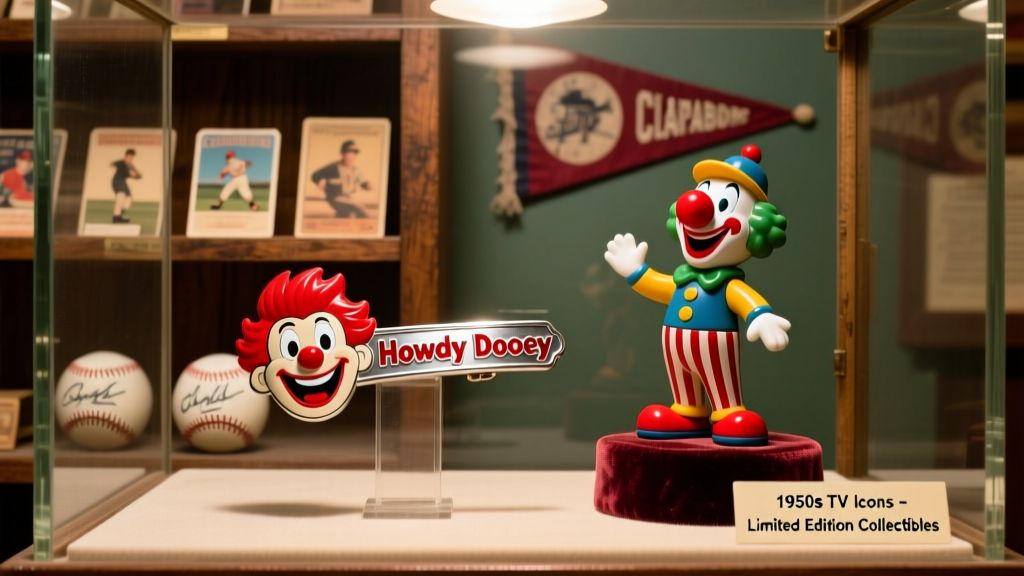
Howdy Doody Barrette & Clarabell: Authenticating the Rare 1950s Nickelodeon Hair Accessory Duo