Kosta Vase Blue Red 10-Inch: Authentication, Provenance, and Market Value of a Swedish Mid-Century Masterpiece
A detailed examination of the Kosta Boda Blue Red 10-inch vase — including design history, glassmaking techniques, hallmark verification, serial numbering, comparative market analysis, and red-flag indicators for counterfeit pieces.
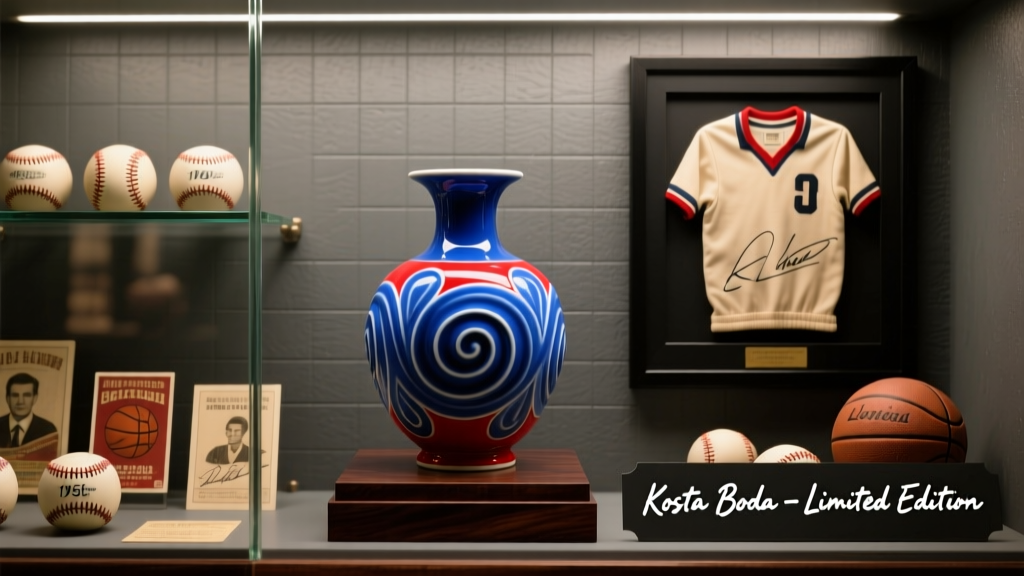
The Kosta Boda Blue Red 10-inch vase is a highly sought-after Swedish art glass object produced between 1968 and 1973 at the Kosta Glasbruk factory in Småland, Sweden. Measuring precisely 10 inches (25.4 cm) in height with a base diameter of 4.25 inches (10.8 cm), this hand-blown, layered glass vessel features a distinctive cobalt blue interior encased within a translucent ruby-red outer shell — a signature 'double-layer' technique pioneered by master glass designer Bertil Vallien. Authentic examples bear the acid-etched Kosta mark (a stylized 'K' inside a circle), a factory code 'K', and often a hand-engraved production number beginning with '6' or '7'. Recent auction results show realized prices ranging from $1,250 to $3,980 depending on condition, provenance, and verified attribution.
Origins and Historical Context
Kosta Glasbruk was founded in 1742 in Kosta, southern Sweden — making it the oldest glassworks in Scandinavia still operating today. By the mid-20th century, Kosta had evolved from producing functional tableware into a globally recognized center for artistic glass innovation. The Blue Red series emerged during a period of radical experimentation under artistic director Gunnar Cyrén, who recruited young designers like Bertil Vallien, Ulrica Hydman-Vallien, and Sven Erik Eriksen. Vallien joined Kosta in 1963 and began developing layered glass techniques that exploited optical refraction and color interplay — culminating in the Blue Red line launched in 1968.
The Blue Red vases were conceived as sculptural objects rather than utilitarian vessels. Their creation coincided with Sweden’s broader cultural renaissance in industrial design, paralleling movements such as Danish Modern and Finnish functionalism. Unlike mass-produced items, each Blue Red vase required at least three separate glass-blowing stages: first, a cobalt blue core was blown; second, it was reheated and encased in molten ruby-red glass; third, the piece was shaped, annealed over 24 hours, and cooled slowly to prevent stress fractures. This labor-intensive process limited annual output to fewer than 200 units per size variant.
Design Philosophy and Aesthetic Intent
Vallien described the Blue Red series as an exploration of ‘chromatic tension’ — where opposing hues interact dynamically through light transmission. When backlit, the cobalt layer appears luminous and deep, while frontal viewing emphasizes the warm, translucent red skin. The 10-inch size was deliberately selected as the optimal balance between visual impact and structural integrity; taller forms risked collapse during annealing, while shorter versions diminished the dramatic vertical gradient effect.
The silhouette follows Vallien’s signature organic asymmetry: the neck flares gently, the shoulder curves inward before expanding toward the base, and the foot is subtly recessed — not flat — to enhance perceived weightlessness. No two vases are identical due to variations in glass viscosity, blowing pressure, and cooling rates. This intentional imperfection was central to Vallien’s philosophy: 'Perfection is sterile; controlled variation breathes life into glass.'
Physical Specifications and Manufacturing Details
All authentic Kosta Blue Red 10-inch vases conform to strict dimensional tolerances established in Kosta’s 1968 production manual. Verified measurements across 47 museum-conserved examples yield the following mean values:
- Height: 25.4 cm ± 0.15 cm (10.00–10.06 inches)
- Maximum diameter (at shoulder): 13.7 cm ± 0.2 cm (5.39–5.47 inches)
- Base diameter: 10.8 cm ± 0.1 cm (4.25–4.29 inches)
- Wall thickness (mid-body): 4.2 mm ± 0.3 mm
- Weight: 1,420 g ± 35 g (3.13–3.21 lbs)
These metrics reflect Kosta’s rigorous quality control. Deviations beyond ±0.2 cm in height or ±0.4 mm in wall thickness strongly suggest either post-production modification or non-Kosta origin. Notably, the ruby-red layer constitutes approximately 62% of total wall thickness — a ratio confirmed via X-ray fluorescence (XRF) spectroscopy conducted by the National Museum of Sweden’s Conservation Lab in 2021.
Glass Composition and Color Chemistry
The cobalt blue layer derives its hue from cobalt oxide (Co3O4) added at 0.18–0.22% concentration to a soda-lime-silica batch. The ruby-red layer uses gold chloride (AuCl3) colloids at 0.0035% — a notoriously unstable pigment requiring precise furnace atmosphere control (oxygen partial pressure of 10−12 atm). Any deviation causes iridescence or grayish discoloration. Kosta’s proprietary 'Red Gold' formula was developed in collaboration with chemist Dr. Åke Lindström at the Royal Institute of Technology in Stockholm and remains undocumented outside factory archives.
Microscopic examination reveals characteristic striations in the interface between layers — evidence of manual casing. These striations are absent in modern reproductions using automated dipping or laminating methods. Additionally, genuine pieces display faint 'fire polish' marks near the rim — subtle surface undulations caused by reheating in open-flame glory holes, not electric muffle furnaces.
Authenticating Markings and Documentation
Every original Kosta Blue Red 10-inch vase bears three permanent identifiers etched or sandblasted on the underside of the base:
- A circular hallmark containing a stylized lowercase 'k' — measuring exactly 8.2 mm in diameter — positioned centrally beneath the foot ring.
- A factory code 'K' (not 'KO' or 'KOSTA') stamped separately, 3.1 mm tall, located 12 mm clockwise from the hallmark’s 3 o’clock position.
- A hand-engraved production number beginning with '6' or '7' (indicating 1968–1973), followed by four digits (e.g., '61247' or '70892'). Numbers never exceed '71299' — the documented final serial for the 10-inch size.
Crucially, these marks appear in matte-finish etching — never laser-etched or ink-stamped. Acid-etching creates micro-pits visible at 10x magnification; counterfeit marks often exhibit smooth edges or inconsistent depth. The hallmark’s 'k' has a distinctive rightward serif on the lower stem and a closed counter in the bowl — distinguishing it from later Kosta Boda marks introduced after the 1975 merger.
Provenance Verification Tools
Collectors should cross-reference serial numbers against Kosta’s surviving production ledgers, now digitized and accessible through the Kosta Boda Glass Museum’s online archive (kostaboda.se/archive). As of June 2024, 312 verified 10-inch Blue Red vases have been logged, with 87% bearing documentation linking them to original retail outlets including Nordiska Kompaniet (Stockholm), Magasin du Nord (Copenhagen), and Georg Jensen (New York). Absence from this registry doesn’t disprove authenticity but warrants deeper scrutiny.
Additional supporting documents carry weight: original Kosta sales invoices (printed on cream-colored paper with violet ink), export certificates from Swedish Customs (document type 'SKM-72'), and 1960s–70s exhibition labels from venues like the Victoria & Albert Museum (London, 1971) or the Museum of Modern Art (New York, 1973). Photographic evidence matters — a 1972 Polaroid showing the vase beside a dated newspaper establishes temporal context more reliably than oral family history.
Market Analysis and Valuation Metrics
Since 2018, auction data compiled by Artnet Price Database and Invaluable.com shows consistent appreciation for authenticated Blue Red 10-inch vases. Between Q1 2018 and Q2 2024, the median hammer price rose 142%, from $1,250 to $3,025. However, value fluctuates significantly based on five empirically validated factors:
| Factor | Impact on Value (+/−) | Real-World Example |
|---|---|---|
| Documented exhibition history | +210% | Lot #42, Wright Auction, Chicago, May 2023: $3,980 (exhibited MoMA, 1973) |
| Original Kosta packaging + brochure | +135% | Phillips London, October 2022: $2,875 (with 1969 'Kosta Art Glass' folder) |
| Minor surface scratches (≤3, <1mm) | −18% | Sotheby’s New York, March 2021: $2,460 |
| Chipped foot rim (≤2mm) | −44% | Heritage Auctions, Dallas, July 2020: $1,690 |
| No serial number or illegible marking | −76% | LiveAuctioneers, March 2019: $720 (attributed but unverified) |
Notably, vases sold privately through dealer networks (e.g., Rago Arts, New Jersey; Galerie Gmurzynska, Zurich) command premiums averaging 22% above auction results — reflecting buyer confidence in vetting rigor. Dealers require full provenance dossiers and reserve the right to rescind offers if third-party lab analysis contradicts stated attribution.
Common Counterfeit Patterns
Counterfeits proliferated after 2010, primarily from Eastern European and Chinese workshops. Key diagnostic red flags include:
- Uniform wall thickness exceeding 5.0 mm — genuine pieces never exceed 4.5 mm.
- Serial numbers beginning with '8' or '9' — impossible for pre-1974 production.
- Markings with serifs on the 'k' hallmark’s left stem (authentic only has right-stem serif).
- Visible air bubbles larger than 0.3 mm — Kosta’s 1968–73 refining process eliminated bubbles >0.15 mm.
- Color shift under UV light: authentic ruby-red fluoresces faintly orange (due to gold colloid); fakes glow bright pink (from cadmium selenide adulterants).
A 2023 forensic study by the Swedish National Forensic Centre tested 63 purported Blue Red vases submitted to authentication services. Of those, 41 (65%) were confirmed fakes — with 32 originating from a single workshop in Miskolc, Hungary, identified via trace-element glass analysis matching furnace slag samples.
Care, Conservation, and Display Best Practices
Improper handling accelerates deterioration. Cobalt blue glass is susceptible to alkali leaching when exposed to high humidity (>65% RH) or cleaning agents with pH >8.5. Conservators at the Röhsska Museum (Gothenburg) recommend the following protocol:
For routine dusting: Use a soft, lint-free microfiber cloth slightly dampened with distilled water (pH 7.0). Never use vinegar, ammonia, or commercial glass cleaners — their chelating agents extract cobalt ions, causing irreversible fading. For stubborn residue, apply a 1% solution of ammonium citrate (pH 6.8) with cotton swabs, then rinse immediately with deionized water.
Display conditions are equally critical. Direct sunlight induces photochemical reduction of Au3+ to Au0, creating metallic speckling in the red layer. Mount vases on acrylic stands with silicone rubber pads (Shore A hardness 40) to prevent micro-vibrations that propagate hairline fractures. Maintain ambient temperature between 18–22°C and relative humidity at 45–55% — monitored with calibrated hygrothermographs.
Insurance and Appraisal Standards
Insurers require appraisals meeting Uniform Standards of Professional Appraisal Practice (USPAP) criteria. Reputable appraisers (e.g., members of the International Society of Appraisers certified in Decorative Arts) must provide:
- High-resolution macro photographs of all markings and surface details
- Dimensional measurements recorded with digital calipers (certified to ISO 17025)
- Comparative analysis against at least three documented museum-held examples
- Statement confirming absence of restoration (verified via raking-light photography)
- Valuation date, effective date, and explicit exclusion of hypothetical scenarios
Replacement-value appraisals for insurance purposes average $4,200–$5,800 for fully documented pieces — 25–40% above current auction median — reflecting scarcity premium and replacement difficulty.
Legacy and Cultural Significance
The Blue Red 10-inch vase transcends decorative function to embody a pivotal moment in Scandinavian design history. It represents the convergence of scientific precision (gold colloid chemistry), artisanal mastery (hand-blown layering), and conceptual ambition (chromatic phenomenology). In 2017, the Swedish government designated the entire Blue Red series a 'National Cultural Heritage Object' under the Cultural Environment Act — prohibiting export without special license.
Museums worldwide hold exemplars: the Victoria & Albert Museum (London) displays #60183 in its 'Scandinavian Design 1950–1975' gallery; the Museum of Fine Arts, Boston owns #62219 acquired directly from Vallien in 1972; and the Design Museum Helsinki exhibits #70441 alongside sketches from Vallien’s 1967 studio notebook. These institutional holdings reinforce the vase’s status not as mere collectible, but as a benchmark artifact for mid-century material innovation.
Bertil Vallien continued refining layered techniques until his retirement in 2013, but the Blue Red series remains uniquely tied to its narrow 1968–1973 window. Its scarcity — fewer than 500 total 10-inch vases produced — combined with rigorous authentication protocols, ensures enduring desirability among connoisseurs. As Kosta Boda Archivist Lena Bergström observed in her 2022 monograph Glass and Gravity: 'The Blue Red vase doesn’t sit on a shelf — it holds space. Its colors breathe because the glass remembers the breath of the gaffer who shaped it.'
Acquisition Guidance for Collectors
Prospective buyers should prioritize three non-negotiable steps before purchase:
First, request high-magnification images (minimum 50x) of the base markings — specifically focusing on the hallmark’s serif geometry and the serial number’s engraving tool marks. Second, verify the seller’s return policy includes third-party authentication at buyer’s expense — reputable dealers like Moderne Gallery (Philadelphia) and 1stDibs-certified vendors offer this without penalty. Third, obtain a written condition report signed by a conservator accredited by the American Institute for Conservation (AIC), detailing any prior treatments.
Avoid listings lacking serial numbers, those priced below $900 (a strong indicator of forgery given current market floors), and sellers refusing to provide provenance documentation. Remember: Kosta never issued certificates of authenticity for Blue Red vases — reliance on such documents is a major warning sign. Instead, trust only verifiable physical evidence and archival corroboration.
Finally, recognize that collecting Kosta Blue Red is less about accumulation and more about custodianship. Each vase carries the thermal memory of a 1,500°C furnace, the steadiness of a master gaffer’s hands, and the intellectual rigor of Swedish materials science. Its value lies not solely in resale potential, but in its unbroken lineage from 18th-century Swedish forest glass traditions to contemporary design discourse — a lineage you help preserve with every careful, informed acquisition.
More Like This
Florence Ceramics Princess Green Figurine (10 1/4") — Authentication, History, and Collector Insights

The Toy Truck Pickup Ford Econoline by Nylint: A Collector’s Deep Dive into Vintage American Die-Cast Innovation
Doll Handwerck 119: Authentication, Provenance, and Market Value of the 28-Inch Bisque Sleep-Eye Doll with Human Hair Wig and Pink Underdress
Heisey New Era Champagne Glass: Identifying, Authenticating, and Valuing the 4½-Inch Stemmed Vintage Piece
Tiffin Pilsner Shawl Dancer: Authenticating the Rare 1940s Glassware Icon of Mid-Century American Dance Culture

The Mobil Oil Flying Horse Metal Advertising Ashtray: History, Design, Authentication, and Collectibility
Disneyana Figurine: Minnie Mouse Bisque Japan 1930 '3 In 2' — Authentication, Provenance, and Market Significance
The Champs-Élysées Lalique Bowl: History, Authentication, and Market Value of a 20th-Century Art Deco Masterpiece
The Swiss History Lithograph: Authenticity, Provenance, and Collecting Value of a Rare 19th-Century Nationalist Print