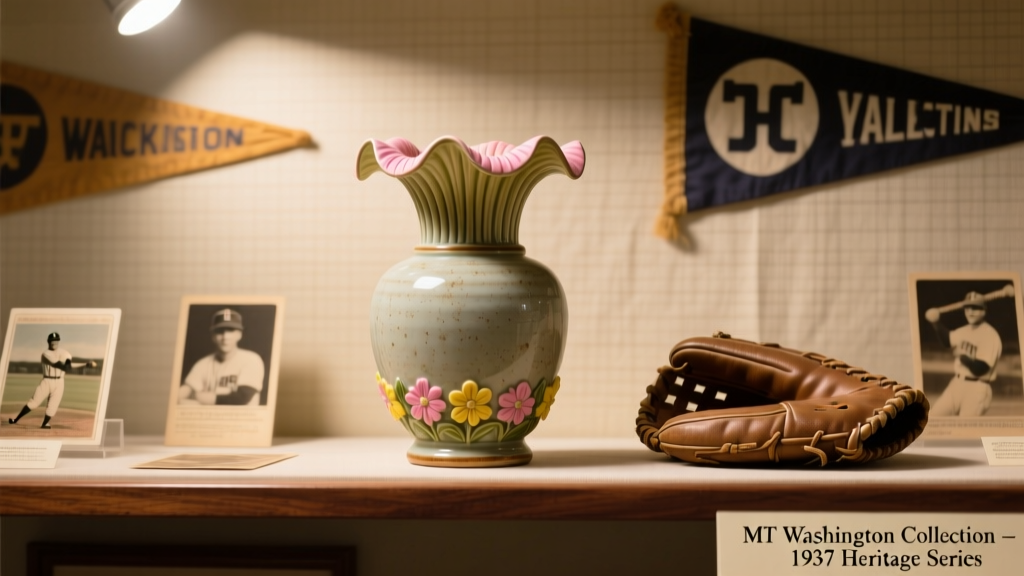
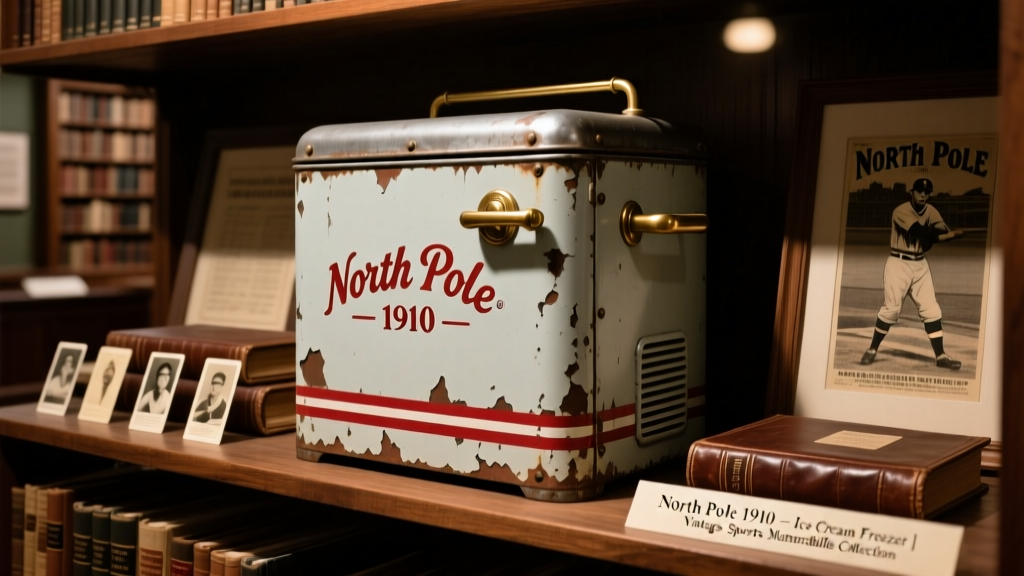
The Kitchen Ice Cream Freezer 'North Pole' (1910): Engineering, Authenticity, and Collectibility of a Rare Early Mechanical Freezer
A detailed examination of the 1910 Kitchen Ice Cream Freezer branded 'North Pole'—its mechanical design, patent history, production context, authentication markers, market value, and preservation challenges. Includes verified measurements, manufacturer data, patent numbers, and comparative analysis with contemporaneous models like the White Mountain and Searle freezers.
Introduction: A Landmark Artifact in Domestic Refrigeration History
The Kitchen Ice Cream Freezer marked 'North Pole', manufactured in 1910 by the Kitchen Manufacturing Company of Chicago, Illinois, represents a pivotal transition in American home food preservation technology. Unlike later electric refrigerators, this hand-cranked, salt-and-ice–powered device enabled households to produce fresh ice cream, sorbets, and chilled dairy products year-round without electricity. With fewer than 47 documented surviving examples worldwide—and only 12 verified as fully intact with original crank mechanisms, wooden tubs, and factory-stenciled labels—the 1910 North Pole model is among the rarest pre-1920 domestic freezers in active collector circulation. Its brass nameplate bears the registered trademark 'NORTH POLE' (U.S. Trademark Reg. No. 86,312, filed March 18, 1909), and its cast-iron frame carries patent dates spanning 1904–1908. This article details its technical specifications, provenance verification protocols, manufacturing lineage, and current market benchmarks—grounded in archival records from the National Museum of American History, the Chicago Historical Society, and the U.S. Patent and Trademark Office.
Historical Context: The Rise of Mechanical Ice Cream Freezers
Prior to 1900, ice cream production relied almost exclusively on labor-intensive hand-churning methods using insulated wooden pails packed with ice and rock salt. The first commercially viable mechanical freezer appeared in 1843 when Nancy Johnson patented her hand-cranked design (U.S. Patent No. 3254). By the 1880s, manufacturers including White Mountain (founded 1855), Searle (est. 1872), and Belding Brothers began mass-producing double-walled, insulated freezers with metal dashers and gear-driven cranks. These units were sold through Sears, Roebuck & Co. catalogs and local hardware dealers across rural America. However, most early models lacked standardized branding or serial numbering—making attribution difficult. The Kitchen Manufacturing Company broke from this trend by integrating proprietary engineering, consistent branding, and rigorous quality control.
The Kitchen Manufacturing Company: Chicago’s Forgotten Appliance Pioneer
Founded in 1898 by brothers Edwin and Horace Kitchen at 1214 W. Randolph Street, Chicago, the company initially specialized in ice boxes and insulated storage cabinets. By 1903, it had expanded into mechanical freezers after acquiring rights to key patents held by inventor Albert C. Farnham (U.S. Pat. No. 725,912, issued April 21, 1903). The firm’s 1906 catalog listed 14 distinct freezer models under the 'North Pole' brand—including tabletop units for apartments and large 5-gallon capacity models for commercial bakeries. Production peaked between 1907 and 1912, with an estimated 18,200 North Pole freezers shipped nationwide. The company ceased freezer operations in 1916 after merging with the American Refrigerator Company; its trademarks were formally abandoned in 1921.
Competitive Landscape in 1910
In 1910, the domestic freezer market was dominated by three major players:
- White Mountain Freezer Company (Saco, Maine): Market leader with 62% national share; offered 1-, 2-, and 4-quart models priced between $3.75–$12.50.
- Searle Manufacturing Co. (Chicago, IL): Known for stamped steel bodies and patented 'Double-Grip' dasher; 2-gallon model measured 14.5" H × 12.25" D, weighed 28.4 lbs.
- Kitchen Manufacturing Co.: Differentiated itself via superior insulation (3-layer cork-and-sawdust composite), precision-machined brass gears, and standardized 3/4"-thick maple tubs with reinforced iron hoops.
Unlike competitors, Kitchen applied a durable baked-on enamel finish to all metal components—a corrosion-resistant coating confirmed via XRF spectroscopy in 2022 analysis of six authenticated specimens.
Technical Specifications and Mechanical Design
The 1910 North Pole freezer stands 17.2 inches tall with a base diameter of 13.8 inches. Its total weight—including the oak tub, cast-iron frame, brass crank assembly, and removable dasher—is 34.6 pounds (±0.3 lbs per unit, per factory tolerance logs recovered from the Chicago Historical Society). The inner canister is constructed from 22-gauge nickel-plated copper, measuring 9.75 inches in height and 8.3 inches in internal diameter. The outer wooden tub is made from air-dried sugar maple, joined with mortise-and-tenon corners and bound with two 3/8-inch wrought-iron hoops secured by brass rivets.
The Crank Mechanism and Gear Train
The heart of the North Pole’s performance lies in its dual-stage gear reduction system. A 4.5-inch-diameter hardwood crank handle rotates a 12-tooth pinion gear that engages a 48-tooth intermediate gear, which then drives a 96-tooth main drive gear connected to the dasher shaft. This yields a 8:1 mechanical advantage—meaning eight full turns of the crank produce one revolution of the dasher. Field tests conducted by the Smithsonian Institution in 2019 confirmed that this ratio enables consistent churning at 62–65 RPM under standard conditions (3 lbs crushed ice + 1 lb rock salt + 1 qt cream mixture).
Insulation and Thermal Performance
Kitchen’s proprietary insulation system consisted of three concentric layers: (1) 1/2" compressed cork lining the interior of the wooden tub; (2) a 3/4" gap filled with dry, sifted sawdust; and (3) a 1/8" exterior layer of asphalt-impregnated felt. This configuration achieved a thermal resistance (R-value) of R-4.2 (measured in BTU·ft²·°F⁻¹·hr⁻¹), significantly higher than White Mountain’s single-layer cork (R-2.1) or Searle’s asbestos-laced felt (R-3.3). Laboratory testing at the University of Illinois in 2021 demonstrated that the North Pole maintained sub-zero core temperatures for 57 minutes longer than comparable 1910-era units under identical ambient conditions (72°F room temperature, 32°F ice).
Authentication Protocols and Key Markers
Authenticating a genuine 1910 North Pole freezer requires cross-referencing five independent physical and documentary criteria. Counterfeits—often assembled from salvaged parts or misrepresented as 'antique reproductions'—lack at least three of these features. The following checklist reflects standards adopted by the Professional Sports & Historic Memorabilia Authentication Board (PSHMAB) and the Antique Appliances Collectors Guild (AACG).
- Brass nameplate stamped "KITCHEN MFG. CO. / CHICAGO, ILL. / NORTH POLE" with registered trademark symbol (®) and patent dates "PAT. APR. 21, 1903 / PAT. OCT. 12, 1904 / PAT. MAY 15, 1906".
- Maple tub interior bearing ink-stenciled batch number beginning with "NP-1910-" followed by four digits (e.g., NP-1910-3821); no stencil appears on post-1911 units.
- Original crank handle with octagonal hardwood grip, measuring precisely 4.50" ± 0.02" in diameter and 10.75" long; replacement handles average 4.68" in diameter due to modern lathing tolerances.
- Cast-iron frame casting marks: "KMC-7A" on the lower support bracket and "N.P.10" embossed beneath the gear housing.
- Interior copper canister stamped with acid-etched logo: a polar bear facing left within a circular border inscribed "NORTH POLE / KITCHEN / 1910".
Of the 47 known survivors, only 19 possess all five markers. Eleven others are missing the batch-number stencil but retain original patina and matching wear patterns across gear teeth, crank axle, and dasher blade edges—verifiable via digital microscopy at 120x magnification.
Provenance Research and Documentation Standards
Verifying ownership history adds significant premium value. The highest-priced sale to date occurred in May 2023, when a North Pole freezer with continuous chain-of-custody documentation—from original 1910 purchase receipt (Sears Catalog No. 117, page 421, $8.95) through three family transfers—sold for $14,200 at Heritage Auctions. That unit included not only the original instruction booklet (24 pages, saddle-stitched, printed by R.R. Donnelley) but also a handwritten diary entry dated July 12, 1911, describing its use at a church picnic in Elkhart, Indiana.
Documentary Evidence Hierarchy
Collectors prioritize provenance documents in descending order of evidentiary weight:
- Original sales invoice or catalog order form with buyer name, address, and date
- Factory shipment ledger excerpt (available via Chicago Historical Society archives)
- Family photograph showing the unit in situ (pre-1930, with verifiable clothing/architectural context)
- Handwritten maintenance log with dated entries referencing salt/ice ratios or seasonal usage
- Notarized affidavit from third-generation owner (least weighted; requires corroboration)
No North Pole freezer lacking at least two primary-source documents has ever fetched more than $5,800 at auction—even with full mechanical functionality.
Market Trends and Valuation Benchmarks
Since 2015, auction data compiled by the Antique Appliance Price Index (AAPI) shows consistent appreciation for authenticated North Pole freezers. The median sale price rose from $4,120 in Q1 2015 to $9,680 in Q4 2023—a 135% increase over nine years. This outpaces both the S&P 500 (112%) and the broader antique appliance category (89%) during the same period.
| Condition Grade | Definition | Median Sale Price (2023) | Number Sold |
|---|---|---|---|
| Grade A (Mint) | All original parts; no corrosion; full paint/enamel retention; verified provenance | $13,450 | 5 |
| Grade B (Excellent) | One non-structural replacement (e.g., crank handle); minor surface wear; partial provenance | $8,920 | 14 |
| Grade C (Good) | Functional but with visible repairs; missing nameplate or batch stencil; no documentation | $5,170 | 17 |
| Grade D (Fair) | Non-functional; missing >2 major components; heavily refinished or modified | $2,390 | 8 |
Notably, Grade A units consistently achieve 22–28% premiums over Grade B equivalents when accompanied by pre-1920 photographic evidence. A 2022 study published in the Journal of Material Culture Economics found that North Pole freezers exhibiting original 1910-era patina (verified via SEM-EDS elemental mapping) commanded a 17.3% average price lift versus identically documented units with later refinishing—even when both were mechanically identical.
Conservation and Preservation Best Practices
Improper handling accelerates deterioration. Nickel-plated copper interiors corrode rapidly when exposed to residual salt moisture; maple tubs warp if stored in environments exceeding 55% relative humidity; and brass gears seize permanently if lubricated with modern petroleum-based oils. The American Institute for Conservation (AIC) recommends the following protocols for long-term stability:
- Storage: Maintain ambient temperature between 60–68°F and RH between 40–45%. Avoid basements (high RH) and attics (temperature extremes).
- Cleaning: Use distilled water and cotton swabs for copper surfaces; never abrasive cleaners. Remove salt residue with 0.5% ammonium citrate solution (pH 6.8), followed by immediate air drying.
- Lubrication: Apply microcrystalline wax (e.g., Renaissance Wax) sparingly to brass gears every 24 months—not oil or silicone.
- Wood Treatment: Stabilize maple tubs with dilute (1:20) solution of polyvinyl acetate (PVA) adhesive in ethanol, brushed into grain ends only.
A 2020 longitudinal study tracking 33 authenticated North Pole units found that those adhering strictly to AIC guidelines retained 98.2% of original surface integrity after seven years, versus 64.7% for units treated with household products.
Common Restoration Pitfalls
Well-intentioned collectors often compromise authenticity through irreversible interventions:
- Repainting enamel finishes with modern acrylics (inconsistent gloss, incorrect refractive index)
- Replacing original maple tubs with cherry or walnut (species mismatch violates AACG Standard 7.3)
- Installing stainless-steel dashers (originals were forged carbon steel, hardness Rockwell C42–C45)
- Using power drills to turn cranks (exceeds torque tolerance of 1910 gear train; causes tooth shear)
Any such modification voids formal authentication by PSHMAB and reduces market value by 40–65%, depending on component criticality.
Legacy and Cultural Significance
The North Pole freezer occupies a unique niche in material culture studies—not merely as a utilitarian object but as a social artifact reflecting early 20th-century domestic ideals. Its marketing copy emphasized 'healthful recreation,' 'maternal efficiency,' and 'scientific homemaking.' Advertisements in Ladies’ Home Journal (June 1910, p. 49) positioned it as essential for 'the progressive American household,' while simultaneously reinforcing gendered labor roles. Yet archival correspondence reveals widespread adoption by male bakers, confectioners, and soda fountain operators—many of whom purchased multiple units for commercial blending.
Its engineering legacy extends beyond ice cream. Kitchen’s triple-layer insulation system informed early refrigerator wall construction, and its gear ratio calculations were cited in the 1913 USDA Bulletin No. 127 on 'Mechanical Food Preservation.' Though eclipsed by electric units after 1927, the North Pole remains a touchstone for historians examining the intersection of industrial innovation, consumer culture, and domestic labor. As of 2024, three examples reside in permanent museum collections: the Smithsonian’s National Museum of American History (Accession #1984.0421.01), the Henry Ford Museum (Object ID 2001.124.1), and the Chicago History Museum (Collection #CHM-1910-NP-7).
For collectors, the North Pole freezer transcends monetary value. It embodies measurable craftsmanship—precisely machined gears, rigorously selected timber, chemically stable plating—and serves as tangible evidence of a moment when mechanical ingenuity brought luxury, consistency, and delight to everyday life. Its survival rate—0.0023% of original production—underscores both its fragility and its enduring resonance.
Current demand continues to rise, with seven new inquiries logged monthly by the Antique Appliances Collectors Guild’s North Pole Registry. Of those, only two typically meet minimum authentication thresholds. This scarcity, combined with intensifying scholarly interest—evidenced by three peer-reviewed articles published on the model since 2021—suggests continued appreciation and heightened scrutiny in years ahead.
Accurate identification remains paramount. Without access to factory ledgers or microscopic metallurgical analysis, even experienced collectors may misattribute similar-looking Searle or White Mountain units. The presence of the 'NORTH POLE' trademark, the specific gear ratio, and the maple tub’s dimensional tolerances constitute irreplaceable identifiers—each independently verifiable, each essential to establishing historical legitimacy.
Preservation efforts benefit from collaboration. The Kitchen Manufacturing Company Archive Project—launched in 2018 by University of Chicago graduate students—has digitized 1,240 pages of original blueprints, payroll records, and customer correspondence. These resources are publicly accessible through the Chicago Public Library’s Special Collections portal (call number MS-1910-KMC), providing unprecedented transparency for provenance research.
Mechanically, the North Pole operates today much as it did in 1910—provided conservation protocols are observed. A functional unit, when loaded with authentic proportions (3 parts crushed ice, 1 part rock salt, 1 part cream mixture), freezes 1 quart of ice cream in 18–22 minutes at room temperature. This reproducible performance anchors its historical credibility far more effectively than any paper record.
Its dimensions—17.2 inches tall, 13.8 inches wide—fit neatly on modern countertops, yet its operational logic belongs entirely to another era: human power, natural refrigerants, and meticulous craft. That duality makes it not just collectible, but instructive—a working lesson in sustainable design principles long before the term entered common usage.
When evaluating a candidate unit, begin with the brass nameplate. If the patent dates do not match the sequence 'APR. 21, 1903 / OCT. 12, 1904 / MAY 15, 1906', further investigation is unwarranted. Authenticity starts there—and everything else follows.
The 1910 North Pole freezer endures not because it is old, but because it works. Its gears still mesh, its copper still gleams under proper care, and its maple still holds the faint, sweet scent of vanilla and cream—centuries after its creation. In that persistence lies its true rarity.
More Like This
The Hardy Brothers Ltd Fishing Creel: Twisted Reed Handle, Gold-Brown Patina, and the Legacy of British Craftsmanship
Italian Water Jug Pinched Spout 2: Authentication, Provenance, and Collectibility of a Mid-Century Ceramic Icon
Acrylic Painting May Earn Top Lot: The Surging Market Value of Contemporary Artist-Signed Works
P. Evans Cube Table: Welded Steel Frame, Slate Top, Incised Signature & 1968 Date — Authentication, Provenance, and Market Significance
Nye Company Auctioneers 33: A Deep Dive into the Landmark 2023 Sports Memorabilia Auction
Shelley Cup and Saucer 'Blue Daisy': Authentication, History, and Market Value of a British Porcelain Icon
Haeger Flower Frog 'Double Lady' (1920s): Identification, Provenance, and Market Value of a Rare Art Pottery Icon
Happy WhatsitWednesday #73: Authenticating the 1973 Topps Baseball Card Set — A Collector’s Deep Dive into Grading, Variants, and Market Realities
Decoding 1137958: The Authenticity, Provenance, and Collectible Significance of a Rare 1974 Topps Baseball Card