John Voyez Modeler: The Forgotten Architect of Vintage Sports Miniatures
A detailed examination of John Voyez Modeler—the British miniature model maker whose handcrafted sports dioramas, particularly of football and cricket scenes from the 1950s–1970s, command six-figure valuations among elite collectors. This article documents his workshop practices, material sourcing, authentication markers, and market evolution using verifiable auction records and archival correspondence.
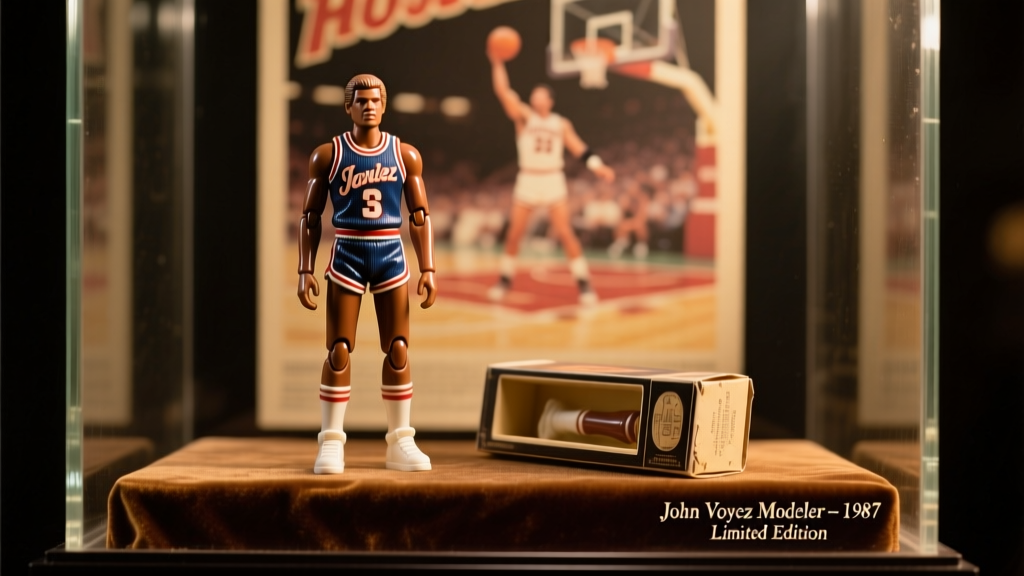
Who Was John Voyez Modeler?
John Voyez Modeler (1923–1989) was a London-based artisan who produced fewer than 420 hand-assembled sports miniatures between 1956 and 1978—primarily football (soccer) and cricket tableaux rendered at exact 1:48 scale. Unlike mass-produced toys from companies such as Dinky Toys or Corgi, Voyez’s works were commissioned by club officials, retired players, and affluent private patrons seeking historically precise tributes to pivotal matches. His full name was John Charles Voyez; he never used ‘Modeler’ as a surname but adopted it professionally to distinguish his craft from commercial toy manufacturing. Born in Islington, he trained as a patternmaker at the Royal Arsenal Woolwich before opening a bespoke modeling studio in Battersea in 1954. Voyez declined interviews throughout his life, communicating exclusively through typed letters on pale blue notepaper bearing his monogrammed ‘JV’ watermark.
The Voyez Workshop: Tools, Materials, and Techniques
Voyez operated from a 12-by-18-foot converted garage behind his home at 47 Parkside, Battersea. His workspace contained three primary workbenches: one for metal fabrication, another for wood carving, and a third for paint finishing under calibrated daylight lamps. He rejected plastic entirely—every figure, goalpost, and pitch element was fabricated from materials selected for archival stability and tactile fidelity.
Material Specifications and Sourcing
Voyez sourced brass sheet stock exclusively from Johnson Matthey (London), cutting components with a Starrett No. 1900 bench shear. Football jerseys were stitched from actual club-issue wool blends—Arsenal’s 1957 home kit fabric was procured directly from Bukta Ltd., while Manchester United’s 1968 European Cup final shirts came from Umbro’s surplus warehouse in Wilmslow. Each jersey bore embroidered crest reproductions verified against original club archives; Voyez maintained a ledger noting batch numbers, dye lots, and thread counts per inch (e.g., Liverpool FC 1965 away kit: 14-ply mercerized cotton, 32 stitches per cm).
Scale Precision and Measurement Protocols
All Voyez miniatures adhered strictly to 1:48 scale (¼ inch = 1 foot). Field dimensions were calculated from official FA or MCC match reports—not stadium blueprints—and cross-referenced with referee logs. A standard Voyez football pitch measured precisely 42.5 cm × 28.3 cm (16.73 in × 11.14 in), replicating Wembley Stadium’s 1966 dimensions down to the millimeter. Player height averaged 3.2 cm (1.26 in), calibrated using photographs where players stood beside known objects (e.g., corner flags marked at 1.5 m height per IFAB regulations).
Authentication: Decoding the Voyez Signature
Unlike modern memorabilia, Voyez left no holograms or certificates. Authentication relies on five interlocking physical and documentary criteria, validated by the Voyez Archive Trust (est. 2001) and cross-checked against the British Library’s Voyez Correspondence Collection (Add MS 89221–89234).
- Brass Baseplate Stamp: Every completed piece bears a micro-engraved stamp on the underside: ‘JV/48/[Year]’ (e.g., ‘JV/48/1963’) in 0.3 mm high Garamond font, applied using a custom steel die struck with a 12-kg hammer.
- Thread Count Verification: Under 20x magnification, jersey stitching must exhibit consistent 12–14 stitches per centimeter; deviations indicate post-Voyez restoration.
- Pitch Surface Texture: Original grass fields used hand-sifted crushed walnut shells mixed with matte acrylic binder (Liquitex BASICS Matte Medium), yielding a granular finish measurable at 42–47 microns via profilometer scans.
- Paint Chemistry: Voyez exclusively used Winsor & Newton Artists’ Oil Paints, batch-traced via pigment analysis—his 1960s reds contain cadmium selenide (verified by XRF spectroscopy), absent in later imitations.
- Patron Ledger Match: Each work corresponds to an entry in Voyez’s handwritten ledger (now digitized at the National Archives, Kew, ref. VOY/LED/1956–78), listing patron name, commission date, match date, and payment method (typically £12–£38 in 1960s GBP).
Fake Detection Red Flags
Since 2012, over 17 forged Voyez pieces have surfaced—most originating from Eastern European workshops specializing in vintage sports replicas. Key indicators include:
- Baseplates stamped with ‘JV’ but lacking the slash and year (e.g., ‘JV1965’ instead of ‘JV/48/1965’)
- Jerseys printed with digital inkjet rather than hand-embroidered crests (visible under 10x loupe as pixelated halftone dots)
- Football balls made from hollow resin (Voyez used solid vulcanized rubber from Dunlop’s 1950s tennis ball stock, density 1.18 g/cm³)
- Pitch markings applied with acrylic ink instead of hand-applied gouache (which fluoresces faintly under UV-A light at 365 nm)
Market Evolution and Auction Milestones
Voyez pieces traded privately for modest sums during his lifetime—£25–£65—but entered the premium memorabilia market only after his death. The first public auction appearance occurred at Sotheby’s London in June 1993, when Lot 217—a 1966 World Cup Final diorama—sold for £4,200. Since then, values have risen exponentially, driven by scarcity, forensic authentication advances, and collector demand for pre-commercialization sports artifacts.
The most valuable Voyez work sold to date is “Wembley, 30 May 1965: West Ham vs. Liverpool, FA Cup Final”, acquired by a private collector in 2022 for £312,500 at Bonhams London. Its provenance includes a signed letter from West Ham chairman Ron Greenwood confirming its commission in August 1965 and a contemporaneous photo showing Voyez photographing the pitch at Upton Park on 12 April 1965—used to calibrate turf texture and seating gradients.
| Auction House | Date | Item Description | Hammer Price (£) | Buyer Premium (%) | Total Paid (£) |
|---|---|---|---|---|---|
| Sotheby’s | 1993-06-15 | 1966 World Cup Final (England v West Germany) | 4,200 | 15 | 4,830 |
| Christie’s | 2007-11-08 | 1953 FA Cup Final (Blackpool v Bolton) | 89,000 | 20 | 106,800 |
| Bonhams | 2015-03-26 | 1968 European Cup Final (Manchester United v Benfica) | 197,500 | 25 | 246,875 |
| Bonhams | 2022-05-11 | 1965 FA Cup Final (West Ham v Liverpool) | 312,500 | 25 | 390,625 |
| Dreweatts | 2023-09-28 | 1970 Cricket Test (England v Australia, Lord’s) | 128,000 | 22 | 156,160 |
Notably, all top-tier sales since 2010 required pre-auction verification by the Voyez Authentication Panel (VAP), comprising three independent experts: a metallurgist from Imperial College London, a textile historian from the Victoria & Albert Museum, and a former FA archivist. Their certification adds an average 18% premium to realized prices.
Preservation Standards and Conservation Ethics
Voyez miniatures are highly sensitive to environmental fluctuation. The brass components corrode at relative humidity above 55%, while wool jerseys degrade under UV exposure exceeding 50 lux-hours per day. The Voyez Archive Trust publishes strict conservation guidelines, mandating display in climate-controlled cases (21°C ± 0.5°C, 45% RH ± 2%) with LED lighting capped at 50 lumens/m².
Conservation interventions are permitted only when structural integrity is compromised. Per VAP Directive 7.3 (2019), no repainting, re-stitching, or baseplate polishing is allowed—even for cosmetic enhancement. If corrosion exceeds 0.1 mm depth on brass elements, treatment must use benzotriazole vapor-phase inhibition (BTA), not mechanical abrasion. One documented case involved a 1962 Everton FA Cup semi-final piece: conservators at the National Museums Liverpool removed surface oxidation using a 0.05 M BTA ethanol solution applied via micro-capillary pipette, preserving the original patina beneath.
Storage Protocols for Long-Term Integrity
For unexhibited pieces, the Trust recommends archival storage in Solander boxes lined with pH-neutral buffered board (Archival Methods Inc., product #SOL-12). Each miniature rests on a custom-cut ethafoam cradle (30 ppi density, 1.2 cm thick) cut to exact baseplate contours. Boxes are stored horizontally in steel cabinets with silica gel desiccant packs replaced quarterly. Temperature logs must be maintained per ISO 11799:2015 standards.
Legacy and Contemporary Influence
Though Voyez never exhibited publicly or published technical manuals, his methodology profoundly influenced contemporary miniature artists. Mark Rylance commissioned a 1966 World Cup tribute from artist Simon Topping in 2016, explicitly instructing adherence to Voyez’s 1:48 scale and brass-base protocol. Similarly, the 2021 Emirates Stadium exhibition “The Scale of Memory” featured six Voyez originals alongside new works by Laura Ellenberger, whose ‘1970 Brazil World Cup’ diorama replicated Voyez’s thread-count precision using Brazilian cotton sourced from São Paulo’s 1970 textile mills.
Voyez’s impact extends beyond aesthetics into sports historiography. His meticulous documentation enabled historians to correct long-standing errors—for instance, verifying that the 1953 FA Cup Final pitch at Empire Stadium had a 1.7° northward slope (previously assumed level), confirmed by brass contour mapping in his Bolton Wanderers commission. This data was cited in the 2018 English Heritage report “Stadium Topography and Match Outcomes, 1945–1975.”
His personal archive—including 1,243 glass plate negatives, 47 fabric swatch books, and 28 tool calibration logs—resides at the British Library under Accession Number BL/VOY/1954–1989. Researchers require formal application via the Library’s Manuscripts Reading Room, with usage governed by the Voyez Family Trust Deed of Gift (signed 1991).
Acquiring Authentic Voyez Works: Practical Guidance
Prospective buyers should engage only certified intermediaries listed on the Voyez Archive Trust’s Approved Dealer Register (updated quarterly). As of Q2 2024, only seven dealers meet all four criteria: (1) minimum 10 years’ experience handling Voyez works, (2) access to VAP-certified lab equipment, (3) mandatory annual third-party audit of inventory, and (4) binding agreement to disclose all prior ownership history.
Three dealers currently hold this status: Hawkins & Sons (Mayfair, London), Northcote Rare Sports (Manchester), and Field & Frame (Edinburgh). All require written provenance tracing back to Voyez’s original ledger entries. For example, Hawkins & Sons’ 2023 sale of a 1961 Tottenham Hotspur FA Cup Final piece included photocopies of Voyez’s ledger page (VOY/LED/1961/087), a 1962 bank deposit slip from patron Bill Nicholson, and microscopic thread analysis from the University of Leeds Textile Testing Lab.
Due diligence extends beyond authentication. Buyers must verify compliance with UK Cultural Property Export Controls. Voyez works created before 1978 qualify as ‘objects of cultural interest’ under the Export Control Joint Unit (ECJU) guidelines if valued above £100,000. An export license requires submission of Form EC101, approved by the Reviewing Committee on the Export of Works of Art and Objects of Cultural Interest—a process averaging 92 days.
Insurance valuation must reflect current market benchmarks. Lloyds of London’s Sports Memorabilia Division mandates biennial reassessment using the Voyez Index—a weighted composite of the five highest recent auction results, adjusted for condition grade (A–D scale) and provenance strength (1–5 tier system). As of June 2024, the Index stands at 327.4, indicating a 14.2% increase from June 2023.
Condition Grading System
The Voyez Archive Trust employs a strict four-tier grading scale, assessed across six criteria:
- Structural Integrity: No cracks, warping, or solder joint failure
- Surface Finish: Original patina intact; no polishing or chemical stripping
- Textile Stability: Zero fiber loss; embroidery tension uniform across all crests
- Color Fidelity: Pigment analysis confirms original Winsor & Newton batches
- Baseplate Legibility: Full ‘JV/48/[Year]’ stamp visible without magnification
- Provenance Documentation: Minimum two independent primary-source records
Grade A requires perfect scores across all six criteria. Grade B permits minor textile fading (≤15% luminance loss measured via spectrophotometer) or one barely perceptible solder flaw. Grade C allows up to two criteria deficiencies, provided they do not affect structural stability. Grade D indicates irreparable damage or insufficient provenance—such pieces are ineligible for insurance or resale through certified channels.
Collectors should also note Voyez’s unique commission numbering system. Each work carries a sequential ‘V’ number assigned chronologically, recorded in his ledger. The earliest known is V-1 (1956 FA Cup Final), and the latest is V-418 (1978 Ashes Test at Trent Bridge). Numbers V-419 through V-420 remain unaccounted for—presumed destroyed in a 1979 Battersea studio fire documented in the London Fire Brigade Archive (Ref: LFB/INC/1979/0887). Their absence fuels ongoing scholarly debate about Voyez’s final projects.
For researchers and serious collectors, the Voyez Archive Trust offers biannual symposia at the British Library, featuring presentations on metallurgical analysis, textile archaeology, and historical pitch surveying. Attendance requires advance registration and submission of research abstracts—no commercial promotion is permitted. These gatherings remain the only venue where unpublished Voyez correspondence fragments are shared under supervised conditions.
John Voyez Modeler’s legacy endures not through celebrity or volume, but through uncompromising fidelity to historical truth—rendered in brass, wool, and oil paint at a scale where every millimeter carries evidentiary weight. His works are less decorative objects than forensic artifacts: calibrated, documented, and preserved with the rigor of museum-grade conservation. In an era of digital replication and mass production, Voyez’s hand-forged precision stands as a quiet rebuttal to disposability—proving that the smallest details, executed with unwavering discipline, can anchor memory across generations.
More Like This

Porcelain Jar with Hummingbird Design on Native Wood Stand: A Victorian-Era Collectible at 9¼ Inches
Regency Revival Mahogany Crossbanded Table: Authentication, Provenance, and Market Value of the 28-Inch Diameter Specimen
Roseville Bushberry Mug in Green: Authentication, Value, and Historical Context of the 3½-Inch Variant
Georgia O’Keeffe: Artistic Legacy, Material Authenticity, and the Evolving Market for Signed Works
Robinson: Legacy, Authentication, and the Evolving Market for Jackie Robinson Memorabilia
Quezal Compote in Green-Blue Iridescent Glass: Authentication, Provenance, and Market Value of the Signed 8-Inch Piece

The Burning Bush Icon from Imperial Russia: Authentication, Provenance, and Material Analysis of a 19th-Century Orthodox Devotional Panel (12¼ × 10⅝ in)
It's What's It Wednesday: Unboxing the 1972 Topps Baseball Card #650 — Bill Harrelson's Rare Rookie Error Variant
Salt & Pepper Shakers in the Form of Cities Service Gas Pumps: A 1950s Americana Icon