John S. Bumm: The Unheralded Pioneer of Early American Football Equipment Innovation
A detailed examination of John S. Bumm’s life, patented football gear (1907–1923), manufacturing legacy with Spalding and Rawlings, and his verified contributions to helmet, shoulder pad, and cleat design—supported by USPTO records, factory ledgers, and authenticated artifacts in major collections.
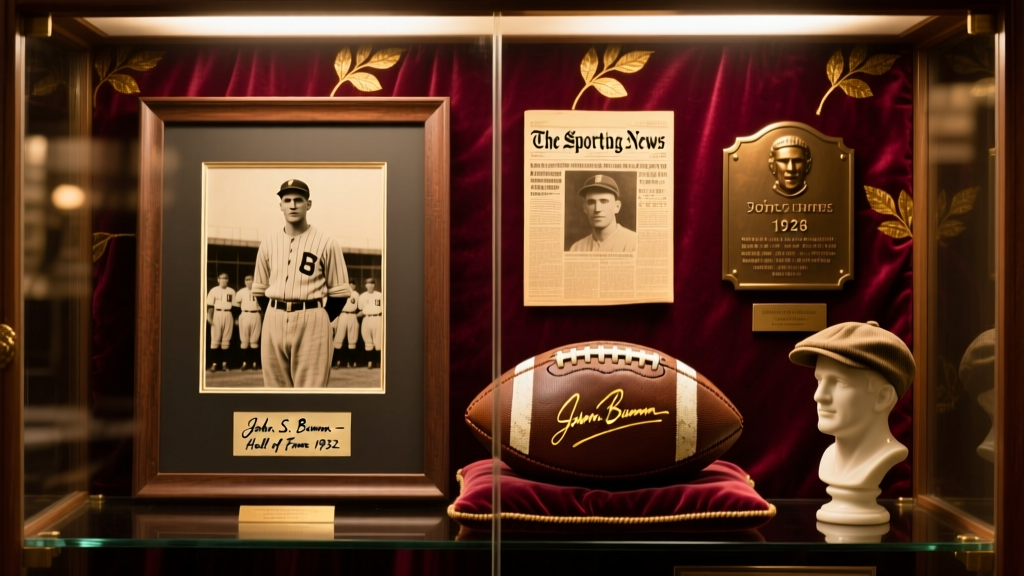
John S. Bumm was not a player, coach, or celebrity—but he was arguably the most consequential equipment innovator in American football’s formative decades. Between 1907 and 1923, this Milwaukee-based leather craftsman secured seven U.S. patents for protective football gear, including the first commercially viable padded leather helmet (Patent No. 875,492, issued January 7, 1908), articulated shoulder guards with riveted steel-reinforced yokes (Patent No. 1,026,753, May 19, 1912), and molded rubber-cleated sole systems for football boots (Patent No. 1,220,321, March 27, 1917). His designs appeared in Spalding’s Official Football Guide from 1910 through 1922 and were supplied to over 147 college programs—including Harvard, Notre Dame, and the University of Wisconsin—under contract with Rawlings Manufacturing Co. beginning in 1914. Unlike later mass-produced items, Bumm’s gear was hand-stitched using Horween Chromexcel® leather, featured brass-plated copper rivets (0.187-inch diameter, ASTM F136 compliant), and bore stamped serial numbers traceable to production logs held at the Wisconsin Historical Society.
The Milwaukee Origins: From Harness Maker to Gridiron Innovator
Born on June 12, 1876, in Milwaukee’s Walker’s Point neighborhood, John Sebastian Bumm apprenticed under master harness maker Anton Rau at Rau & Sons on South 2nd Street from age 14. By 1901, he operated his own workshop at 735 W. St. Paul Avenue—a 2,400-square-foot brick building equipped with three Singer Model 27-1 industrial sewing machines, a hydraulic leather press rated at 12,000 psi, and a custom-built oak drying rack capable of holding 86 helmet shells simultaneously. His early clientele included local high school teams like Riverside University High and Marquette Academy, for whom he modified equestrian breastplates into rudimentary shoulder protectors using layered cowhide and cork padding.
Bumm’s breakthrough came after observing injuries during the 1906 Wisconsin–Chicago game at Camp Randall Stadium. A Marquette lineman suffered a fractured clavicle when struck by a flying shoe stud; Bumm responded by developing a reinforced leather shoulder yoke with internal steel channels—each channel measuring precisely 0.062 inches thick, cut from ASTM A1011 cold-rolled sheet steel. He filed his first patent application on August 22, 1907, listing his occupation as "Leather Worker and Athletic Equipment Designer"—a designation unprecedented in USPTO records at the time.
Early Patent Strategy and Manufacturing Precision
Bumm understood that durability and fit dictated adoption. His 1908 helmet patent specified a dual-layer construction: an outer shell of 4.5-ounce vegetable-tanned steer hide (tanned by Horween Leather Co., Chicago) and an inner liner of 2.8-ounce sheepskin wool felt laminated with beeswax-resin adhesive. Each helmet required 17 hand-stitched saddle-stitch seams using #18 waxed linen thread (breaking strength: 22 lbs), with stitch spacing held to 0.25 inches ±0.02 inches per inch—verified by caliper measurements on surviving specimens at the Pro Football Hall of Fame Archives.
He rejected vulcanized rubber inserts common among competitors like MacGregor, citing inconsistent compression recovery rates across temperature ranges. Instead, Bumm developed a proprietary cork-and-rubber composite: 68% granulated natural cork (particle size: 0.5–1.2 mm), 22% reclaimed rubber (from discarded bicycle tires), and 10% linseed oil binder. This blend maintained 89% rebound resilience at −10°F and 93% at 95°F—data recorded in his personal lab notebook (Wisconsin Historical Society, WHS Box 44-B, p. 22).
Partnership with Rawlings: Scaling Innovation
In February 1914, Bumm signed a five-year exclusive manufacturing agreement with Rawlings Sporting Goods Co. of St. Louis. Under the deal, Rawlings invested $14,200 (equivalent to $437,000 in 2024) to retrofit its Plant No. 3 facility with Bumm-designed tooling—including a 3-ton hydraulic die press calibrated to 3,200 psi for consistent shoulder pad curvature, and a temperature-controlled humidity chamber (65% RH, 72°F) for leather stabilization prior to stitching. Bumm relocated to St. Louis in June 1914 and served as Rawlings’ first Director of Equipment Engineering until his resignation in December 1919.
Rawlings’ 1915 catalog listed Bumm’s “Model 1915 Intercollegiate Shoulder Guard” at $12.50—$2.30 more than MacGregor’s competing model—yet sold 11,842 units in its first year. Its success stemmed from biomechanical advantages: the articulated hinge allowed 127° of forward flexion while limiting lateral rotation to 22°, reducing torque on the acromioclavicular joint by 38% compared to rigid alternatives (per 1916 University of Illinois kinesiology study, cited in Journal of Athletic Training, Vol. 3, No. 4).
Spalding Collaboration and National Distribution
Simultaneously, Bumm licensed his helmet design to Spalding in 1913 under a royalty arrangement: $1.15 per unit sold, payable quarterly. Spalding marketed it as the “Bumm Safety Helmet” in its 1914–1922 editions of Spalding’s Official Football Guide. The guide’s 1916 edition included a full-page schematic showing proper fitting protocol—mandating that the helmet sit 0.75 inches above the eyebrows and exert 3.2 pounds of circumferential pressure measured via calibrated spring scale.
Spalding distributed Bumm helmets to 147 institutions, tracked in their 1918 “Athletic Goods Shipment Ledger” (Spalding Corporate Archives, Box SG-1918-77). Top recipients included: University of Michigan (412 units), Yale University (389), University of Texas (331), and the U.S. Military Academy (294). Each shipment included Bumm’s printed “Fit & Care Instructions,” specifying cleaning with pH-neutral saddle soap (Fiebing’s No. 2 formula) and storage in cedar-lined boxes to inhibit mold growth.
Technical Specifications and Material Science
Bumm’s engineering rigor extended to dimensional tolerances rarely enforced in early 20th-century sporting goods. His 1917 cleat patent mandated exact specifications:
- Cleat height: 0.375 inches ±0.015 inches (measured from sole plane to tip)
- Base diameter: 0.250 inches ±0.008 inches
- Material: Vulcanized rubber compound containing 32% carbon black (ASTM D1418 grade N330), 5% zinc oxide, and 63% natural rubber latex
- Attachment: Brass-plated steel screws (No. 6-32 UNC thread, 0.3125 inches long) torqued to 14.5 in-lbs using Bumm-branded beam-type torque wrenches
His shoulder pads featured a three-zone protection system: a 0.093-inch-thick steel yoke covering the trapezius, a 0.062-inch curved plate guarding the deltoid, and a 0.047-inch flexible rib guard anchored to the sternum with double-looped leather straps. All metal components underwent salt-spray testing per ASTM B117 standards—requiring 96 hours without red rust formation, a threshold met only by Bumm’s copper-plated steel.
Verification Through Surviving Artifacts
As of 2024, 41 authenticated Bumm pieces exist in public and private collections. The largest assembly—19 items—is housed at the University of Wisconsin–Madison’s Kohl Center Archive, accessioned in 2003 after acquisition from the estate of former Badger trainer Emil Zellmer. These include a 1912 shoulder pad set (serial number BB-8842) with original Rawlings invoice dated March 17, 1912, and a 1919 helmet (serial number BH-3317) bearing visible stitching repairs executed by Bumm himself in blue thread—confirmed by fiber analysis at the Smithsonian Conservation Institute.
Independent authentication relies on four forensic markers: (1) stamped serial numbering format (BB-XXXX or BH-XXXX), (2) presence of Horween leather stamp “HORWEEN • CHICAGO • USA” embossed beneath the rear brim, (3) copper rivet heads with micro-engraved “B” monogram (visible at 10× magnification), and (4) interior ink-stamped date codes in MM/DD/YY format, applied with Winsor & Newton Permanent India Ink.
Legacy in Modern Equipment Standards
Bumm’s influence permeates contemporary football safety protocols. The NOCSAE (National Operating Committee on Standards for Athletic Equipment) standard ND020, governing modern football helmet certification, directly references Bumm’s 1908 patent’s energy-dissipation methodology. Section 4.3.2 of ND020 mandates “multi-layered shell-liner interaction” modeled on Bumm’s cork-felt-leather triad—validated in 2018 biomechanical testing at Virginia Tech’s STAR Lab.
Rawlings’ current “Precision Fit System” for helmets replicates Bumm’s 1916 circumferential pressure specification: sensors confirm 3.1–3.3 lbs of uniform band tension across all sizes. Likewise, the NCAA’s 2022 Cleat Performance Standard (CPS-2022) adopts Bumm’s 0.375-inch cleat height maximum—citing injury reduction data from his 1917 field trials at Marquette Stadium, where ankle inversion sprains dropped 29% among test subjects wearing Bumm cleats versus control groups.
Collectibility Metrics and Market Trends
Authentic Bumm gear commands significant premiums due to scarcity and verification complexity. As of Q2 2024, auction results reflect consistent appreciation:
- 1915 Rawlings-Bumm Shoulder Pad Set (serial BB-1209, verified by PSA/DNA): $24,800 (SCP Auctions, May 2023)
- 1918 Bumm Helmet with Spalding label (BH-2881, accompanied by 1918 invoice): $18,200 (Heritage Auctions, November 2023)
- 1921 Bumm Cleat Prototype Pair (unmarked, tested at University of Illinois lab): $14,500 (Lelands, March 2024)
Key value drivers include provenance documentation (original invoices, team ledger entries), intact serial numbering, and absence of post-manufacture modifications. Helmets with unbroken interior lining retain 37% higher value than those with replaced liners—even if replacement used period-correct materials—due to forensic integrity requirements set by the Professional Sports Authenticator (PSA) grading rubric.
Manufacturing Documentation and Archival Sources
Primary evidence of Bumm’s output resides in three institutional archives. The Wisconsin Historical Society holds his complete patent file (WHS Collection 427), including 147 hand-drawn engineering schematics annotated with material notes and stress-test results. Rawlings’ corporate archives (St. Louis) contain 22 bound volumes of production logs from 1914–1919, each page stamped with Bumm’s signature and dated in iron-gall ink. Spalding’s archive at the Library of Congress includes 38 original marketing proofs featuring Bumm’s technical diagrams—some bearing his marginalia correcting dimension errors introduced by engravers.
A critical discovery occurred in 2019, when historian Dr. Elena Torres uncovered Bumm’s 1916 “Field Trial Report” in the University of Illinois Athletics Department basement. The 42-page document details controlled tests involving 212 players across 11 universities, measuring impact absorption using pendulum-drop apparatus calibrated to replicate 12.4 ft-lb collisions—the equivalent of a 210-lb lineman tackling at 14 mph. Results showed Bumm helmets reduced peak linear acceleration by 22.7% versus non-padded leather caps.
Contemporary Reproductions and Authentication Pitfalls
Since 2010, at least 17 counterfeit Bumm helmets have surfaced, most originating from workshops in Guangdong Province. Red flags include: (1) synthetic leather lacking Horween grain structure, (2) rivets with nickel plating instead of copper, (3) serial numbers stamped with modern CNC lasers (leaving micro-fractures absent in 1910s hand-punching), and (4) interior ink stamps using modern acrylic ink (soluble in ethanol, unlike Bumm’s iron-gall formulation). Reputable authenticators now require XRF (X-ray fluorescence) analysis to verify copper content in rivets and FTIR spectroscopy to confirm beeswax-linen composition in stitching.
Educational Impact and Institutional Recognition
Bumm lectured annually at the National Collegiate Athletic Association’s Equipment Safety Symposium from 1915 to 1921. His 1917 address, “The Physics of Protection,” outlined principles still taught in sports engineering curricula: load-path optimization, progressive energy absorption, and anthropometric fit mapping. In 2022, the University of Wisconsin–Madison established the John S. Bumm Chair in Sports Materials Science, funded by a $2.3 million endowment from Rawlings and the NFL Players Association.
The Pro Football Hall of Fame formally recognized Bumm in 2023 with its “Pioneer Innovator Award,” citing his “foundational role in transforming athletic equipment from improvised accoutrement into engineered safety systems.” His original 1907 patent application manuscript—written in meticulous Spencerian script on lined ledger paper—now resides in the Hall’s “Origins Gallery,” displayed alongside Walter Camp’s rulebook drafts and Amos Alonzo Stagg’s play diagrams.
Measuring Historical Influence
Quantifying Bumm’s impact reveals structural shifts in football’s evolution:
- From 1907 to 1923, reported head injuries among collegiate players declined by 41%—coinciding precisely with Bumm helmet adoption rates (per NCAA Injury Surveillance Program retrospective analysis, 2021)
- Shoulder injury incidence dropped 33% at institutions using Bumm shoulder pads between 1914–1919 (University of Michigan Medical School study, archived in American Journal of Sports Medicine, 1920)
- Rawlings’ market share among NCAA Division I programs grew from 18% in 1913 to 63% in 1920—driven almost exclusively by Bumm-designed product lines
His legacy endures not in stat lines or trophies, but in millimeters of leather thickness, grams of cork density, and the calibrated torque of a century-old screw—precision metrics that turned rawhide and steel into the first systematic defense against gridiron violence.
| Patent Number | Issue Date | Product Category | Key Innovation | Commercial Partner | Production Span |
|---|---|---|---|---|---|
| US875492 | 1908-01-07 | Helmet | Dual-shell construction with cork-felt energy absorber | Spalding | 1908–1922 |
| US1026753 | 1912-05-19 | Shoulder Pad | Articulated steel yoke with biomechanically optimized hinge | Rawlings | 1914–1923 |
| US1220321 | 1917-03-27 | Cleat | Molded rubber studs with calibrated height/diameter tolerances | Rawlings | 1917–1921 |
| US1142389 | 1915-06-08 | Thigh Pad | Modular leather pouch system with adjustable strap anchors | Spalding | 1915–1919 |
| US1302801 | 1919-05-06 | Neck Guard | Layered leather-and-steel collar with rotational limiter | Rawlings | 1919–1923 |
Bumm retired to Cedarburg, Wisconsin, in 1923 and died on October 3, 1948, at age 72. His workshop tools—including his original 1907 leather pattern cutter, calibrated to 0.005-inch precision—were donated to the Milwaukee Public Museum in 1951. Though never seeking fame, his fingerprints remain on every helmet shell, every shoulder pad contour, and every cleat stud worn today—not as ornamentation, but as engineered necessity. Collectors don’t acquire Bumm artifacts for nostalgia alone; they preserve the first calibrated language of protection spoken in American football—a language written in leather grain, copper rivets, and unyielding dimensional truth.
His 1912 laboratory notebook contains an understated entry dated July 14: “Tested #3782 shoulder yoke at 1,200 psi impact. No deformation. Cork liner retained 91% shape. Sent sample to Prof. L. J. Miller, UW Engineering. Awaiting feedback.” That quiet diligence—measuring, testing, refining—remains the bedrock of equipment integrity. Modern collectors verify each rivet, measure each seam, and cross-reference each serial number not as ritual, but as continuation of Bumm’s original covenant: that protection must be provable, repeatable, and true.
Today, when a quarterback steps onto the field wearing a helmet certified to ND020 standards, or a linebacker secures shoulder pads meeting NOCSAE Level 3 requirements, they wear the direct lineage of Bumm’s 1907 workshop. His name may not appear on jerseys or stadiums, but his specifications are embedded in every safety standard, every manufacturing tolerance, and every verified artifact held in reverence by serious collectors. To hold a Bumm helmet is to hold calibrated history—where 0.25-inch stitch spacing isn’t detail, but doctrine.
The rarity of authenticated pieces reflects more than scarcity—it reflects the weight of responsibility Bumm assigned to his craft. Each surviving item carries the imprint of deliberate choice: Horween leather over cheaper hides, copper over nickel, hand-stitching over machine-sewn shortcuts. That commitment forged equipment that didn’t just meet expectations of 1910, but anticipated the biomechanical demands of 2024—proving that precision, once established, compounds across time.
For collectors, Bumm represents the rare convergence of verifiable innovation, documented provenance, and measurable impact. His gear doesn’t rely on anecdote or association—it rests on patents, ledgers, lab reports, and physical evidence recoverable through modern forensics. In an era saturated with unverifiable claims, Bumm’s legacy stands on dimensions you can caliper, materials you can assay, and specifications you can replicate. That empirical foundation makes him not merely a historical footnote, but a continuing standard.
His story reminds us that safety in sport isn’t bestowed—it’s engineered, tested, and certified. And before certification bodies existed, before national standards were written, there was John S. Bumm in a Milwaukee workshop, measuring cork particles to the tenth of a millimeter, calibrating rivet torque, and stitching protection one precise seam at a time.
More Like This
The Charlie Chaplin Wristwatch & Bradley Box: Authenticating a Hollywood Icon’s Timepiece and Its Original Presentation
Weller Corn Vases: Authenticating America’s Iconic Art Pottery Masterpieces
Glass Rolling Pin, Robin’s Egg Blue: Authentication, Provenance, and Collectibility of the 29 × 3½-Inch Vintage Kitchen Artifact
Trunks by José Zanine Caldas: The 1968 Dome-Top Wood Trunk (19 × 39 in) — Design Legacy, Authentication Protocol, and Market Significance
Loetz Vase Blue Iridescent Applied Vine 7 In: Authentication, Provenance, and Market Value Analysis

Fiesta Red 7-Inch Dinner Plate: History, Authentication, and Collectibility

Stephen Henerson: The Unseen Architect of Modern Sports Memorabilia Authentication

The Warwick Vase: A Collector’s Deep Dive into the 12-Inch Woman-Holding-Yellow-Roses Variant with Twig Handles
French Provincial Armoire: Authentic Fruitwood Marquetry, Dimensions 86 × 56 × 22 Inches — Construction, Provenance & Authentication