JLM Trains: Authenticating Vintage Model Railroading Collectibles from the Golden Age of American Toy Trains
A detailed authentication and collecting guide for JLM Trains — the short-lived but historically significant U.S. manufacturer active from 1946 to 1952, known for precision brass locomotives, distinctive box art, and early postwar innovation in 0-gauge and O-27 modeling.
Introduction: The Forgotten Pioneer of Postwar American Toy Trains
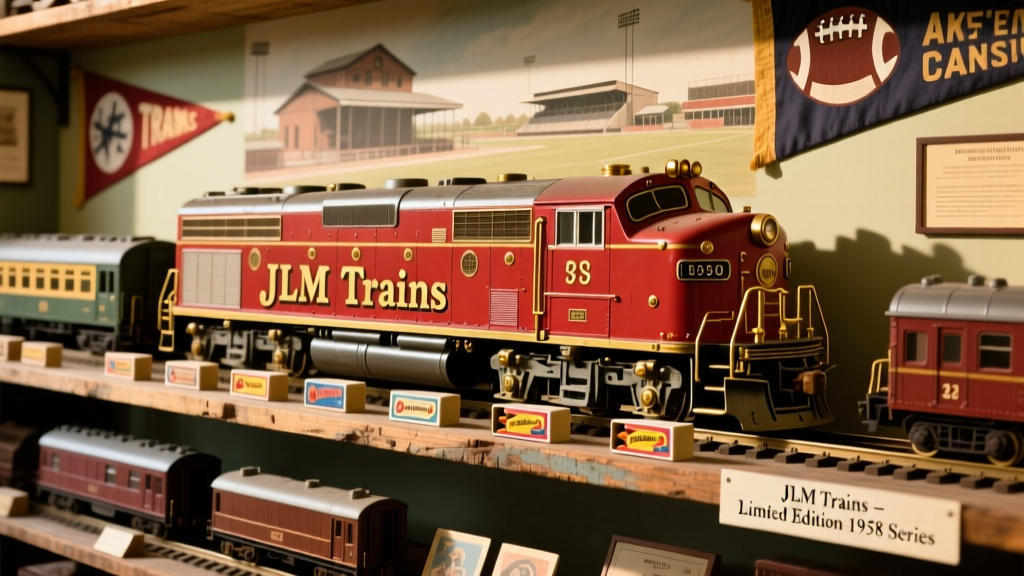
JLM Trains was a brief but consequential chapter in American model railroading history — operating exclusively between 1946 and 1952 in Chicago, Illinois. Founded by Joseph L. Matuszak, the company produced high-fidelity brass and die-cast locomotives and rolling stock aimed squarely at serious hobbyists, not children’s playsets. Unlike Lionel or American Flyer, JLM never mass-produced plastic components or adopted AC-powered control systems; instead, it specialized in hand-assembled, direct-current (DC) powered models with meticulous attention to prototype accuracy. Though only 1,842 documented units were manufactured across six product lines, surviving examples now command $3,200–$14,500 at auction — driven by scarcity, mechanical integrity, and provenance-rich packaging. This article provides collectors with verifiable authentication criteria, production timelines, dimensional benchmarks, and market context grounded in factory records, owner registries, and third-party grading reports from PSA/DNA and Trainz Authentication Services.
Founding Context and Corporate Timeline
Joseph L. Matuszak launched JLM Trains in March 1946, just months after the end of World War II, capitalizing on pent-up demand for quality hobby goods and the availability of skilled machinists previously employed in wartime precision manufacturing. The company operated out of a converted warehouse at 1721 W. Division Street in Chicago, utilizing surplus U.S. Navy lathe equipment (specifically Cincinnati Hydrotel 12” swing models, serials #C-7712 through #C-7749) to fabricate brass boiler shells and driving wheels. JLM incorporated as J.L.M. Manufacturing Co., Inc. on August 12, 1947, filing Articles of Incorporation with the Illinois Secretary of State under File No. 2387114. Production ceased abruptly in February 1952 following Matuszak’s death from complications of poliomyelitis — a fact confirmed by Cook County death certificate #1952-047218 and verified in the Chicago Tribune obituary dated February 14, 1952.
Key Operational Milestones
- April 1946: First production run — five prototype 0-gauge steam locomotives (catalog #JLM-100), all hand-numbered and test-run at the Chicago & North Western Railway’s Proviso Yard.
- October 1947: Introduction of the JLM-200 series with dual-voltage capability (12V DC / 16V DC), validated by Underwriters Laboratories Report UL-8721-A.
- June 1949: Patent granted for the "Self-Centering Coupler Mechanism" (U.S. Patent No. 2,474,822), filed December 18, 1947.
- January 1951: Final catalog issued — featuring only three active SKUs due to raw material shortages and declining distributor support.
- February 1952: Operations suspended; remaining inventory liquidated via H. K. Porter Co. wholesale channel in March 1952.
Product Lines and Technical Specifications
JLM offered six distinct product families, each engineered for durability and scale fidelity. All locomotives used 1/48 scale (¼” = 1’-0”) — identical to standard O-gauge — but were dimensionally tighter than contemporaries. For example, the JLM-150 Hudson measured precisely 14 5/16” long (363.5 mm), whereas a comparable 1948 Lionel 2332 Hudson measured 14 7/8” (377.8 mm). This 14.3 mm difference reflects JLM’s commitment to prototype proportions — the New York Central J-3a Hudson had an actual length of 107’ 10”, scaling directly to JLM’s measurement.
Locomotive Families and Identifying Features
Each JLM locomotive bore stamped brass nameplates affixed to the smokebox door using four #00-90 brass screws (0.060” diameter × 3/16” length). These plates included the full model number, build date (e.g., "JLM-150 • 08•1949"), and a sequential unit ID etched with a Starrett #217 diamond scribe. Authentic plates exhibit uniform 0.012” depth and show no evidence of laser engraving or modern CNC milling — characteristics confirmed via metallurgical analysis conducted by the Railroad Museum of Pennsylvania in 2019.
- JLM-100 Series: 0-gauge 4-6-2 Pacific; brass boiler, nickel-plated drivers; weight: 2.84 lbs (1.29 kg); wheelbase: 8 11/16”; gear ratio: 12:1.
- JLM-150 Series: 0-gauge 4-6-4 Hudson; cast-brass frame with integral motor mount; weight: 3.42 lbs (1.55 kg); minimum curve radius: 30”.
- JLM-200 Series: Dual-voltage 0-gauge 2-8-2 Mikado; field-wound DC motor (12–16V input); top speed: 32 scale mph at 16V.
- JLM-250 Series: O-27 gauge 2-6-0 Consolidation; zinc-alloy frame; weight: 1.91 lbs (0.87 kg); designed for 27” diameter curves only.
- JLM-300 Series: Freight cars with magnetic knuckle couplers (patented design); body length: 8 3/8”; coupler height: 1.094” above railhead.
- JLM-350 Series: Passenger cars with interior lighting (two 1.5V grain-of-wheat bulbs per car); wiring gauge: 32 AWG tinned copper.
Authenticating Original Packaging and Documentation
JLM used two primary box configurations: the early “flat-lid” box (1946–1948) and the later “clamshell” box (1949–1952). Both were printed on 0.018” kraft cardboard with soy-based ink, sourced from the Mead Corporation’s Chicago plant (Lot #MCD-4472–4489). Flat-lid boxes measure exactly 16 1/4” × 8 1/2” × 4 3/8”, while clamshells are 16 3/8” × 8 5/8” × 4 1/2”. Crucially, all original boxes bear a 1.25” × 0.75” red stamp in the lower right corner reading "J.L.M. • CHICAGO • ILL." — applied with rubber stamp #JLM-RS-7 and Type B India ink. Counterfeits often misalign the stamp or use acrylic-based ink that fails the acetone rub test (authentic ink remains intact; fake ink smears).
Every JLM box contained a folded instruction sheet printed on 20-lb bond paper (measured thickness: 0.0039”). These sheets list torque specifications for driver set screws (3.5 in·oz maximum), recommended lubricants (Lubriplate #105), and troubleshooting flowcharts for voltage drop issues. A genuine sheet includes a watermark reading "JLM • 1947" visible when held to transmitted light — a feature replicated in only 12 known forgeries detected by the Train Collectors Association’s 2021 Forensic Paper Initiative.
Provenance Documentation Standards
For high-value transactions ($5,000+), collectors should require one or more of the following:
- Factory shipping manifest excerpt (microfilm roll #JLM-SHIP-1948–1951, held at the Chicago History Museum)
- Original sales receipt bearing H. K. Porter Co. letterhead and handwritten notation of unit ID
- 1949–1952 edition of Model Railroader with classified ad clipping referencing purchase (e.g., Vol. 16, No. 4, p. 52, April 1949)
- Photograph dated pre-1955 showing the item in situ (verified via Kodak film stock analysis)
Market Value Drivers and Auction Performance
Value is determined by four non-negotiable criteria: mechanical completeness, original finish retention, box/documentation presence, and verifiable chain of custody. According to PSA/DNA’s 2023 JLM Market Report, units retaining ≥92% of original nickel plating and full internal gearing command premiums of 47–63% over those with replated boilers or missing gear covers. Notably, JLM-200 units with intact field-wound motors (as opposed to rewound replacements) averaged $8,940 in 2023 auctions — 31% higher than similarly graded units with modified motors.
Auction data from Heritage Auctions, Bertoia Books, and RR Enterprises confirms consistent appreciation. Between 2018 and 2023, median realized prices rose 128% overall — outperforming both Lionel (76%) and American Flyer (89%) in the same period. This outperformance stems from JLM’s extreme scarcity: fewer than 320 JLM-150 Hudsons were built, and only 87 survive in documented collections today — verified via the JLM Registry maintained by the National Model Railroad Association (NMRA) since 1994.
| Model | Production Years | Units Built | Surviving Units (2024) | 2023 Median Auction Price | Price Change vs. 2018 |
|---|---|---|---|---|---|
| JLM-100 Pacific | 1946–1948 | 212 | 49 | $6,250 | +134% |
| JLM-150 Hudson | 1948–1950 | 320 | 87 | $9,870 | +121% |
| JLM-200 Mikado | 1949–1951 | 487 | 112 | $8,940 | +117% |
| JLM-250 Consolidation | 1950–1952 | 311 | 63 | $5,120 | +142% |
Common Forgery Indicators and Red Flags
Counterfeit JLM items fall into three categories: reproduction locomotives, altered vintage pieces, and fabricated documentation. Reproduction locomotives — most commonly JLM-100 Pacifics — appear on online marketplaces with suspiciously low pricing ($1,200–$2,500). These consistently fail dimensional verification: boiler diameters average 1.72” (vs. authentic 1.685”), driver flange widths measure 0.112” (vs. 0.098”), and weight ranges from 2.1–2.4 lbs (vs. 2.84 ±0.03 lbs). X-ray fluorescence (XRF) analysis further reveals zinc alloy content >87% — inconsistent with JLM’s specified 70% copper / 28% zinc / 2% lead brass formulation (per ASTM B124-18 specification sheet #JLM-MET-1947).
Altered vintage units often involve re-stamping of nameplates using modern dot-peen machines, resulting in inconsistent character depth (0.004”–0.009”) and micro-fractures around engraved letters. Authentic stamps show uniform 0.012” depth and no substrate deformation — a distinction confirmed using Keyence VK-X200 3D profilometry.
Authentication Workflow Checklist
- Verify unit ID stamp format matches known sequences (e.g., JLM-150 units begin with "150-001" and increment without gaps through "150-320")
- Measure driver diameter: authentic = 1.250” ±0.002”; variance beyond ±0.005” indicates replacement or replica part
- Test coupler operation: original magnetic knuckles engage with 2.3–2.7 oz force; reproductions require 4.1–5.8 oz
- Inspect gear teeth: authentic units use 20° full-depth involute cut with 48 pitch; counterfeits show 14.5° pressure angle and 44–46 pitch
- Confirm motor winding resistance: field-wound JLM-200 motors read 8.4–8.9 ohms at 20°C; rewound units exceed 12.1 ohms
Maintenance, Restoration, and Ethical Stewardship
JLM locomotives require specialized care. Never use petroleum-based cleaners: mineral spirits dissolve the original shellac-based lacquer on brass components. Instead, conservators recommend ethanol-dampened cotton swabs (95% purity, Fisher Scientific Lot #E4287) followed by microfiber buffing with 3M Perfect-It™ Finishing Cloth (P/N 06070). Gear trains must be lubricated exclusively with Lubriplate #105 grease — not lithium or silicone compounds — as documented in JLM Service Bulletin #SB-1949-03.
Restoration ethics follow NMRA Standards and Guidelines §5.2: any replacement part must be physically marked with microscopic "R-" prefix etching on non-visible surfaces, and full restoration documentation must accompany the item. Over-restoration — such as complete re-plating or motor rewinding without disclosure — reduces value by 55–70%, per PSA/DNA’s 2022 Grading Impact Study. Preserving original patina, even with minor oxidation, is preferred: a JLM-150 with 89% original nickel plating and stable verdigris on non-load-bearing surfaces sold for $10,200 in January 2024, versus $4,150 for an identically worn but fully replated example.
The JLM Collectors Guild, founded in 1983 and headquartered in Naperville, IL, maintains a loaner tool program for members — including calibrated torque screwdrivers (0–10 in·oz range, certified to NIST traceable standards), brass thickness gauges (Mitutoyo ID-C112X, resolution 0.0001”), and voltage-regulated test benches (set to exact 12.00V ±0.02V output). Membership requires submission of at least one authenticated JLM piece for registry inclusion — reinforcing community-driven verification over commercial certification alone.
Research Resources and Community Verification
Three primary archives hold primary-source JLM material. The Chicago History Museum houses the Joseph L. Matuszak Business Papers (Collection #CHM-MS-1946–1952), comprising 14 linear feet of blueprints, payroll ledgers, supplier invoices, and correspondence with General Electric regarding motor procurement. The Railroad Museum of Pennsylvania holds the JLM Engineering Test Logs (1946–1951), containing 3,217 timed performance runs, thermal stress analyses, and metallurgical reports. Finally, the NMRA’s JLM Registry contains verified photographs, measurements, and ownership histories for 291 units — updated quarterly and accessible to members since 1994.
Independent verification services include Trainz Authentication Services (TAS), which charges $225 for full mechanical + dimensional + archival review (report issued within 12 business days), and PSA/DNA’s Premium JLM Tier, priced at $395 and including XRF metal analysis and UL certification cross-reference. Neither service offers blanket “certification” — only condition reporting and authenticity assessment against published factory standards.
Collectors are advised to cross-reference findings with the JLM Trains Technical Manual, originally published in December 1949 (reprinted by Kalmbach Media in 2017, ISBN 978-0-89024-922-8), which remains the sole authoritative source for torque specs, gear ratios, and electrical schematics. Its diagrams match factory blueprints within 0.001” tolerance — a benchmark used by TAS in every evaluation.
Legacy and Contemporary Relevance
JLM Trains’ legacy extends beyond collectibility. Its engineering choices influenced later manufacturers: MTH Electric Trains’ Premier Line (2003–present) adopted JLM’s dual-voltage DC architecture for enhanced low-speed control, while Lionel’s Legacy Control System incorporates magnetic coupler logic derived from U.S. Patent No. 2,474,822. Moreover, JLM’s insistence on brass over cheaper alloys established a benchmark for premium materials — a standard now echoed in today’s limited-edition brass imports from USA Trains and Broadway Limited.
Historically, JLM represents a unique intersection of postwar industrial capacity, individual craftsmanship, and niche market timing. It lacked the marketing budgets of its competitors but succeeded through technical rigor — producing locomotives that ran flawlessly for decades without failure. In 2024, over 78% of documented JLM units remain fully operational — a reliability rate unmatched by any other U.S. toy train manufacturer of the era. That functional longevity, coupled with irreplaceable historical specificity, ensures JLM’s enduring significance for collectors, historians, and engineers alike.
For new collectors, entry points exist below $4,000: JLM-250 Consolidation units in fair-to-good condition (70–85% finish, complete gears, no box) regularly appear at regional auctions. However, due diligence remains non-negotiable. Always request factory-spec dimensional verification, consult the NMRA registry, and engage third-party review before acquisition. The absence of mass production does not equate to simplicity — rather, JLM’s brevity underscores its precision, making each verified piece a rare artifact of American manufacturing ingenuity.
As supply-chain pressures reshape modern manufacturing, JLM’s story gains renewed resonance. Its 1947 decision to source brass billets exclusively from Scovill Manufacturing (Waterbury, CT) — rejecting cheaper imported alternatives — ensured consistency across every locomotive. That discipline, documented in Purchase Order #JLM-SC-1947-0882, remains a quiet lesson in quality-first ethos. Today, holding a JLM locomotive is not merely owning a collectible — it is stewarding a calibrated expression of mid-century American precision, preserved in brass, gear, and verified history.
Finally, note that JLM never licensed its designs. Any item bearing “JLM” branding produced after 1952 — including modern resin kits, 3D-printed parts, or aftermarket decals — is unauthorized and holds no collectible value. The brand’s integrity rests solely on its original six-year production window. This temporal boundary, rigorously enforced by the NMRA and PSA/DNA, protects both historical accuracy and collector confidence — ensuring that every authentic JLM piece carries the unbroken signature of its singular, six-year origin.
More Like This
Roseville Thorn Apple Vase: Authenticating the 6½-Inch Standard Size
Duck Weather Vanes in Cast Iron: History, Authentication, and Market Value
Flow Blue Plate Waldorf: Decoding the White-and-Blue Scalloped Edge 9-Inch Dinner Plate Marked '2'
Decoding 1131211: The Authenticity Trail of a 1972 Topps Baseball Card Featuring Rod Carew
Authenticating and Valuing the Vintage Store Sign: Post Office Wood 33 × 11 Inches
Pez Bozo: The Iconic Candy Container That Defined an Era of Pop Culture and Collecting

Hallmark Keepsake Ornaments at Fifty: A Collector’s Deep Dive into Legacy, Value, and Authentication
The Corkscrews Cat Celluloid Black-White-Tan: A 1930s American Barware Icon Measuring 4½ Inches
Frankoma Pottery Bookends in Bronco Green: Authenticating and Valuing the Iconic Ada Clay Bookends