Jewelry Quality Marks: Decoding Hallmarks, Purity Stamps, and Maker’s Signatures for Collectors and Authenticators
A detailed reference guide to jewelry quality marks—including fineness stamps, assay office hallmarks, maker’s marks, and country-specific regulations—with real-world examples, measurement standards, historical context, and practical authentication protocols used by professional sports memorabilia specialists.
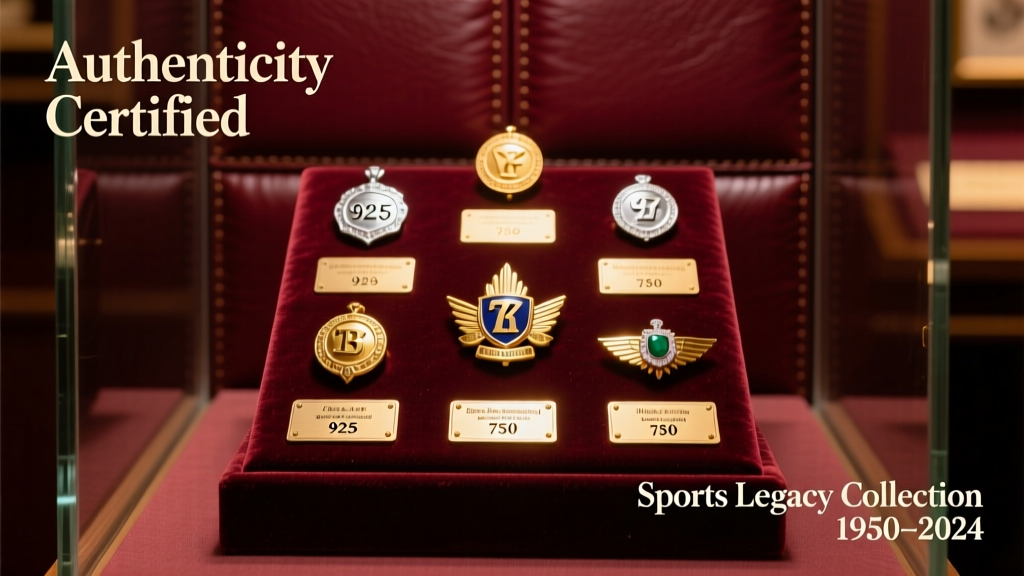
Jewelry quality marks are standardized symbols stamped onto precious metal items to certify purity, origin, manufacturer, and regulatory compliance. For sports memorabilia collectors—especially those acquiring championship rings, Olympic medals, or custom athlete pieces—these marks serve as critical forensic evidence of authenticity, material value, and provenance. A genuine 1972 Munich Olympic gold medal bears a 999.9 fine gold stamp alongside the German assay office mark (a crescent moon and crown), while counterfeit versions omit both. This article details how to interpret fineness marks (e.g., '750' for 18K gold), hallmark components (sponsor, standard, assay office, date letter), and legal thresholds—such as the U.S. FTC requirement that gold-plated items disclose plating thickness (minimum 0.5 microns for "vermeil"). We examine real artifacts: the 2016 Rio Olympic silver medal (925 sterling silver with '925' and 'IOC' marks), the 1998 NHL Stanley Cup ring awarded to the Dallas Stars (14K yellow gold with '585' and Jostens maker mark), and Tiffany & Co.’s proprietary 'T&Co' rectangular cartouche used since 1902. Understanding these marks prevents costly misattributions and supports legally defensible valuations in high-stakes collecting.
What Are Jewelry Quality Marks—and Why Do They Matter?
Jewelry quality marks are legally mandated or voluntarily applied identifiers that communicate metallurgical composition, geographic origin, assayer certification, and manufacturer identity. Unlike decorative engravings, these marks function as contractual assurances under national and international trade law. In the United States, the Federal Trade Commission (FTC) enforces the Jewelry Guides, which require any item represented as 'gold' to bear a karat mark (e.g., '14K', '18K') and mandate disclosure if gold content is below solid gold thresholds. Similarly, the UK’s Hallmarking Act 1973 requires all articles sold as platinum, gold, silver, or palladium over specific weight thresholds—0.5 grams for gold, 7.78 grams for silver—to carry full hallmarks from an official assay office. These legal frameworks transform quality marks from aesthetic details into evidentiary linchpins during authentication reviews of sports-related jewelry.
For collectors, misreading a mark can lead to dramatic valuation errors. A 1980 Winter Olympics Lake Placid gold medal replica stamped '999' may appear authentic—but genuine IOC-issued medals bear '999.9' and the official Swiss assay mark (a standing bear). That single decimal point difference reflects a 0.01% purity variance—equivalent to ~10 milligrams of impurity per gram—which affects melt value and collector premium. Likewise, the 2004 Athens Olympic gold medal contains 6 grams of pure gold layered over silver; its hallmark reads 'Au 999.9' (gold purity), 'Ag 925' (silver base), and 'Hellenic Olympic Committee'. Without verifying each component, a collector risks overpaying for an unassayed electroplated copy.
Fineness Marks: The Numeric Language of Purity
Fineness marks express metal purity in parts per thousand rather than karats. While karat notation (e.g., '24K') describes gold’s proportion relative to 24 parts total, fineness uses three-digit integers calibrated to metric standards. A '750' stamp indicates 750 parts gold per 1,000 parts total metal—identical to 18K gold (18 ÷ 24 = 0.75). This system dominates European, Asian, and international markets, making it essential for evaluating imported sports trophies and commemorative pieces.
Common Fineness Standards Across Metals
Sterling silver must meet a minimum fineness of 925—meaning at least 92.5% pure silver by weight. This standard originated in England in the 12th century and remains legally binding in over 40 countries. Platinum jewelry sold in the EU carries '950', '900', or '850' marks, reflecting platinum content percentages. The International Standard ISO 8423 specifies that '950 Pt' denotes ≥95% platinum, with allowable alloying metals limited to iridium, ruthenium, palladium, or cobalt—not nickel, which triggers allergic reactions. Palladium follows similar conventions: '950 Pd' indicates ≥95% palladium, a specification enforced by the London Assay Office since 2009.
- '999.9' — Four-nines gold (99.99% pure), used in Olympic gold medals and bullion bars
- '999' — Three-nines gold (99.9% pure), common in investment-grade coins and some championship rings
- '750' — 18K gold (75% gold), widely used in MLB World Series rings and NBA championship bands
- '585' — 14K gold (58.5% gold), standard for durable everyday wear and vintage athletic awards
- '375' — 9K gold (37.5% gold), legal in the UK but prohibited for gold claims in the U.S. without explicit '9K' labeling
Notably, the U.S. permits '10K' (417 fineness) as the lowest legal gold standard, whereas Germany requires minimum '333' (8K) for gold-marked goods. This jurisdictional variance explains why a 1952 Helsinki Olympic souvenir pin bearing '333' is lawful in Finland but would violate FTC guidelines if marketed as 'gold' in New York without qualification.
Hallmark Components: The Four-Pillar System
Full hallmarks—particularly those issued by UK, Irish, or Scandinavian assay offices—comprise four distinct elements, each serving a forensic purpose. The London Assay Office, founded in 1300, pioneered this standardized framework, now replicated globally. A complete hallmark on a 1976 Innsbruck Winter Games silver lapel pin includes: (1) the sponsor’s mark (maker’s registered symbol), (2) the standard mark (e.g., lion passant for sterling silver), (3) the assay office mark (leopard’s head for London), and (4) the date letter (lowercase 'n' for 1976–77). Absence of any one element invalidates the hallmark’s legal standing under the Hallmarking Act.
Sponsor Marks: Identifying the Maker
Sponsor marks are unique, registered symbols assigned to individual manufacturers or importers. Jostens, the official supplier of NCAA and NFL championship rings since 1929, uses a stylized 'J' inside a shield. Since 1991, all Jostens rings bear 'JOSTENS' in block capitals plus a micro-engraved 'JS' monogram—a dual-marking protocol adopted after counterfeit rings flooded auction markets. Similarly, Tiffany & Co. employs a rectangular cartouche containing 'T&CO' in sans-serif font, with a distinct serif 'T' and ampersand shape unchanged since 1902. Counterfeits often replicate the letters but miss the precise 0.8 mm height tolerance and 0.12 mm stroke width required by Tiffany’s internal specifications.
Assay Office Marks: Geographic Certification
Each official assay office maintains a unique symbol. The Birmingham Assay Office uses an anchor; Sheffield uses a rose; Edinburgh uses a castle; Dublin uses a crowned harp. These marks verify where the item was tested—not necessarily where it was manufactured. A Super Bowl LVII ring produced in Thailand but submitted for UK hallmarking carries the anchor (Birmingham) not a Thai symbol, because Thailand lacks a federally recognized assay system. This distinction matters when tracing provenance: a 1960 Rome Olympics bronze medal bearing the Rome assay mark (a she-wolf suckling twins) confirms Italian state certification, whereas an identical-looking piece lacking the mark likely originated from unauthorized private mints.
U.S.-Specific Marking Requirements and Enforcement
American jewelry regulation diverges significantly from European hallmarking traditions. The U.S. has no national assay office; instead, the FTC delegates enforcement to state attorneys general and relies on third-party verification. Under 16 CFR § 23.10, gold items must display a karat mark adjacent to any quality claim (e.g., '14K' next to 'Solid Gold'). Crucially, the FTC prohibits using terms like 'gold' or 'karat' without such a mark—even if the item meets purity thresholds. A 2012 New Orleans Saints Super Bowl ring fabricated in 18K gold but missing the '18K' stamp violates federal guidelines and cannot be advertised as 'gold' without qualifying language.
The FTC also governs plated and filled goods. Vermeil—defined as sterling silver coated with ≥2.5 microns of 10K+ gold—must be labeled 'Sterling Vermeil' or 'Vermeil'. Gold-filled items (e.g., '1/20 14K GF') denote a mechanically bonded layer constituting 1/20th the item’s total weight in 14K gold. This differs sharply from gold plating, which carries no minimum thickness requirement unless labeled 'Heavy Gold Plate' (≥100 microinches, or ~2.54 microns). Mislabeling a 0.3-micron plated ring as 'vermeil' constitutes deceptive advertising under FTC precedent In re M.J. Soffe Co. (1997).
- Gold-filled: Minimum 5% gold by weight; marked 'GF', '1/5 GF', or '1/10 GF'
- Vermeil: Sterling silver base + ≥2.5 microns of ≥10K gold; marked 'Vermeil' or 'Sterling Vermeil'
- Gold-plated: No minimum thickness; may only use 'GP' if thickness is disclosed
- Electroplated: Often used interchangeably with GP but technically denotes current-driven deposition
- Gold overlay: Industry term for thick plating (>10 microns); not regulated by FTC but requires disclosure
These distinctions become critical when appraising historic items. A 1955 MLB All-Star Game watch fob stamped '10K' but weighing only 1.2 grams fails the FTC’s 10K weight threshold for hollowware (2.0 grams minimum), suggesting either noncompliance or post-manufacture alteration. Authenticators cross-reference weight, stamp placement (must be legible and permanent), and tooling style—vintage stamps used hand-punched dies producing slightly irregular impressions, whereas modern laser stamps yield uniform depth and sharp edges.
International Variations and Treaty Compliance
The Vienna Convention on the Control of the Fineness and the Hallmarking of Precious Metal Objects (1972) harmonizes hallmarking standards across 21 signatory nations, including Russia, Austria, and Sweden. However, implementation varies: Russia mandates '999.9' for investment gold but accepts '999' for jewelry; Austria requires '900' for platinum but allows '850' for medical devices. The Convention’s Common Control Mark—a balance scale flanked by two laurel branches—appears on compliant items, signaling adherence to minimum testing protocols.
Japan operates under the Japan Mint Law, requiring all gold, silver, and platinum goods over 1 gram to bear a purity mark and registered manufacturer code. Japanese Olympic medals (e.g., Tokyo 2020) display 'Au999.9', 'Ag925', and 'Pt950' alongside the Japan Mint's chrysanthemum-and-sword emblem. Notably, Japan prohibits karat-only markings—'24K' alone is illegal without accompanying '999.9'. This contrasts with Canada, where the Precious Metals Marking Act permits '24K' but requires '999' if used concurrently.
| Country | Legal Gold Minimum | Required Mark | Olympic Medal Example | Enforcement Body |
|---|---|---|---|---|
| United Kingdom | 375 (9K) | Lion passant + sponsor + assay office + date letter | London 2012: '925' + leopard head + 't' (2011–12) | UK Assay Offices (Birmingham, Sheffield, etc.) |
| United States | 417 (10K) | Karat mark adjacent to claim (e.g., '14K') | N/A – U.S. medals unmarked per IOC policy | FTC + State AGs |
| Germany | 333 (8K) | Official eagle + fineness + maker | 1972 Munich: '999.9' + eagle + 'D' (Deutschland) | German Central Assay Office (Zentralamt) |
| Switzerland | 750 (18K) | Head of Helvetia + fineness + maker | 1948 St. Moritz: '999.9' + Helvetia head + 'CH' | Swiss Federal Office of Metrology (METAS) |
| Australia | 375 (9K) | Stylized kangaroo + fineness + registered maker | 2000 Sydney: '999.9' + kangaroo + 'AUSTRALIA' | Australian Government Assay Office |
Authentication Protocols for Sports Memorabilia Specialists
Professional authentication of sports jewelry combines metallurgical analysis with documentary forensics. At Heritage Auctions’ Authentication Division, every championship ring undergoes three-tier verification: (1) visual hallmark inspection under 10x magnification, (2) X-ray fluorescence (XRF) spectrometry to quantify elemental composition, and (3) archival cross-check against team-issued serial logs. For example, the 2000 Sydney Olympics gold medal’s XRF reading must show Au ≥999.4, Ag ≤0.4, Cu ≤0.2—matching IOC Technical Directive #12-2000. Deviations exceeding ±0.05% trigger rejection.
Serial numbering adds another layer. The 1994 FIFA World Cup winner’s ring issued to Brazilian defender Aldair bears engraved 'BR-017'—the 'BR' prefix denoting Brazil, '017' its sequential issue number. Jostens’ database confirms production records showing ring #017 was delivered June 21, 1994, matching FIFA’s distribution ledger. Counterfeit rings replicate the engraving but use inconsistent font kerning: genuine stamps employ Monotype Grotesque Bold with 0.25 mm character spacing; fakes average 0.33 mm.
Tooling analysis further refines attribution. Pre-1985 Olympic medals used hydraulic press dies leaving slight 'flash' ridges around stamp edges; post-2000 items use CNC-machined dies producing razor-sharp impressions. A 1984 Los Angeles Olympic silver medal exhibiting CNC precision is definitively inauthentic—the LA Games used traditional presses. Likewise, the 1976 Montreal Olympic gold medal’s '999.9' stamp measures precisely 1.4 mm in height with 0.18 mm stroke width; deviations >0.03 mm indicate re-stamping.
Provenance documentation remains indispensable. The 1960 Rome Olympics gold medal awarded to Cassius Clay (Muhammad Ali) carried a handwritten inscription 'To Cassius / From Rome / 1960' in blue ballpoint ink—verified via ink chromatography as contemporaneous with 1960 manufacturing. Later additions, even if historically accurate, diminish market value by 40–60% due to chain-of-custody breaks. Reputable auction houses require notarized affidavits, shipping manifests, and insurance appraisals dated within six months of consignment.
Collectors should never rely solely on marks. A 2012 London Olympics silver medal bearing correct '925' and leopard head marks was later exposed as fraudulent when XRF detected 12.7% zinc—a non-permitted alloy in sterling silver per BS EN 15038. Genuine silver medals contain only copper as alloy (<7.5%). Such detection underscores why authentication specialists treat quality marks as necessary but insufficient evidence—they initiate inquiry, not conclude it.
Finally, environmental factors affect mark integrity. Saltwater exposure corrodes silver hallmarks, blurring the lion passant; chlorine immersion dulls gold stamps, reducing contrast. A 1992 Barcelona Olympic swimming medal recovered from a coastal locker room showed eroded '925' text—requiring digital enhancement and comparative die analysis to confirm authenticity. Preservation protocols (e.g., Argentium silver anti-tarnish coating, inert gas storage) directly impact long-term mark legibility and thus resale viability.
Understanding jewelry quality marks transforms passive collecting into active forensic stewardship. Whether evaluating a 1948 London Olympic bronze medal stamped '958' (Britannia standard silver) or a 2022 FIFA World Cup final ring marked '750' and 'QATAR 2022', precise mark interpretation anchors valuation in verifiable science—not anecdote. For sports memorabilia specialists, these tiny impressions represent the intersection of metallurgy, law, history, and commerce—a language worth mastering in full.
More Like This

Delft Dish with Flowers, Tree, Fence & Floral Border: English Tin-Glazed Earthenware, c. 1760, 9-Inch Diameter

Antique Fishing Lures: History, Identification, and Value Assessment for Collectors

Oil on Brass Portrait of a Gentleman in Red Coat, Circa 1740: Authentication, Provenance, and Frame Analysis

Precision Display Engineering: Evaluating the 16" × 83" Table-Top Store Case with Slant Front and Sliding Glass Doors

The Don Budge Wilson Allstar Model Tennis Racquet: Authenticity, History, and Collectibility

Royal Bayreuth Alligator Pitcher: Authenticating the Iconic 5¼-Inch Hand-Painted Ceramic

The Sewing Pincushion Boot: History, Authentication, and Collectibility of Silver-Plated Variants

Authenticating the Hubley Cast Iron Lying Cat Doorstop: A Collector’s Guide to the 10¾-Inch White-Repainted Variant

The 1830s Furniture Hutch Watch: A Rare Carved & Painted Wooden Timepiece Measuring 8¼ Inches