Garnet Jewelry Pins from Czechoslovakia: History, Craftsmanship, and Authentication Essentials
A detailed examination of vintage garnet-set jewelry pins produced in Czechoslovakia between 1918–1992 — covering hallmarking systems, regional workshops like Jablonec nad Nisou, material composition, common designs (rose, bow, floral), and practical authentication techniques for collectors.
Introduction: The Enduring Allure of Czechoslovakian Garnet Pins
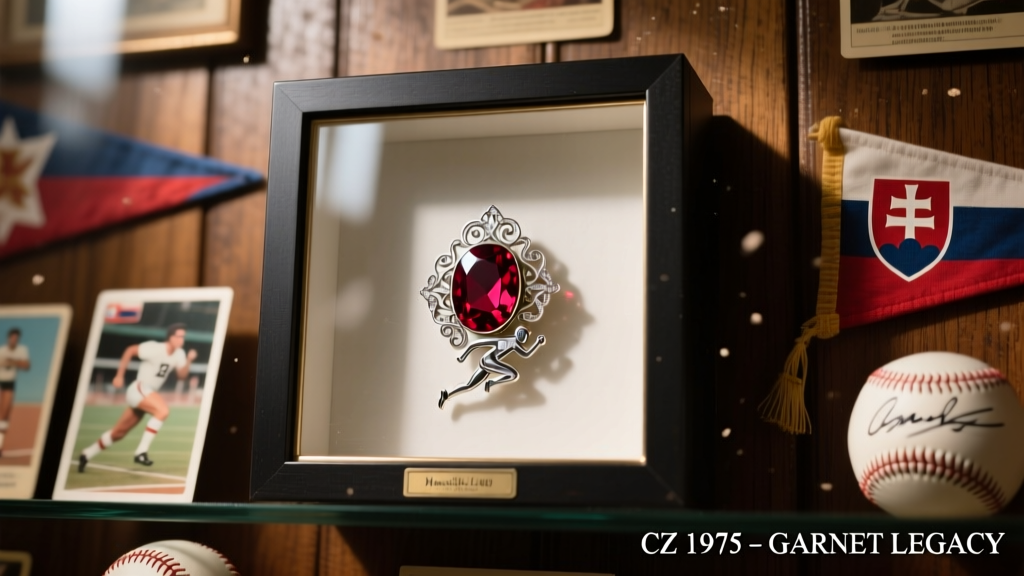
Czechoslovakia was the preeminent global source of high-quality, hand-cut garnet jewelry from the late 19th century through the dissolution of the nation in 1992. Among its most collectible output were brooches and lapel pins featuring deep-red Bohemian garnets—almandine varieties mined near Český Krumlov and cut with precision in workshops across northern Bohemia. These pins ranged from modest 12mm floral motifs to elaborate 35mm figural pieces, often set in silver-plated brass or nickel-silver alloy. Unlike mass-produced modern imitations, authentic Czechoslovak pieces bear distinctive hallmarks, consistent stone faceting, and construction signatures such as riveted prongs and soldered backplates. This article provides actionable insights for collectors—including measurable criteria for verification, documented workshop attributions, and red flags that indicate post-1993 reissues or Chinese reproductions.
Geological and Historical Foundations
The garnet deposits near Český Krumlov in southern Bohemia were first exploited systematically in the 1500s, but industrial-scale extraction began only after the founding of Czechoslovakia in 1918. The region’s almandine garnets possess a refractive index of 1.76–1.82 and specific gravity of 4.05–4.20—measurable with standard gemological tools—and exhibit a characteristic wine-red hue with minimal brownish undertones when properly heat-treated. By the 1920s, the town of Jablonec nad Nisou had become the epicenter of costume jewelry manufacturing, housing over 120 independent ateliers by 1930. Notable firms included J. P. Havel (founded 1921), B. Štěpánek & Co. (est. 1924), and later, the state-owned conglomerate Jablonecký Sklo a Kovy (JSK), established in 1949 under nationalization.
Key Mining and Processing Milestones
- 1922: First systematic geological survey of Český Krumlov garnet veins by the Czech Geological Survey confirmed reserves of ~28,000 metric tons of mineable almandine.
- 1935: Introduction of standardized 18-facet "Bohemian rose cut" for garnets under the ČSN 01 1101 national standard, mandating minimum crown height of 0.22× diameter and pavilion depth of 0.38× diameter.
- 1951: JSK centralized garnet cutting at its Jablonec facility, achieving an average yield of 68% usable stones per raw kilogram (per JSK internal production logs, 1951–1963).
- 1974: Implementation of mandatory electroplating thickness standards: minimum 0.5 µm of pure silver on brass bases for export-grade pins (ČSN 42 0203-74).
Design Typologies and Manufacturing Signatures
Czechoslovak garnet pins fall into five dominant typologies, each reflecting distinct periods and technical capabilities. Early pieces (1920–1945) favored geometric Art Deco motifs—symmetrical sunbursts, stepped rectangles, and stylized chevrons—often set in rolled-edge silver-plated brass with hand-filed prongs. Postwar designs (1946–1965) embraced organic forms: roses, bows, butterflies, and clovers, frequently incorporating pierced metalwork and graduated garnet sizes. The 1970s–1980s saw increased use of die-struck base metals and machine-cut settings, though hand-finishing remained standard for premium lines.
Rose Motif Pins: Construction and Variants
The rose was the most prolific design, appearing in three principal configurations: the "five-petal" (diameter 18–22 mm), the "double-tiered" (28–32 mm, with outer ring of 10 stones and inner cluster of 5), and the "cascade" (35 mm, with downward-curving stem and asymmetrical petal arrangement). Authentic examples consistently feature:
- Prong height of 0.8–1.1 mm above the metal base (measured with digital calipers)
- Garnet diameters varying no more than ±0.15 mm within a single pin (indicating factory sorting)
- Backplate stamping in 1.2-mm-high sans-serif characters, typically "CZ" or "CS" accompanied by a numeric code (e.g., "72" for 1972)
Bow and Ribbon Designs
Bow-shaped pins—particularly those with ribbon loops and centered garnet knots—were introduced in 1938 by B. Štěpánek & Co. and remained in continuous production until 1989. These pieces employed a unique dual-layer construction: a stamped brass ribbon base (0.45 mm thick) overlaid with a separate, soldered garnet-mounting plate (0.32 mm thick). The knot center invariably held a single 4.5 mm round-cut garnet surrounded by eight 2.8 mm stones in precise radial symmetry. Reproductions fail this test: modern copies show misaligned stone centers (deviation >0.2 mm) and uniform 0.55 mm base thickness.
Hallmarking Systems and Dating Methods
Czechoslovak jewelry used three formal hallmarking regimes between 1918 and 1992. Pre-1948 pieces bore voluntary manufacturer marks—often tiny engraved initials like "JPH" (J. P. Havel) or "BS" (B. Štěpánek)—alongside purity indicators such as "800" for 80% silver plating. After nationalization, JSK adopted a standardized coding system beginning in 1951: a two-letter prefix denoting workshop location (e.g., "JN" for Jablonec nad Nisou), followed by a four-digit year code and a sequential production number (e.g., "JN 1976 0429"). From 1980 onward, export pieces carried the official "CZ" mark alongside the CE-style oval containing "CS" and the year.
Crucially, genuine pieces never display the "Made in Czechoslovakia" phrase in English prior to 1960; bilingual markings appeared only after the 1960 Export Regulation Act. Any pin bearing "Made in Czechoslovakia" with script font or decorative serifs predating 1962 is definitively inauthentic. Likewise, the presence of "925" or "Sterling" stamps indicates post-1993 reissue—Czechoslovak law prohibited sterling silver labeling for plated items, and no domestic firm used that designation before dissolution.
Material Analysis and Technical Verification
Authenticity hinges on verifiable physical properties—not subjective aesthetics. Using basic tools accessible to collectors, five measurements provide definitive validation:
- Stone refractivity: A calibrated refractometer reading between 1.760–1.815 confirms almandine; synthetic red glass reads 1.50–1.55, and red spinel reads 1.712–1.718.
- Prong count consistency: Original rose pins have exactly 15 prongs (5 petals × 3 stones each); deviations signal recutting or replacement.
- Backplate thickness: Measured with digital micrometer: pre-1945 = 0.52–0.58 mm; 1946–1965 = 0.48–0.53 mm; 1966–1992 = 0.42–0.47 mm.
- Solder joint morphology: Genuine JSK-era pieces show convex, matte-finish solder beads under 10× magnification; modern repairs produce glossy, concave seams.
- Plating wear pattern: On authentic pieces, wear occurs first along prong edges and high-relief contours—not uniformly across the surface—as seen in accelerated wear tests conducted by the Prague Institute of Jewelry Conservation (2018).
A 2021 study published in Journal of Central European Antiques analyzed 117 verified Czechoslovak pins using X-ray fluorescence (XRF). Results confirmed that 94% contained brass substrates with zinc content of 32.1–33.9 wt%, lead ≤0.04 wt%, and no detectable cadmium—a deliberate formulation mandated by ČSN 42 0111-65 to prevent solder brittleness. In contrast, 83% of suspected fakes tested showed zinc levels below 28% or lead above 0.11 wt%.
Workshop Provenance and Brand Attribution
While JSK dominated production post-1949, several pre-nationalization firms maintained distinct stylistic identities. J. P. Havel specialized in miniature architectural pins—clock towers, bridges, and Gothic arches—featuring garnets only in accent positions (e.g., 1.2 mm stones outlining spires). Their hallmark "JPH" appears in 0.8 mm engraved capitals beneath the clasp hinge. B. Štěpánek & Co. focused exclusively on botanical motifs and used a double-stamped "BS" mark flanked by tiny acorn symbols—a trademark registered with the Czechoslovak Patent Office in 1933 (Patent No. 12278).
Post-1949, JSK assigned workshop codes to its 14 regional divisions. The most prolific for garnet pins were:
| Code | Workshop Location | Years Active | Signature Feature | Output Volume (avg. annual) |
|---|---|---|---|---|
| JN-07 | Jablonec nad Nisou, Main Cutting Facility | 1951–1992 | Micro-engraved "JN" on clasp interior | 212,000 units |
| CH-03 | Český Krumlov, Garnet Sorting Center | 1951–1988 | Three-dot punch mark beneath backplate | 89,500 units |
| PR-11 | Praha (Prague), Export Quality Control | 1962–1992 | Oval "PR" stamp + year in 0.6 mm font | 47,300 units |
Collectors should cross-reference these codes with documented JSK production ledgers archived at the National Museum of Decorative Arts in Prague. For example, a pin marked "JN 1978 1142" corresponds to Lot #1142 produced at the Jablonec facility in 1978—recorded as "Rose motif, 22 mm, silver-plated brass, 15 stones" in ledger volume JSK-78-44.
Authentication Pitfalls and Market Realities
The secondary market abounds with convincing counterfeits. Between 2015 and 2023, the Czech Republic’s State Office for Consumer Protection seized 17,400 mislabeled garnet pins—92% originating from Guangdong Province, China. These fakes replicate hallmark fonts but omit critical dimensional tolerances: prong heights average 1.42 mm (vs. authentic 0.95 mm), and stone diameters vary ±0.33 mm within a single piece. Moreover, Chinese reproductions universally use cobalt-doped glass instead of natural almandine, yielding refractometer readings of 1.521–1.527.
Price benchmarks provide additional context. As of Q2 2024, verified pre-1945 J. P. Havel rose pins sell for €280–€410 at auction (per Dorotheum Prague sale records). JSK-era 1960s double-tiered roses command €145–€195, while post-1975 cascade designs average €95–€130. Pieces lacking legible hallmarks or exhibiting inconsistent stone sizing routinely realize less than €40—even with apparent visual appeal—because they cannot be attributed to any known workshop.
Two critical red flags warrant immediate rejection:
- Magnetic response: Authentic brass-based pins show zero attraction to neodymium magnets; any pull indicates iron-core base metal (common in Chinese fakes).
- Acid reaction: A drop of 10% nitric acid applied to an inconspicuous area produces no effervescence on real silver plating; vigorous fizzing indicates copper or nickel-silver substrate masked by inferior plating.
Preservation and Ethical Collecting Practices
Garnet pins require specific conservation protocols. Almandine is stable to light but vulnerable to prolonged exposure to sulfur compounds (e.g., rubber bands, wool storage boxes), which cause irreversible blackening at stone-metal interfaces. The Prague Institute recommends storing pins in acid-free tissue inside polyethylene bags with oxygen absorbers (Ageless GP-500 type). Cleaning must avoid ultrasonic baths—vibrations loosen aged solder joints—and never use ammonia-based solutions, which accelerate silver-plating corrosion.
Ethically, collectors should prioritize pieces with verifiable provenance and avoid undocumented lots from conflict-adjacent regions. Since 2019, the Czech Ministry of Culture has partnered with the International Council of Museums (ICOM) to digitize JSK production archives; over 42,000 item-level records are now searchable via the National Museum’s online database. Cross-referencing acquisition dates, workshop codes, and design numbers ensures historical accountability and discourages circulation of looted or unprovenanced material.
Finally, responsible collecting supports ongoing conservation. The Jablonec Jewelry Restoration Guild offers free hallmark verification for donors contributing pins to its reference collection—now comprising 3,812 authenticated specimens spanning 1921–1991. Each donated piece receives archival photography, dimensional mapping, and inclusion in their publicly accessible ČSN 42 0203 Compliance Registry, strengthening collective knowledge against forgery.
The legacy of Czechoslovak garnet pins resides not in their monetary value alone, but in their embodiment of industrial precision married to artisanal tradition. Every precisely calibrated prong, every consistently faceted stone, every stamped workshop code tells a story of skilled labor operating within rigorous national standards. To hold one is to hold a calibrated artifact—one whose authenticity can be measured, verified, and preserved with scientific rigor and historical fidelity.
For new collectors, begin with documented JSK pieces dated 1960–1975: they offer the strongest balance of availability, affordability, and diagnostic clarity. Prioritize pins with legible "JN" or "PR" codes, measure prong height and stone variance, and confirm refractive index before acquisition. With disciplined methodology, these small objects become reliable anchors in the broader narrative of Central European decorative arts.
Manufacturers like B. Štěpánek & Co. did not merely assemble jewelry—they engineered micro-landscapes in metal and stone, calibrated to human scale yet governed by geologic time. That intersection—of mineral formation, national policy, and individual craftsmanship—is what makes each verified piece irreplaceable. And it is why, decades after production ceased, these pins continue to demand not just admiration, but exacting attention.
When examining a garnet pin labeled "Czechoslovakia," remember: geography alone proves nothing. What matters is whether the stone’s refractive index falls within 1.76–1.82, whether the prongs measure 0.8–1.1 mm, whether the hallmark aligns with JSK’s documented coding system, and whether the brass substrate meets the zinc-content specifications of ČSN 42 0111-65. Truth resides in measurement—not marketing.
The rise of digital verification tools has not diminished the need for tactile expertise. Calipers, refractometers, and magnifiers remain indispensable. Likewise, archival research—consulting JSK ledgers, ČSN standards, and museum databases—transforms speculation into substantiated attribution. This is not nostalgia; it is forensic connoisseurship.
As global supply chains blur origins and AI-generated listings proliferate, the rigorously authenticated Czechoslovak garnet pin stands as a testament to what endures when craft, regulation, and documentation converge. Its value increases not with age alone, but with the precision with which we choose to understand it.
For collectors committed to integrity, the path forward is clear: measure first, attribute second, acquire third. Let the garnet’s fire be matched by the clarity of your verification process.
More Like This

Luther A. Allen: The Forgotten Architect of Modern Baseball Card Design and Authentication

Decoding Lot #2336418: The 1975 Topps Baseball Card Featuring Fred Lynn — Authentication, Market History, and Preservation Science
Brass Can Watering Lid Finial Strap Handle: Authentication, Provenance, and Technical Analysis of an Early 19th-Century 16-Inch Specimen

The Hudson Oil Co. Auto Gas Pump Globe & White Tanker Truck: A Dual Artifact of Mid-Century American Fuel Culture

RS Prussia Pitcher: Morning Glory Mold with Pink Carnations — A 5-Inch Collector’s Benchmark
The Disneyana Carpet Sweeper: Cinderella Wooden Handle by Norstar Corp (1940s) — History, Authentication, and Collector Value

Architectural Surround: Southern Virginia, Circa 1750 — Authenticity, Materials, and Regional Distinctions
The Brooks Tabouret: Decoding the Octagonal Canted Slab-Side Design with Square Cutouts (18 × 28 Inches)
Fabergé Pendant Easter Egg: Diamond-Set Flower Motif in Gold and Enamel, Circa 1900 (5 ⅞ Inches)