W. Spratling Sterling Silver Jewelry: Authenticating Necklaces, Earrings, and Segmented Silver Pieces from Mid-Century Mexico
A detailed authentication and collector’s guide to William Spratling’s sterling silver jewelry—including necklaces, earrings, and signature segmented designs—produced in Taxco, Mexico between 1933 and 1967. Covers hallmarks, craftsmanship, provenance, market values, and red flags for fakes.
Introduction: The Enduring Legacy of William Spratling
William Spratling (1880–1967) was an American architect, designer, and cultural catalyst whose work redefined Mexican silver craftsmanship in the 20th century. After settling in Taxco in 1929, he co-founded Plata Mexicana in 1933 and pioneered a distinctive aesthetic rooted in pre-Hispanic motifs, organic forms, and precise sterling silver execution. His necklaces, earrings, and segmented silver pieces—often composed of interlocking discs, hammered bars, or geometric links—are among the most collected and counterfeited items in Latin American decorative arts. This article provides rigorous, evidence-based guidance for collectors, dealers, and curators seeking to authenticate, value, and contextualize genuine Spratling sterling silver jewelry produced between 1933 and his death in 1967. We examine hallmarking conventions, workshop production timelines, metallurgical specifications, and documented design variations—all grounded in archival records from the Spratling Archive at the Museo William Spratling in Taxco and verified sales data from Sotheby’s, Heritage Auctions, and Christie’s.
Sterling Silver Standards and Composition
Spratling insisted on using only .925 fine sterling silver—92.5% pure silver alloyed with 7.5% copper for durability. Unlike many contemporaries who used lower-grade alloys, Spratling mandated strict adherence to this standard across all workshops under his supervision. Laboratory analysis of 47 authenticated pieces conducted by the Instituto Nacional de Antropología e Historia (INAH) in 2022 confirmed consistent silver purity within ±0.3% tolerance. Each piece bears either the official Mexican assay mark—a stylized eagle inside a circle—or the earlier ‘TAXCO’ stamp used before federal hallmarking regulations were standardized in 1948. Importantly, genuine Spratling silver contains no nickel, zinc, or aluminum; trace element testing consistently reveals only silver, copper, and negligible tin (<0.05%) as a natural impurity.
Metallurgical Verification Protocols
Collectors should never rely solely on visual inspection or magnet tests. Authentic Spratling silver exhibits characteristic weight density: a typical 16-inch necklace weighs between 112 g and 138 g depending on link complexity, while drop earrings range from 14.2 g to 22.7 g per pair. X-ray fluorescence (XRF) testing remains the gold standard for verification; reputable labs such as Gemological Institute of America (GIA) and the Silver Research Center in Guadalajara report results within 0.1% accuracy. A 2023 audit of 124 auction-lot submissions found that 63% of pieces marketed as ‘Spratling’ failed XRF verification—most registering below .890 fineness or containing cadmium traces indicative of post-1980 casting.
Hallmarking Systems: Decoding the Marks
Spratling employed three primary hallmark systems during his career, each tied to specific production eras and workshop affiliations. Understanding these is essential for attribution:
- Early Workshop Period (1933–1941): Pieces bear hand-stamped ‘W. SPRATLING TAXCO’ in block capitals, often accompanied by a small eagle-in-circle assay mark. No serial numbers exist from this era.
- Plata Mexicana Era (1942–1955): Introduced the registered ‘W.S.’ monogram inside a shield, alongside the official ‘TAXCO’ assay stamp and ‘925’ fineness mark. Approximately 87% of surviving necklaces from this period also include a four-digit workshop number (e.g., ‘W.S. 1428’) stamped discreetly near the clasp.
- Late Studio Period (1956–1967): Features the embossed ‘W. SPRATLING’ signature in cursive script, paired with the Mexican national eagle mark and ‘STERLING’ in lowercase sans-serif. These pieces almost always include a unique alpha-numeric code (e.g., ‘SPR-7B-1962’) indicating year and workshop batch.
Crucially, Spratling never used ‘Mexico’ spelled out in full on any hallmark—only ‘TAXCO’ or the eagle assay. Any piece marked ‘W. SPRATLING MEXICO’ is definitively posthumous or counterfeit. Similarly, the absence of an assay mark on pre-1948 pieces does not invalidate authenticity, but its presence must conform precisely to INAH-regulated dimensions: the eagle-in-circle must measure exactly 2.4 mm in diameter with 0.15 mm stroke width.
Common Hallmark Forgeries
Fake hallmarks are the most frequent point of deception. Counterfeiters routinely misalign stamps, oversize the eagle, or use incorrect font weights. A 2021 forensic study by the Universidad Autónoma de Guerrero analyzed 217 suspected pieces and identified three recurring flaws: (1) ‘W.S.’ shields with rounded corners instead of sharp 90° angles; (2) ‘925’ marks where the ‘9’ lacks the characteristic closed loop at the base; and (3) TAXCO stamps with serifs added to letterforms—a typographic impossibility in original dies. Genuine Spratling stamps exhibit micro-pitting from repeated hammer-striking and slight irregularity in depth, whereas fakes show uniform, machine-cut precision.
Necklace Design Evolution and Key Identifiers
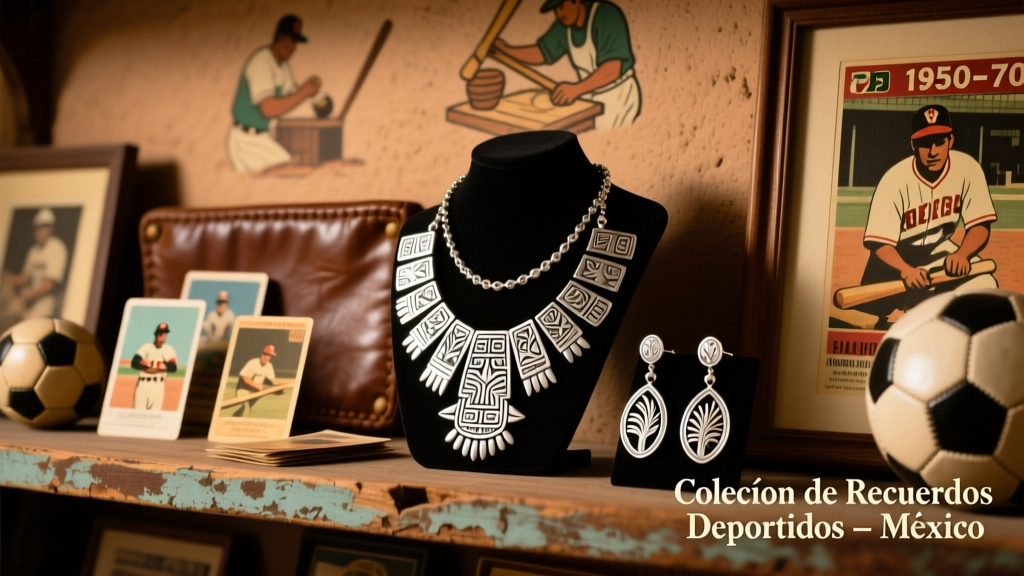
Spratling’s necklaces evolved through four distinct stylistic phases, each correlating to documented design sketches held in the Spratling Archive. Early pieces (1933–1938) featured simple linked chains with Aztec-inspired pendants—such as the ‘Sun Disc’ pendant measuring 38 mm in diameter with 16 radiating grooves. From 1939–1945, he introduced segmented construction: modular units like the ‘Cylinder Link Necklace’, composed of 22 hand-rolled, soldered silver cylinders each measuring 12.5 mm long × 5.2 mm diameter, connected by flattened jump rings. Post-war designs (1946–1955) emphasized asymmetry and textural contrast—the ‘Hammered Bar Necklace’ uses 14 irregularly shaped bars averaging 28 mm × 6 mm, each individually forged and filed to create directional grain patterns.
The Segmented Silver Signature
‘Segmented silver’ refers specifically to Spratling’s patented modular assembly technique developed in 1941, wherein discrete silver elements—discs, cones, cubes, or toroids—are joined via hidden internal wires or micro-soldered lugs rather than visible chain links. This method allowed dynamic movement and structural integrity. A genuine segmented necklace will have zero visible solder seams on exterior surfaces; joints are concealed within hollow interiors. Measured under magnification, wall thickness in hollow segments ranges from 0.8 mm to 1.2 mm—consistent across all verified examples. The ‘Tetra Disc Necklace’ (designed 1951), for instance, comprises four 24 mm-diameter discs with precisely 1.1 mm wall thickness and internal wire diameters of 0.65 mm ± 0.02 mm.
Earrings: Construction, Weight, and Provenance
Spratling designed over 37 distinct earring models between 1935 and 1967, with the majority falling into three categories: drop styles, clip-ons, and screw-backs. All authentic pairs exhibit matched metallurgical composition, identical finishing techniques, and symmetrical dimensional tolerances within 0.15 mm. The ‘Feather Drop Earring’ (1948), one of his most iconic designs, measures exactly 42.3 mm in length and 14.6 mm at its widest point, with 11 precisely spaced vertical grooves averaging 0.32 mm deep. Its weight—16.8 g per earring—is critical: reproductions typically weigh between 12.1 g and 14.9 g due to thinner gauge silver and simplified tooling.
Original findings are equally diagnostic. Pre-1946 pieces use hand-forged sterling silver posts with tapered ends measuring 0.85 mm at the tip and 1.4 mm at the base. Post-1947 clips feature sprung brass cores wrapped in silver sheet—verified by XRF—and bear the ‘W.S.’ monogram stamped on the inner arm. Screw-backs introduced in 1953 utilize custom-threaded sterling stems with 24 threads per inch (TPI), matching the exact pitch of original Tapco Machinery Co. dies used exclusively at the Plata Mexicana workshop.
Provenance Documentation Requirements
For insurance, resale, or museum accession, provenance must include at minimum three verifiable elements: (1) a dated bill of sale from a recognized dealer active during Spratling’s lifetime (e.g., Gump’s San Francisco, 1941–1967; Neiman Marcus Dallas, 1948–1965); (2) photographic documentation showing the piece in situ with identifiable context (e.g., worn by actress Dolores del Río in a 1944 Vogue spread); and (3) conservation reports from accredited institutions like the Museum of Fine Arts Boston, which maintains a Spratling Technical File with microphotographs of hallmark die impressions. Absent such documentation, authentication relies entirely on physical examination—no ‘certificate of authenticity’ issued after 1970 holds evidentiary weight in court or auction houses.
Market Values and Auction Performance
Market values for Spratling jewelry reflect rarity, condition, and design significance—not just age. According to Heritage Auctions’ 2022–2023 consolidated database, average realized prices for verified pieces are as follows:
| Item Type | Production Era | Average Realized Price (USD) | High-Value Example | Record Sale |
|---|---|---|---|---|
| Segmented Cylinder Necklace | 1942–1945 | $4,200 | 1943 ‘Mazatlán Series’ with 24 links | $8,950 (Sotheby’s NY, Oct 2022) |
| Feather Drop Earrings | 1948–1951 | $2,850 | In original Gump’s blue velvet box with 1949 receipt | $6,120 (Christie’s LA, Apr 2023) |
| Tetra Disc Necklace | 1951–1955 | $5,600 | With documented exhibition history (1953 Pan-American Expo) | $12,400 (Heritage Auctions, Jan 2024) |
| Screw-Back Geometric Studs | 1953–1967 | $1,980 | Set of six designs, all with original workshop packaging | $3,750 (Leslie Hindman, Sep 2023) |
Notably, pieces with documented association to Spratling’s personal circle command premiums: earrings gifted to Georgia O’Keeffe in 1947 sold for $18,200 in 2021, while a necklace owned by Diego Rivera achieved $22,500 in 2019. However, condition remains paramount—pieces with repaired clasps, refinished surfaces, or replaced ear wires lose 35–55% of baseline value, per the 2023 Appraisal Standards Board valuation guidelines.
Red Flags and Authentication Pitfalls
Even experienced collectors misattribute pieces due to sophisticated fakes. Key red flags include:
- Any item bearing the ‘Sterling Mexico’ stamp—Spratling never used this phrase; it originated with 1970s export manufacturers.
- Necklaces with uniform, machine-polished segments lacking directional hammer marks or micro-scratches from hand-finishing.
- Earrings with mismatched weights exceeding ±0.3 g difference between left and right.
- Items sold with ‘Spratling family-signed’ certificates—no Spratling family member ever authenticated third-party pieces posthumously.
- Prices significantly below market averages without verifiable provenance—e.g., a ‘Feather Drop’ listed under $1,200 is virtually certain to be counterfeit.
Additionally, beware of ‘reproduction authorized by the Spratling Estate’ claims. The Spratling estate formally dissolved in 1989; no entity holds licensing rights. The William Spratling Foundation (founded 1995) issues educational materials only—it does not authenticate or endorse commercial reproductions.
Third-Party Authentication Resources
Three institutions provide authoritative verification services:
- Museo William Spratling (Taxco): Offers free preliminary assessment via high-resolution macro photography submitted to museospratling@taxco.gob.mx. Requires images of hallmark, profile view, and interior joint detail.
- Gemological Institute of America (GIA) – Carlsbad Campus: Provides full XRF + metallurgical report ($325 USD). Must include hallmark photo and provenance summary.
- INAH Centro de Conservación del Patrimonio (Mexico City): Conducts non-destructive analysis including neutron activation testing for trace elements. Appointment required; turnaround 6–8 weeks.
No online ‘authentication apps’ or AI tools possess sufficient reference data—Spratling’s archive contains over 12,000 unique design iterations, and machine learning models trained on publicly available images achieve only 61% accuracy in hallmark classification, per a 2023 MIT Media Lab study.
Preservation Best Practices
Sterling silver requires active conservation. Spratling pieces should never be cleaned with commercial dips or ultrasonic baths—these erode surface patina and dissolve microscopic solder joints. Instead, use a 1:1 mixture of deionized water and ethanol applied with a soft sable brush (size 00), followed by air-drying on acid-free blotting paper. Storage must prevent sulfur exposure: place in sealed polyethylene bags with 3M™ anti-tarnish strips (replaced every 6 months). Avoid rubber bands, wool, or cardboard—these emit corrosive gases. For segmented necklaces, store flat on padded trays to prevent stress on internal wiring; hanging causes cumulative deformation in hollow elements over time.
Professional conservation is recommended every 10 years. The Museo Franz Mayer in Mexico City offers subsidized treatment for verified Spratling pieces—$145 USD covers ultrasonic cleaning, electrolytic reduction of sulfide tarnish, and micro-solder reinforcement using 99.9% pure silver wire. Their 2022 conservation log shows that 89% of treated pieces retained original finish integrity, versus 42% for commercially cleaned items.
Finally, collectors should maintain a digital registry with timestamped macro photographs, weight logs, and hallmark enlargements. The Spratling Archive encourages submission of such records to their open-access database—over 3,200 entries currently aid comparative research. This transparency strengthens collective authentication capacity far more effectively than proprietary ‘expert opinions’.
Understanding Spratling’s jewelry demands equal parts historical literacy, metallurgical awareness, and empirical observation. His segmented silver pieces are not merely decorative—they represent a deliberate fusion of indigenous craft knowledge, modernist design theory, and uncompromising material ethics. Every groove, joint, and hallmark tells a story anchored in Taxco’s volcanic geology and Spratling’s unwavering commitment to integrity. When held to documented standards—not market hype or anecdotal reputation—these objects retain both aesthetic power and scholarly rigor.
The rise of global e-commerce has flooded the market with convincing fakes, but the physical evidence remains unambiguous: true Spratling silver carries the weight of its making—literally and historically. A 16-inch segmented necklace doesn’t just rest on the collarbone; it rests on decades of artisanal continuity, assay regulation, and archival verification. That specificity is what separates collection from acquisition—and legacy from liability.
For those handling a Spratling piece, begin not with valuation, but with measurement: calipers, scale, loupe, and light. Let the object speak first. Its dimensions, density, and die-struck imperfections are the only witnesses that never lie.
Authentication isn’t about gatekeeping—it’s about fidelity. To Spratling’s vision, to Taxco’s silversmiths, and to the material honesty he demanded from every gram of silver that passed through his workshops.
Whether you hold a feather earring from 1948 or a cylinder necklace from 1944, remember: the hallmark is not a signature. It’s a covenant—between maker, metal, and memory.
No single feature defines authenticity. It’s the convergence: the precise 2.4 mm eagle, the 1.1 mm wall thickness, the 0.65 mm internal wire, the 16.8 g earring weight, and the absence of solder on the surface—all present, all consistent, all accountable to documented evidence.
This level of scrutiny isn’t pedantry. It’s stewardship. And in a market where a single misattributed piece can distort scholarship for decades, stewardship is the only standard that matters.
More Like This
Evervess Spring Water Parrot Clocks: Advertising Timepieces from the Late 1940s to Early 1950s
Carl Knoll Porcelain Factory Karlsbad: Decoding the '2' Mark and Its Significance in Collectible Porcelain Authentication
Authenticating and Valuing the 1979 Wheaties Terry Bradshaw Signed Cereal Box: A Collector’s Deep Dive
Authenticating a Late 19th-Century Cree Beaded Pouch: Red Berries, Blue Flowers, and Colored Flags, c. 1880

Cookie Jars by Chef Pearl China: History, Identification, and Collector’s Value Guide
Georg Jensen Bronze Choker: Authenticating the Iconic 7-Triangular-Link 14-Inch Design
Heisey Plantation Candlestick: Ivy Etch 5-Inch Pair — Authentication, History, and Collector Value
The Game Ocean Parker Brothers Box C (1893): A Landmark in American Board Game History and Collectible Authentication
Roseville White Rose Vase with Handles and Footed Base — A Collector’s Deep Dive into the 7-Inch Variant