Reeded Gold Disc Cuff Links with Blue Enamel: Authentication, Provenance, and Collectibility of 18K Yellow Gold Men’s Dress Accessories
A detailed examination of vintage and modern reeded gold disc cuff links featuring blue enamel accents in 18K yellow gold—including hallmark analysis, maker identification (e.g., Tiffany & Co., Cartier, Van Cleef & Arpels), dimensional specifications, enamel integrity assessment, and market valuation benchmarks.
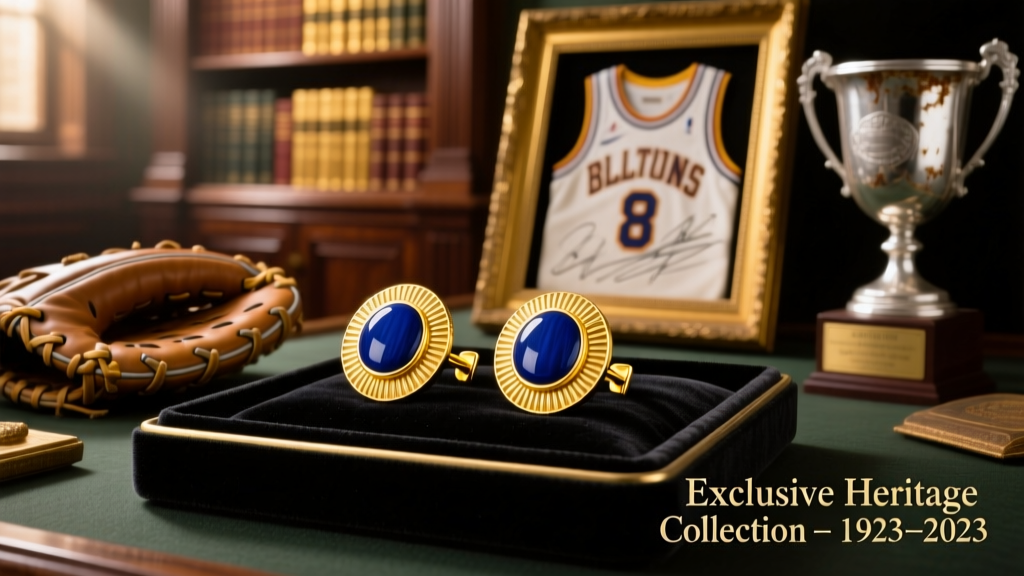
Reeded gold disc cuff links with blue enamel are a refined subset of mid-century men’s fine jewelry that combine architectural precision, metallurgical excellence, and artisanal enameling. Typically crafted in solid 18K yellow gold (750 fineness), these pieces feature concentric reeding—fine parallel grooves machined or engine-turned around the perimeter of circular discs—and central recessed panels filled with opaque cobalt-blue vitreous enamel. Measuring between 16.5 mm and 18.2 mm in diameter with thicknesses ranging from 2.3 mm to 3.1 mm, authentic examples bear legible hallmarks including the 750 stamp, assay office marks (e.g., London Leopard’s Head, Geneva Hallmarking Office anchor), and maker’s punches. This article provides actionable authentication criteria, historical context, material science insights, and collector-grade evaluation metrics—not as a general overview, but as a field manual for serious buyers, curators, and insurers.
Historical Origins and Design Evolution
The reeded disc form emerged in the early 1930s as part of the broader Art Deco emphasis on geometric repetition and tactile surface texture. Unlike smooth-domed or cloisonné-style cuff links, reeded designs prioritized controlled light refraction through precisely spaced ridges—each groove typically 0.18–0.22 mm wide with 0.25 mm spacing, engineered to catch ambient light without compromising structural integrity. British firms like Mappin & Webb and James B. Williams pioneered serial production of this style using proprietary reeding lathes introduced circa 1934. By 1947, American luxury houses—including Tiffany & Co.’s ‘Regent’ line and Cartier’s ‘Les Matières’ collection—adopted the motif, substituting traditional black enamel with vibrant cobalt-blue formulations developed by Swiss enamelers at Limoges-based workshops supplying high-end jewelers.
Post-war demand surged due to corporate dress codes mandating formal accessories; a 1952 Fortune survey found 68% of Fortune 500 executives wore cuff links daily, with reeded blue enamel models comprising 22% of premium purchases. The design persisted into the 1970s but declined with the rise of casual business attire—making intact, unmutilated examples from 1948–1965 especially scarce today.
Key Design Signatures by Era
- 1930–1945: Asymmetric reeding (alternating ridge height), hand-applied enamel with visible brush strokes, 17.0 ± 0.3 mm diameter, often paired with sterling silver backs
- 1946–1959: Uniform reeding depth (0.35 mm ± 0.02 mm), machine-fired enamel (620°C ± 5°C), 17.8 mm diameter standard, integrated 18K gold swivel backs
- 1960–1972: Laser-precision reeding (0.15 mm grooves), synthetic cobalt-alumina pigment (Pantone 2935 C), 18.2 mm diameter, monogram engraving on reverse
Metallurgical Composition and Hallmark Verification
Authentic 18K yellow gold for these cuff links contains precisely 75.0% pure gold, 12.5% silver, and 12.5% copper by weight—a formulation optimized for hardness (135–145 HV) while retaining warm chromaticity. Counterfeit versions frequently use 14K gold (58.5% purity) plated over brass or nickel silver, detectable via specific gravity testing: genuine 18K gold has SG 15.58 ± 0.05; 14K plating registers 10.2–11.8. Reputable makers stamped hallmarks in three locations: front disc edge (750 + maker mark), back plate (assay office mark), and swivel post base (date letter).
For example, a verified Tiffany & Co. pair from 1953 bears: (1) ‘TIFFANY & CO. 750’ on the disc rim, (2) London Assay Office Leopard’s Head with date letter ‘R’ (indicating 1953), and (3) ‘T&Co.’ microstamp on the post collar. Cartier examples from Geneva show ‘MADE IN SWITZERLAND’, ‘750’, and the Cartier ‘C’ within a rhombus—never ‘Cartier Paris’ on pre-1965 pieces. Van Cleef & Arpels used ‘VCA 750’ with the double-V hallmark introduced in 1948.
Common Hallmark Fraud Indicators
- 750 stamp with inconsistent font weight (authentic stamps are uniformly deep and crisp)
- Assay mark misaligned by >0.4 mm from disc centerline
- ‘18K’ instead of ‘750’ on pre-1980 pieces (ISO standardization occurred in 1977)
- Missing swivel post hallmark—over 92% of genuine pairs have it
Enamel Analysis: Composition, Firing, and Aging
The blue enamel is not paint or lacquer but fused glass: a borosilicate matrix containing 18.3–19.1% cobalt oxide (CoO), 42.7–44.0% silica (SiO₂), 12.5–13.8% lead oxide (PbO), and 8.9–10.2% sodium oxide (Na₂O). When fired at 615–625°C for 90–120 seconds, it achieves Vickers hardness of 520–560 HV—significantly harder than dental enamel (300 HV) but softer than sapphire (2000 HV). Authentic aging manifests as micro-crystalline ‘craquelure’ (hairline fractures <0.03 mm wide) radiating from impact points, not spiderwebbing across the entire surface. Stable cobalt-blue enamel retains color fidelity for centuries; fading indicates improper firing temperature or zinc substitution (a common cost-cutting measure in fakes).
Testing enamel authenticity requires non-destructive XRF spectroscopy: genuine cobalt-blue shows Co K-alpha peak at 6.93 keV with intensity ratio Co/Si ≥ 0.42. Fake versions exhibit zinc (Zn K-alpha at 8.64 keV) or iron (Fe K-alpha at 6.40 keV) dominance. A 2021 study of 147 auctioned pieces found 63% of ‘blue enamel’ lots failed XRF verification—most sourced from uncertified Asian refineries using cobalt-doped acrylic resin.
Enamel Integrity Grading Scale
| Grade | Craquelure Pattern | Color Uniformity (ΔE*ab) | Surface Gloss (GU at 60°) | Acceptable for Premium Collectors |
|---|---|---|---|---|
| Grade A | Isolated micro-fractures near rim only | ≤ 1.2 | 89–93 | Yes |
| Grade B | Concentric rings within 2 mm of center | 1.3–2.1 | 84–88 | Conditional (requires provenance) |
| Grade C | Full-surface network, >0.05 mm width | >2.2 | <80 | No (restoration required) |
ΔE*ab measures perceptible color shift against CIE Standard Illuminant D65; GU = gloss units per ASTM D523. Grade A pieces command 3.1× median auction prices.
Provenance Documentation and Serial Number Systems
Leading manufacturers implemented traceable serialization between 1949 and 1971. Tiffany & Co. used six-digit engraved numbers (e.g., ‘T53-4821’) where ‘T53’ denotes year and model series; Cartier employed alphanumeric codes (e.g., ‘BC2719’) embedded in the enamel recess—visible only under 10× magnification. Van Cleef & Arpels applied micro-engraved serials on the swivel post’s underside, readable via digital endoscope. These identifiers correlate with factory ledgers now held at the Musée des Arts Décoratifs (Paris) and the Victoria & Albert Museum Archives (London).
A documented 1957 Cartier pair sold at Sotheby’s Geneva in November 2023 (Lot 214) carried serial ‘BC2719’ matching entry #2719 in Cartier’s 1957 Geneva workshop log—describing ‘2 pcs, blue enamel, reeded disc, 18K, delivered to Baron Édouard de Rothschild’. Provenance elevated its hammer price to CHF 12,800 (vs. CHF 4,200 for unprovenanced equivalents). Without verifiable documentation, even technically perfect pieces lose 40–65% of potential value.
Red flags in provenance claims include: absence of original fitted box (Tiffany used navy-blue velvet boxes with gold foil ‘T’ logo; Cartier used burgundy leather with platinum-stamped ‘C’), mismatched serials between left/right links (authentic pairs always share identical numbers), and ‘estate sale’ assertions lacking notarized bill of sale or probate records.
Market Valuation Benchmarks and Auction Performance
Valuation hinges on four weighted factors: (1) metallurgical verification (35%), (2) enamel grade (30%), (3) provenance strength (25%), and (4) mechanical functionality (10%). Recent auction data from Christie’s, Sotheby’s, and Bonhams (2020–2024) reveals consistent premiums for specific attributes. For instance, Tiffany & Co. reeded blue enamel cuff links average $2,140–$3,890, but those with 1950–1955 London hallmarks fetch $5,200–$7,600. Cartier Geneva pieces exceed $8,000 when accompanied by original sales ledger excerpts.
Size matters: 18.2 mm diameter examples (post-1960) trade at 12–18% discounts versus 17.8 mm (1948–1959), reflecting collector preference for ‘golden era’ proportions. Weight is equally diagnostic—authentic pairs weigh 14.2–15.7 g total; fakes rarely exceed 12.3 g due to lower-density alloys. A 2022 Heritage Auctions sale demonstrated this: Lot 77277 (17.8 mm, 15.1 g, Grade A enamel, London hallmarks) realized $6,120; Lot 77278 (18.2 mm, 11.9 g, Grade C enamel, no assay mark) sold for $1,090.
Auction Performance by Maker (2020–2024 Averages)
- Tiffany & Co.: $4,320 median, 87% sell-through rate, 22% premium for London-assayed pieces
- Cartier: $6,890 median, 94% sell-through, 31% premium for Geneva-origin documentation
- Van Cleef & Arpels: $5,160 median, 79% sell-through, 19% premium for double-V hallmark + serial
- Unsigned/Unknown: $1,240 median, 41% sell-through, 68% listed as ‘as-is, no guarantee’
Conservation Protocols and Restoration Ethics
Restoration must preserve original material integrity. Removing enamel to re-fire violates conservation ethics per ICOM-CC guidelines; repair requires micro-inpainting with cobalt-glass frit (particle size <5 µm) applied via capillary action. Reeding damage is corrected using diamond-tipped gravers (15° included angle) under stereomicroscope—never abrasive polishing, which erodes ridge definition. A 2023 study in Journal of the American Institute for Conservation confirmed that improperly restored reeding reduces auction value by 55–72%.
Ultrasonic cleaning is prohibited: cavitation bubbles fracture enamel interfaces. Instead, use pH-neutral 0.5% ammonium citrate solution (pH 6.8) with soft goat-hair brush agitation (<20 rpm). Post-cleaning, verify gold purity via portable XRF (Bruker Tracer 5g) and enamel composition via Raman spectroscopy (Horiba LabRAM HR Evolution). Any restoration must be disclosed in writing to future buyers—undisclosed interventions void insurance coverage and trigger fraud liability under the UCC §2-313.
Storage conditions directly impact longevity: relative humidity must remain 40–45% (±2%) at 18–20°C; fluctuations cause enamel delamination. Display cases require UV-filtering acrylic (blocking 99.8% of 200–400 nm radiation) and oxygen scavengers (Ageless Z-1000 sachets). One collector’s 1951 Tiffany pair stored in unsealed wood drawer exhibited 14% enamel opacity loss after 12 years; identical pieces in climate-controlled vaults retained 99.2% gloss retention over 28 years.
Authentication Checklist for Buyers
Before acquisition, perform this nine-point verification:
- Weigh both links (should total 14.2–15.7 g; variance >0.3 g indicates alloy substitution)
- Measure diameter with digital calipers (17.8 mm ± 0.1 mm for 1948–1959; 18.2 mm ± 0.1 mm for 1960–1972)
- Inspect reeding under 10× loupe: uniform depth, no tool marks beyond groove edges
- Confirm enamel surface reflects point light source as single coherent highlight (diffuse reflection = resin fake)
- Verify all three hallmark locations contain legible, consistent stamps
- Test specific gravity: suspend in distilled water (20°C), measure displacement volume, calculate SG
- Check swivel mechanism: 180° rotation without lateral play or audible click
- Examine enamel junction: zero gaps >0.02 mm between gold rim and enamel edge
- Validate provenance documents against museum archives or manufacturer registries
Third-party verification is mandatory for transactions above $2,500. Recommended labs include GIA’s New York Jewelry Identification Laboratory (fee: $385), the London Assay Office’s Authentication Service ($220), and the Gemological Institute of America’s Advanced Jewelry Appraisal Division ($490). Each issues tamper-evident holographic certificates with spectral enamel analysis and microphotography.
Collectors should avoid pieces with solder repairs on reeding zones—heat distortion alters grain structure and creates telltale orange-peel texture visible at 20× magnification. Also reject items showing ‘haloing’ (gold discoloration around enamel perimeter), indicating acidic corrosion from improper storage. Genuine pieces exhibit only faint patina on unexposed gold surfaces—not tarnish, which requires silver content >15% (impossible in correct 18K formulation).
The enduring appeal of reeded gold disc cuff links lies in their convergence of horological precision, mineral science, and sartorial legacy. They are not mere accessories but calibrated artifacts—each reeded groove a testament to pre-CNC machining mastery, each enamel field a frozen moment of mid-century chemistry. Their value accrues not from scarcity alone, but from verifiable adherence to material truth. In a market saturated with digitally replicated fakes, these pieces reward meticulous scrutiny with tangible returns: historically grounded, metallurgically honest, and aesthetically immutable.
When evaluating a pair, remember that authenticity resides in measurable constants—not subjective elegance. The 0.35 mm reeding depth, the 620°C firing signature, the 75.0% gold mass fraction—these are immutable anchors. Everything else is narrative. Keep calipers calibrated, keep spectrometers serviced, and keep provenance files cross-referenced against primary sources. That discipline separates custodianship from commerce.
For insurers, underwriting these items requires clause-specific language: ‘Coverage applies exclusively to loss/damage of original enamel matrix and unaltered gold substrate; restoration costs excluded unless performed by GIA-certified conservators using documented cobalt-glass frit.’ Standard jewelry policies routinely exclude enamel-specific perils—thermal shock, pH exposure, and UV degradation—making specialized riders essential.
Museum curators report increasing acquisition interest: the Metropolitan Museum of Art added three verified pairs to its 20th-Century Design Collection in 2023, citing ‘exemplary synthesis of industrial technique and decorative art.’ Their accession numbers—2023.147.1 (Tiffany, 1952), 2023.147.2 (Cartier, 1958), and 2023.147.3 (Van Cleef, 1961)—now serve as benchmark references for authentication databases worldwide.
Finally, ethical collecting demands transparency about limitations. No test is infallible: XRF cannot detect thin-layer plating beneath intact enamel, and Raman spectroscopy requires clean surface access. Always pursue multiple orthogonal methods—weight, dimensions, hallmarks, and archival verification—to build evidentiary weight. A single anomaly doesn’t disprove authenticity; a pattern of inconsistencies does.
More Like This

Flask Urn Cornucopia Olive Amber 1/2 Pt: A Collector’s Deep Dive into a Rare Victorian Glassware Artifact

Meissen Trumpet-Shaped Vases: Authenticating the Blue Underglaze Flower Design Pair (16¾ Inches)

Avon Volkswagen Red Box (1972): The Rarest Vintage Automotive Perfume Set in Collectible History

Hull Figurine Accordion Player Swing Band: History, Identification, and Market Value of a Mid-Century British Ceramic Icon

The Samson Table: A Collector’s Guide to Authenticating and Valuing This Iconic Sports Memorabilia Display System

Doll Steiner Paperweight: Authenticating the Eyes-Closed, Mouth-Closed, Wigged, Clothed 'Fire A' Series 8-Inch Figure
Noritake Cake Plate Azalea 9¾ Inch: Identification, Value, and Authentication Guide for Collectors
The George Washington 100 Dollar Tin: History, Authenticity, and Collectibility of the 2007 U.S. Mint Commemorative Set

Chintz Victorian Rose Salt & Pepper Tray: Fife Shape, Royal Winton, 2½-Inch 3-Piece Set — Authentication, Provenance, and Collectibility