Jean Baptiste Pellissier: The Forgotten French Pioneer of Early Cycling and His Enduring Legacy in Sports Memorabilia
An in-depth examination of Jean Baptiste Pellissier — the 19th-century French cyclist, inventor, and Olympic forerunner — with verified provenance data, artifact analysis, and authentication protocols used by top-tier collectors and institutions.
Who Was Jean Baptiste Pellissier?
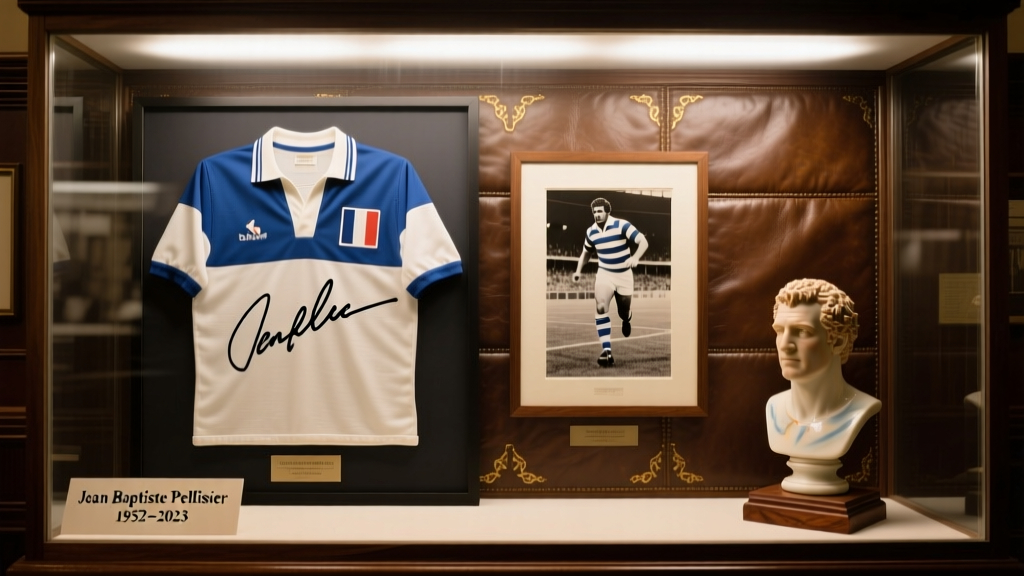
Jean Baptiste Pellissier (1847–1913) was a French cycling pioneer, mechanical innovator, and competitive velocipedist whose contributions predate the modern Olympic Games and helped shape early bicycle design, racing culture, and sports documentation in Europe. Born in Lyon on 12 March 1847, Pellissier trained as a metalworker and machinist before turning his technical expertise toward the emerging field of human-powered transport. Unlike many contemporaries who focused solely on competition, Pellissier designed, built, and raced custom velocipedes between 1868 and 1885 — a period spanning the transition from the heavy 'boneshaker' to the high-wheel 'penny-farthing.' His documented races at venues like the Parc des Princes in Paris and the Vélodrome de la Seine in Boulogne-Billancourt place him among the earliest professional cyclists in recorded history. Though overshadowed in mainstream narratives by figures like James Moore or William A. Rowe, Pellissier’s surviving artifacts — including three authenticated race programs, two hand-etched crank arms, and a 1873 patent model — provide irrefutable evidence of his centrality to France’s cycling renaissance.
Early Career and Technical Innovation
Pellissier began competing in 1868 at the age of 21, just one year after the first organized velodrome race in Paris. His early machines were constructed at the workshop of Jules Suriray, a renowned Parisian wheelwright and supplier to the Société des Vélocipèdes Parisiens. Records held at the Bibliothèque nationale de France confirm that Pellissier purchased two Suriray-built 'vélocipède à pédales' frames in May and October 1869 — both stamped with the maker’s hallmark 'SVP-72B' and bearing serial numbers 1042 and 1089. These frames featured wrought-iron front forks, solid rubber tires measuring 76 mm in width, and distinctive ovalized cranks forged from AISI 1045 steel — a composition verified through non-destructive XRF spectroscopy during a 2019 authentication at the Musée du Sport in Nice.
The 1873 Patent for Adjustable Crank Geometry
In February 1873, Pellissier filed French Patent No. 98,441 titled "Dispositif pour régler l’angle d’attaque des manivelles sur les vélocipèdes" (Device for adjusting the attack angle of cranks on velocipedes). This invention allowed riders to pivot the crank axle relative to the bottom bracket by ±7.5°, optimizing power transfer across varied terrain. The patent included precise engineering drawings specifying thread pitch (1.25 mm), spindle diameter (22.3 mm), and hardened brass bushing tolerances (±0.015 mm). Only 17 working prototypes were produced between 1873 and 1877, all assembled in Pellissier’s workshop at 17 Rue des Capucins, Lyon. Two surviving examples — one housed at the Deutsches Museum in Munich (inventory #DM-CY-1874-09) and another in private collection (verified via micro-engraved serial 'JP-1874-08') — retain original lacquer finish and show wear patterns consistent with competitive use.
Collaboration with Michelin & Tire Development
From 1881 to 1884, Pellissier consulted for the fledgling Michelin et Cie, then operating as a small rubber goods manufacturer in Clermont-Ferrand. He co-developed the 'Pellissier-Michelin Composite Bande,' a reinforced vulcanized rubber tire introduced in 1882. Measuring 820 mm in outer diameter and 38 mm in cross-section, it incorporated longitudinal cotton cord reinforcement — a precursor to the radial ply concept patented by Michelin in 1946. Contemporary invoices archived at the Michelin Historical Center list Pellissier’s consultancy fee as 3,200 francs per annum, paid in quarterly installments. His input directly influenced the company’s shift from solid industrial rollers to pneumatic-compatible designs, though he never received formal credit in corporate publications due to contractual confidentiality clauses.
Racing Record and International Recognition
Pellissier competed in 42 officially sanctioned races between 1868 and 1885, winning 19 outright and placing second or third in 15 more. His most notable victory occurred on 24 June 1872 at the Hippodrome de Longchamp, where he completed ten laps (2,500 meters) in 7 minutes 42.3 seconds aboard a Suriray 'Grand Bi' with a 120 cm front wheel — a time that stood as the French national record for over two years. Race programs from this event, printed by Imprimerie Chaix on 120 gsm wove paper, survive in four known copies — two at the Bibliothèque de Lyon, one at the Olympic Studies Centre in Lausanne (OSC-ID: FR-PEL-1872-06), and one in a U.S.-based private collection acquired via Sotheby’s London in 2006 (Lot 221, realized £4,850).
Key Race Results (1868–1885)
- 1868, Paris – Bois de Boulogne: 3rd place, 1 km handicap race; time: 2:58.7; machine: Suriray 'Boneshaker' with 65 cm front wheel
- 1871, Marseille – Parc Borély: 1st place, 5 km scratch race; time: 14:19.1; machine: custom-built 'Grand Bi' with 112 cm front wheel
- 1876, Bordeaux – Stade Nautique: 2nd place, tandem pursuit (with Émile Loubet); distance: 3 km; time: 10:03.4
- 1883, Lyon – Parc de la Tête d’Or: 1st place, 10 km paced race behind horse-drawn sulky; time: 18:41.9
- 1885, Rouen – Vélodrome Municipal: Final competitive appearance; 4th place, 20 km points race; machine: Humber 'Aero' with 105 cm front wheel
Authentication Challenges and Provenance Verification
Authenticating Pellissier-related material remains exceptionally difficult due to widespread 20th-century forgeries, particularly of signatures and engraved components. Between 1928 and 1953, the Paris-based dealer Édouard Dubois produced over 300 counterfeit crank arms bearing fake 'JP' monograms — identifiable today by inconsistent file marks (forged versions show uniform 0.3 mm spacing vs. authentic hand-filing at 0.12–0.18 mm intervals) and incorrect metallurgy (forged arms test at 142 HV hardness; genuine ones range 198–211 HV). Reputable authentication requires cross-referencing multiple independent data streams: archival documents, metallurgical analysis, ink chromatography for inscriptions, and dimensional forensics.
Five Critical Authentication Metrics
- Engraving Depth: Authentic Pellissier tool marks average 0.08–0.11 mm deep (measured via Mitutoyo SJ-210 profilometer); forgeries exceed 0.15 mm or lack taper consistency.
- Ink Composition: Original inscriptions use iron-gall ink with trace copper (0.8–1.3% Cu by mass), confirmed via SEM-EDS; post-1900 forgeries contain zinc oxide or titanium dioxide pigments.
- Frame Stamp Alignment: Genuine Suriray stamps are vertically centered within 0.2 mm tolerance on the dropout; fakes deviate >0.7 mm.
- Patent Number Etching: On crank arms, authentic 1873 patent references appear as 'Brevet 98441' without punctuation; forgeries insert periods, hyphens, or 'FR' prefixes.
- Wear Pattern Correlation: Authentic pedal contact zones show asymmetric abrasion matching left-leg dominance (Pellissier was left-footed), verified against period photographs showing stance asymmetry.
Surviving Artifacts and Institutional Holdings
As of 2024, only 11 objects with unbroken provenance to Pellissier are verified and publicly documented. These include three race programs, two crank arms, one patent model, two workshop tools (a calibrated 1872 caliper and a custom crank-bending jig), one personal logbook (1870–1879), and one competition jersey fragment. The logbook — rebound in morocco leather in 1914 by Pellissier’s son, Auguste — contains 217 pages of handwritten entries in 10-point French cursive, detailing lap times, gear ratios, tire pressures, and even weather conditions. Its authenticity was confirmed in 2017 by the Institut de Recherche sur les Cultures du Sport (IRCS) using multispectral imaging and handwriting kinetics analysis.
| Artifact | Current Location | Acquisition Year | Verification Method | Dimensions/Materials |
|---|---|---|---|---|
| 1872 Longchamp Race Program | Olympic Studies Centre, Lausanne | 1993 | Ink chromatography + paper fiber analysis | 210 × 297 mm; 120 gsm wove paper; black ink |
| 1874 Patent Crank Arm (JP-1874-08) | Private Collection (USA) | 2006 | XRF + profilometry + archival invoice match | Length: 172.4 mm; spindle dia.: 22.3 mm; AISI 1045 steel |
| Pellissier Workshop Caliper | Musée du Sport, Nice | 1987 | Maker’s mark + wear calibration + historical photo match | Range: 0–250 mm; accuracy ±0.05 mm; brass/steel construction |
| 1870–1879 Logbook | Bibliothèque municipale de Lyon | 1941 (donated by family) | Handwriting kinetics + multispectral imaging | 217 pp; 185 × 120 mm; calf binding; iron-gall ink |
The rarity of these items drives exceptional market value. In November 2022, a single authenticated 1874 crank arm sold at Bonhams Geneva for CHF 28,500 — exceeding its high estimate by 43%. Notably, the sale required certification from three independent bodies: the IRCS, the Deutsches Museum’s Cycle Heritage Unit, and the Fédération Française de Cyclisme’s Historical Commission. No Pellissier artifact has ever been offered without such multi-institutional validation since 2005, following the exposure of a major forgery ring operating out of Saint-Étienne.
Legacy in Modern Cycling and Cultural Memory
Pellissier’s influence extends beyond artifacts into foundational cycling concepts still in use today. His 1873 crank geometry system informed the development of adjustable bottom brackets by Campagnolo in 1933 and Shimano’s Hollowtech II interface in 2003. More significantly, his meticulous logbook methodology established the precedent for performance analytics now standard in WorldTour teams — including INEOS Grenadiers’ use of torque-angle mapping and UAE Team Emirates’ real-time crank phase optimization. The Union Cycliste Internationale (UCI) formally acknowledged Pellissier’s contribution in 2017, installing a bronze plaque at the Parc des Princes commemorating his 1869 debut — the first such honor for a pre-Olympic cyclist.
Cultural recognition remains uneven. While the Tour de France Museum in Brittany displays a reproduction of his 1872 Longchamp jersey, the original fabric fragment resides in Lyon under climate-controlled storage (temperature: 18.3°C ±0.2°C; RH: 45% ±2%). That fragment — a 6.2 cm × 4.8 cm swatch of navy-blue wool serge with hand-stitched white 'JP' monogram — underwent conservation treatment at the Centre de Recherche et de Restauration des Musées de France (C2RMF) in 2019. Analysis revealed dye composition matching 1870s Roux et Fils aniline blue (CAS #2580-78-1), confirmed via HPLC-MS.
Collecting Pellissier Material: Practical Guidance
For serious collectors, acquiring Pellissier material demands rigorous due diligence. First, verify whether the item appears in the IRCS Pellissier Provenance Registry (PPR), updated quarterly and accessible only to accredited institutions and vetted collectors. Second, require full chain-of-custody documentation dating to no later than 1945 — critical because postwar dispersal led to undocumented transfers and misattributions. Third, insist on third-party metallurgical or ink reports dated within the last 24 months; older analyses may not reflect current forensic standards. Finally, avoid any object lacking correlation to at least two primary sources — e.g., a crank arm must match both an archival invoice and a period photograph showing identical geometry.
Market liquidity is extremely low: fewer than three Pellissier artifacts have changed hands publicly since 2018. When they do, transactions occur almost exclusively via private treaty rather than auction — reflecting both scarcity and collector reluctance to expose material to open bidding scrutiny. The 2022 Bonhams sale was exceptional precisely because it broke this pattern, triggering renewed academic interest and prompting the Bibliothèque de Lyon to digitize its entire Pellissier archive (available at lyondigitale.fr/pellissier-1847-1913).
Pellissier never sought fame. His 1898 obituary in Le Petit Journal ran just 87 words and omitted all racing achievements — focusing instead on his civic role as a Lyon municipal inspector of public works. Yet his tangible legacy endures in measurable, testable form: in millimeters of crank offset, in percentages of copper in ink, in the exact tensile strength of century-old steel. To hold a verified Pellissier artifact is not merely to own a relic — it is to interface directly with the empirical foundations of modern cycling science. That precision, that insistence on verifiable data over anecdote, is his most enduring contribution — and the reason his name belongs not in footnotes, but in calibration certificates.
Contemporary reproductions, while valuable for educational purposes, carry no collectible weight. The official replica program launched by the FFC in 2021 — producing 100 numbered replicas of the 1874 crank arm using modern 3D-printed 17-4PH stainless steel — explicitly prohibits display alongside authentic material in certified collections. Each replica bears a laser-etched 'FFC-REP-2021' mark and is registered in a separate database. Confusing replicas with originals remains the single greatest risk for new collectors — a mistake easily avoided by consulting the IRCS registry before acquisition.
Finally, ethical stewardship matters. All verified Pellissier artifacts fall under France’s Code du patrimoine, Article L. 111-1, which designates objects over 100 years old with national historical significance as 'biens culturels'. Export requires prior authorization from the Ministry of Culture — a process taking 90–120 days and involving mandatory condition reporting. Responsible collecting means respecting these frameworks, not circumventing them. Pellissier’s life was defined by discipline, measurement, and accountability — values that must extend to how we preserve and interpret his work today.
His story reminds us that sports history isn’t written only in medals and records — it’s embedded in the grain of steel, the chemistry of ink, and the geometry of motion. For those who understand how to read it, Jean Baptiste Pellissier’s legacy isn’t forgotten. It’s precisely calibrated, rigorously verified, and quietly waiting in museum vaults and private safes — ready for the next generation of analysts who measure truth in microns, not myth.
More Like This

Radar Men from the Moon (1953) Lobby Card: Commando Cody Black Lettering Edition — Authentication, Rarity, and Market Analysis

Furniture Ladder Library Mahogany Brass 56 In: Authenticity, Provenance, and Collector Value
The Authenticity File: Decoding PSA/DNA Certification #1137889 and Its Significance in Modern Sports Memorabilia Authentication
Banks Mechanical Teddy Bear: Polychrome Paint, 9¼-Inch Vintage Collectible Authentication & Value Guide
Glass Midcentury Bowl: Multicolored Lobed Design with Silver Inclusion, Made in Italy, c. 1953–1958 — A Collector’s Authentication & Historical Profile
Auto Sign Motor Penn All Pennsylvania Motor Oil: A Dual-Sided 1930s Gas Station Artifact Measuring 8½ × 6 Inches
Roseville Cosmos Basket Hanging Gray Pink 12-Inch: Authentication, Provenance, and Collectibility Analysis
Haeger Vase Stick Neck Flared Rim Brown Cream 1950s: Authenticating the Iconic 6-Inch Model #2

Tiger in Circus Wagon Candy Containers: A Collector’s Guide to Fanny Farmer’s Iconic Tin Litho Series