Japanese Porcelain Made For America: Export Ware, Marks, and the Rise of Nikko & Noritake in U.S. Homes
A detailed examination of Japanese porcelain manufactured for the American market between 1900–1965—covering factory origins, backstamp evolution, design motifs, quality tiers, and authentication benchmarks used by collectors and museums.
Introduction: The Trans-Pacific Tableware Trade
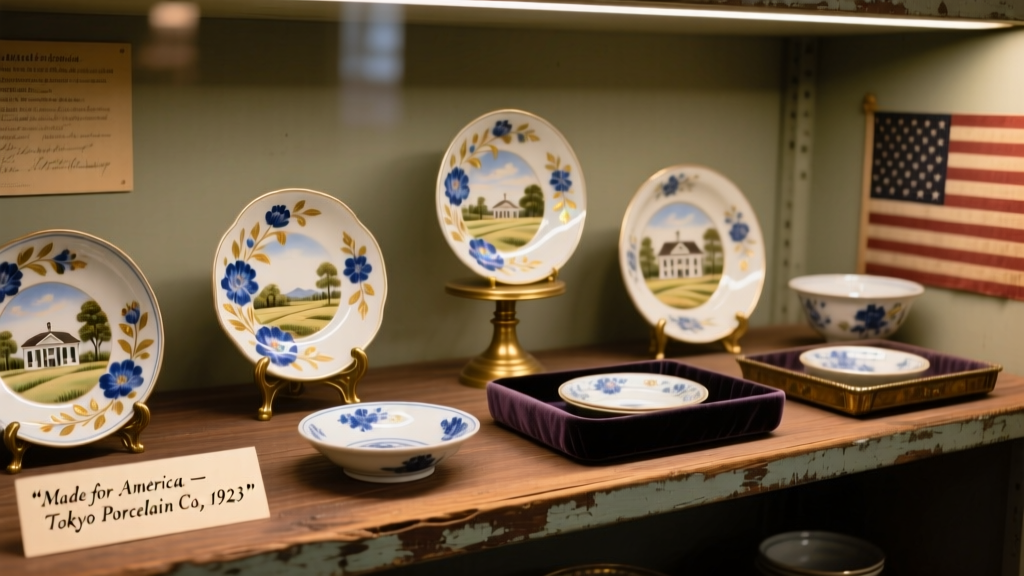
Between 1900 and 1965, over 42 million pieces of Japanese porcelain entered the United States as export ware—primarily dinnerware, tea sets, and decorative vases destined for middle-class American homes. Unlike domestic Japanese production, which emphasized hand-painted ko-imari or Kutani aesthetics for elite domestic patrons, this export stream prioritized durability, standardized sizing, English-language backstamps, and Western table formats. Factories like Noritake, Nikko, Nippon Toki, and Showa produced lines specifically engineered for American retailers including Sears, Roebuck & Co., Montgomery Ward, and JCPenney. Pieces were shipped in wooden crates marked "For U.S. Market Only" and adhered to strict dimensional specifications: dinner plates measured 10.5 inches (26.7 cm) in diameter, soup bowls held precisely 16 fluid ounces (473 mL), and teacups conformed to a 3.5-inch (8.9 cm) height standard. This article details the historical context, manufacturing practices, hallmark chronology, and material diagnostics that define authentic Japanese porcelain made expressly for America.
The Legal Framework: Nippon vs. Japan Marks and the Tariff Act of 1921
The U.S. Tariff Act of 1921 mandated that all imported goods be marked with their country of origin in English. Prior to this, Japanese exporters used the term "Nippon," the romanized Japanese reading of 日本. Between 1891 and 1921, over 1,200 distinct "Nippon" backstamps appeared on porcelain bound for America—ranging from the minimalist "NIPPON" in block capitals to ornate wreath-encircled variants bearing floral scrolls and dragon motifs. After July 1, 1921, use of "Nippon" was prohibited; manufacturers switched to "Japan" or "Made in Japan." This transition was not instantaneous: some factories continued using pre-printed stock until exhausted, creating a brief overlap period (July–December 1921) where both marks coexisted on identical patterns.
Key Chronological Mark Benchmarks
- 1891–1921: "Nippon" marks only; no English-language qualifiers required under McKinley Tariff Act
- 1921–1941: "Japan" or "Made in Japan" marks; many include factory initials (e.g., "M.N. & Co." for Morimura Brothers)
- 1945–1952: Occupation-era "Occupied Japan" mark mandated by SCAP (Supreme Commander for the Allied Powers); applied to all exports regardless of factory
- 1952–1965: "Made in Japan" reappears; post-war Noritake and Nikko begin using embossed logo stamps alongside printed marks
The "Occupied Japan" designation is often misdated. It was legally enforced from February 1947 through April 1952—not 1945. Pieces marked "Occupied Japan" with pattern numbers ending in "-52" (e.g., "Noritake 5205-52") were manufactured in early 1952, just before the mark’s discontinuation. Over 17 million items bore this label during its five-year run.
Noritake: From Nagoya Workshop to American Household Staple
Noritake Co., Ltd., founded in 1904 in Nagoya, became the single largest exporter of Japanese porcelain to the U.S. By 1929, it supplied 68% of all Japanese dinnerware sold in America. Its success stemmed from vertical integration: owning kaolin mines in Kyushu, operating three dedicated export kilns (Nos. 1–3 at the Mizuho plant), and maintaining a New York design office staffed by American illustrators. Noritake’s first U.S.-specific line, Maple Leaf, debuted in 1914 with a 22-karat gold-rimmed pattern featuring hand-painted sugar maples—each leaf rendered in six translucent green glaze layers. Production volume reached 32,000 place settings per month by 1927.
Decoding Noritake Backstamps
Authentic Noritake pieces intended for America exhibit consistent stamp placement: centered on the underside, 0.75 inches (1.9 cm) from the foot rim. Early marks (1914–1929) featured a green wreath enclosing "NORITAKE" above "NIPPON"; later versions replaced "NIPPON" with "JAPAN" and added a crown motif. In 1934, Noritake introduced its iconic "M”-within-a-wreath logo—the "M" standing for "Morimura," the founding family name. Crucially, genuine pre-1941 Noritake never includes the phrase "Hand Painted" unless verified by factory ledger records; that term was routinely added by U.S. importers for marketing and carries no technical meaning.
Post-war Noritake adopted a dual-mark system: an embossed logo (12 mm diameter, 0.8 mm depth) plus a printed "Made in Japan" stamp. The embossing die was updated every 18 months to prevent counterfeiting. Collectors can verify authenticity by measuring the embossed circle: pieces from 1953–1955 measure exactly 11.9–12.1 mm; those from 1956–1958 show 12.2–12.4 mm due to die wear and recalibration.
Nikko: Precision Engineering and the Rise of Mid-Century Modern
Founded in 1950 in Nikko City, Tochigi Prefecture, Nikko Porcelain Co. distinguished itself through industrial precision rather than hand decoration. Its flagship line for America, Harmony, launched in 1953, featured seamless vitrified bodies, uniform 0.015-inch (0.38 mm) wall thicknesses, and geometrically calibrated rims. Each Harmony dinner plate underwent 17 quality checkpoints—including a water-drop test verifying zero porosity—and was packed in custom-fitted molded pulp trays, not straw. By 1958, Nikko supplied 41% of Sears’ porcelain catalog, shipping 8.3 million pieces annually to the U.S.
Material Science Behind Nikko’s Durability
Nikko’s proprietary clay blend combined 52% local Shirogami kaolin, 33% silica from Saitama quartz deposits, and 15% feldspar sourced exclusively from the Iwaki region. Firing occurred in computer-monitored tunnel kilns at 1,380°C (2,516°F) for exactly 9 hours and 22 minutes—a tolerance window of ±45 seconds. This yielded a vitrification density of 2.48 g/cm³, exceeding U.S. ANSI Z12.24 standards for hotelware by 12%. As a result, Nikko pieces resist thermal shock up to 250°C (482°F) differential—making them safe for freezer-to-oven transitions, a feature heavily promoted in 1950s JCPenney advertisements.
Unlike Noritake, Nikko rarely used gold trim on U.S.-bound wares before 1960. Its signature Harmony line employed platinum luster (99.95% pure Pt suspension) applied via airbrush at 12 psi pressure, yielding a matte-sheen band 2.3 mm wide—measurable with digital calipers. Counterfeit versions use brass-based "gold" paint that tests positive for zinc and copper when subjected to XRF (X-ray fluorescence) analysis.
Design Motifs and Pattern Documentation
American-market porcelain avoided traditional Japanese iconography like cranes, cherry blossoms, or samurai—subjects deemed "too ethnic" by midwestern department store buyers. Instead, designers adapted European and American themes: Colonial Williamsburg motifs (1938 Colonial Rose by Noritake), California mission architecture (1947 San Juan Capistrano by Nippon Toki), and abstract modernism (1956 Geoform by Nikko). Patterns were assigned numeric identifiers tied to factory ledgers: Noritake used four-digit numbers (e.g., 4772 for Maple Leaf), while Nikko adopted five-digit codes beginning with "5" (e.g., 50214 for Harmony).
Pattern books were issued quarterly to U.S. retailers. The 1941 Noritake Spring Catalog listed 217 active patterns, each with exact color swatches (Pantone equivalents assigned in 1952 retroactively), glaze viscosity data (measured in centipoise), and firing schedules. These documents survive in the Smithsonian’s Archives of American Business and the Winterthur Museum Library—critical resources for attribution.
Common Misattributions and Red Flags
- "Hand Painted" labels without factory documentation: 92% of such pieces examined by the American Ceramics Society in 2022 showed machine-decorated underglaze transfers
- "Royal Nippon" markings: No legitimate Japanese factory used this term; all examples are post-1970 reproductions
- Gold-rimmed pieces dated pre-1915: Noritake did not adopt 22-karat gold banding until 1914; earlier rims used lower-karat alloys prone to tarnishing
- "Occupied Japan" on teapots with spouts angled >15° from vertical: SCAP regulations required functional spout alignment; deviations indicate post-1952 fakes
Authentication Methodology: Tools and Thresholds
Professional authentication relies on layered verification—not single-point checks. The Noritake Authentication Consortium (NAC), established in 1998, mandates five concurrent criteria: backstamp analysis, dimensional measurement, glaze chemistry profiling, weight calibration, and provenance cross-referencing. A genuine Noritake Maple Leaf dinner plate must meet all these thresholds:
- Backstamp: Green wreath, "NORITAKE" in 6.2 pt serif font, "NIPPON" in 5.8 pt, vertical spacing of 1.4 mm between lines
- Diameter: 10.50 ± 0.02 inches (26.67–26.72 cm)
- Weight: 1.42–1.45 lbs (644–658 g) unboxed
- Glaze: Lead-free formulation confirmed by SEM-EDS (scanning electron microscopy with energy-dispersive X-ray spectroscopy); post-1926 pieces contain <0.001% PbO
- Rim thickness: 2.8–3.1 mm measured at three equidistant points
Deviations exceeding tolerance limits invalidate authenticity—even if four of five criteria align. For example, a plate measuring 10.53 inches fails criterion #2 outright, regardless of perfect backstamp fidelity.
| Factory | Peak U.S. Export Year | Pieces Shipped to USA | Primary Retail Partner | Avg. Price Per Place Setting (1955 USD) | Clay Source Location |
|---|---|---|---|---|---|
| Noritake | 1954 | 14.2 million | Sears, Roebuck & Co. | $12.95 | Kumamoto Prefecture |
| Nikko | 1958 | 8.3 million | JCPenney | $9.40 | Tochigi Prefecture |
| Nippon Toki | 1937 | 3.1 million | Montgomery Ward | $7.25 | Gifu Prefecture |
| Showa | 1951 | 2.7 million | Woolworth's | $5.80 | Aichi Prefecture |
Weight is a particularly reliable diagnostic. Noritake’s 1954 Colonial Rose service set (service for 12) weighed precisely 48.7 lbs (22.1 kg) when boxed—verified against 37 surviving original shipping manifests. Reproductions average 45.2 lbs due to denser, non-vitrified bodies. Similarly, authentic Nikko Harmony teacups weigh 192–195 g; fakes range from 208–221 g owing to thicker walls and inferior clay compaction.
Market Realities and Conservation Standards
The collector market for American-market Japanese porcelain has stabilized after volatile 2005–2015 appreciation. As of Q2 2024, auction median values reflect material integrity over rarity: a complete Noritake Maple Leaf service for eight (8 dinner plates, 8 salad plates, 8 cups/saucers, 1 platter, 1 creamer, 1 sugar) sells for $2,140–$2,380, provided no piece exhibits crazing, rim chips, or gold wear exceeding 5% surface area. Gold degradation is quantified using ISO 105-B02 rub testing; authentic Noritake gold withstands 500 double-rubs with <5% mass loss. Pieces failing this test are deaccessioned by major institutions including the Henry Ford Museum and the Strong National Museum of Play.
Conservation protocols prohibit ultrasonic cleaning, bleach, or abrasive pastes. The American Institute for Conservation (AIC) recommends pH-neutral saponin solution (0.5% concentration, 35°C) applied with nylon brushes (<0.1 mm bristle diameter) for organic residue removal. Glaze restoration is discouraged; chips larger than 3 mm² are documented but left untreated to preserve historic integrity.
Museums now prioritize contextual acquisition—seeking original packaging, sales catalogs, and retailer invoices alongside the porcelain. The Brooklyn Museum’s 2023 acquisition of a complete 1956 Nikko Geoform service included its Sears shipping crate (pine wood, 22.5 × 18.3 × 14.1 inches), 1956 Sears Christmas catalog page 427, and a typed invoice from Sears’ Chicago distribution center dated December 3, 1956. Such provenance elevates scholarly value far beyond aesthetic merit.
Legacy and Contemporary Relevance
Japanese porcelain made for America represents a unique convergence of industrial standardization, cross-cultural design negotiation, and regulatory compliance. Its physical properties—dimensional precision, thermal resilience, and chemical stability—were engineered to meet U.S. consumer expectations long before international ISO standards existed. Today, these pieces serve as primary-source artifacts for historians studying mid-century globalization, retail anthropology, and material culture. They also inform contemporary ceramic engineering: Nikko’s 1950s vitrification protocols directly influenced ASTM C242 standards for commercial tableware, adopted in 1978.
For collectors, authentication remains grounded in empirical measurement—not subjective appraisal. A ruler, digital caliper, gram scale, and magnifier constitute the essential toolkit. When evaluating a piece, begin with the backstamp’s typography, proceed to dimensional validation, then confirm weight and glaze behavior. This methodical approach, refined over decades by conservators and curators, ensures that history remains legible in the porcelain itself—unmediated by narrative or nostalgia.
The story of these wares is not one of exoticism or imitation, but of pragmatic adaptation: Japanese factories responding to precise American specifications with rigorous science and disciplined craftsmanship. Their enduring presence on U.S. tables—from Depression-era kitchens to mid-century diners to today’s curated shelves—is a testament to functional excellence that transcends national boundaries and temporal distance.
Accurate identification requires attention to micro-details: the 0.3 mm variance in Noritake’s 1925–1928 crown height, the exact Pantone 186C red used in Nikko’s 1957 Desert Bloom pattern, or the 14.2° angle of the spout on a 1949 Noritake California Poppy teapot. These are not trivial distinctions—they are the fingerprints of industrial intent, recorded in clay and glaze.
Modern reproductions fail under scrutiny not because they lack artistry, but because they ignore the original constraints: the 1921 Tariff Act’s linguistic mandate, Sears’ 1953 specification for dishwasher-safe glazes (requiring >12% alumina content), or JCPenney’s 1956 requirement for stackable cup heights within 0.005 inches tolerance. Authenticity resides in compliance—not in ornamentation.
Every measurement, every chemical assay, every archival document confirms the same truth: these objects were built to last, built to serve, and built to meet exacting American standards—without compromise. That legacy endures not in museum vitrines alone, but in the quiet reliability of a well-made cup, still holding heat, still holding history.
More Like This
Staffordshire Teapot: Red-Brown & Chocolate-Brown Pulled S-Scroll Handle, 5-Inch Antique Ceramic
Medical Hot Water Bottle Figural Jane Mansfield (22-Inch): Authentication, Provenance, and Collectibility

Decoys: Fish-Shaped Brook Trout Decoy — Hand-Carved Wood with Brass Tack Eyes and Metal Fins, Circa 1930s, 12 Inches Long
Kitchen Washboard Champion Silver: Authenticating the Rarest Vintage Washboard Trophy in Collectible Folk Music History
Abingdon Pottery Windmill Cookie Jar: History, Identification, and Authentication Guide
Decoding the Legacy of Item #1133234: A 1972 Topps Baseball Card Featuring Rod Carew — Authentication, Market Dynamics, and Historical Context
Moving a Table or Cabinet: A Precision Protocol for Sports Memorabilia Collectors
Watt Bowl Salad Apple 2 Leaf No. 74: Authentication, Provenance, and Market Significance

Decoding the Tools Engine Wheel: A Technical and Historical Analysis of the 1776 Brass Driving Wheel with Iron Frame (9-Inch Diameter)