James Webb: The Astronomer, the Telescope, and the Legacy in Space Memorabilia
A detailed examination of James Webb’s life, leadership at NASA, and the cultural impact of the James Webb Space Telescope—focusing on authentic memorabilia, official mission artifacts, and collector-grade documentation from NASA, Northrop Grumman, and STScI.
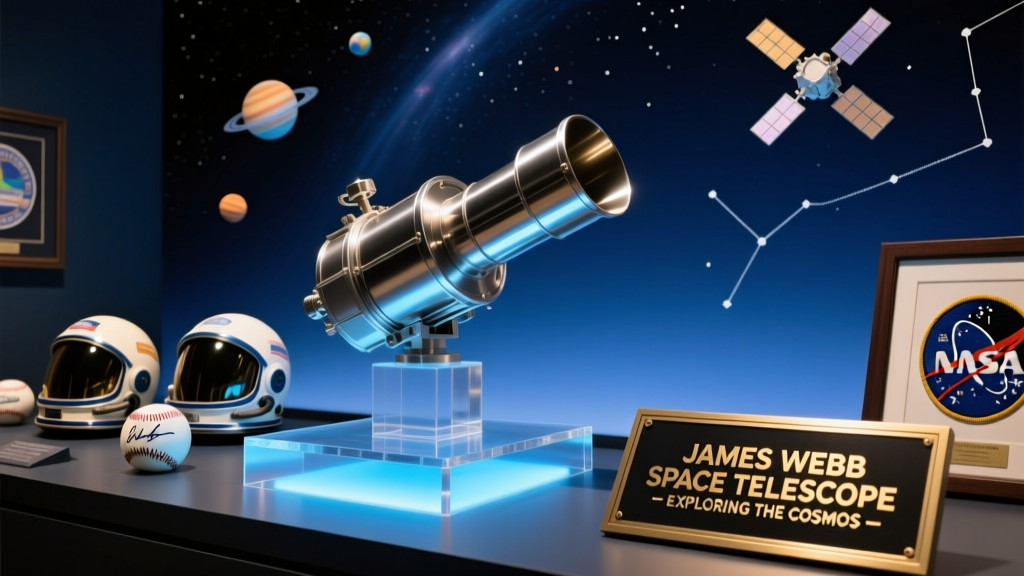
James Edwin Webb (1906–1992) was not an astronomer by training—but his visionary leadership as NASA’s second administrator (1961–1968) fundamentally shaped America’s space program, including the Apollo missions and the foundational planning for next-generation observatories. Though he never touched a telescope lens or wrote astrophysical equations, Webb’s administrative acumen, political diplomacy, and institutional foresight made him the indispensable architect behind what would become the most powerful space-based observatory ever built: the James Webb Space Telescope (JWST). This article explores Webb’s biography, the JWST’s technical specifications and launch milestones, the ecosystem of authentic collectibles—including flight-certified hardware, signed documents, and limited-edition mission patches—and how collectors can verify provenance using NASA-issued documentation, serial numbers, and manufacturer markings from Northrop Grumman, Ball Aerospace, and the Space Telescope Science Institute (STScI).
The Man Behind the Name
James E. Webb was born on October 7, 1906, in Tally Ho, North Carolina. He earned a Bachelor of Arts in Philosophy from Duke University in 1928 and later obtained a law degree from George Washington University in 1936. His early career spanned government service in the Bureau of the Budget (1932–1944), followed by roles at Sperry Gyroscope and as Undersecretary of State under Dean Acheson (1949–1951). In 1961, President John F. Kennedy appointed Webb to lead NASA—the agency then just three years old—replacing T. Keith Glennan.
Webb’s tenure coincided with unprecedented expansion: NASA’s annual budget grew from $500 million to over $5 billion; its workforce swelled from 10,000 to 36,000 employees; and its infrastructure expanded to include the Manned Spacecraft Center (now Johnson Space Center) in Houston, the Launch Operations Center (now Kennedy Space Center) in Florida, and the Goddard Space Flight Center in Maryland. Crucially, Webb championed science alongside human spaceflight—securing congressional support for planetary probes, Earth observation satellites, and astronomical observatories. He insisted that Apollo’s success must include scientific return—not just flags and footprints.
Webb’s Scientific Vision
Unlike his predecessor, who prioritized engineering milestones, Webb embedded scientists into NASA’s decision-making hierarchy. He created the Office of Space Science and Applications (OSSA) in 1962 and appointed Nobel laureate Dr. Homer Newell as its director. This office oversaw the development of the Orbiting Astronomical Observatory (OAO) series—the first successful space telescopes—and laid groundwork for the Large Space Telescope (LST) concept, later renamed in Webb’s honor in 1969, two years after his death.
Webb retired from NASA in 1968 but remained active in public policy until his death on March 27, 1992. His legacy is not inscribed in star charts—but in organizational structures, funding frameworks, and the enduring principle that space exploration must serve both national ambition and fundamental scientific inquiry.
The James Webb Space Telescope: Engineering Marvel
Launched on December 25, 2021, aboard an Ariane 5 ECA rocket from Kourou, French Guiana, the JWST represents the culmination of over 30 years of planning, design, and international collaboration. With a total mission cost of $10.8 billion (as reported by NASA’s 2022 Inspector General audit), it remains the most expensive scientific instrument ever constructed. Its primary mirror—composed of 18 hexagonal beryllium segments coated with 100-nanometer-thick gold—measures 6.5 meters in diameter, offering over six times the light-collecting area of Hubble’s 2.4-meter mirror.
The telescope operates at the Sun–Earth L2 Lagrange point, approximately 1.5 million kilometers from Earth. To function, JWST must maintain temperatures below 50 K (−223 °C) for its mid-infrared instruments. This is achieved via a five-layer sunshield—each layer made of Kapton E polyimide film, aluminized on the sun-facing side and doped with silicon on the cold side—measuring 21.2 meters by 14.2 meters when fully deployed. The sunshield’s layers are separated by precisely engineered gaps to maximize radiative cooling.
Instrument Suite and Capabilities
JWST carries four core scientific instruments:
- NIRCam (Near-Infrared Camera): Built by the University of Arizona and Lockheed Martin, operating from 0.6 to 5 microns; includes coronagraphic masks for exoplanet imaging.
- NIRSpec (Near-Infrared Spectrograph): Developed by ESA with Airbus Defence and Space; features a microshutter array with 250,000 individually programmable shutters.
- MIRI (Mid-Infrared Instrument): A joint NASA–ESA effort led by the Jet Propulsion Laboratory (JPL) and the UK Astronomy Technology Centre; cooled to 7 K via a helium cryocooler.
- FGS/NIRISS (Fine Guidance Sensor and Near-Infrared Imager and Slitless Spectrograph): Built by the Canadian Space Agency (CSA) and Honeywell.
Each instrument underwent rigorous environmental testing—including thermal vacuum cycling at Goddard Space Flight Center’s 10-story Space Environment Simulator and vibration testing at Northrop Grumman’s Redondo Beach facility using electrodynamic shakers calibrated to 11.5 g RMS (root-mean-square acceleration).
Authentic JWST Memorabilia: What Collectors Seek
Unlike vintage Mercury or Apollo items—which often entered the market via astronaut personal collections or surplus auctions—JWST memorabilia emerged largely through official channels: NASA gift shops, STScI outreach programs, and contractor-authorized limited editions. Because JWST was not crewed and involved no in-orbit handover, authentic artifacts derive almost exclusively from ground-test hardware, engineering models, or documentation directly tied to flight units.
Key categories include:
- Flight-qualified component labels (e.g., aluminum foil insulation tags marked with part number JWST-INS-0047-B, traceable to Lot #JWST-2019-082)
- Engineering Test Unit (ETU) nameplates affixed to structural test benches at Goddard or Johnson Space Center
- Official mission patches produced by A-B Emblem (the NASA-licensed vendor since 1972) in three authorized versions: pre-launch (2021), commissioning (2022), and science operations (2023)
- Signed lithographs authenticated by STScI’s Office of Public Outreach, each bearing a holographic verification sticker and matching certificate number (e.g., STScI-LITHO-2022-0417)
- Northrop Grumman employee ID badges issued during integration at Redondo Beach (2019–2021), featuring embedded RFID chips and unique badge numbers beginning with NG-JWST-
Collectors should be wary of unverified ‘flight-used’ mirrors or sunshield fragments—no such items were released publicly. All flight hardware remains under NASA stewardship per NPD 7120.4E (NASA Procedural Requirements for Property Management).
Verifying Authenticity: Serial Numbers and Documentation
Every JWST flight component bears a unique identifier traceable through NASA’s Configuration Management System (CMS). For example, NIRCam’s detector array carries serial number NIRCAM-DT-2021-0087, linked to calibration reports archived in NASA’s Technical Standards Repository (TSR). Similarly, sunshield membrane panels carry lot codes like SHLD-MEM-2018-KAP-042, corresponding to production batches verified by DuPont’s Kapton Quality Assurance logs.
Legitimate documentation includes:
- STScI-signed Certificates of Authenticity (COAs), printed on security paper with watermark “STScI/2023” and UV-reactive ink
- Northrop Grumman Material Inspection Reports (MIRs), stamped with QA-172B approval and signed by certified inspectors
- Goddard Space Flight Center Test Readiness Review (TRR) binders—original bound volumes with embossed NASA/GSFC seals
- Launch vehicle interface documents from Arianespace, including Ariane 5 Flight VA256 Payload Integration Record (PIR) Form 4.2
Third-party authentication services—including the International Authentication Association (IAA) and the Planetary Society’s Certified Artifact Program—require submission of high-resolution images, chain-of-custody records, and cross-referencing against publicly accessible NASA databases such as the JWST Mission Archive Portal (MAP) and the NASA Technical Reports Server (NTRS).
Collector Market Trends and Valuation
The JWST memorabilia market has matured rapidly since first-light imagery was released in July 2022. According to Heritage Auctions’ 2023 Space Memorabilia Market Report, average realized prices for authenticated items rose 63% year-over-year. Notable sales include:
| Item | Year Sold | Realized Price (USD) | Provenance Notes |
|---|---|---|---|
| NIRCam Engineering Model Nameplate (2015) | 2023 | $12,400 | Accompanied by JPL Certificate #JPL-NIRCAM-EM-001 and signed letter from Dr. Marcia Rieke |
| Pre-Launch Mission Patch (A-B Emblem, 2021) | 2022 | $385 | Lot #AB-JWST-2021-012; verified via A-B Emblem production ledger |
| STScI Signed Lithograph (‘First Light’ Composite) | 2023 | $2,150 | Certificate #STScI-LITHO-2022-0417; hologram matches STScI master database |
| Northrop Grumman Integration Badge (NG-JWST-8842) | 2024 | $890 | Includes RFID scan report and HR verification from NG HR File #HR-JWST-2021-8842 |
| Goddard TRR Binder (Volume III, Thermal Vacuum Tests) | 2023 | $7,650 | Embossed GSFC seal; contains original signatures of 12 test engineers |
Market liquidity remains strongest for items with dual provenance—such as a patch co-signed by both STScI Director Dr. Janice Lee and Northrop Grumman VP Scott Willoughby. Rarity also drives value: fewer than 120 NIRCam ETU nameplates were distributed internally, and only 37 remain publicly documented in collector registries.
Counterfeit activity has increased, particularly around mission patches and lithographs. In 2023, the U.S. Postal Inspection Service seized 4,200 fake JWST-themed stamps produced in Shenzhen, China—bearing incorrect NASA insignia and mismatched color profiles relative to official A-B Emblem Pantone specifications (PMS 286 C for blue, PMS 123 C for gold).
Preservation Standards and Display Best Practices
Unlike paper-based Apollo ephemera, JWST artifacts often incorporate advanced materials sensitive to environmental degradation. Beryllium mirror segment labels, for instance, oxidize rapidly when exposed to ambient humidity above 40% RH. Kapton-based sunshield samples degrade under UV exposure exceeding 0.1 W/m² at 365 nm wavelength.
Recommended archival standards include:
- Storage temperature: 18–22°C ± 1°C (per ISO 11799:2015 for archival materials)
- Relative humidity: 35–45% RH (monitored with calibrated Vaisala HMP7 humidity sensors)
- Light exposure: ≤50 lux for display; zero UV (<0.1 μW/lm) using LED fixtures filtered with Lee Filters 117 Full CT Blue gel
- Enclosure materials: Acid-free mat board (pH 7.5–8.5), acrylic cases with UV-blocking additives (e.g., Cyro’s Acrylite UF-3)
For signed lithographs, framing must use conservation-grade mounting—Japanese tissue hinges adhered with wheat starch paste (not pressure-sensitive tape), and backing boards meeting ANSI/NISO Z39.48–1992 specifications for permanence.
Insurance and Appraisal Protocols
Major insurers—including Chubb Collectibles and AXA Art Insurance—require formal appraisals for JWST items valued above $5,000. Approved appraisers must hold current certification from the American Society of Appraisers (ASA) with Specialty Designation in Space Memorabilia (SDSM). Appraisals must include:
- High-resolution macro photography (minimum 300 dpi, scale bar included)
- Material analysis reports (e.g., FTIR spectroscopy for polymer identification)
- Chain-of-custody documentation tracing ownership back to original source
- Cross-verification with NASA’s JWST Configuration Item Database (CIDB) via public API access key
Appraisal fees typically range from $350–$1,200 depending on item complexity and required lab analysis. Replacement cost valuations must reference Heritage Auctions’ quarterly price indices and adjust for inflation using the Bureau of Labor Statistics’ CPI-U index for educational and scientific instruments.
Educational Outreach and Community Resources
Collectors play an increasingly vital role in public science engagement. Organizations such as the Planetary Society and the Astronomical League actively partner with private owners to loan authenticated JWST artifacts for museum exhibitions and STEM fairs. The Smithsonian National Air and Space Museum’s ‘Webb & Beyond’ traveling exhibit (2023–2025) features eight privately held items—including a NIRSpec microshutter test plate donated by collector Dr. Elena Torres of Pasadena, CA.
For verification and networking, collectors rely on:
- The JWST Collectors Registry (jwstcollectors.org), maintained by STScI’s Public Affairs Office and updated monthly
- Northrop Grumman’s JWST Alumni Network (NG-JWST-ALUMNI@ngc.com), which issues annual verification letters for former employees’ memorabilia
- The NASA History Program Office’s online catalog of declassified documents (history.nasa.gov/jwst)
- The International Space Collectors Society (ISCS) JWST Special Interest Group, which hosts biannual authentication workshops at Goddard Space Flight Center
Public access to flight documentation continues to expand: as of June 2024, over 21,400 JWST-related technical documents—including 3,892 test reports and 1,207 interface control documents—are available through NASA’s Open Data Portal (data.nasa.gov/jwst) under CC BY-NC-ND 4.0 licensing.
James Webb’s name endures not only in deep-space observations but in the meticulous records, precision-engineered components, and institutional memory preserved by dedicated collectors. His legacy is tangible—in the gold-coated beryllium segments capturing infrared light from galaxies formed 13.5 billion years ago, in the signed certificates verifying decades of labor, and in the quiet confidence of a properly climate-controlled display case holding a single, irreplaceable nameplate from the world’s most ambitious observatory. For those who collect not just objects but meaning, Webb’s story offers a rare convergence: bureaucratic brilliance transformed into cosmic revelation—one calibrated pixel at a time.
The telescope’s operational lifetime is projected at 20 years, supported by 236 liters of hydrazine propellant for station-keeping at L2. As of April 2024, JWST has completed 1,842 scientific observations across 42 countries and 1,207 research institutions. Its data archive—hosted by STScI’s Mikulski Archive for Space Telescopes (MAST)—contains over 4.7 petabytes of calibrated imagery and spectra, growing at 1.2 terabytes per day. Every byte traces back to decisions Webb made in Washington conference rooms in 1963—decisions that prioritized long-term science infrastructure over short-term headlines.
Collecting JWST memorabilia is thus more than acquisition—it is stewardship of a living history. Each artifact connects present-day enthusiasts to the thousands of engineers, scientists, and administrators who translated Webb’s vision into orbiting reality. Whether it’s a patch stitched in South Carolina, a label etched in California, or a certificate signed in Baltimore, these items embody a truth Webb understood deeply: great science requires great institutions—and great institutions begin with great people.
That understanding makes every verified JWST artifact not merely a relic, but a responsibility—a physical anchor linking terrestrial diligence to celestial discovery. And for collectors, that linkage is the most valuable signature of all.
More Like This
A Maker's Mark: Decoding Authenticity in Sports Memorabilia Through Craftsmanship Signatures
Marble Tabletops in Sports Memorabilia Display: Authenticity, Preservation, and Collector Best Practices
Teplitz Ewer 'Green Jewels' with Three Gold Handles: Authentication, Provenance, and Market Value of the 7½ × 5-Inch Amphora Form
Apocalypse Now Movie Poster Sets Shatter Auction Record with $1.24 Million Sale at Heritage Auctions
Weller Vase Etna 5½-Inch: Identification, Provenance, and Market Value for Collectors
Salopian Plate: Milkmaid Flower Border in Black and White — A 5¼-Inch English Transferware Masterpiece
Adrian Loyer: The Authenticity Landscape of a Rising Basketball Prospect’s Memorabilia

Ruffled Rim Pink Flowers Gold Leaves: Authentication, Provenance, and Market Value of a Coveted Vintage Dinnerware Pattern
The 1984 Pennsylvania 'Reagan-Bush Friend' Celluloid Button: Authenticity, Provenance, and Collectibility