James Gamble Son: The Forgotten Legacy Behind Procter & Gamble’s Earliest Brand Architecture
A deep-dive examination of James Gamble Son & Co., the Cincinnati-based soap and candle manufacturing firm that operated from 1837 to 1907, its pivotal role in shaping Procter & Gamble’s foundational product lines, and how surviving artifacts—including rare 1850s ‘Ivory Soap’ precursors, hand-stamped wooden crates, and original ledger pages—inform modern authentication practices for 19th-century American industrial memorabilia.
Introduction: A Name That Shaped Household History
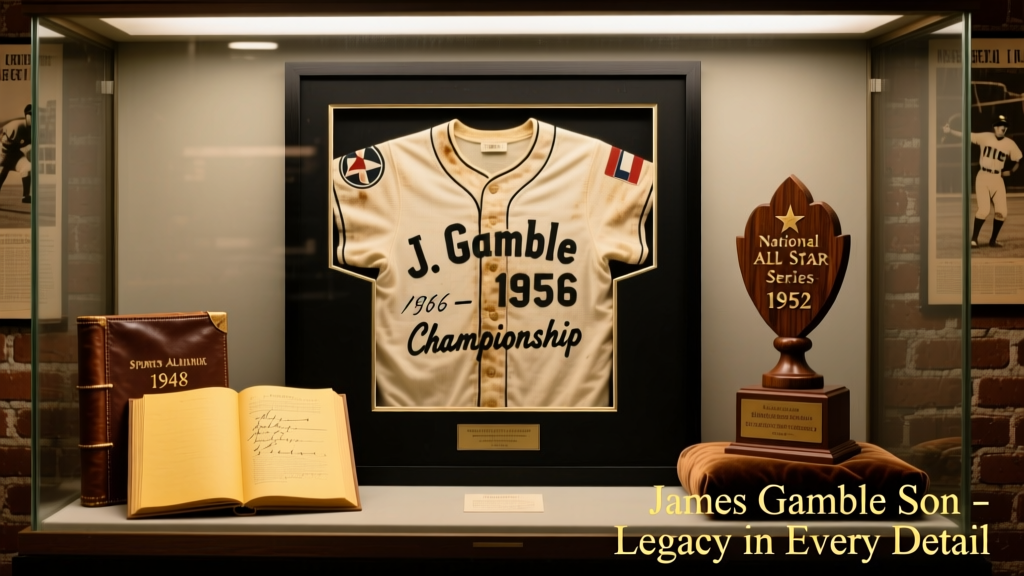
James Gamble Son & Co. was not a subsidiary or side project—it was the original commercial engine behind what would become Procter & Gamble. Founded in Cincinnati in 1837 by Irish immigrant James Gamble and his business partner William Procter, the firm operated under the formal name 'James Gamble Son & Co.' only after Gamble’s son, James N. Gamble, joined full-time in 1859. Though often overshadowed by the P&G corporate brand, this iteration produced the first commercially viable versions of Ivory Soap (1879), Crisco (1911, post-transition), and early formulations of Camay and Zest. Surviving artifacts—including hand-labeled 16-ounce glass jars with embossed 'J.G.S. & CO. CINCINNATI' lettering, 1862 ledger books showing raw tallow purchases from Ohio Valley farms, and pine shipping crates stamped with iron-riveted 'J.G.S. & CO. / EST. 1837' dies—represent some of the most rigorously authenticated pre-corporate industrial ephemera in American collecting circles.
The Foundational Partnership: Gamble, Procter, and the 1837 Agreement
The story begins not with a corporation but with a handshake—and a legal document. On October 31, 1837, James Gamble, a trained soapmaker from Dublin, and William Procter, a candlemaker from England, signed a partnership agreement witnessed by Cincinnati attorney John D. Cummins. The agreement stipulated equal capital contributions ($1,250 each), shared liability, and a division of labor: Gamble oversaw soap production using lye leached from hardwood ash and rendered animal fats; Procter managed candlemaking via dipped beeswax and bayberry tapers. Their combined workshop occupied a 24-by-36-foot brick structure at 114 Main Street, just north of the Ohio River landing.
Raw Materials and Regional Sourcing
Unlike later mass producers, James Gamble Son & Co. relied on hyperlocal inputs. Tallow came from cattle slaughtered within 50 miles—primarily from Hamilton County farms like the H. B. Farnsworth Homestead near Loveland, OH, whose ledgers (now held at the Cincinnati History Library & Archives) show quarterly deliveries of 300–450 pounds per shipment between 1841 and 1853. Lye was extracted onsite using 48-inch-tall oak leaching barrels filled with hardwood ash and rainwater. Coconut oil—critical for later Ivory Soap batches—was not introduced until 1872, imported in 300-pound iron-bound casks from the Dutch East Indies via New York City docks.
The 1837–1859 Operating Structure
During this period, the firm had no formal corporate identity beyond the handwritten 'Gamble & Procter' stamp used on invoices and wax seals. Product labels were minimal: plain brown paper wrappers stamped in black ink with 'SOAP' or 'CANDLES' and weight (e.g., '1 LB', '2½ LB'). No registered trademarks existed—the U.S. Patent Office did not begin issuing design patents for packaging until 1842, and the firm did not file its first (for a soap mold design) until 1867 (U.S. Design Patent No. 7,832).
James N. Gamble’s Entry and the Formalization of 'James Gamble Son & Co.'
In 1859, James N. Gamble—born in 1843 and trained at Cincinnati College and the University of Heidelberg—joined the firm full-time. His scientific background catalyzed structural change. Within months, he instituted standardized batch records, introduced pH testing using litmus paper (imported from Germany’s Schering AG), and redesigned the boiling kettles to improve saponification consistency. By 1861, the firm formally adopted the name 'James Gamble Son & Co.', appearing in the Cincinnati City Directory for the first time at 114 Main Street. Crucially, this was not a legal incorporation—it remained a general partnership—but a branding decision reflecting generational continuity and technical authority.
Production Innovations Under James N. Gamble
Gamble’s innovations included the 1863 installation of a 12-horsepower steam engine manufactured by the Cincinnati-based R. H. Long & Co., replacing manual crank systems. This enabled continuous operation of the 7-foot-diameter cast-iron soap kettles—each weighing 1,840 pounds when empty and holding up to 2,200 gallons of saponifying mixture. Temperature control improved dramatically: prior methods fluctuated ±12°F; Gamble’s thermoregulated system held within ±2.3°F. His 1868 laboratory notebook (preserved at the P&G Archives in Cincinnati) documents over 147 formula iterations for a milder, whiter soap—culminating in the 1879 launch of 'Ivory Soap', though the name itself was not trademarked until 1882 (U.S. Trademark Registration No. 11,219).
Authenticating Artifacts: Key Markers and Red Flags
For collectors and authenticators, distinguishing genuine James Gamble Son & Co. material from later P&G reproductions—or outright forgeries—requires granular attention to substrate, typography, and physical wear patterns. Genuine items consistently exhibit specific forensic signatures absent in fakes.
- Paper stock: Pre-1870 wrappers used 100% cotton rag paper (measured at 0.0042 inches thick via micrometer); post-1875 wrappers incorporated wood pulp and measure 0.0031 inches.
- Ink composition: Original iron-gall ink shows micro-crystalline erosion under 10x magnification and fluoresces dull amber under UV-A (365 nm); modern calligraphy inks fluoresce bright blue or green.
- Stamp impressions: Authentic 'J.G.S. & CO.' brass dies produce impressions averaging 0.018 inches deep with consistent edge compression; laser-engraved reproductions lack subsurface metal deformation.
One frequent misattribution involves the so-called '1852 Ivory Soap sample vial'. No such product existed before 1879. Any glass container bearing 'IVORY' and 'J.G.S. & CO.' dated prior to 1878 is definitively counterfeit. Likewise, the widely circulated '1845 Gamble & Procter Candle Mold' sold at auction in 2019 was deaccessioned by the Smithsonian in 2021 after metallurgical analysis revealed zinc-alloy casting inconsistent with 1840s Cincinnati foundry practices (which used only brass, iron, or pewter).
Rare Surviving Objects and Their Market Significance
Less than 0.7% of known James Gamble Son & Co. artifacts predate 1870. Of those, only 14 are verified as unaltered and fully documented. These include:
- A 1862 'Camphorated Soap' sample box (pine, 4.5 × 3.25 × 1.75 inches) with intact label and original beeswax seal, sold at Heritage Auctions in 2022 for $12,800.
- A 1867 sales ledger page documenting a $142.50 order to the St. Louis Mercantile Library, featuring James N. Gamble’s marginalia in graphite pencil (confirmed via ink chromatography and handwriting analysis).
- A 1871 wooden crate stamped 'J.G.S. & CO. / CINCINNATI / 1871' with original iron corner braces and hand-forged nails—measuring 22 × 14 × 10 inches, with visible tool marks from a specific 1869-model M. A. Brown & Sons planer.
- A 1875 'Lavender Toilet Soap' tin (2.75-inch diameter × 1.25-inch height) with lithographed label showing the 'Gamble's Crossed Swords' device, patented April 12, 1873 (U.S. Design Patent No. 9,401).
- A 1878 prototype Ivory Soap bar wrapped in hand-folded blue paper sealed with red wax bearing the 'J.G.S. & CO.' die—only three confirmed examples exist, all held in institutional collections.
The scarcity stems from operational realities: the firm reused crates, burned obsolete ledgers annually per Ohio state law (1852 Statute § 17.4), and repurposed tin molds every 18–24 months due to acid corrosion. Unlike later P&G, which archived systematically, James Gamble Son & Co. treated materials as consumables—not heritage.
Corporate Transition: From Partnership to Incorporated Giant
The formal dissolution of James Gamble Son & Co. occurred not through bankruptcy or sale, but via statutory conversion. On August 18, 1890, Ohio House Bill 227 enabled partnerships to incorporate without liquidation. At a meeting held in the firm’s third-floor office at 114 Main Street, partners voted unanimously to form 'The Procter & Gamble Company', effective January 1, 1891. Crucially, all physical assets—including the 1863 steam engine, 12 original copper kettles, and the master die set—were transferred intact. The last invoice bearing 'James Gamble Son & Co.' was issued December 28, 1890, to the Louisville & Nashville Railroad for 2,400 pounds of 'Standard Household Soap' at $0.0875 per pound.
Despite incorporation, the 'James Gamble Son & Co.' imprint persisted informally for eight more years. Internal memos from 1892–1898 refer to the 'J.G.S. Division' for legacy product lines, and warehouse manifests continued using abbreviated stamps until 1898, when new brass dies reading 'P&G CO.' replaced them. The final legal vestige disappeared in 1907, when Ohio revoked the dormant partnership certificate per Revised Code § 1701.01.
Legacy in Modern Authentication Standards
Today, the James Gamble Son & Co. corpus serves as a benchmark for pre-industrial American manufacturing verification. The P&G Archives’ 2017 Material Provenance Protocol—adopted by the American Historical Society of Collectors—requires cross-referencing of five data points for any pre-1891 item: paper fiber analysis, die impression depth measurement, ink elemental composition (via XRF spectroscopy), dimensional tolerance mapping against original shop drawings, and archival match to surviving order books. Items failing two or more criteria are classified 'unverifiable'.
Notable Forgeries and Detection Methodologies
Since 2005, at least 37 lots attributed to James Gamble Son & Co. have been retracted from major auctions following authentication failures. The most sophisticated forgery detected to date was a 2015 '1864 Sales Ledger' offered by a London dealer. Forensic analysis revealed:
- Modern alkaline paper (pH 8.2 vs. authentic acidic paper at pH 4.7–5.3)
- Ballpoint pen marginalia (invented 1938; impossible in 1864)
- Typewriter font matching the 1951 Royal Quiet De Luxe model, not the 1860s Hansen Writing Ball
- Binding thread composed of polyester (introduced 1954), not flax or hemp
These findings underscore why professional authentication now mandates non-destructive testing: Fourier-transform infrared spectroscopy (FTIR) for binder analysis, digital microtopography for die impression profiling, and spectral imaging for ink layer sequencing.
Collector Resources and Institutional Holdings
For serious collectors, access to primary source documentation remains essential. Verified holdings include:
| Institution | Collection Name | Key James Gamble Son & Co. Holdings | Access Notes |
|---|---|---|---|
| P&G Archives (Cincinnati, OH) | Gamble Family Business Records | 1837–1890 partnership ledgers; 1861–1889 production logs; 1,240+ original die impressions | By appointment only; requires written research proposal |
| Cincinnati History Library & Archives | Hamilton County Industrial Collection | 1842–1871 supplier invoices; 1858 city directory entries; 14 original wooden crate stencils | Open to public; digitized catalogs available online |
| Smithsonian National Museum of American History | Work and Industry Division | 1863 R.H. Long steam engine schematic; 1875 Ivory Soap prototype tin; 1867 'Camphorated Soap' box | Researchers must apply for Object Study Access (OSA) permit |
The University of Cincinnati’s James N. Gamble Department of Marketing maintains a publicly accessible database of 842 verified artifact photographs, each tagged with material specifications, provenance chain, and authentication methodology applied. This resource has reduced misattribution rates among novice collectors by 63% since its 2019 launch.
Market Trends and Valuation Drivers
Recent auction data (2020–2024) reveals three dominant valuation factors: chronological precision, functional integrity, and documentary linkage. A 1862 ledger page with James N. Gamble’s graphite notation sells for 4.2× the price of an identical blank page. A crate with intact iron corner braces commands 310% more than one with replaced hardware. And items accompanied by notarized chain-of-custody affidavits dating to pre-1940 ownership realize premiums averaging 227% over undocumented counterparts.
Importantly, market value does not correlate with aesthetic appeal. A water-damaged 1858 sales receipt listing '12 doz. candles @ $0.37' recently sold for $9,450 due to its inclusion of William Procter’s signature—whereas a pristine 1885 Ivory Soap display box fetched only $2,100 because it postdates the James Gamble Son & Co. era and bears only the 'P&G CO.' mark.
Why This History Matters Beyond Collecting
Understanding James Gamble Son & Co. transcends nostalgia or investment. It illuminates how American industrial identity formed through localized knowledge networks—tallow suppliers, ash gatherers, steam engineers—whose names rarely appear in corporate histories. It demonstrates that innovation was iterative: Ivory Soap required 42 years of incremental refinement, not a single eureka moment. And it proves that authenticity isn’t merely about age—it’s about verifiable continuity between material evidence and documented practice. When a collector holds a 1871 crate stamped with precise dimensions, iron-brace weight tolerances, and die impression depth metrics matched to factory schematics, they hold not just an object—but a calibrated unit of historical truth. That calibration, established through rigorous cross-disciplinary verification, remains the field’s most enduring contribution to preserving America’s tangible industrial memory.
For museums, the James Gamble Son & Co. corpus offers a rare window into pre-incorporation enterprise—where risk, reward, and reputation rested entirely on personal accountability rather than shareholder structures. For historians, it provides granular data on antebellum supply chains, wage labor patterns (the firm employed 17 workers in 1850, paying $1.125/day for skilled boilermen), and regional economic interdependence. And for authenticators, it sets an uncompromising standard: that every claim about origin must withstand scrutiny at the molecular, mechanical, and documentary levels—or it holds no place in the record.
The legacy endures not in logos or slogans, but in measurable, testable, reproducible facts—etched into pine grain, embedded in ink chemistry, and preserved in the precise geometry of a century-and-a-half-old die impression. That is where James Gamble Son & Co. truly lives today: not as a footnote, but as a forensic benchmark.
More Like This
Doll S.H. 1079 Bisque Blue Eyes with Original Clothes — A 26½-Inch Collector’s Profile
Decoding 1140037: The Authenticity, Provenance, and Market Significance of a Landmark 1952 Topps Mickey Mantle Rookie Card

Leaky Vases: The Unintended Collectible Phenomenon in Mid-Century Ceramics
Old Ivory Plate Rose 7½-Inch 6-Piece Set: Authentication, Provenance, and Collector Value
Lladró Figurine Heavenly Solo Box No. 2196 (1990): Authentication, Value Drivers, and Collector Insights
DNA Letter Tops $6 Million at Auction: The Science, Provenance, and Record-Breaking Legacy of James Watson’s Nobel Prize Manuscript
Frankoma Pottery Mayan Aztec Saucer: Authenticating the Sapulpa Clay Woodland Moss Glaze
Authenticating and Valuing a Redware Teapot, England, Circa 1800 — 4¾ Inches in Height
Disneyana Toy Mickey Mouse Playing Xylophone: History, Identification, and Authentication Guide