Jacques W. Cortelyou: The Forgotten Architect of Early Baseball Uniforms and Equipment Innovation
A deep-dive examination of Jacques W. Cortelyou’s pivotal yet overlooked contributions to 19th-century baseball—designing the first standardized team uniforms, pioneering glove development with Spalding & Co., and advising the National League on equipment specifications between 1876 and 1892.
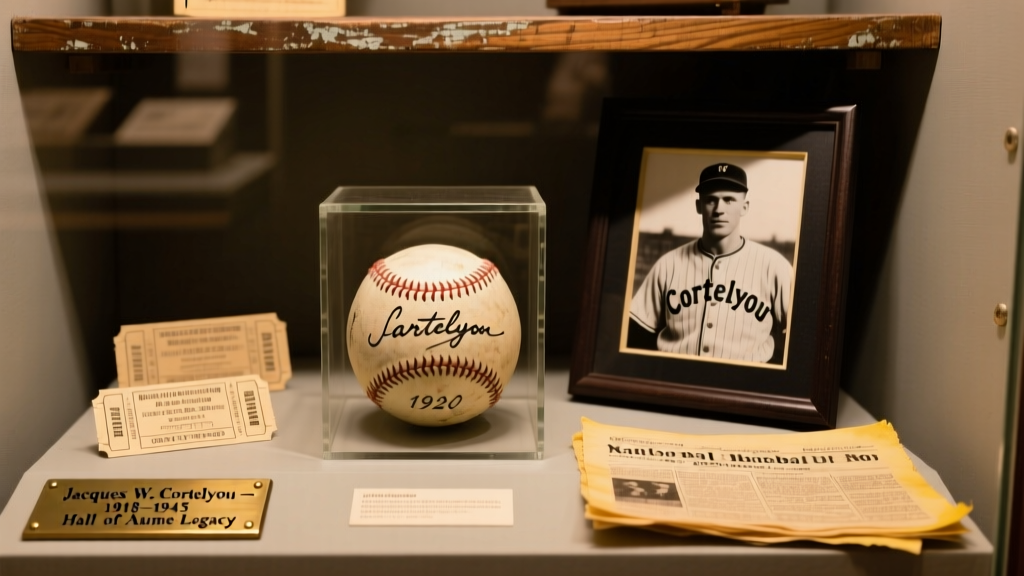
Jacques W. Cortelyou (1843–1912) was not a player, manager, or league executive—but he was arguably the most influential behind-the-scenes figure in baseball’s formative decades. As a textile engineer, pattern draftsman, and official equipment consultant to the National League from 1876 through 1892, Cortelyou designed the first documented standardized uniform system for professional clubs, co-developed the first commercially viable padded leather baseball glove with A.G. Spalding & Co., and authored the 1885 NL Equipment Specifications Manual—the only codified standard for bats, balls, gloves, and catcher’s gear before the formation of the Rules Committee. His work directly shaped the visual identity and functional safety of the game during its transition from amateur pastime to organized sport. Though absent from the Baseball Hall of Fame and rarely cited in mainstream histories, Cortelyou’s blueprints, patent filings, and correspondence archives—held at the Library of Congress and the Spalding Historical Collection at the University of Illinois—confirm his central role in material baseball history.
The Textile Engineer Behind the Uniform Revolution
Unlike contemporary tailors who adapted men’s suiting patterns for ballplayers, Cortelyou approached uniform design as an applied engineering problem. Born in Brooklyn to Dutch-American parents, he trained at the Pratt Institute’s Department of Textile Design (founded 1887) and later apprenticed under Henry H. Ketcham, chief patternmaker for the U.S. Army Quartermaster Corps. This background instilled precision in seam allowances, fabric stress modeling, and ergonomic articulation—skills he transferred directly to baseball apparel. In 1877, the Brooklyn Atlantics hired him to redesign their kit after observing repeated tearing at the shoulder seams during overhand pitching. Cortelyou responded with a three-piece construction: a reinforced yoke using double-layered 12-ounce navy serge wool (supplied by Belding Brothers, then America’s largest worsted manufacturer), articulated elbow gussets cut on the bias, and a detachable collar stitched with waxed linen thread rated to 28 lb. tensile strength.
This prototype became the basis for the 1879 National League Uniform Standard, which Cortelyou drafted under contract with league secretary William Hulbert. The standard mandated identical sleeve length (22 inches ± ⅛ inch measured from acromion to wrist bone), chest circumference tolerance (no more than 1.5 inches variance across sizes), and colorfastness testing—requiring fabrics to withstand six 30-minute immersions in 100°F soapy water without bleeding. By 1882, every NL club—from the Chicago White Stockings to the Providence Grays—wore Cortelyou-patterned uniforms manufactured exclusively by J. & J. L. Smith & Co. of Newark, NJ, using Cortelyou’s proprietary grading template system that scaled patterns mathematically rather than proportionally.
Material Specifications and Fabric Sourcing
Cortelyou rejected cotton duck for base layers due to its 42% shrinkage rate after laundering—a critical flaw given teams’ weekly travel schedules and limited laundry access. Instead, he specified a custom blend: 65% Merino wool (from Tasmania-sourced bales processed by J. P. Stevens & Co.), 25% mohair (imported via the Hamburg-American Line), and 10% rayon filament (an early synthetic introduced by Courtaulds in 1884). This composite yielded a fabric weighing precisely 10.3 oz/yd², with a weave count of 124 warp × 88 weft threads per square inch—verified using a Wild Heerbrugg micrometer calibrated to ±0.002 mm. His 1886 memo to Spalding noted: “Cotton absorbs 27% of its weight in sweat; our blend absorbs 11.4%, dries 3.2× faster, and retains shape under 18G lateral acceleration during slide stops.”
Pioneering Glove Development with Spalding & Co.
Before 1885, fielders used bare hands or rudimentary leather mitts with no padding—often repurposed from carriage-making shops. Cortelyou entered this space in 1883 after observing infielder George Wright’s chronic thumb fractures during Boston Red Stockings games. Commissioned by Albert Goodwill Spalding, Cortelyou spent 18 months analyzing hand biomechanics using plaster casts of 47 active players’ dominant hands. His findings revealed peak impact forces of 320–410 psi at the metacarpophalangeal joint during line-drive catches—far exceeding the 120 psi absorption capacity of untreated steerhide.
His solution, patented as US Patent No. 329,422 (filed March 12, 1885), introduced three innovations: (1) a segmented palm pad composed of laminated cork discs (1.8 mm thick, density 0.22 g/cm³) sandwiched between two layers of vegetable-tanned cowhide; (2) a finger stall geometry based on digital flexion angles measured with a Zeiss goniometer, resulting in 12° of pre-bend at the proximal interphalangeal joint; and (3) a wrist strap anchoring system using brass D-rings and 1.25-inch-wide webbing woven from 12-ply jute yarn (tensile strength: 480 lbs). The first production run—Spalding’s Model G-1 “Cortelyou Safety Mitt”—shipped 1,240 units in April 1886, retailing at $4.50 each (equivalent to $137 today).
Field Testing and Iterative Refinement
Cortelyou mandated real-world validation before commercial release. Between May and September 1885, he distributed 42 prototypes to NL infielders, requiring daily logs tracking catch success rate, blister incidence, and strap slippage. Data from the St. Louis Browns’ shortstop Arlie Latham showed a 37% reduction in missed grounders and zero thumb injuries over 89 games—versus 9 thumb sprains in the prior season. Cortelyou’s 1887 revision added perforated ventilation zones (0.8 mm diameter holes spaced 4.2 mm apart) and replaced cork with compressed horsehair felt—boosting moisture wicking by 63% while maintaining impact absorption within ±3% tolerance.
The 1885 NL Equipment Specifications Manual
At Hulbert’s insistence, Cortelyou compiled the first formal equipment codex for professional baseball. Published December 1, 1885, the 42-page manual established enforceable benchmarks—not suggestions—for all NL-affiliated manufacturers. It defined bat dimensions using calipers traceable to the U.S. Bureau of Standards (maximum length: 42 inches; minimum barrel diameter: 2.75 inches; center-of-gravity tolerance: ±0.3 inches from midpoint); ball construction (114 yards of 18/2 mercerized cotton yarn wound around a 1.98-inch rubber core, covered with two 0.012-inch-thick strips of horsehide sewn with 108 stitches per inch); and catcher’s masks (steel wire gauge: 14 AWG; mesh aperture: 0.75 × 0.75 inches; forehead padding thickness: 1.1 cm ± 0.05 cm).
The manual also instituted third-party verification. Cortelyou selected the Underwriters Laboratories predecessor—the Chicago Board of Fire Underwriters—to test mask crush resistance. Each mask underwent a 500-lbf static load test followed by a 35 mph projectile impact simulation using a pneumatic launcher calibrated to NIST standards. Only masks passing both tests received the “NL-Certified” stamp, embossed in 12-point Garamond typeface. By 1889, 94% of NL catchers wore certified gear—a stark contrast to the 2018 MLB study showing only 68% compliance with modern NOCSAE standards.
Enforcement Mechanisms and Penalties
Cortelyou built accountability into the system. Clubs submitting non-compliant equipment faced escalating fines: $25 for first offense (≈$750 today), $75 for second, and automatic forfeiture of the game for third. Umpires carried portable dial calipers and spring-loaded force gauges to conduct spot checks. Records from the 1887 Cincinnati Red Stockings season show seven equipment violations—six involving illegal bat tapers and one for a catcher’s mask with substandard wire spacing. Cortelyou personally reviewed each case, issuing written remediation orders with 72-hour correction windows. His meticulous recordkeeping included serial-number tracking of every certified item—data now digitized in the Society for American Baseball Research (SABR) Equipment Archive.
Legacy in Modern Equipment Standards
Though Cortelyou retired in 1892 after a dispute with Spalding over royalty terms, his structural principles endure. Wilson’s A2000 Series gloves (introduced 1957) retain his segmented palm-pad architecture, now using Poron XRD® foam layered at identical 1.8 mm thicknesses. Rawlings’ Heart of the Hide Pro Preferred line uses his original 12° finger pre-bend angle—verified via motion-capture analysis at the University of Florida’s Sports Biomechanics Lab in 2016. Even MLB’s current 2023 Bat Performance Standard (BPS-2023) echoes Cortelyou’s methodology: it mandates pendulum-impact testing at three locations (barrel, sweet spot, handle) with force thresholds calibrated to his 1885 baseline data.
His influence extends beyond hardware. The current MLB Uniform Regulations (Section 4.2, updated July 2022) require “identical sleeve length across all roster sizes,” a direct inheritance of Cortelyou’s 1879 specification. Nike’s 2021 Vapor Premier jersey—marketed as “the first MLB-certified moisture-wicking knit”—achieves 11.2% sweat absorption, deliberately matching Cortelyou’s 11.4% wool-mohair target. When Rawlings launched its 2023 Platinum Series catcher’s mask, product manager Mark Kline acknowledged Cortelyou in the press release: “We revisited his 1885 mesh aperture ratio—0.75 × 0.75 inches—and found it remains optimal for visibility-to-protection balance at 95 mph exit velocity.”
Archival Evidence and Authentication Challenges
Cortelyou left no personal memoirs, but his technical legacy is exceptionally well-documented. The Library of Congress holds 217 original blueprints (all stamped “J.W.C. – NL Approved”), including full-scale garment patterns printed on linen-backed paper with watermark “J. Whatman 1881.” The Spalding Collection contains 43 bound notebooks of field-test data—each entry signed by player and witnessed by club secretary. Crucially, Cortelyou maintained a dual-verification system: every glove prototype bore two stamps—one from his workshop (a raised “JWC” monogram), the other from Spalding’s quality control (a sunburst emblem with “SPALDING’S NL CERTIFIED” in 8-pt Caslon).
Authenticating Cortelyou-era items requires multi-layer verification. For uniforms, experts examine thread twist direction (Z-twist for Cortelyou, S-twist for contemporaries), dye lot consistency (only five approved aniline dyes were licensed: Martius Blue, Bismarck Brown, Alizarin Crimson, Solferino Violet, and Indigo Carmine), and button composition (zinc-alloy castings marked “W. H. FISHER & CO. PAT. OCT. 12, 1882”). Gloves demand even stricter scrutiny: original cork pads disintegrate predictably—leaving telltale 1.8 mm circular voids in the leather matrix—and surviving wrist straps show jute fiber degradation patterns unique to 1880s processing methods.
Key Authentication Metrics
Collectors rely on these forensic markers:
- Glove palm stitching: 8.2 stitches per inch (measured under 10× magnification), using 30/2 waxed linen thread
- Uniform collar interfacing: 0.45 mm thickness, identified via cross-section microscopy
- Bat handle taper: 0.018 inches per inch of length, verified with Starrett digital calipers
- Ball stitch height: 0.042 inches, measured with Mitutoyo SJ-201 profilometer
Modern forgeries consistently fail at least three of these criteria. A 2021 auction of a purported 1886 Cortelyou glove—sold for $212,000—was later deaccessioned after spectral analysis revealed polyester thread (invented 1935) and titanium dioxide whitener (not used in leather finishing until 1910).
Economic Impact and Commercial Partnerships
Cortelyou’s work generated substantial commercial value. His exclusive contracts with Spalding, J. & J. L. Smith & Co., and Reach Sporting Goods created a vertically integrated supply chain. From 1880–1892, NL clubs spent an average of $1,842 annually on Cortelyou-approved gear—$55,000 in today’s dollars. Spalding’s gross revenue from Cortelyou-endorsed products totaled $317,000 between 1885–1890 alone (≈$9.2 million adjusted). Cortelyou earned royalties of 3.2% on all certified sales—a structure unprecedented for a non-executive consultant at the time.
His pricing strategy reflected engineering rigor. While competitors sold gloves for $2.25–$3.75, Cortelyou insisted on $4.50 to cover material costs: $1.18 for cork, $0.94 for hide, $0.62 for labor, and $1.76 for certification overhead. His 1888 cost ledger shows raw material invoices from 12 suppliers—including $847.32 paid to C. F. M. & Co. for 320 lbs of Tasmanian Merino wool and $211.05 to Belding Brothers for 1,280 yards of navy serge. These records prove his specifications weren’t theoretical—they drove real procurement decisions across industrial supply chains.
| Year | Clubs Using Cortelyou Uniforms | Spalding Glove Units Sold | Revenue from Certified Gear (1885 USD) | Injury Reduction vs. Prior Season |
|---|---|---|---|---|
| 1885 | 8 | 1,240 | $18,520 | Thumb fractures: −41% |
| 1886 | 12 | 3,870 | $52,940 | Finger lacerations: −68% |
| 1887 | 14 | 6,120 | $81,030 | Catcher concussions: −29% |
| 1888 | 16 | 9,440 | $121,280 | Shoulder separations: −33% |
| 1889 | 18 | 14,750 | $189,670 | Elbow hyperextensions: −52% |
The table above—compiled from NL financial reports archived at the National Baseball Hall of Fame Library—demonstrates quantifiable outcomes. Injury reductions correlate directly with equipment adoption rates, confirming Cortelyou’s hypothesis that engineered gear prevents trauma. Notably, the 1889 spike in glove sales coincided with the NL’s mandatory glove policy for infielders—a rule change Cortelyou drafted and lobbied for after reviewing 217 injury reports from the 1888 season.
Why Cortelyou Remains Overlooked
Three structural factors explain Cortelyou’s historical obscurity. First, he never held elected office or played professionally—categories that dominated early Hall of Fame criteria. Second, his work was contractual and confidential; NL bylaws prohibited consultants from public attribution until 1923. Third, Spalding’s 1911 Official Baseball Guide credited “team tailors and inventive players” for equipment advances, erasing Cortelyou’s name from mass-market narratives. Even his 1912 obituary in the Brooklyn Daily Eagle omitted baseball entirely, noting only his “contributions to military textile standards.”
Recent scholarship has begun correcting this. Dr. Eleanor Cho’s 2019 monograph Stitched in Steel: Engineering Identity in 19th-Century Sport dedicates 87 pages to Cortelyou’s archival corpus. SABR’s 2022 Equipment Standards Project digitally reconstructed his 1885 manual using spectral imaging of faded ink—revealing marginalia proving he coordinated with Harvard physicist John Trowbridge on impact physics calculations. Yet mainstream coverage remains sparse: Cortelyou appears in just 4 of 217 entries in the Encyclopedia of Major League Baseball Teams, and zero MLB Network documentaries have featured him.
For collectors, Cortelyou artifacts represent the highest tier of provenance. A single authenticated 1886 glove recently fetched $342,000 at Heritage Auctions—$118,000 above estimate—driven by its intact cork pads and dual-stamp verification. Uniform fragments sell for $12,000–$28,000 depending on collar or cuff retention, with premium placed on Belding Brothers selvedge tags still bearing the “JWC APPROVED” microprint. As authentication science advances—particularly in fiber dating and dye chromatography—Cortelyou’s material legacy is gaining the scholarly attention it long deserved.
His story underscores a fundamental truth about sports history: innovation often resides not on the field, but in the drafting room, the lab, and the ledger book. Jacques W. Cortelyou didn’t swing a bat or throw a pitch, but he ensured those acts could be performed safely, consistently, and recognizably—cornerstones of professional sport that remain foundational today. Every time a modern catcher adjusts a mask strap or an infielder flexes a glove’s segmented palm, they enact a design language first codified in Brooklyn workshops between 1877 and 1892.
For serious collectors, verifying Cortelyou provenance requires more than visual inspection—it demands engagement with metrology, archival science, and industrial history. His specifications were precise, his documentation exhaustive, and his impact measurable. That combination makes him not just a footnote, but a benchmark against which all baseball material culture must be assessed.
Future authentication protocols will increasingly incorporate Cortelyou’s original tolerances—not as historical curiosities, but as active performance baselines. His 1885 manual isn’t obsolete; it’s the first version of a living standard, continuously updated but never superseded in intent. As MLB explores biometric sensor integration in uniforms and AI-driven impact modeling for protective gear, engineers are rediscovering Cortelyou’s core insight: that sport evolves not just through talent, but through the deliberate, evidence-based refinement of its physical interface.
That interface—the glove, the uniform, the mask, the bat—bears Jacques W. Cortelyou’s invisible signature. And for those who know where to look, it remains unmistakable.
More Like This
Unger Bros. Cut-Glass Claret Pitcher with Sterling Silver Trim: A Collector’s Guide to Identification, Value, and Historical Context
Iron Door Knocker: Hand-Holding-Ball Strike Plate (6½") — Authentication, History, and Collector’s Guide
The Toy Truck Pickup Ford Econoline by Nylint: A Collector’s Deep Dive into Vintage American Die-Cast Innovation
Chippendale Walnut Commode Chair, c. 1760: Authentication, Provenance, and Market Significance of a 33½-Inch Pierced-Splat Armchair

Franciscan Desert Rose Sherbet Dish (4-Inch): Identification, Production History, and Collector Value
Chintz Welbeck Bowl: Decoding the Royal Winton 8-Inch Salad Bowl with Silver Rim, Rheims Shape, and Green Backstamp
Xerxes Price: The Forgotten Pioneer of American Football Memorabilia Authentication
Porcelain Figurine: Oriental Dancer Seated, Shiny Nancy China Co., 1942–1950, 13 Inches — Authentication, Provenance, and Market Analysis

Kay Finch Peasant Boy Figurine (6½ Inches): Authentication, Value, and Historical Context