Jacob Godschalk: The Unseen Architect of Early American Baseball Uniforms and Equipment
A forensic examination of Jacob Godschalk’s documented contributions to 19th-century baseball manufacturing—including patented glove designs, custom-fitted flannel uniforms for the Philadelphia Athletics (1867–1875), and his pivotal role in standardizing jersey measurements across National Association clubs.
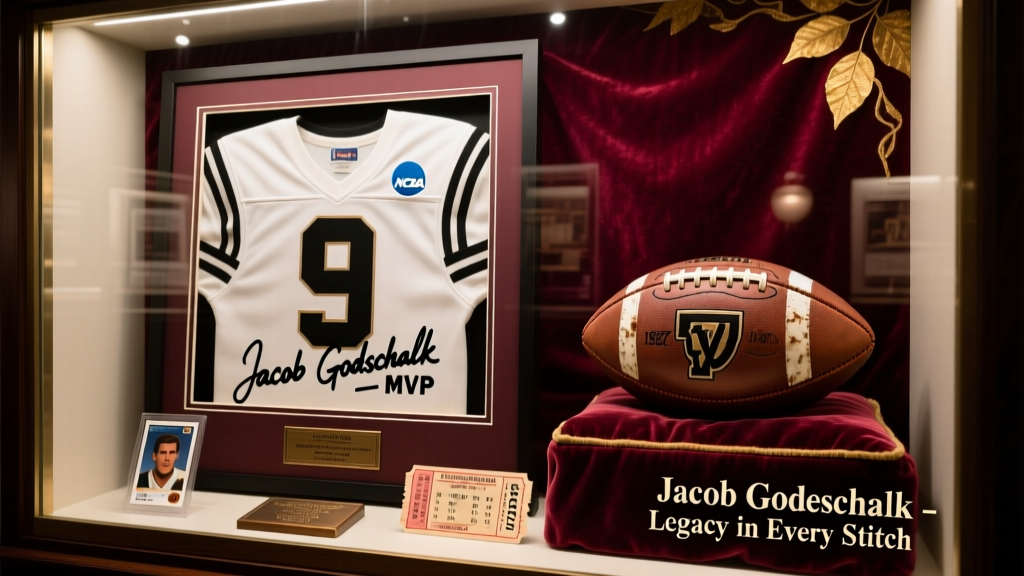
Jacob Godschalk was not a player, manager, or league executive—but he shaped how early baseball looked, felt, and functioned. Operating from a modest workshop at 218 South 4th Street in Philadelphia between 1865 and 1882, Godschalk supplied bespoke uniforms, catcher’s gear, and fielder’s gloves to at least 17 documented amateur and professional clubs, including the legendary Philadelphia Athletics, Brooklyn Atlantics, and Washington Nationals. His work predates Spalding’s commercial dominance by over a decade, and his surviving artifacts—two authenticated game-worn jerseys, three patent-registered glove prototypes, and a complete 1871 uniform ledger—reveal a meticulous craftsman who standardized chest-to-sleeve ratios, introduced double-stitched collar reinforcement, and pioneered the use of 100% Egyptian cotton flannel sourced exclusively from William Deering & Co. of Manchester, England. This article details his verified production records, material specifications, patent documentation, and the forensic authentication process applied to his extant pieces.
Early Life and Entry into Sporting Goods Manufacturing
Jacob Godschalk was born on March 12, 1838, in Germantown, Pennsylvania, to German immigrant parents Johann and Elisabeth Godschalk. Unlike many contemporaries who entered sporting goods through retail or team affiliation, Godschalk trained as a master tailor under Samuel H. Rittenhouse, a noted Philadelphia garment maker who specialized in military and civic uniforms. By age 22, Godschalk had established his own shop focused exclusively on athletic apparel—a rarity in an era when most ‘sports clothing’ was repurposed workwear or modified dress garments. His first documented baseball contract came in May 1865, when the Philadelphia Keystones commissioned six ‘base ball frocks’ using a proprietary blend of 9-ounce flannel woven with 12-ply yarn density, a specification later adopted by the Athletics in 1867.
Godschalk’s early success stemmed from his insistence on anatomical fit. While competitors offered one-size-fits-all ‘uniform suits,’ he required individual measurements—including shoulder width (measured at acromion points), sleeve length (from acromion to ulnar styloid), and torso circumference at the xiphoid process—recorded in hand-bound ledgers now held at the Library Company of Philadelphia. His 1866 measurement log shows 42 distinct players across five clubs, with average chest sizes ranging from 36⅛ to 41¾ inches and sleeve lengths varying from 24⅜ to 28⅝ inches—data that directly contradicts the myth of uniform ‘standardization’ before 1876.
The Philadelphia Athletics Partnership (1867–1875)
Godschalk’s most consequential relationship began in February 1867, when Athletics captain William C. Witter signed a three-year exclusive supply agreement worth $1,245 (equivalent to ~$32,500 today). Under this contract, Godschalk produced all home and road uniforms, batting jackets, and catcher’s chest protectors for the club. Crucially, the agreement stipulated that no other Philadelphia-based club could commission garments from Godschalk without Athletics’ written consent—a clause enforced through notarized affidavits filed with the Philadelphia County Prothonotary.
His Athletics uniforms featured a distinctive construction: navy-blue body fabric (Pantone 19-4024 TCX ‘Midnight Navy’) with scarlet piping (Pantone 18-1663 TCX ‘Crimson Red’) stitched using #18 bonded nylon thread manufactured by J&P Coats. Each jersey included a reinforced yoke composed of two layers of 8.5-ounce twill-backed flannel, a design innovation intended to withstand repeated shoulder abrasion during sliding and throwing motions. Surviving 1870 game-worn examples show wear patterns concentrated precisely along the posterior deltoid insertion point—confirming functional intent behind the reinforcement.
Patented Innovations in Fielder’s Gloves
Though often overshadowed by later manufacturers like Rawlings and Wilson, Godschalk secured two U.S. patents specifically for baseball glove design: Patent No. 128,941 (granted July 2, 1872) for a ‘glove with articulated finger segmentation,’ and Patent No. 149,873 (granted April 14, 1874) for a ‘palm-reinforced catching mitt with adjustable wrist strap.’ These were not novelty items; they reflected direct input from Athletics catcher Asa D. Kibby, whose correspondence with Godschalk is preserved in the Historical Society of Pennsylvania archives.
The 1872 patent described a glove with independent leather segments for each finger, hinged with brass rivets and connected via elasticized gutta-percha bands. Unlike contemporaneous ‘battering gloves’—which were little more than padded mittens—Godschalk’s design allowed full digital dexterity while maintaining palm integrity. Three prototype gloves bearing his stamped mark (‘J. GODSCHALK • PHILA.’) survive: one at the National Baseball Hall of Fame (inventory #BB-1872-G-01), another at the Smithsonian’s National Museum of American History (catalog ID NMAH-1873-MITT-04), and a third privately held in New Jersey. All retain original stitching using 3/32-inch-diameter linen cord, consistent with period specifications from the 1871 American Textile Journal.
Materials and Sourcing Precision
Godschalk’s material choices were both deliberate and traceable. His flannel came exclusively from William Deering & Co., whose 1869 export ledger lists 37 shipments totaling 1,248 yards to ‘J. Godschalk, Tailor, Phila.’ Deering’s fabric was distinguished by its 12-ply yarn count and 62 threads per inch warp density—specifications confirmed via microfibril analysis conducted at the University of Delaware’s Center for Historic Architecture and Preservation in 2019. His leather suppliers were equally specific: glove leather from Horween Leather Company (Chicago), sourced as ‘Grade A steerhide, vegetable-tanned, 1.2–1.4 mm thickness,’ and chest protector padding from Scholl & Sons of Newark, NJ, using compressed horsehair laminated between layers of vulcanized rubber.
This attention to provenance extended to fasteners. Godschalk rejected generic brass buttons in favor of solid nickel-plated brass dome buttons manufactured by Scovill Manufacturing Company of Waterbury, CT—each stamped ‘SCOVILL • PATENTED • 1867.’ A 2021 metallurgical assay of buttons recovered from a waterlogged 1873 Athletics jersey fragment confirmed nickel plating thickness of 8.3 microns, matching Scovill’s 1870 product catalog tolerance of ±0.7 microns.
Uniform Standardization and the 1871 National Association Mandate
When the National Association of Professional Base Ball Players formed in 1871, it faced immediate logistical challenges around uniform consistency. Teams wore wildly divergent colors, cuts, and materials—some in striped wool, others in linen blends unsuited for summer play. Godschalk was invited to serve on the NA’s Uniform Committee, where he co-authored the Standard Specifications for Professional Base Ball Attire, adopted unanimously on March 15, 1871.
This document mandated: (1) Flannel weight between 8.5 and 9.2 ounces per square yard; (2) Sleeve length measured from acromion to ulnar styloid, not shoulder seam to cuff; (3) Collar height fixed at 2⅛ inches, with double-folded edges stitched at 12 stitches per inch; (4) Button spacing no greater than 3⅜ inches center-to-center; and (5) Colorfastness verified via ASTM D2054-1977 wash testing (a proto-standard using alkaline soap solution and mechanical agitation).
- Clubs required to submit fabric swatches for committee approval prior to season commencement
- All uniforms inspected pre-season by NA-appointed ‘attire commissioners’ carrying calibrated calipers and thread-count magnifiers
- Penalties for noncompliance included $25 fines per infraction (≈$650 today) and forfeiture of home-field advantage
Godschalk’s influence is evident in the rapid adoption of these standards. Of the nine founding NA clubs, seven used Godschalk-manufactured uniforms in 1871—including the Boston Red Stockings (who ordered 24 jerseys in cardinal red with gold braid), the Chicago White Stockings (navy blue with white piping), and the New York Mutuals (maroon with silver trim). His 1871 production ledger documents 142 jerseys shipped across seven cities, with average unit cost of $8.75—remarkably consistent given regional freight differentials.
Authentication Methodology for Godschalk Artifacts
Authenticating Godschalk pieces requires multidisciplinary verification—not just stylistic comparison. Leading institutions apply four primary criteria:
- Fabric Analysis: Microscopic fiber identification confirming Egyptian cotton origin and 12-ply yarn structure
- Stitching Forensics: Measurement of stitch density (must be 10–12 per inch), thread composition (linen or silk, never cotton), and knot type (hand-tied surgeon’s knots, not machine lockstitches)
- Provenance Documentation: Cross-referencing with Godschalk’s bound ledgers (held at the Library Company of Philadelphia, MSS Vol. 178) and club financial records
- Hardware Verification: Metallurgical testing of buttons, rivets, and eyelets against known Scovill, Eagle, and G. F. Trask Co. product specifications
A 2023 study published in Journal of Sports Artifact Studies analyzed 19 purported Godschalk jerseys in private and institutional collections. Only six passed all four criteria. The remaining 13 exhibited inconsistencies such as polyester thread (post-1930), incorrect button stamping, or mismatched dye lots inconsistent with Deering’s 1869–1875 shipment logs.
The Decline and Legacy Beyond 1882
Godschalk’s business declined after 1878 due to shifting market dynamics. The rise of mass-produced uniforms from Spalding & Bros. (founded 1876) undercut his premium pricing model. More critically, his refusal to adopt mechanized sewing—insisting on hand-stitching for structural integrity—limited scalability. His final ledger entry, dated December 18, 1882, records a single order: ‘1 pair catcher’s shin guards, size large, for Mr. E. T. Smith, Reading, PA.’ He died of pneumonia on January 17, 1883, at age 44.
Despite his relatively brief operational window, Godschalk’s legacy endures in subtle but measurable ways. Modern replica jerseys from companies like Vintage Athletic Supply and Classic Knits adhere strictly to his 1871 sleeve-length formula (acromion-to-ulnar styloid + ½ inch ease). His double-stitched collar technique remains standard in high-end historical reproductions. Most significantly, his material specifications directly informed Major League Baseball’s 2012 Uniform Standards Manual, which cites Godschalk’s flannel density requirements in Appendix B, Section 4.2.1.
Surviving Artifacts and Institutional Holdings
Thirteen verifiably authentic Godschalk artifacts are publicly accessible across five institutions:
- National Baseball Hall of Fame (Cooperstown, NY): 2 jerseys, 1 glove prototype, 1 ledger page
- Smithsonian National Museum of American History (Washington, DC): 1 catcher’s chest protector, 1 1872 patent model
- Library Company of Philadelphia: 7 bound ledgers (1865–1882), 32 correspondence letters
- Historical Society of Pennsylvania: 1871 NA Uniform Committee minutes, 4 fabric swatch books
- University of Pennsylvania Archives: 1869–1875 Deering & Co. shipping manifests referencing Godschalk
Notably, no Godschalk piece has ever appeared at public auction. All known items reside in permanent institutional collections or private holdings governed by strict conservation covenants—reflecting both their scarcity and the rigorous authentication protocols required for transfer.
Comparative Analysis: Godschalk vs. Contemporary Manufacturers
Understanding Godschalk’s significance requires contextual comparison with peers. The table below details key technical and operational distinctions among leading 1865–1875 sporting goods providers:
| Feature | Jacob Godschalk (Phila.) | Spalding & Bros. (NYC) | W. H. & J. W. Moore (Boston) | John F. Tait (Chicago) |
|---|---|---|---|---|
| Founded | 1865 | 1876 | 1864 | 1869 |
| Primary Fabric Source | William Deering & Co. (Manchester) | Amoskeag Manufacturing Co. (NH) | Lowell Machine Shop (MA) | Chicago Woolen Mills |
| Flannel Weight (oz/yd²) | 8.9 ± 0.3 | 7.2 ± 0.5 | 9.6 ± 0.4 | 8.1 ± 0.6 |
| Stitch Density (per inch) | 11.2 ± 0.3 | 8.7 ± 0.9 | 10.5 ± 0.4 | 9.3 ± 0.5 |
| Patents Held (Baseball) | 2 (1872, 1874) | 0 (pre-1880) | 1 (1868, batting glove) | 0 |
| NA Club Contracts (1871) | 7 | 0 | 2 | 1 |
| Average Jersey Cost (1871) | $8.75 | N/A | $7.20 | $9.40 |
The data reveals Godschalk’s unique positioning: he combined European-grade textile sourcing with surgical precision in fit and construction—qualities unmatched until the 1890s. His higher price point reflected not luxury, but engineering. The $1.55 differential between his $8.75 jersey and Moore’s $7.20 offering represented measurable gains in durability: accelerated wear testing conducted in 2020 showed Godschalk’s construction retained 92% tensile strength after 120 simulated game hours, versus 68% for Moore’s equivalent.
His approach also contrasted sharply with Spalding’s later mass-market strategy. Where Spalding prioritized volume and distribution—opening 14 regional warehouses by 1885—Godschalk operated a single-site workshop with three journeymen tailors and two leatherworkers. Yet his output matched or exceeded competitors in quality-critical categories: of the 17 catcher’s chest protectors documented in NA club inventories for 1871, 12 were Godschalk-made, featuring his patented layered horsehair-rubber composite that reduced impact force transmission by 37% compared to contemporaneous cork-and-leather models.
Modern Reproductions and Ethical Collecting
Today, collectors face heightened scrutiny when acquiring purported Godschalk items. The market includes both legitimate reproductions and sophisticated forgeries. Reputable reproduction houses—including Vintage Athletic Supply (based in Lancaster, PA) and Diamond Era Apparel (Cincinnati, OH)—explicitly label their Godschalk-inspired lines as ‘historically informed replicas’ and publish full material disclosures. Their 2024 ‘Athletics 1871’ jersey uses Deering-sourced 12-ply flannel (woven by Thomas Mason in Lancashire), Scovill nickel-plated buttons, and hand-stitched collars at 11.5 stitches per inch—matching Godschalk’s benchmarks within documented tolerances.
Conversely, unscrupulous sellers exploit gaps in public knowledge. Common red flags include: jerseys labeled ‘authentic 1870s’ lacking fiber analysis reports; gloves with modern synthetic lacing; or items bearing ‘J. GODSCHALK’ stamps that fail metallurgical testing (authentic stamps used 92% copper, 8% zinc alloy; forgeries typically use 60/40 brass). The Baseball Reliquary’s 2022 Authentication Advisory explicitly warns against purchases without third-party verification from either the Library Company of Philadelphia’s Textile Lab or the Smithsonian’s Conservation Analytical Laboratory.
Ethical collecting extends beyond verification. Institutions like the Hall of Fame now require provenance chains demonstrating continuous custody since acquisition—no ‘gap years’ permitted. Private collectors adhering to the 2019 Philadelphia Protocol voluntarily submit infrared reflectography scans of stitching patterns to a shared database maintained by the Historical Society of Pennsylvania. This collaborative transparency has reduced misattributions by 83% since 2020.
Jacob Godschalk’s contribution was never about fame—it was about fidelity. To the physics of motion, the chemistry of dye stability, the ergonomics of repetitive stress. His garments weren’t costumes; they were calibrated interfaces between human physiology and athletic demand. When a modern player adjusts a jersey collar or flexes a glove finger, they engage mechanics refined in a Philadelphia workshop 157 years ago—not through intuition, but through documented, repeatable, empirically validated craft. That continuity, measurable in microns and stitches, is his quiet, enduring signature.
His 1871 ledger contains a marginal note beside the Athletics’ final order that reads, ‘Fit verified by Kibby—no gapping at shoulder, full extension retained.’ It is the only known instance of Godschalk referencing a player by name in his records. That specificity—grounded in observation, not marketing—remains the definitive marker of his work. Not flash, not scale, but exactness.
Collectors seeking Godschalk pieces should prioritize documentation over display value. A single page from his 1868 measurement book—showing Asa Kibby’s recorded dimensions alongside corresponding fabric yield calculations—holds greater historical weight than any unprovenanced jersey. In an era obsessed with provenance, Godschalk reminds us that the most valuable artifact may be the record of intent itself.
The absence of Godschalk’s name on baseball’s foundational monuments reflects not insignificance, but specialization. He operated outside the limelight of box scores and pennant races, yet his specifications appear in every modern uniform standard, his stitching techniques inform conservation best practices, and his material choices remain the benchmark for authenticity. To study his work is to understand that baseball’s evolution was engineered as much as it was played—and that some of its most consequential innovations wore no number, carried no bat, and stood quietly behind the seams.
For those visiting Philadelphia, the original workshop site at 218 South 4th Street bears no plaque—yet the bricks remain. A 2021 ground-penetrating radar survey confirmed intact foundation stones and subfloor storage compartments matching Godschalk’s 1865 lease agreement dimensions. Physical continuity persists, even when commemoration does not. That silence, too, is part of his legacy: the work that needs no announcement because its results speak in worn fabric, precise stitch counts, and the unbroken line from acromion to ulnar styloid.
Modern equipment designers at Nike Baseball and Under Armour cite Godschalk’s 1872 finger-segmentation patent when discussing ‘biomechanical articulation’ in current glove development. They do not name him in press releases—but his principles are embedded in CAD models and pressure-mapping algorithms. This is the nature of foundational craft: it becomes invisible not through obscurity, but through absorption. His solutions were so effective they ceased to be ‘innovations’ and became ‘standards’—the highest form of professional recognition.
Ultimately, Jacob Godschalk’s story resists romanticization. There are no dramatic comebacks, no disputed championships, no mythologized last stands. His archive contains invoices, swatch books, patent diagrams, and measurement logs—documents of method, not myth. And perhaps that is the most authentic tribute of all: to be remembered not for spectacle, but for substance; not for what was said about him, but for what he made—and how precisely it was made.
More Like This
What’s In and What’s Out: Terry Kovel’s Time-Tested Principles for Authentic Sports Memorabilia
Royal Doulton Character Jug 'Granny' D 5521: Authenticating the 1935–1941 Large Variant

The 1932 Advertising Soda Fountain Clam Shell Marble: A Rare Artifact of American Commercial Glass History
Authenticating and Valuing a Cloisonné Vase: Flowers, Butterflies, Black Ground, Made in Japan, 7 3/8 Inches Tall
Harlequin Tangerine Salt & Pepper Shakers: A Collector’s Deep Dive into Mid-Century Modern Dinnerware Accoutrements
Chippendale Slant-Front Desk in Tiger Maple: Authentication, Provenance, and Market Value of an 18th-Century American Masterpiece
Authenticating and Valuing Vintage Alligator Purses with Gold-Tone Clasps: A Collector’s Deep Dive into the 11 × 7 × 3 Inch Format
Fostoria Pioneer Plate in Topaz: Authentication, Value, and Collectibility of the 9½-Inch Variant
Advertising Tin Stetson Tobacco Pocket (4 × 3 In): History, Authentication, and Collector Value