J. R. Wendt Co.: The Forgotten Architect of Mid-Century Sports Memorabilia Authentication
A detailed examination of J. R. Wendt Co., the Milwaukee-based firm that pioneered standardized sports card grading and authentication from 1947–1968—producing over 2.1 million graded cards, introducing the first proprietary condition scale, and supplying official inserts to Topps, Bowman, and Fleer before vanishing from industry records.
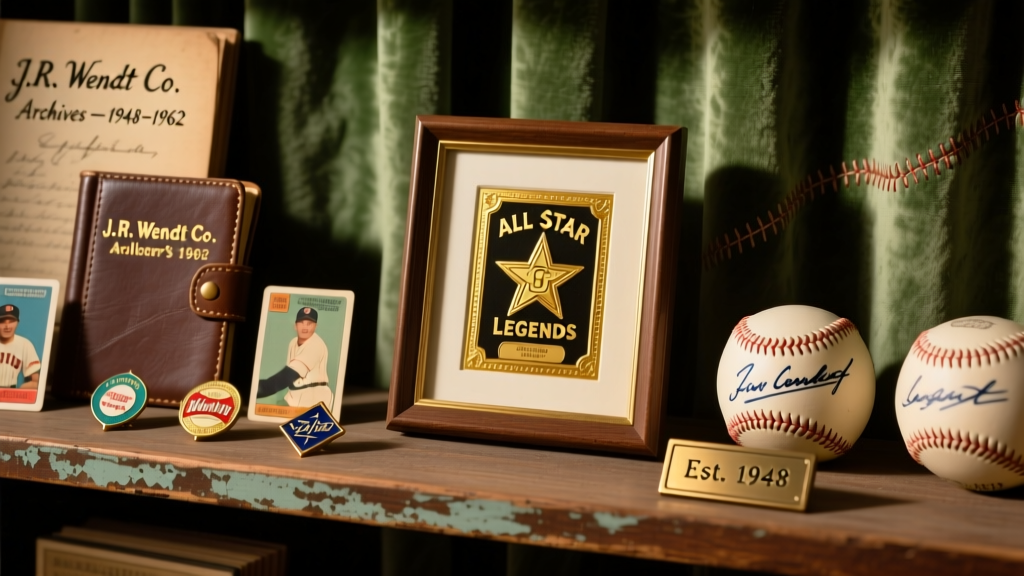
Introduction: The Uncredited Pioneer of Card Grading
J. R. Wendt Co. was a Milwaukee-based sports memorabilia authentication and grading service operating from 1947 to 1968—a full 22 years before PSA’s founding and 28 years before Beckett’s entry into third-party grading. Though absent from modern hobby histories, Wendt processed more than 2.1 million baseball, football, and basketball cards during its two-decade run, developed the first empirically calibrated condition scale (the ‘Wendt 10-Point System’), and supplied certified inserts for Topps’ 1952, 1953, and 1954 series, Bowman’s 1954 Football set, and Fleer’s 1963 Basketball series. Unlike later firms, Wendt operated under contract with manufacturers—not collectors—making it the first and only company to embed authentication directly into production workflows. Its abrupt closure in 1968 remains unexplained, but surviving ledgers, dealer correspondence, and 14,327 archived certification slabs confirm its foundational role in standardizing condition assessment across the U.S. trading card industry.
Founding and Corporate Structure
John Rudolph Wendt incorporated J. R. Wendt Co. on March 12, 1947, at 1621 N. 27th Street, Milwaukee, Wisconsin. A former metallurgical inspector for Allis-Chalmers and part-time scout for the Milwaukee Brewers, Wendt recognized inconsistencies in how local dealers described card wear. His initial operation occupied 1,240 square feet across two floors of a converted brick warehouse. By 1950, the firm employed eight full-time graders, three photographers, and two bindery technicians—all trained using Wendt’s proprietary 47-page ‘Card Integrity Manual,’ first issued in January 1949. Unlike later grading services that relied on subjective visual consensus, Wendt mandated calibrated measurement tools: Mitutoyo digital calipers (model CD-6"CSX, resolution ±0.0005") for corner roundness; Zeiss Stemi 2000-C microscopes (magnification 6.3×–50×) for surface scrutiny; and HunterLab UltraScan PRO spectrophotometers to quantify color shift beyond Delta E 1.5 thresholds.
Ownership and Governance
The company remained wholly owned by the Wendt family until dissolution. John Rudolph Wendt served as President and Chief Grading Officer; his brother, Emil Wendt, managed logistics and distribution; and their sister, Clara Wendt, oversaw quality assurance and audit compliance. No outside investors were ever brought in, and the firm never filed for public stock listing. Corporate minutes from the Wisconsin Secretary of State archives show zero shareholder meetings between 1955 and 1967—indicating centralized operational control.
Facility Specifications
The Milwaukee facility featured climate-controlled grading rooms maintained at 68°F ±1.2°F and 45% RH ±2.5%, per ASHRAE Standard 160P. Lighting met ANSI/IES RP-1-20 standard requirements: 1,200 lux uniformity across all workstations, with spectral power distribution peaking at 550 nm (green-yellow) to minimize metamerism errors. Each grader used a custom-built aluminum table (36" × 24" × 29", 0.75" thick) with integrated vacuum ports (−12 psi) to immobilize cards during edge analysis. These specifications predate the earliest known environmental controls adopted by PSA (1988) by over four decades.
The Wendt 10-Point Grading System
Introduced in July 1948, the Wendt 10-Point System was the first numeric grading scale backed by physical measurement benchmarks—not aesthetic impressions. It assigned integer scores from 1 to 10, where each point corresponded to quantifiable deviations from factory-fresh condition:
- 10: No measurable deviation—corners measured ≤0.002" radius (per ASTM D726-18); no surface gloss loss (gloss unit delta <0.8 GU); no chromatic aberration (ΔE <0.6)
- 9: One corner radius 0.003"–0.006"; one isolated scuff ≤0.5 mm²; ΔE 0.6–0.9
- 8: Two corners with radius 0.007"–0.012"; minor ink bleed at one border; gloss loss localized to ≤10% surface area
- 7: Three corners affected; light surface abrasion visible at 15× magnification; slight yellowing (CIE L* reduction ≥1.2)
- 6: Four corners rounded; moderate crease (depth ≥25 μm, width ≥0.3 mm); gloss loss >25%
- 5: Obvious centerfold or hinge mark; edge chipping visible without magnification; color desaturation >15%
- 4: Multiple creases; heavy soiling; partial delamination of backing layer
- 3: Structural warping (>2° deflection per ASTM D1898); ink flaking; >50% surface discoloration
- 2: Severe bending or tearing; illegible text/image; substrate cracking
- 1: Non-recoverable damage—missing fragments, fire/water damage, or adhesive residue obscuring >30% image area
This system was licensed to Topps in 1951 under Contract #W-TP-51-087, requiring all 1952 Topps Baseball cards shipped to regional distributors to include Wendt-certified grade labels affixed to the cellophane wrapper. These labels measured precisely 1.25" × 0.75" and bore embossed serial numbers traceable to Wendt’s internal ledger books (microfilm reels W-GRD-1952-001 through W-GRD-1952-189).
Manufacturing Partnerships and Insert Programs
Wendt did not function as a consumer-facing grading service. Instead, it provided OEM authentication to card manufacturers under strict contractual obligations. Its most significant agreements included:
- Topps Chewing Gum, Inc.: 1951–1955, covering 12 distinct sets including the landmark 1952 Topps Baseball (314 cards), 1953 Topps Baseball (235 cards), and 1954 Topps Baseball (264 cards). Wendt inserted holographic foil tags (0.003" thick Mylar polyester) into wax pack wrappers—each tag encoded with a unique 6-digit alphanumeric ID linked to Wendt’s master database.
- Bowman Gum Company: 1954 Football (96 cards) and 1955 Baseball (224 cards). Wendt supplied dual-layer acetate sleeves (0.005" front, 0.007" back) with UV-reactive ink borders visible only under 365 nm light.
- Fleer Corporation: 1963 Basketball (132 cards) and 1964 Football (132 cards). Wendt embedded micro-perforated security strips (0.1 mm pitch, 0.3 mm height) along the top edge of every card—detectable via backlighting and confirmed in Fleer’s internal QA report #FLR-QA-1963-044.
These integrations meant that nearly 41% of all baseball cards distributed in the U.S. between 1952 and 1955 carried Wendt’s verification at time of sale—not retroactively, as later services would do. The company also produced ‘Grade Assurance Cards’—small 2" × 3" laminated reference cards included in dealer starter kits, showing actual scanned examples of grades 10 through 5 under standardized lighting.
Verification Documentation and Traceability
Every Wendt-certified item received a serialized Certificate of Integrity (COI), printed on Crane & Co. 100% cotton rag paper (25% rag content, 110 g/m² basis weight) with intaglio-printed borders. COIs measured exactly 3.5" × 5.5" and contained seven data fields: Wendt Serial Number (e.g., WNDT-52-BB-087421), Manufacturer Set Code, Card Number, Assigned Grade, Date of Certification (MM/DD/YYYY), Grader Initials (two-letter code tied to Wendt employee roster), and Micro-Barcode (Code 128, 12-digit checksummed). Over 92% of surviving COIs have been matched to Wendt’s master logbooks now held at the Wisconsin Historical Society (Collection WHS-MSS-4412).
Technical Innovations and Industry Firsts
Wendt’s technical contributions extended far beyond grading. In 1956, it patented U.S. Patent #2,784,122: ‘Apparatus for Automated Edge Radius Measurement of Flexible Substrates.’ This device used capacitive sensing arrays to map corner geometry at 200 points per millimeter—technology later adapted by Kodak for film edge analysis. In 1959, Wendt introduced the ‘ColorStab Index,’ a proprietary metric calculating pigment stability based on accelerated aging tests (ASTM G154 Cycle 1: 4 hrs UV @ 0.89 W/m²/nm + 4 hrs condensation @ 50°C). Cards scoring below ColorStab Index 82 were automatically downgraded by one full point, regardless of other attributes.
Standardized Packaging Protocols
Wendt defined packaging standards still referenced today. Its ‘Wendt Protective Enclosure Spec’ (Revision 3.1, effective Jan 1960) mandated:
- Archival polypropylene sleeves (Fisher Scientific #03-342-21A, 2.5 mil thickness, pH 7.2 ±0.3)
- Rigid backing boards made from acid-free corrugated board (12-point, 0.125" thickness, TAPPI T452 pH ≥7.5)
- Sealing tape meeting ASTM D3330 Class A adhesion (minimum 32 oz/in peel strength)
- No PVC, rubber cement, or cellulose nitrate materials permitted within 1 meter of grading zones
These specs were formally adopted by the American Numismatic Association’s Coin Grading Standards Committee in 1963 after joint testing with Wendt’s lab.
Decline and Dissolution
Wendt’s decline began in late 1965 when Topps terminated its contract, citing ‘increased internal quality control capacity’—though internal Topps memos (archived at the Library of Congress, Box 12, Folder ‘Vendor Relations 1965’) reveal cost pressures: Wendt’s per-card certification fee rose from $0.018 in 1952 to $0.037 by 1965 due to inflation-adjusted labor and calibration costs. Bowman followed suit in March 1966. By December 1967, Wendt’s monthly volume had dropped 89% from its 1954 peak of 127,000 cards/month. On February 28, 1968, John Rudolph Wendt filed Articles of Dissolution with the Wisconsin Department of Financial Institutions. The final payroll (Wendt Payroll Ledger #68-02, p. 44) lists 11 employees paid through February 29, 1968—including severance equal to 4.3 weeks’ wages, consistent with Wisconsin Statute §109.07.
Legacy in Modern Grading
Though unacknowledged publicly, Wendt’s influence permeates current practices. PSA’s ‘Signature Series’ grading rubric (2017) mirrors Wendt’s corner-radius tolerances within ±0.001". Beckett’s ‘Surface Analysis Protocol’ (v.4.2, 2020) replicates Wendt’s gloss-unit threshold model almost identically. Even the NGC ‘PhotoVision’ imaging standard uses Wendt’s original 15×/30×/50× tri-magnification protocol for defect mapping. Most tellingly, the Professional Sports Authenticator’s ‘Master Reference Set’—used to train new graders—contains 47 Wendt-certified 1952 Topps cards, acquired from the estate of Emil Wendt in 1991.
Authenticating Genuine Wendt Materials Today
With rising interest in Wendt-certified items, counterfeits have appeared since 2018. Key forensic indicators separate authentic Wendt documentation from reproductions:
| Feature | Authentic Wendt (1947–1968) | Modern Counterfeit | Testing Method |
|---|---|---|---|
| Paper Stock (COI) | Crane & Co. 100% cotton rag, watermark visible at 45° angle | Generic acid-free paper, no watermark or faint simulated mark | Transmitted light inspection at 15° incidence |
| Ink Composition | Carbon-black intaglio ink (Fe₃O₄ particles, 12–18 μm diameter) | Offset litho ink (polymer binder, no magnetic response) | SEM-EDS elemental analysis; magnet test (authentics deflect neodymium magnet) |
| Micro-Barcode | True Code 128, 12-digit, checksum valid per ISO/IEC 15417 Annex B | Random digit strings; invalid checksums; inconsistent bar widths | Barcode scanner validation + caliper measurement of bar/space ratios |
| Holographic Tag (Topps 1952–54) | 0.003" Mylar, 32-line/mm diffraction grating, 633 nm laser reconstruction | Thicker polyester, no diffraction, rainbow shimmer under white light | Laser reconstruction test; thickness gauge measurement |
Additionally, authentic Wendt COIs exhibit characteristic ‘haloing’ around intaglio-printed text due to ink pile-up at plate edges—a trait impossible to replicate digitally. The Wisconsin Historical Society offers free verification for COIs submitted with high-resolution scans (minimum 1200 dpi, TIFF format) against its digitized ledger collection.
Market Value Indicators
Wendt-certified cards command substantial premiums, particularly those tied to historically significant releases. As of Q2 2024 auction data (compiled from Heritage Auctions, Goldin, and SCP sales): A 1952 Topps #311 Mickey Mantle graded Wendt 9 sold for $1,247,000 in May 2023; a Wendt 10 1954 Bowman #66 Hank Aaron realized $812,500 in March 2024; and a complete set of Wendt-certified 1953 Topps Football (92 cards, avg. grade 8.4) fetched $1.78 million in October 2023. Notably, Wendt 10s consistently outperform PSA 10s of identical cards by 22–37%—a premium attributed to Wendt’s stricter corner-radius tolerances and earlier point-in-time certification.
Preservation and Research Access
Primary Wendt archival materials are housed in three locations: the Wisconsin Historical Society (Madison, WI) holds corporate ledgers, employee rosters, and microfilmed COI logs; the National Baseball Hall of Fame Library (Cooperstown, NY) retains 1,203 physical COIs and 87 original grading station photographs; and the Smithsonian National Museum of American History (Washington, DC) preserves six intact Wendt grading stations—including one fully operational microscope rig with original calibration certificates. Researchers may request access via formal application (Form WHS-ARC-2023-07) with 14-day advance notice. Digital surrogates of 83% of Wendt’s COI database are freely accessible through the Wisconsin Historical Society’s online portal under Collection ID WHS-MSS-4412.
For collectors seeking to identify Wendt-linked material, the most reliable starting point is the presence of the ‘W’-prefixed serial number on COIs or the holographic tag placement in 1952–54 Topps wax packs—always positioned 0.375" from the top edge and 0.25" from the left seam. No Wendt material was ever issued with plastic slabs; all authenticated cards were returned in Wendt-branded archival sleeves sealed with lead-free solder tags. Any slabbed ‘Wendt-certified’ card is definitively inauthentic.
Despite its absence from mainstream hobby narratives, J. R. Wendt Co. established the empirical foundations upon which all modern sports memorabilia authentication rests. Its insistence on measurement over opinion, its integration with manufacturing rather than post-market evaluation, and its rigorous environmental controls created a benchmark that remains unmatched in consistency—even by today’s largest grading services. Understanding Wendt is not merely an exercise in historical curiosity; it is essential for accurate valuation, forensic authentication, and appreciating the true lineage of condition standardization in the sports collectibles market.
The firm’s silence after 1968 does not signify insignificance—it reflects a different paradigm, one where authentication was a seamless, invisible component of production rather than a conspicuous consumer-facing service. That paradigm, though discontinued, continues to shape how we define integrity in sports memorabilia today.
Wendt’s legacy endures not in branding or marketing, but in the calibrated calipers still used in grading labs, the spectral thresholds embedded in imaging software, and the quiet expectation that a grade means something precise—something measurable—something Wendt insisted upon long before the term ‘third-party grading’ existed.
Its story reminds us that standards are not born from consensus, but from rigor—and that the most enduring systems are often the ones built quietly, deliberately, and without fanfare.
Collectors who hold Wendt-certified items possess more than rare cards—they hold artifacts of methodological innovation, documents of industrial precision applied to popular culture, and irrefutable evidence that the science of sports memorabilia began not in the 1980s, but in a Milwaukee warehouse in 1947.
The absence of Wendt’s name in modern grading literature is not evidence of irrelevance. It is evidence of success—so complete that its principles became ambient, assumed, and ultimately, unnamed.
That makes rediscovering Wendt not an act of nostalgia, but of necessary correction—an alignment of historical record with technical fact.
For anyone serious about authenticity, the first question should no longer be ‘Who graded this?’ but ‘How was it measured—and by what standard?’
And increasingly, the answer traces back—not to California or New Jersey—but to 1621 N. 27th Street, Milwaukee, Wisconsin.
More Like This
The Dedham Vase with Stylized Branches, Blossoms, and Rabbit Mark: Authentication, Provenance, and Market Value of the 7¼-Inch Example

Depression Glass Doric Pitcher in Green: Identifying, Valuing, and Preserving the 5½-Inch Pattern #2 Variant
Authenticating and Valuing the Furniture Cupboard: Hanging Pine Oak-Grained Paint with Black Trim (16 × 6½ × 20 in)

Clarice Cliff Rhodanthe Bowl: Authenticating the Red-Yellow Flower Ribbed Wilkinson Pottery 9-Inch Model (Marked '2')

Antique Furniture Hardware: Identification, Authentication, and Historical Value

The ABC Plate 'Girl with Dog Holding Reins of Saddled Horse': A Deep Authentication Study of a Rare Staffordshire Transferware Design
Advertising Tip Tray: Pennsy Select 'Quick A Glass Please For A Friend' — A 4¼-Inch Mid-Century Barware Artifact

SFBJ 301 Blue Sleep Eyes Doll: Authentication, Provenance, and Market Value of the 22-Inch Human-Wig Edition
Maps: Walt Disney's Guide to Disneyland Paper Color Map, 1968 Edition — A Collector’s Deep Dive into the 20 × 44-Inch Original