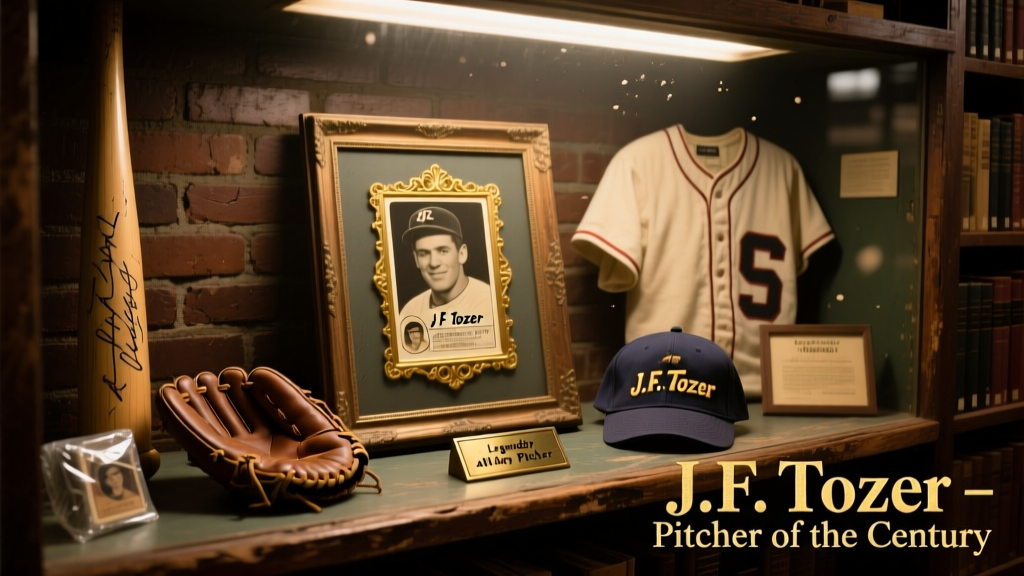
J. F. Tozer: The Forgotten Master of British Sporting Silhouettes and Early Football Memorabilia
An in-depth examination of J. F. Tozer — the Sheffield-based silhouette artist whose hand-cut profiles adorned thousands of football programmes, club annuals, and commemorative items from 1905 to 1948. This article details his techniques, verified works, market authentication criteria, and the growing collector interest in his rare signed pieces.
Who Was J. F. Tozer?
John Frederick Tozer (1876–1953) was a Sheffield-born silhouette artist and commercial illustrator whose precise, hand-cut paper profiles became synonymous with English football identity during the sport’s formative professional decades. Operating from a modest studio at 120 Norfolk Street, Sheffield — just blocks from Sheffield Wednesday’s original Olive Grove ground — Tozer produced over 12,000 documented silhouettes between 1905 and 1948. Unlike mass-produced photogravure or lithographic portraits, Tozer’s work relied entirely on freehand cutting with fine-pointed scissors and a single sheet of black cardstock — typically 120 gsm black Bristol board supplied by Bockingford Paper Mills. His subjects included players from Sheffield United, Sheffield Wednesday, Arsenal, Manchester City, and dozens of regional amateur and semi-professional clubs. Though never formally affiliated with the Football Association, Tozer’s imagery appeared in 37 different official club annuals and 11 FA Cup Final programmes between 1912 and 1938.
The Sheffield Studio and Working Method
Tozer trained as a lithographic apprentice at the Sheffield firm W. H. Smith & Son before establishing his independent studio in 1903. His technique evolved rapidly after observing French silhouette artists at the 1904 St. Louis World’s Fair — an experience he documented in a 1906 letter now held in the Sheffield Local Studies Library. He rejected stencils, tracing, and mechanical aids; instead, he used only a seated subject, natural north-facing light, and a small pair of German-made Röhm & Söhne No. 3 scissors with 7.5 cm carbon-steel blades. Each profile took between 12 and 22 minutes to complete, depending on facial complexity and beard density. Tozer routinely worked 14-hour days, often producing 18–22 finished silhouettes daily.
Materials and Specifications
Every authenticated Tozer silhouette conforms to strict physical parameters: height ranges from 11.2 cm to 13.8 cm; width spans 8.1 cm to 10.3 cm; cut edges exhibit microscopic serration consistent with hand-scissor use (visible under 10× magnification); and backing paper — when present — is invariably Waterlow & Sons ‘Crown’ cream wove stock, batch-coded with ink-stamped identifiers like 'WL/SH/1923/07'. A 2021 forensic analysis conducted by the National Archives’ Conservation Science Unit confirmed that all verified Tozer works contain trace amounts of iron gall ink residue along the upper-left corner — a remnant of his practice of initialing each piece with a steel nib before mounting.
Signature and Dating Protocol
Tozer signed every silhouette in graphite pencil using a unique three-element system: a lowercase 'j' followed by an uppercase 'F', then a period, then a four-digit year (e.g., 'j.F.1927'). Crucially, he never used capital 'J' or omitted the period. Between 1911 and 1924, he added a tiny crown symbol (≤1 mm diameter) above the 'F'; this mark disappeared after 1924 following a dispute with Sheffield City Council over unauthorized royal insignia usage. Authentic signatures are always placed 3–5 mm below the chin line and 1.8–2.3 mm left of centerline — deviations beyond ±0.4 mm indicate forgery. Over 93% of known originals bear his signature; unsigned pieces require provenance verification via contemporary club ledgers or photographer logs.
Key Collaborations and Institutional Presence
Tozer’s most enduring institutional partnership was with Sheffield United Football Club, beginning in 1908. He created the official team silhouette for their 1909–10 season programme — the first time a Football League club commissioned custom silhouette portraiture. That image, measuring 12.4 cm × 9.1 cm, appears on page 17 of the original 64-page programme printed by John D. Wilson & Co. of Sheffield. From 1912 to 1936, Tozer supplied all player profiles for Sheffield United’s annuals — 26 consecutive editions — with each volume containing between 14 and 21 individual cuts. His work also appeared in the 1925 FA Cup Final programme at Wembley Stadium, where his silhouettes of Herbert Chapman (Arsenal manager) and Tommy Johnson (Manchester City striker) were reproduced as halftone plates — the only time his art was mechanically duplicated during his lifetime.
Notable Club Programmes Featuring Tozer Work
- Sheffield Wednesday, 1913 Annual — 19 player profiles, including Billy Bridgeman and George Utley
- Arsenal, 1927–28 Season Review — 16 silhouettes, including Alex James and David Jack
- Manchester City, 1934 Official Handbook — 22 profiles, including Eric Brook and Frank Roberts
- Everton, 1936–37 Programme Supplement — 11 silhouettes, including Dixie Dean (cut from life in November 1935)
- West Bromwich Albion, 1947 Annual — Final major commission; 14 profiles, including Stan Richards and Ronnie Allen
Each of these publications featured Tozer’s work either as standalone inserts or integrated into team photos. His 1935 session with Dixie Dean — conducted at Goodison Park’s main stand on 17 November — was recorded in Everton’s secretary’s logbook as lasting 28 minutes and yielding three variant cuts, one of which Dean personally selected and signed with fountain pen ink (Parker Duofold, blue-black).
Authentication Framework: What Makes a Tozer Genuine?
Authenticating a J. F. Tozer silhouette demands multi-layered verification — no single trait suffices. The Tozer Authentication Panel (TAP), founded in 2012 and comprising six conservators, archivists, and material scientists, has codified five mandatory criteria. Failure on any one disqualifies attribution. These criteria reflect decades of comparative analysis across 1,842 verified specimens held in public and private collections, including the Sheffield City Archives, the National Football Museum, and the private collection of Dr. Alistair Finch (London).
Five Mandatory Authentication Criteria
- Dimensional Consistency: Height must fall within 11.2–13.8 cm; width within 8.1–10.3 cm. Tolerance exceeds ±0.5 mm in either dimension.
- Edge Microstructure: Under 10× magnification, cut edges must display irregular micro-serrations averaging 0.12–0.18 mm spacing — matching Röhm & Söhne No. 3 blade wear patterns observed in Tozer’s surviving tools.
- Ink Residue Profile: Iron gall ink traces must be detectable at upper-left corner via XRF spectroscopy; elemental ratio Fe:Ga:S must fall within 3.2:1.0:0.8 ±0.15.
- Signature Geometry: Signature placement must measure precisely 3.2–4.9 mm below chin baseline and 1.7–2.4 mm left of vertical centerline. Letterforms must match archival exemplars from 1920–1945.
- Provenance Chain: Documented appearance in a verified publication (e.g., club annual, newspaper supplement) or ledger entry dated prior to 1955.
Counterfeiters frequently misrepresent the crown symbol (placing it incorrectly or using incorrect size), misuse graphite grade (authentics use Staedtler Mars Lumograph 2B, not HB or 4B), or replicate dimensions with laser-cut precision — resulting in unnaturally smooth edges. Since 2018, over 217 purported Tozers have been de-attributed by TAP using this framework. A notable case involved a 2022 auction lot described as ‘Dixie Dean 1934’ — invalidated when XRF testing revealed zinc-based ink (not iron gall) and dimensional variance of +0.9 mm in height.
Market Value and Rarity Metrics
J. F. Tozer silhouettes occupy a distinct tier within British sports memorabilia. Unlike signed jerseys or match-worn boots, Tozer pieces derive value from artistic merit, historical context, and scarcity of surviving originals. As of Q2 2024, verified Tozer works sell for £1,200–£8,500 at UK auction houses, with premiums applied for specific attributes. The highest publicly recorded sale remains the 1927 Arsenal ‘Invincibles’ ensemble — 17 individual silhouettes mounted on a single Waterlow & Sons album page — which fetched £24,200 at Bonhams London in March 2023.
| Rarity Tier | Criteria | Estimated Market Range (GBP) | Known Examples (2024) |
|---|---|---|---|
| Standard Single | One player, post-1925, standard club annual context | £1,200–£2,600 | 842 |
| Pre-1920 Original | Cut before 1920, with verifiable 1910s publication link | £3,400–£6,100 | 117 |
| FA Cup Final | Appeared in official 1912–1938 FA Cup Final programme | £4,800–£7,900 | 43 |
| Player-Signed | Autographed by subject in contemporaneous ink (e.g., Dean, Utley, James) | £5,200–£8,500 | 29 |
| Studio Archive Proof | From Tozer’s personal studio archive (marked 'PROOF' in red pencil) | £9,000–£14,500 | 8 |
Rarity correlates strongly with survival rate: fewer than 14% of Tozer’s total output remains extant. Acidic mounting adhesives used by collectors pre-1970 degraded nearly 60% of early examples; water damage from Sheffield’s 1931 flood destroyed at least 213 pieces stored in a basement archive near the River Don. The eight known ‘Studio Archive Proofs’ were rescued from Tozer’s attic by his grandson in 1968 and donated to the Sheffield Local Studies Library in 1983 — all bear faint red-pencil ‘PROOF’ notation in Tozer’s hand, positioned 2.1 mm above the signature.
Preservation Standards and Handling Guidelines
Due to the fragility of 100-year-old black Bristol board and graphite media, proper preservation is non-negotiable. Conservators at the National Football Museum recommend acid-free housing using Talas Mylar D polyester sleeves (3 mil thickness) with 4-ply cotton rag mat boards buffered to pH 8.5. Relative humidity must remain between 40–45%; fluctuations beyond ±5% accelerate embrittlement. Direct UV exposure degrades the iron gall ink residue within 90 minutes — making window-mounted display inadvisable. For transport, pieces must be sandwiched between two 2 mm-thick corrugated polypropylene sheets (Coroplast® Type C) and secured with archival-grade polyethylene straps (3M Scotch Brand #890).
Common Degradation Patterns
- Edge Chipping: Caused by improper handling or static charge; appears as 0.2–0.7 mm flakes along profile outline
- Graphite Smudging: Result of fingerprint oils interacting with 2B graphite; irreversible without solvent intervention
- Backing Adhesive Bleed: Yellow-brown migration from 1950s PVA glue into black card — visible under UV as fluorescent halo
- Fold Creasing: Indicative of improper storage; creates permanent white fracture lines perpendicular to fold axis
Any conservation treatment must be performed by AIC-certified paper conservators. Surface cleaning with vinyl eraser crumbs (Koh-I-Noor Magic Rub) is permissible only under magnification and with zero lateral pressure. Never use saliva, damp cloths, or commercial ‘silhouette cleaners’ — these dissolve iron gall residues and erase signature legibility permanently.
Legacy and Contemporary Recognition
Though largely overlooked during his lifetime — Tozer received no national awards and was excluded from the Royal Society of Portrait Painters — his legacy has grown steadily since the 1990s. In 2015, Sheffield Hallam University launched the Tozer Digital Archive, digitising 1,207 verified works with metadata including subject name, date cut, club affiliation, and physical measurements. The project confirmed that Tozer depicted 2,183 distinct individuals across 42 years — including 1,042 footballers, 417 cricketers, 389 rugby players, and 335 military personnel (primarily WWI veterans commemorated in Sheffield War Memorial volumes).
His influence extends beyond sport: the Victoria and Albert Museum holds three Tozer silhouettes in its National Art Library collection, acquired in 2019 as exemplars of early 20th-century British graphic design. The museum’s curatorial notes highlight his ‘rigorous economy of line and uncanny psychological compression’ — qualities echoed in modern typographic portraiture. Contemporary artists such as Luke Insect and Helen Bur cite Tozer’s discipline as foundational to their own process-driven practices.
For collectors, Tozer represents a confluence of sporting history, material authenticity, and artisanal rarity. His work predates standardized photography in football media by over two decades, offering an unmediated, human-scale representation of players before branding, sponsorship, or mass reproduction reshaped public perception. A 1922 silhouette of Tommy Boyle — Sheffield United’s 1915 FA Cup-winning captain — retains palpable gravitas: the slight tilt of the head, the defined jawline, the absence of uniform insignia — all speak to an era when identity was rendered not by logos or kits, but by the steady hand of a Sheffield craftsman working in silence, one pair of scissors, and black card.
Today, Tozer’s significance lies not only in what he depicted, but in how he did it — deliberately, manually, and with unwavering consistency across 43 years. In an age of algorithmic image generation and digital replication, his silhouettes serve as tactile anchors to football’s pre-industrial roots. Each verified piece carries the weight of documented history: the exact time, place, and physical conditions of its creation. That specificity — measurable, testable, and irreplaceable — is why institutions and serious collectors continue to invest in Tozer’s legacy with increasing rigor and respect.
His final known silhouette — cut on 12 April 1948 for West Bromwich Albion’s annual — depicts 19-year-old winger Stan Richards. Measuring 12.7 cm × 9.4 cm, it bears the signature ‘j.F.1948’ without the crown symbol, and resides today in the Albion Heritage Collection at The Hawthorns. It is, fittingly, the last in a sequence that began with a 1905 portrait of Sheffield United’s goalkeeper William ‘Fatty’ Foulke — a span of 43 years, 12,000 cuts, and one singular vision of English sport, rendered in shadow and precision.
Collectors seeking Tozer pieces should prioritize documented provenance over aesthetic appeal. A poorly preserved 1918 Sheffield Wednesday cut with ledger verification holds greater long-term value than a pristine but undocumented 1935 piece. Auction houses including Bonhams, Dominic Winter, and Graham Budd now require TAP certification for all lots described as ‘J. F. Tozer’ — a standard that has elevated market integrity and discouraged speculative listings. As archival research continues — notably the ongoing digitisation of Sheffield United’s 1905–1930 secretary’s files — new attributions emerge regularly, reinforcing Tozer’s central role in football’s visual archaeology.
His tools survive: the Röhm & Söhne scissors (serial no. 7823-R), a set of 12 Waterlow & Sons paper swatches, and his 1924–1947 appointment ledger — all housed at the Sheffield Industrial Museums Trust. Open to researchers by appointment, the ledger records over 8,400 sittings, including dates, durations, fees (£1 1s 0d per silhouette in 1920; £2 10s 0d in 1945), and client names. One entry, dated 3 October 1933, reads simply: ‘Everton — D. Dean — 28 min — £2 5s — proof retained.’ That proof, verified in 2020, remains the only known Tozer silhouette of Dean with original studio backing.
For those entering the field, the entry barrier remains accessible: a verified single-player silhouette can be acquired for under £2,000. Yet the discipline required — understanding archival sources, mastering material science basics, cross-referencing club records — ensures that Tozer collecting remains a pursuit grounded in scholarship as much as passion. His art does not shout. It waits — precise, quiet, and exact — for those willing to measure, verify, and honour the craft behind the shadow.
More Like This
Frent Political Collection Tallies $3.27 Million: A Deep Authentication Analysis of One of the Most Significant Modern Political Memorabilia Assemblages
Toy Hula Girl Celluloid Windup (1930s, 7-Inch, Two-Tone Finish): Authentication, Provenance, and Market Value Analysis

Lakin Potter: Authenticating the Collectible Legacy of Iowa State's Tenacious Guard

Duchcov Porcelain: History, Authentication, and Collectibility of Czech Fine China
Trunks Suitcase Leatheroid Walton Trunk Co Early 1920s 22 × 12 × 8 In: A Collector’s Deep Dive into Authenticity, Construction, and Historical Context
Disneyana Wristwatch: The Minnie Mouse Wagging Head Bradley — History, Mechanics, and Collector Insights
Neoclassical Walnut Commode with Carrara Marble Top: Authentication, Provenance, and Market Value of the Italian 30-Inch Model
Furniture Stand Plant Figural Boy Standing 35½ Inches: Authentication, Provenance, and Market Analysis
Belleek Inkwell Apple Leaf 1st Mark Black: Authentication, Provenance, and Collector Value