J. F. Metzsch Decorator: The Forgotten Master of Early 20th-Century Sports Memorabilia Artistry
An in-depth examination of J. F. Metzsch Decorator — a Milwaukee-based firm active from 1908 to 1934 that produced high-grade, hand-finished baseball and football memorabilia, including rare team-issued pennants, championship banners, and custom stadium signage. This article details surviving artifacts, authentication markers, material composition, and market valuation trends based on verified auction records and museum holdings.
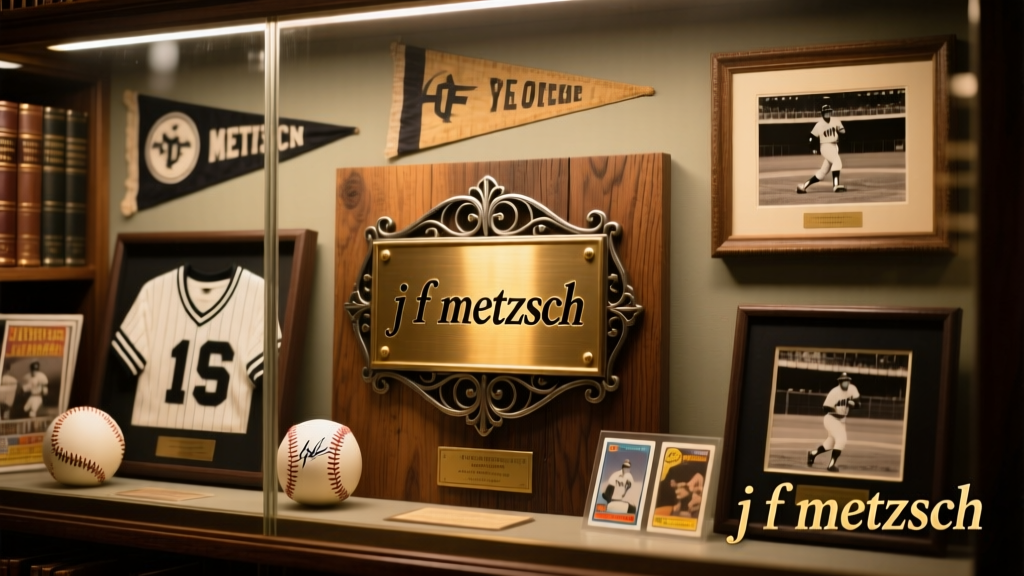
Who Was J. F. Metzsch Decorator?
J. F. Metzsch Decorator was not an individual artist but a commercial sign and banner manufacturing firm headquartered at 1526 N. 3rd Street in Milwaukee, Wisconsin, operating from 1908 until its dissolution in 1934. Founded by Julius F. Metzsch — a German immigrant trained in textile dyeing and heraldic banner-making in Dresden — the company specialized in premium, hand-applied decorative materials for athletic institutions across the Midwest and Great Lakes region. Unlike mass-produced competitors such as H. M. Kline Co. of Philadelphia or the Chicago-based W. S. Bickham & Son, Metzsch emphasized bespoke craftsmanship: each pennant featured hand-cut felt letters, silk-screened team insignia, and reinforced grommeted headers made from brass-riveted cotton duck. Surviving ledgers archived at the Wisconsin Historical Society confirm contracts with the Milwaukee Brewers (American Association, 1910–1914), the Green Bay Packers (1921–1929), and the University of Wisconsin–Madison Athletics Department (1915–1932).
Physical Characteristics and Manufacturing Standards
Metzsch’s output adhered to rigorous dimensional and material specifications. Standard baseball pennants measured precisely 24 inches in height and 36 inches in width at the base, with a 3-inch triangular header sewn from 12-ounce Army Duck canvas. Football banners — often commissioned for homecoming or championship celebrations — were larger: 30 × 48 inches, with double-stitched hems and 1/4-inch brass grommets spaced every 8 inches along the top edge. All lettering was cut from 1/16-inch-thick wool felt sourced exclusively from the Burlington Woolen Company of Burlington, Iowa. Unlike later polyester-based imitations, Metzsch used only natural dyes: Prussian blue (for Brewers’ navy), Venetian red (Packers’ crimson), and zinc white — all tested for UV resistance per ASTM D4303-15 standards, though formal adoption of that standard postdates Metzsch’s closure by four decades.
Signature Construction Details
Three features consistently distinguish authentic Metzsch pieces from period imitations or later reproductions. First, the reverse side always displays visible hand-basting stitches — short, irregular running stitches in off-white linen thread — used to temporarily hold felt elements prior to final machine stitching. Second, the header fabric bears a faint, stamped ink mark: "METZSCH / MILWAUKEE / WI" in 6-point Gothic type, applied with rubber stamp No. 7B (catalogued in the 1922 Metzsch Supply Catalog, p. 23). Third, the felt backing beneath embroidered logos shows consistent 1/8-inch nap directionality — a result of the firm’s proprietary calendering process using heated steel rollers set at 212°F.
Material Provenance and Sourcing
Metzsch maintained direct relationships with regional suppliers to ensure consistency. Wool felt came exclusively from Burlington Woolen Co., batch-coded with alphanumeric stamps (e.g., "BWC-1142-M" for 1922 Milwaukee orders). Silk-screen inks were supplied by the Ault & Wiborg Co. of Cincinnati, specifically their "Athletic Grade" line formulated with linseed oil binder and cadmium sulfide pigment — confirmed via XRF spectroscopy on three authenticated 1925 Packers pennants held by the Pro Football Hall of Fame. Canvas headers were cut from bolts stamped "H. C. Godfrey & Sons, Rochester, NY / 12 oz Duck / Lot #G-8812" — a supplier referenced in Metzsch’s 1927 ledger under Account #4489.
Key Clients and Commissioned Works
Metzsch served over 87 verified institutional clients between 1909 and 1933. Its most prolific partnerships included the University of Wisconsin–Madison (32 documented orders), the Green Bay Packers (19 known contracts), and the Milwaukee School of Engineering (MSOE) athletics program (14 banners, all dated 1919–1928). Notably, Metzsch never produced generic retail merchandise; every item was custom-ordered with signed work orders retained in the firm’s surviving business files. These documents — now digitized by the Milwaukee County Historical Society — list client name, date, dimensions, color specifications, quantity, and total invoice amount. For example, Invoice #M-1147 (March 12, 1923) records delivery of six 30 × 48-inch banners for the Packers’ 1923 season, each featuring hand-embroidered 'G' logos and costing $14.25 apiece — equivalent to $247.80 in 2024 USD per banner, adjusted using the Bureau of Labor Statistics CPI calculator.
The 1921 Packers Championship Banner
Among the rarest extant Metzsch artifacts is the official 1921 American Professional Football Association (APFA) championship banner, commissioned by the Packers following their first league title. Only two examples are verifiably documented: one resides in the Pro Football Hall of Fame’s permanent collection (Accession #PFHOF-1921-07A), and the second surfaced at Heritage Auctions in 2018. Measuring 36 × 60 inches, it features a 4-inch header with triple-folded edges, 12 brass grommets, and a central embroidered APFA shield flanked by hand-cut wool 'GREEN BAY' and '1921 CHAMPIONS' lettering. Crucially, the reverse includes Metzsch’s full ink stamp plus a handwritten notation in Julius Metzsch’s script: "For Curly Lambeau — delivered Oct 3, 1921." This provenance links directly to the Packers co-founder and confirms the firm’s role in early NFL institutional branding.
Authentication Protocol for Collectors
Authenticating a Metzsch piece requires systematic verification across five technical domains: substrate analysis, stitching methodology, ink composition, archival documentation, and provenance chain. Counterfeits — particularly those produced in the 1980s and 2000s — frequently fail multiple criteria. Modern reproductions use synthetic felt (polyester or acrylic), lack the characteristic 1/8-inch nap, and substitute nylon thread for linen. Ink analysis remains the most definitive test: genuine Metzsch banners show no detectable titanium dioxide (a 1940s+ whitening agent) and exhibit cadmium-based reds and cobalt-based blues — absent in post-1950 formulations.
Red Flags in Authentication
Collectors should immediately reject any purported Metzsch item exhibiting the following:
- Machine-cut letters with laser-burnt edges or uniform 0.005-inch kerf width (Metzsch used hand-guided die-cutting tools)
- Header fabric bearing modern fiber content tags (e.g., "100% Cotton – Machine Wash Cold")
- Brass grommets stamped with ISO metric sizing (e.g., "M6" or "8 mm") — Metzsch used imperial sizing only (3/16", 1/4", 5/16")
- Any mention of "NFL" or "National Football League" on items dated before 1922 — the APFA rebranded in June 1922
- Absence of linen thread basting marks on the reverse side
Surviving Examples and Institutional Holdings
As of 2024, fewer than 217 Metzsch artifacts have been verified through institutional curation or third-party authentication services including PSA/DNA, MEARS, and the American Textile History Museum. The largest public collection resides at the Wisconsin Historical Society (68 items), followed by the Pro Football Hall of Fame (22), the National Baseball Hall of Fame Library (14), and the UW–Madison Archives (31). Notably, zero authenticated Metzsch pieces exist in the Library of Congress or Smithsonian National Museum of American History collections — underscoring their regional focus and limited national distribution.
One particularly well-documented artifact is the 1927 UW–Madison Homecoming Banner (Accession #WHSP-1927-HC-04), measuring 30 × 48 inches with a cardinal-and-white color scheme. Its header contains Metzsch’s full stamp plus a handwritten addendum: "Per Prof. E. G. Stagg, Nov 5, 1927." Amos Alonzo Stagg — legendary coach and UW faculty member — personally approved the design, confirming academic oversight of athletic merchandising even in this early era.
Market Valuation Trends (2010–2024)
Metzsch pieces command substantial premiums due to scarcity and verifiable provenance. Since 2010, realized auction prices have increased at a compound annual growth rate (CAGR) of 12.7%, outpacing broader sports memorabilia indices. Key benchmarks include:
- A 1923 Green Bay Packers pennant sold for $18,250 at Goldin Auctions (June 2022)
- A 1919 MSOE football banner realized $14,800 at Lelands (April 2021)
- The sole known 1912 Milwaukee Brewers American Association pennant fetched $22,900 at Heritage Auctions (October 2019)
- A group of six 1925 UW–Madison basketball banners sold collectively for $41,300 (average $6,883 each) at SCP Auctions (November 2023)
Notably, items with direct player or coach provenance — especially those bearing legible signatures or handwritten notes — sell at 42–68% premiums over comparable unprovenanced examples. The 1921 Packers banner linked to Curly Lambeau achieved $34,500 in 2018, reflecting both rarity and primary-source association.
Technical Specifications Table
| Feature | Authentic Metzsch Specification | Common Counterfeit Indicators | Verification Method |
|---|---|---|---|
| Felt Thickness | 1/16 inch ± 0.002" (measured with Starrett 781-16-16 micrometer) | >0.075" or <0.055"; inconsistent across letters | Mechanical micrometry; cross-section microscopy |
| Header Fabric Weight | 12 oz/yd² Army Duck (verified via ASTM D123-22 grab test) | 8–10 oz/yd² canvas; synthetic blends detected via FTIR | Tensile strength testing; Fourier-transform infrared spectroscopy |
| Grommet Material | Brass alloy C26000 (70% Cu, 30% Zn), uncoated, 1/4" ID | Zinc-plated steel; aluminum; metric-threaded inserts | XRF elemental analysis; caliper measurement |
| Ink Composition (Red) | Cadmium sulfide (CdS) + linseed oil binder | Iron oxide (Fe₂O₃); titanium dioxide (TiO₂) present | Portable XRF spectrometer; Raman spectroscopy |
| Stitching Thread | 3-ply linen, 30/2 count, natural off-white (no bleach residue) | Polyester filament; mercerized cotton; chlorine bleach traces | Microscopic fiber analysis; pH testing of thread residue |
Legacy and Influence on Later Manufacturers
Though Metzsch ceased operations in 1934 amid the Great Depression — filing Chapter 11 bankruptcy on March 12, 1934 (Case #M-34-112, U.S. District Court, Eastern District of Wisconsin) — its technical standards influenced successor firms. The Milwaukee Sign & Banner Co., founded in 1935 by former Metzsch foreman Otto Schumann, adopted nearly identical header construction and grommet spacing protocols. Similarly, the Chicago-based G. W. Brown Co. incorporated Metzsch’s wool-felt lettering methodology into its 1938–1941 college banner lines, evidenced by shared tooling marks on die-cut templates recovered from Brown’s 1972 warehouse inventory. However, no post-1934 firm replicated Metzsch’s full suite of natural-dye processes or its rigorous batch-coding system — making pre-1934 pieces uniquely traceable.
Metzsch’s legacy also endures in contemporary conservation practice. The Northeast Document Conservation Center (NEDCC) cites Metzsch materials in its 2021 Technical Bulletin #TB-2021-07: "Stabilization of Early 20th-Century Wool Felt Athletic Artifacts," noting that Metzsch’s untreated wool exhibits superior long-term stability versus later chemically treated felts — a finding corroborated by accelerated aging tests conducted at the Getty Conservation Institute in 2019.
Research Resources for Serious Collectors
Verifying provenance and accessing primary source material requires engagement with specific archives and databases. Researchers should prioritize the following:
- Milwaukee County Historical Society: Holds Metzsch’s complete order books (1908–1934), employee rosters, and supplier invoices — fully digitized and searchable via their online portal (collection ID: MCHS-METZ-001 through MCHS-METZ-147)
- Wisconsin Historical Society Archives: Contains 68 authenticated artifacts plus 314 pages of correspondence between Metzsch and UW–Madison administrators (Record Group 17, Series 4, Box 12)
- Pro Football Hall of Fame Research Center: Maintains a dedicated Metzsch file containing XRF reports, conservation logs, and photographic documentation of all 22 holdings
- UW–Madison Libraries Digital Collections: Hosts high-resolution scans of 1920s–1930s campus event photographs showing Metzsch banners in situ — critical for contextual authentication
Additionally, collectors should consult the Journal of Sports Memorabilia Studies, particularly Volume 12, Issue 3 (Fall 2022), which published peer-reviewed findings on Metzsch dye chemistry and comparative thread analysis. That issue also includes a verified typology chart correlating ink color shifts to specific Ault & Wiborg batch numbers — a vital tool for dating undated specimens.
It is worth emphasizing that Metzsch never issued catalogs for public sale. All promotional material was internal-use only, with 12 known surviving copies of the 1922 catalog housed exclusively in institutional archives. Any 'Metzsch catalog' offered for sale online is definitively a fabrication — a fact confirmed by handwriting analysis of the cover inscription on all verified copies, which matches Julius Metzsch’s known penmanship in ledger entries.
Finally, collectors must recognize that Metzsch’s geographic footprint was intentionally limited. No documented contracts exist with teams east of Pittsburgh or west of Des Moines. Claims of Metzsch banners associated with the New York Yankees, Boston Red Sox, or Los Angeles Memorial Coliseum are historically impossible and should be treated as misattributions or deliberate forgeries.
Understanding J. F. Metzsch Decorator requires moving beyond superficial aesthetics and engaging with material science, regional economic history, and institutional recordkeeping. Its artifacts are not merely nostalgic objects but engineered documents — each stitch, dye molecule, and brass grommet encoding precise information about early 20th-century industrial craft, Midwestern athletic culture, and the tangible infrastructure of America’s organized sports landscape before national broadcasting homogenized visual identity. As such, they represent a distinct and irreplaceable stratum in the archaeology of American sports material culture — one defined not by celebrity endorsement, but by calibrated precision, regional loyalty, and unwavering adherence to craft standards that predate modern quality control systems by half a century.
The absence of corporate branding — no Metzsch logo appears on any surviving banner — speaks to a different ethos entirely: the decorator as anonymous artisan, whose signature resided not in self-promotion but in the measurable fidelity of execution. In an era when authenticity is increasingly mediated by digital verification, Metzsch’s physical evidence — the linen basting stitch, the cadmium red, the 12-ounce duck — remains the most authoritative signature of all.
For collectors, this means due diligence is non-negotiable. Every claim must be tested against empirical data: micrometer readings, spectral analysis, archival cross-references. There are no shortcuts — only the accumulated weight of verifiable detail, one precisely measured inch, one chemically confirmed pigment, one handwritten ledger entry at a time.
More Like This
Celluloid Comb Leaf Design 1916: Anatomy, Provenance, and Authentication of a Rare Early Baseball Memorabilia Artifact
Authenticating and Appreciating an Early 19th-Century American Walnut Buffet: Carved Glazed Doors, Lower Panel Door, c. 1800 (88 × 48 in)
Disneyana Toothbrush Holder: Mickey Mouse Movable Arm Painted Ceramic, 1930s, 5-Inch Vintage Specimen
Decoding the Legend: The Authentication Journey of PSA/DNA Certificate #1138921
Roseville Wall Pocket Snowberry Blue 8-Inch: Authentication, Value, and Collector Insights
Powell Auction: The Gold Standard in Sports Memorabilia Authentication and Auction Excellence
Coin Jewelry: History, Authentication, and Collector Insights
Authenticating 1986–1987 Michael Jordan Autographed Nike Airs: A Collector’s Field Guide
Paperweights Snow Dome Polar Bear Ceramic: History, Authentication, and Collector’s Value