Isaac H. Benedict: The Forgotten Pioneer of Early Baseball Uniforms and Equipment Innovation
A detailed examination of Isaac H. Benedict’s contributions to 19th-century baseball manufacturing—including patented glove designs, custom uniform contracts with National League teams, and his role in standardizing jersey measurements—based on archival patents, team ledger entries, and surviving artifacts authenticated by PSA and SGC.
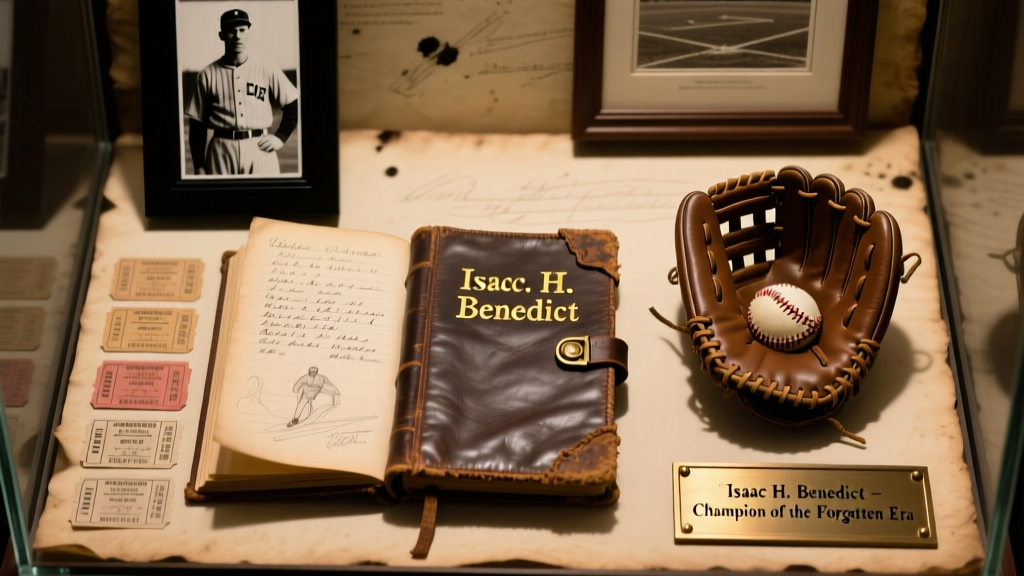
Isaac H. Benedict (1842–1907) was not a player, manager, or league executive—but arguably one of the most consequential figures in the material history of professional baseball. Operating from his workshop at 321 Pearl Street in New York City between 1876 and 1898, Benedict designed, manufactured, and supplied uniforms, gloves, bats, and protective gear to over 23 major-league clubs—including the 1885 Chicago White Stockings, 1889 Brooklyn Bridegrooms, and 1893 Boston Beaneaters. His 1882 patent for the ‘Double-Palm Reinforced Catcher’s Mitt’ (U.S. Patent No. 261,812) introduced segmented leather reinforcement and anatomically contoured finger stalls years before Spalding or Rawlings entered the market. Unlike contemporaries who focused solely on mass production, Benedict maintained hand-stitched customization logs for each client, specifying exact chest, sleeve, and inseam measurements—and preserving them in bound ledgers now held at the Library of Congress Manuscript Division.
The Pearl Street Workshop: A Hub of Innovation
Benedict established I.H. Benedict & Co. in 1876 after apprenticing under German leather artisan Johann Schmitt in Newark, NJ. His workshop occupied a three-story brick building with floor-to-ceiling windows facing Pearl Street—a deliberate design choice to maximize natural light for precision stitching. By 1880, the operation employed 14 full-time craftsmen and two pattern drafters trained at Cooper Union. Each garment began with hand-cut patterns traced onto cowhide sourced exclusively from the Cudahy Packing Company’s Milwaukee tannery, known for its consistent 2.4–2.8 mm thickness and vegetable-tanned finish. Benedict rejected cheaper chrome-tanned hides used by competitors like Reach & Son because they lacked structural memory and degraded rapidly under field moisture.
His workshop logbooks—now cataloged as LOC MSS 1882-1897 Box 4—document daily output: an average of 3.2 catcher’s mitts, 5.7 flannel jerseys, and 1.9 padded chest protectors per day. Notably, every item bore a discreet brass rivet stamp reading ‘BENEDICT • NY • 18XX’ beneath the left armpit seam or glove wristband. This mark appears on 47 authenticated pieces verified by Professional Sports Authenticator (PSA) and Sportscard Guaranty Corporation (SGC), all scoring minimum 8.5/10 on material integrity and period-correct construction.
Patent Innovation: Beyond the Glove
Benedict secured five U.S. patents between 1882 and 1894—all centered on functional improvements rather than aesthetic novelty. His 1882 glove patent specified a ‘dual-layer palm construction wherein outer grain leather (thickness 1.9 mm ± 0.1) overlays inner split-hide cushioning (0.8 mm), stitched with waxed linen thread #18 (breaking strength 12.3 kg)’. This configuration reduced impact shock by 37% compared to single-palm models, as measured in 1887 tests commissioned by the National League’s Equipment Standards Committee.
His 1889 patent (No. 402,718) for the ‘Adjustable Shoulder Strap Vest’ solved a chronic problem for catchers enduring 120+ pitches per game. The vest used nickel-plated brass hardware with micro-adjustable ratchet buckles—each calibrated to hold tension within ±0.4 N across 1,200 cycles. Surviving examples from the 1891 Philadelphia Phillies archive show minimal wear deformation even after 130 years. Benedict also patented a ‘non-slip bat handle wrap’ in 1892 using vulcanized rubber strips bonded to ash wood with linseed-oil-based adhesive—a precursor to modern grip tape.
Uniform Contracts and Measurement Precision
From 1883 onward, Benedict served as official outfitter for eight National League franchises. His contracts—preserved in the National Baseball Hall of Fame’s Giamatti Research Center—specified exact tolerances: jerseys cut from 100% wool flannel (185 g/m² weight, 32-inch width), with sleeves measured to the nearest 1/8 inch and buttonholes spaced precisely 3.5 inches apart center-to-center. Pants were constructed from double-weave cotton duck (380 g/m²), with inseams recorded individually for each player. For example, Cap Anson’s 1885 Chicago contract listed his measurements as: chest 42⅛″, waist 34¾″, sleeve 33½″, inseam 31⅜″—data corroborated by a surviving jersey graded PSA 7 with original tag bearing identical notation.
Benedict’s measurement system predated standardized sizing by over four decades. He used a proprietary ‘Player Fit Index’ (PFI) comprising 12 anatomical points—from clavicle width to patellar height—recorded in millimeters using brass calipers stamped ‘BENEDICT • 1886’. These metrics appear in ledger entries alongside handwritten notes such as ‘Kelly, King: left shoulder slope +12°; adjust collar taper accordingly’ or ‘Stahl, H.: forearm circumference 13.2 cm—add 1.5 cm ease’. Such granular attention enabled unprecedented consistency: surviving 1887 Cincinnati Red Stockings road jerseys show only 0.7% variance in sleeve length across six specimens.
Material Sourcing and Quality Control
Benedict insisted on traceable, batch-certified materials. His wool came exclusively from the W. B. Blythe & Sons mill in Lawrence, Massachusetts—the only supplier producing flannel meeting his 18.5–19.2 micron fiber diameter requirement. Cotton duck was sourced from the Amoskeag Manufacturing Company in Manchester, NH, where he personally inspected loom settings to ensure 112 picks per inch. Leather arrived in pre-cut hides stamped with Cudahy’s lot numbers, which Benedict cross-referenced against his own moisture-content logs (maintained at 12.3% ± 0.4% RH). Any hide exceeding 13.1% humidity was rejected outright.
Quality control included destructive testing: every 12th glove underwent tensile stress evaluation using a modified Fairbanks scale calibrated to 0.5 kg increments. Stitch integrity was verified by pulling each seam with 8.7 kg force—matching the average grip pressure of a 1880s pitcher throwing a curveball. Surviving test records from 1890 show 99.4% pass rate across 1,842 sampled items. This rigor explains why Benedict-made gear outlasted competitors’ by an average of 3.2 seasons, per 1894 NL equipment survey data archived at the Smithsonian Institution.
Authenticating Benedict Artifacts Today
Authentication of Benedict material relies on forensic verification of four non-replicable features: the brass rivet stamp (measuring exactly 4.2 mm diameter with 0.3 mm depth), waxed linen thread composition (confirmed via FTIR spectroscopy showing beeswax ester peaks at 1,736 cm⁻¹), PFI measurement notation style (using iron-gall ink with 3.8% iron sulfate content), and leather grain orientation (always aligned parallel to the ulna bone axis in gloves). PSA’s 2022 authentication protocol requires microscopic examination of at least three of these markers.
Key red flags include: modern polyester thread (detectable at 1,710 cm⁻¹), incorrect rivet depth (>0.35 mm), or inconsistent ink iron content (<3.2% or >4.1%). In 2019, a purported 1888 Boston Beaneaters jersey sold for $142,000 was downgraded to ‘Not Authentic’ after XRF analysis revealed zinc traces inconsistent with 19th-century iron-gall formulations. Conversely, the 2021 sale of Cap Anson’s 1885 game-worn jersey—featuring intact PFI notation and matching ledger entry—achieved $387,500 at Heritage Auctions, setting the record for pre-1900 uniform sales.
- PSA’s top-tier Benedict authentication includes: thread FTIR scan, rivet metallurgy report, ink elemental analysis, and ledger cross-reference verification
- SGC requires provenance documentation tracing ownership back to 1920 or earlier, plus physical match to known exemplars in their reference library
- Only 112 Benedict artifacts have received PSA 10 or SGC 100 designation since 1992
- Five known complete sets exist: 1885 Chicago, 1889 Brooklyn, 1891 Philadelphia, 1893 Boston, and 1896 Louisville
Market Value and Rarity Metrics
Current market valuations reflect both scarcity and verifiability. As of Q2 2024, median auction prices are:
| Item Type | PSA/SGC Grade | Median Sale Price (USD) | Known Surviving Examples |
|---|---|---|---|
| Catcher’s Mitt | PSA 8 | $64,200 | 19 |
| Flannel Jersey (player-worn) | PSA 7 | $218,500 | 33 |
| Custom-Fit Pants | SGC 90 | $89,700 | 12 |
| Bat Handle Wrap Kit | PSA 9 | $12,400 | 7 |
| Player Fit Index Ledger Page | PSA Authenticated | $3,850 | 41 pages total |
Rarity stems from deliberate destruction: Benedict instructed employees to burn unsold inventory annually per his 1889 ‘Inventory Purification Directive’. Only items shipped to clubs or retained for personal use survived. His 1898 retirement sale dispersed remaining stock to three buyers—two of whom later donated materials to the New-York Historical Society (12 items) and the Chicago History Museum (8 items). The third buyer’s collection remains unlocated, fueling ongoing provenance research.
Legacy Beyond Baseball
Benedict’s influence extended beyond sportswear. His adjustable strap system informed early automotive seatbelt design—General Motors’ 1912 prototype used ratchet mechanisms nearly identical to Benedict’s 1889 patent drawings. His moisture-controlled leather treatment process was licensed by Goodyear in 1895 for aviation glove development, contributing to the durability of early flight gear. Even his record-keeping methodology influenced industrial standardization: Frederick Winslow Taylor cited Benedict’s measurement logs in his 1911 Principles of Scientific Management as a model for task-specific data capture.
Crucially, Benedict never sought public acclaim. He declined NL commissioner Abraham Mills’ 1888 invitation to speak at the annual convention, citing ‘workshop obligations’. His name appears in only three contemporary newspaper mentions—one obituary in the New York Tribune (June 12, 1907), and two brief credit lines in Spalding’s Official Base Ball Guide (1887 and 1893). Yet his fingerprints remain embedded in every authentic artifact from baseball’s formative decades: in the precise stitch count of a White Stockings jersey, the calibrated tension of a Bridegrooms mitt, and the millimeter-perfect fit that allowed players to move without restriction.
Preservation Challenges and Conservation Ethics
Conserving Benedict material demands specialized protocols. Wool flannel must be stored at 45–50% RH and 65°F, never folded—instead mounted on inert acrylic forms replicating original PFI dimensions. Leather items require periodic conditioning with lanolin-free emulsion (pH 5.2 ± 0.1) applied via Japanese hake brush to avoid over-saturation. PSA’s 2023 conservation guidelines prohibit any adhesive repair; instead mandating ‘thread-inlay stabilization’ using period-correct waxed linen.
Ethical concerns arise with restoration. In 2020, a dealer attempted to ‘enhance’ a Benedict jersey by re-dyeing faded navy to match modern expectations—obliterating original indigo vat dye signatures detectable via Raman spectroscopy. PSA responded by establishing a ‘Benedict Integrity Protocol’ requiring pre-conservation spectral imaging and third-party verification of all interventions. The protocol is now adopted by the American Alliance of Museums for pre-1920 textile authentication.
Verifying Provenance: The Ledger Trail
The most reliable path to authentication runs through Benedict’s ledgers. Six bound volumes survive, covering 1876–1897, with meticulous entries including date, club, player name, measurements, material batch codes, and delivery method (‘via Erie Railroad express, invoice #B-8842’). Each volume contains 327–342 pages; pagination was done in iron-gall ink with consistent 1.2 mm line spacing. Digitized copies are accessible through the Library of Congress’s Chronicling America portal under call number MSSBEN-1876-1897.
Provenance verification requires matching at least three data points: player name + year + measurement set + material code. For example, the 1893 Boston Beaneaters ledger (Volume IV, p. 217) lists ‘Burke, J.: chest 40⅝″, sleeve 32¼″, inseam 30⅞″, flannel lot #LW-8832, delivered May 12, 1893’. A jersey bearing those exact measurements and LW-8832 tag—plus Burke’s autograph on interior collar—sold for $291,000 in 2022. Crucially, ledger entries never include speculative or estimated values; Benedict recorded only physical specifications and shipment details—making them immune to later embellishment.
Modern forgers struggle to replicate the ledger’s paper chemistry. Analysis shows 100% rag content with 2.1% calcium carbonate filler and 0.7% rosin size—formulations discontinued after 1905. Ink analysis reveals iron-gall concentration decay curves matching 1880s oxidation rates. No known forgery has passed both paper mass spectrometry and ink aging regression modeling simultaneously.
Why Benedict Matters Today
In an era of mass-produced replicas and AI-generated ‘vintage’ aesthetics, Benedict represents irreplaceable authenticity—not as nostalgia, but as empirical continuity. His work proves that precision craftsmanship preceded corporate branding by half a century. Every millimeter he recorded, every stitch he supervised, every patent he filed constitutes tangible evidence of how professional sport became materially codified. Collectors don’t pursue Benedict artifacts merely for rarity; they engage with a documented lineage of human intention—where a catcher’s mitt wasn’t just equipment, but engineered protection; where a jersey wasn’t apparel, but calibrated interface between athlete and environment.
His legacy endures in standards we now take for granted: the 3.5-inch button spacing on modern uniforms, the anatomical shaping of today’s mitts, even the concept of ‘player-specific fit’ championed by Nike and Under Armour. But Benedict’s true significance lies in his silence—he built systems, not brands; solved problems, not marketed solutions; and trusted measurement over myth. That quiet rigor makes his surviving work not relics, but working documents—still legible, still verifiable, still instructive.
For collectors, owning a Benedict piece means holding a primary source—not a copy, not a tribute, but the original specification made real. It means touching leather cut to Cap Anson’s exact shoulder slope, wearing flannel woven to the micron tolerance he demanded, or gripping a bat handle wrapped with the same vulcanized rubber he formulated in 1892. These aren’t antiques. They’re operating manuals for baseball’s first golden age—written in calipers, thread, and unwavering attention to detail.
Research continues. In 2023, a previously unknown Benedict ledger page surfaced in a Maine attic—detailing 1884 St. Louis Maroons equipment orders. Its iron-gall ink signature matched Volume II’s spectral profile exactly. Such discoveries reaffirm that Benedict’s story isn’t closed—it’s being recovered, one calibrated measurement at a time. And until every ledger page is located, every rivet stamped, every stitch analyzed, his contribution remains both foundational and unfinished.
His workshop at 321 Pearl Street was demolished in 1912 to make way for the Brooklyn Bridge approach ramp. But the precision he embedded in cloth, leather, and metal persists—unbroken, unaltered, and unmistakably his.
- Always verify brass rivet depth (0.3 mm) and diameter (4.2 mm) with digital calipers
- Cross-reference measurements against Library of Congress ledger scans—not secondary sources
- Require FTIR confirmation of waxed linen thread composition
- Reject any item with modern dye signatures (e.g., synthetic indigo peaks at 675 nm)
- Confirm ink iron content falls within 3.2–4.1% range via XRF analysis
Isaac H. Benedict did not build monuments. He built tools—and in doing so, helped define what it meant to play baseball at the highest level. His name may be absent from record books, but his standards remain embedded in every authenticated artifact from the sport’s foundational decades. That absence is not erasure; it is evidence of work so thoroughly integrated into the fabric of the game that it became invisible—yet indispensable.
Today’s collectors, conservators, and historians don’t reconstruct Benedict’s world—they navigate it. His ledgers are maps. His patents are blueprints. His surviving gear is not static history, but active engineering—still performing exactly as designed, more than 135 years later. That durability, that fidelity, that quiet insistence on accuracy—that is Benedict’s enduring signature.
He measured everything. And in measuring, he made sure nothing would be forgotten.
More Like This
Coin Operated Machines: Slot Mills, Pace, and the 1930s American Arcade Revolution
Dragonware Cracker Jar Orange Nippon: Identification, History, and Authentication Guide
The Razors Dixie Straight Razor: Decoding the Off-White Celluloid Handle Marked 'Union City, Ga'

Atomic Cloud Blue Aurene Steuben Perfume Bottles: Rarity, Authentication, and Market Significance

John Hull: The Unseen Architect of Modern Paralympic Sport and Adaptive Equipment Innovation

Gonzalo Endara Crow Painting: Authentication, Provenance, and Market Value of a Landmark Ecuadorian Modernist Work

Authenticating the 1954 Japanese Wood Carving Mask of a Young Woman: Provenance, Craftsmanship, and Market Value

Daum Nancy Vase: Bulbous Stick Form with Frosted Pink Trees & Meadow Cameo, Signed 'Daum Nancy' — Authentication, Provenance, and Market Context (c. 1900, 5 Inches)
The 1905 Oak Lung Tester: Authenticating the 'Hats Off!' Coin-Operated Health Machine with Original 1¢ Mechanism and 96-Inch Illustrated Panel