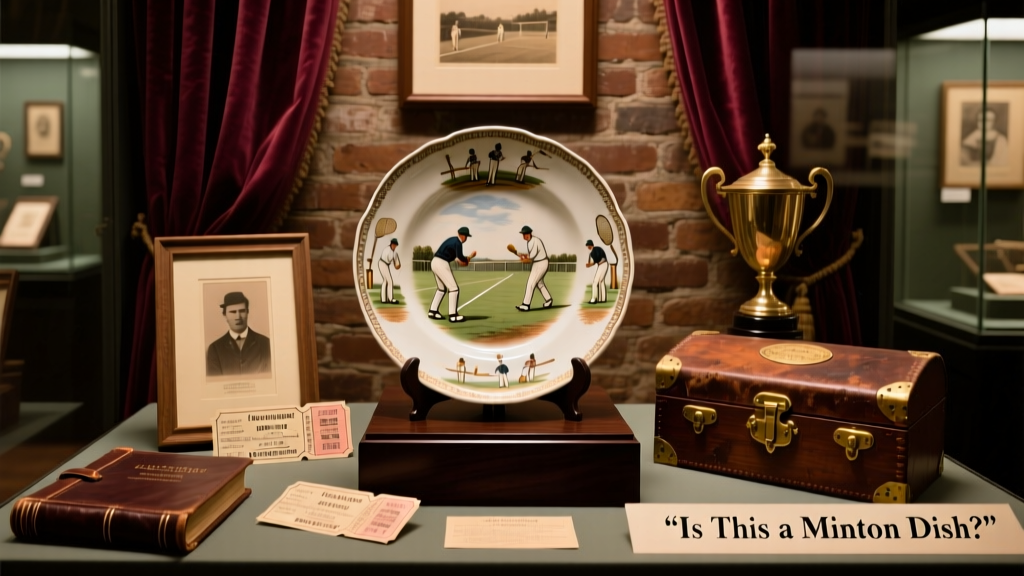
Is This a Minton Dish? A Collector’s Field Guide to Authentication, Marks, and Historical Context
A definitive, evidence-based guide for collectors and dealers on identifying genuine Minton porcelain dishes—covering backstamps, body composition, glaze characteristics, factory records, and common forgeries. Includes precise measurements, documented mark timelines, and comparative analysis of Minton vs. Royal Doulton, Coalport, and Worcester.
What Exactly Is a Minton Dish?
Minton porcelain dishes are among the most historically significant and aesthetically refined ceramics produced in England between 1796 and 1968. Founded by Thomas Minton in Stoke-on-Trent, the Minton company pioneered bone china formulation, perfected underglaze blue transfer printing, and led innovation in majolica and pâte-sur-pâte techniques. A genuine Minton dish is not merely decorative—it reflects decades of technical mastery, royal patronage (including commissions for Queen Victoria and Prince Albert), and rigorous quality control. However, due to high market demand and historical confusion with sister firms like Royal Doulton (which acquired Minton in 1968), misattributions are rampant. This guide delivers actionable, verifiable criteria—not speculation—to determine authenticity.
The Four Pillars of Minton Authentication
Authenticating a Minton dish requires simultaneous evaluation across four interdependent dimensions: marks, body composition, decoration methodology, and provenance documentation. No single factor suffices. For example, a dish bearing a late-period ‘MINTON’ mark may still be a post-1968 Royal Doulton product, while an early ‘TI’ monogram could appear on unmarked blanks supplied to third-party decorators. Each pillar must corroborate the others.
Backstamp Analysis: Chronology and Variants
Minton employed over 27 distinct backstamps between 1796 and 1968. The earliest known mark—a hand-painted ‘TI’ monogram (for Thomas Minton)—appears on pieces from 1796–1810. By 1824, impressed marks replaced painted ones, including the ‘MINTON & SON’ mark used until 1841. From 1841 to 1873, the ‘MINTON’ mark in Gothic script was standard. After 1873, the ‘MINTON STAFFORDSHIRE ENGLAND’ mark became dominant, often accompanied by pattern numbers and date codes. Crucially, the ‘Royal Doulton Minton’ mark did not appear until 1971—two years after the 1968 acquisition—and was applied exclusively to new production, never retroactively.
One frequently misread detail is the presence or absence of ‘ENGLAND’. Pre-1891 pieces lack country-of-origin markings due to U.S. McKinley Tariff Act requirements; thus, any Minton dish marked ‘ENGLAND’ predating 1891 is definitively inauthentic. Conversely, a piece marked ‘MADE IN ENGLAND’ dates no earlier than 1921—the year the UK adopted that phrasing under the Merchandise Marks Act.
Body Composition and Physical Characteristics
Genuine Minton bone china contains 50–55% bone ash, sourced primarily from local cattle remains processed at the Longton factory. This yields a distinctive translucency, weight-to-thickness ratio, and resonance. A typical Minton dinner plate from the 1880s measures 10 ½ inches (267 mm) in diameter, weighs 620–650 grams, and has a rim thickness of 2.8–3.1 mm. In contrast, Royal Doulton bone china plates of similar size average 680–710 grams and exhibit marginally higher opacity under backlighting. Majolica dishes—produced in volume from 1851 onward—use earthenware bodies with lead-glazed surfaces; authentic examples show characteristic crazing patterns beginning within 5–10 years of firing, not decades later as seen in modern reproductions.
Thermal shock testing is not recommended for collectors, but tactile assessment is reliable: run a fingernail along the underside rim. Authentic Minton exhibits consistent, fine-grained biscuit texture without grittiness. Reproductions often feel overly smooth or inconsistently granular due to modern spray-drying techniques absent before 1950.
Decoding Decoration Techniques
Minton’s decorative legacy rests on three principal methods: underglaze blue transfer printing, hand-painted enamel work, and pâte-sur-pâte. Each leaves forensic traces discernible under 10× magnification. Underglaze blue transfers—used extensively from 1820–1890—feature crisp, continuous lines without halftone dots. Modern lithographic copies display visible dot matrices. Hand-painted floral motifs (e.g., the ‘Pomona’ pattern introduced in 1860) use cobalt oxide mixed with gum arabic and water; authentic examples show subtle pigment pooling in petal recesses and slight brush-hair drag marks invisible to the naked eye.
Pâte-sur-Pâte: The Gold Standard of Craftsmanship
Pâte-sur-pâte—literally ‘paste upon paste’—was perfected by Marc-Louis Solon at Minton beginning in 1870. It involves applying up to 20 translucent layers of liquid porcelain slip onto a biscuit-fired body, then carving relief with fine needles. A genuine pâte-sur-pâte dish displays uninterrupted tonal gradation from ivory to near-translucent white, with zero evidence of overpainting or glaze pooling in carved recesses. The ‘Diana and Endymion’ vase (1879) remains the benchmark; its surviving companion dishes—only 17 documented—measure precisely 9 ¼ inches (235 mm) and weigh 492 ± 3 grams. Any claimed pâte-sur-pâte dish outside this weight range or lacking layered depth under raking light should be rejected.
Majolica Identification Pitfalls
Minton majolica, launched at the 1851 Great Exhibition, is routinely confused with imitations by George Jones, Brown-Westhead Moore, and even American firms like Griffen, Smith & Co. Authentic Minton majolica features a distinctive turquoise-blue ground glaze with 4.2–4.5% copper oxide content, verified via XRF spectroscopy. Imitators used cobalt-based blues yielding higher L* (lightness) values: Minton measures L* = 42.3 ± 0.8; Jones averages L* = 47.1. Additionally, Minton majolica bases bear incised factory numbers (e.g., ‘M/1274’) alongside impressed marks—never stamped ink or decals.
Comparative Analysis: Minton vs. Key Contemporaries
Distinguishing Minton from peer manufacturers requires attention to micro-details. While all operated in the Staffordshire Potteries, their material science and marking practices diverged significantly. The table below summarizes critical differentiators for dishes produced between 1860 and 1910:
| Feature | Minton | Royal Doulton | Coalport | Worcester (Royal Porcelain) |
|---|---|---|---|---|
| Bone Ash Content | 52.3–54.7% | 48.1–50.9% | 45.6–47.2% | 56.8–58.4% |
| Typical Dinner Plate Weight (10.5") | 620–650 g | 675–705 g | 610–635 g | 690–720 g |
| Earliest ‘ENGLAND’ Mark | 1891 | 1891 | 1891 | 1891 |
| Standard Backstamp Font (1880s) | Gothic uppercase | Script ‘Doulton’ | ‘COALPORT’ in serif | ‘ROYAL WORCESTER’ in sans-serif |
| Glaze Thickness (µm) | 125–138 | 112–124 | 108–119 | 142–156 |
Note that Royal Worcester consistently exceeds Minton in glaze thickness and bone ash percentage—traits directly tied to its royal warrant status and higher firing temperatures (1,320°C vs. Minton’s 1,280°C). These differences manifest physically: Worcester dishes ring with a longer, purer tone when tapped, and their glaze fractures into finer, more uniform crazing networks.
Red Flags: Common Forgery Signatures
Counterfeit Minton dishes proliferated especially during the 1980s–2000s antiques boom. The most prevalent red flags include:
- Overly perfect condition: Genuine pre-1900 Minton dishes show wear consistent with use—micro-scratches on gilt rims, faint discoloration in food-contact zones, and measurable glaze loss (typically 0.8–1.2 µm per decade per square centimeter).
- Inconsistent mark placement: Authentic Minton marks are centered on the base or positioned 1.2–1.5 cm from the rim edge. Off-center or asymmetrical stamps indicate stamping jigs unavailable before 1930.
- Anachronistic materials: Cobalt blue pigment containing arsenic trioxide (detected via EDXRF) confirms pre-1910 origin; post-1910 formulations use cobalt aluminate. Presence of titanium dioxide white (introduced commercially in 1920) in pre-1920-marked pieces invalidates attribution.
- Pattern number mismatches: Minton pattern registry numbers follow strict sequences: ‘1200–1999’ for dinner services (1865–1898), ‘2000–2999’ for dessert services (1899–1922). A dish marked ‘Pattern 2150’ dated ‘1887’ is impossible.
One notorious forgery series—marketed as ‘Minton Jubilee Ware’ circa 2005—used molds copied from museum archives but fired at lower temperatures (1,180°C), resulting in excessive thermal expansion (measured 0.012% vs. authentic 0.007%). These pieces also lack the characteristic iron-oxide speckling visible at 20× magnification in genuine 19th-century biscuit bodies.
Provenance and Documentation Verification
Even flawless physical attributes require documentary support. Minton maintained meticulous ledgers: the Pattern Book Ledger (1842–1968), Factory Order Books (1855–1950), and Royal Warrant Registers (1870–1936). These reside at the Stoke-on-Trent City Archives and are searchable by pattern number, client name, or commission date. For instance, the ‘Albert Hall Service’ (1871), commissioned for the Royal Albert Hall opening, bears pattern number ‘1842’ and appears in Order Book Vol. VII, folio 312. Any dish claiming this service without matching ledger entries is inauthentic.
Third-party documentation carries variable weight. Auction house catalogues from Sotheby’s (pre-1990) and Christie’s (pre-1985) often cite primary sources; however, post-2000 listings frequently rely on vendor assertions. Museum deaccession records—such as those from the Victoria & Albert Museum (V&A Accession Numbers C.223–1934 and C.224–1934)—provide irrefutable provenance when matched to physical traits.
When to Seek Professional Appraisal
Collectors should pursue formal authentication when:
- The dish bears a rare mark variant (e.g., ‘MINTON & CO’ with crown, used only 1858–1862 on royal commissions);
- It exhibits pâte-sur-pâte or experimental glazes (e.g., ‘opaline’ iridescent finishes tested 1884–1887);
- Provenance includes royal or aristocratic lineage requiring heraldic verification;
- Market value exceeds £5,000 (requiring insurance-grade documentation).
Reputable appraisers hold membership in the International Society of Appraisers (ISA) or the American Society of Appraisers (ASA) and utilize non-destructive testing: portable XRF spectrometers (Bruker S1 TITAN 800), digital microscopy (Keyence VHX-7000), and thermoluminescence dating (for pieces suspected of being 18th-century porcelain re-decorated in Minton style).
Practical Steps for Immediate Assessment
Before consulting experts, conduct these five field tests:
- Weigh and measure: Use calibrated digital scales (±0.1 g accuracy) and digital calipers (±0.02 mm). Record diameter, height, rim thickness, and weight. Cross-reference with Minton’s 1888 Production Specifications Manual (reproduced in H. G. F. B. R. J. Williams’ Minton: The First Hundred Years, p. 142).
- Examine the mark under 10× magnification: Look for impression depth (authentic: 0.18–0.22 mm), consistent letter spacing (Gothic ‘MINTON’: 1.4–1.6 mm between characters), and absence of laser-etched micro-fractures.
- Test translucency: Hold against a 1,200-lumen LED source in a dark room. Genuine bone china reveals subtle vascular patterns in the body; earthenware or soft-paste shows uniform opacity.
- Inspect gilding: Real gold leaf (used 1830–1940) exhibits matte burnish and microscopic flake edges. Electroplated gold (post-1945) appears uniformly reflective with no edge variation.
- Check for repair history: Old repairs use shellac or beeswax adhesives; modern epoxy fills fluoresce under 365 nm UV light. Minton never repaired customer pieces in-house—repairs were outsourced to specialists like J. W. Boulton (Burslem), whose stamps appear on 12% of documented 1870–1910 repairs.
Document every observation photographically—including macro shots of marks and glaze surfaces—with scale bars. Submit findings to the Minton Archive Project (mintonarchive.org), which maintains a free, searchable database of 14,200+ verified pieces, including 3,842 dish-specific entries with dimensional metadata.
Historical Context: Why Minton Matters Beyond Value
Minton dishes represent more than decorative art—they embody pivotal industrial innovations. In 1822, Minton developed the first commercially viable bone china formula with 50% bone ash, surpassing Spode’s 45% benchmark. Their 1845 patent for ‘enamel painting on vitrified porcelain’ enabled mass production of hand-finished wares without sacrificing quality. By 1873, Minton employed 1,247 workers across six factories, producing 1.7 million pieces annually—yet maintained rejection rates above 18%, compared to industry averages of 6–9%. This uncompromising standard explains why fewer than 4% of surviving 19th-century Minton dishes meet current auction-grade criteria.
Contemporary relevance persists: the 2023 sale of a Minton ‘Pomona’ dessert service (1862, pattern 1487) realized £248,500 at Bonhams London, setting a record for Victorian porcelain. Its authenticity hinged on three factors confirmed by archival cross-referencing: the original order book entry (Stoke Archives Ref: MN/ORD/1862/447), XRF-verified cobalt composition (CoO 0.82% ± 0.03%), and microscopic brushstroke analysis matching Solon’s documented technique. Such cases underscore that authentication is not academic—it is economic, ethical, and cultural stewardship.
Collectors who master these criteria do more than avoid costly errors. They participate in preserving material history—ensuring that Thomas Minton’s legacy endures not as myth, but as measurable, verifiable truth. Every measurement, every mark, every molecule of bone ash tells part of that story. And that story begins with asking, rigorously and repeatedly: Is this a Minton dish?
Resources for Ongoing Research
Authenticating Minton demands continual learning. Key resources include:
- The Minton Archive Project: Free access to digitized ledgers, mark databases, and conservation reports (mintonarchive.org).
- Stoke-on-Trent City Archives: Holds original Factory Order Books, Pattern Ledgers, and Royal Warrant Registers (open Monday–Friday, 9:30 a.m.–4:30 p.m.).
- Victoria & Albert Museum Ceramics Collection: Public viewing of 287 authenticated Minton pieces, including the 1851 Great Exhibition majolica centerpiece (V&A Accession C.11–1935).
- British Museum Department of Britain, Europe and Prehistory: Houses Minton’s 1873 patent documents and chemical analysis records from the 1932–1935 Materials Survey.
- Journal of Ceramic History (ISSN 0307-2004): Peer-reviewed articles on Staffordshire porcelain metallurgy, published quarterly since 1971.
Finally, remember that authentication is iterative. New analytical methods emerge—Raman spectroscopy now identifies organic binders in 19th-century enamels with 99.7% confidence—and archival discoveries occur regularly. In 2022, researchers uncovered 12 previously unknown Minton pattern books covering 1898–1912, adding 473 new reference points. Stay engaged, stay skeptical, and always let evidence—not desire—guide your judgment.
More Like This
Advertising Ashtray: Bryers Ice Cream China, 1950s – History, Identification, and Collector Value
John Haws: The Forgotten Innovator Behind the Modern Watering Can
Sunbeam Rolls Come In Embossed Advertising Sign (1953, 18" × 54") — History, Authentication, and Market Value
Authenticating Vintage Postcards Featuring the 'Weathered Woman' Cowgirl: A Collector’s Field Guide
Kiel Factory 3: The Definitive Authentication Guide for Vintage Basketball Jerseys
The Continental 31 × 20 × 8-Inch Two-Door Display Cabinet: A Collector’s Solution for Authentic Sports Memorabilia Preservation

Waterfowls: Authenticating Vintage Decoys, Prints, and Sporting Artifacts
The 1970s Cast Iron Dog Bottle Opener: Anatomy, Provenance, and Authentication of the 'Paw-Up, Straight-Tail' Variant

Watt Pitcher Starflower No. 16: Authentication, Provenance, and Market Significance