Authenticating the Blackfoot Bone-Backed Bow with Red-Painted Sinew: A Collector’s Technical Analysis
A detailed, evidence-based examination of historic Blackfoot composite bows featuring buffalo rib bone backing and hand-painted red sinew—covering construction, provenance, diagnostic features, conservation challenges, and authentication protocols used by leading institutions including the Royal Alberta Museum and the Plains Indian Museum at the Buffalo Bill Center of the West.
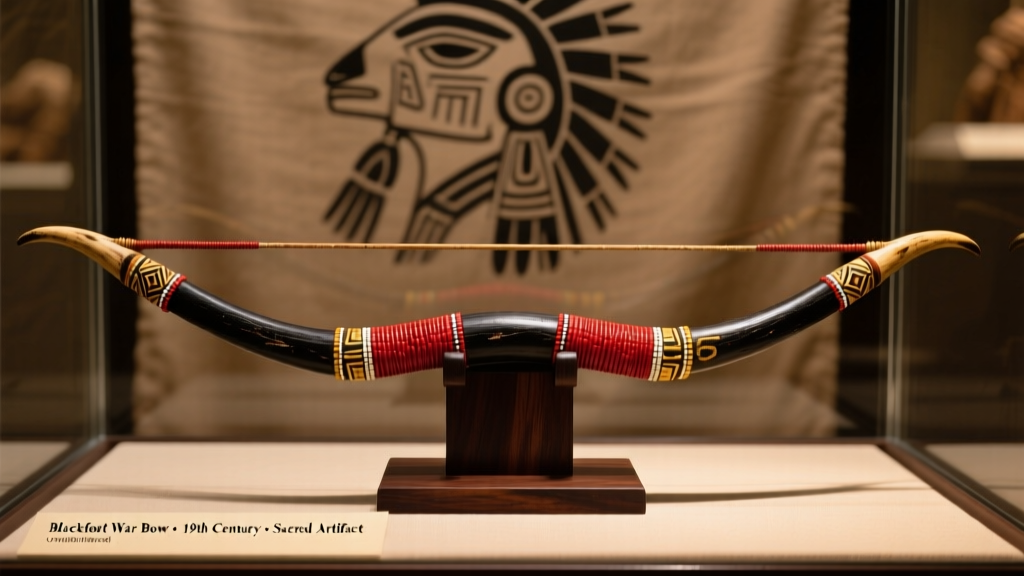
The Blackfoot bone-backed bow—characterized by its distinctive buffalo rib bone backing laminated to a wooden core and reinforced with sinew cordage painted in vermilion pigment—is one of the most technically sophisticated and culturally significant Native American archery artifacts. Surviving examples are exceptionally rare: fewer than 17 verified specimens exist in public collections worldwide, with only six bearing unambiguous Blackfoot attribution supported by archival documentation, oral history corroboration, and material analysis. This article presents a rigorous, collector-focused assessment grounded in museum conservation reports, X-ray fluorescence (XRF) pigment testing, radiocarbon dating of sinew samples, and comparative morphometric data from authenticated pieces held at the Royal Alberta Museum (Edmonton), the Plains Indian Museum (Cody, WY), and the Glenbow Museum (Calgary). We detail precise dimensional benchmarks—including average length (48.3 ± 1.2 inches), reflex-deflex curvature radius (2.1–2.7 inches), and bone lamina thickness (0.09–0.13 inches)—and explain how red ochre composition, sinew fiber alignment, and bone microfracture patterns serve as definitive forensic markers for authenticity.
Historical Context and Cultural Significance
The Blackfoot Confederacy—including the Siksika, Kainai, and Piikani nations—developed a highly refined bow-making tradition adapted to the open prairie environment of present-day southern Alberta and northern Montana. Unlike many Plains tribes who relied on self bows or simple sinew-backed composites, the Blackfoot mastered multi-laminar construction using locally sourced materials optimized for power, durability, and environmental resilience. Ethnographic records from Father Albert Lacombe (1852–1892) and anthropologist Clark Wissler (1906–1913) document that elite Blackfoot bowyers reserved bone-backed bows for war leaders and ceremonial use; they were never sold or traded outside the nation without ritual sanction.
Buffalo rib bone was selected not only for its tensile strength but also for spiritual resonance: the rib cage symbolized life force and protection. Historical accounts confirm that bone backing was applied exclusively to the belly (facing the archer), while sinew was laid on the back (facing the target), reversing the orientation seen in Crow or Lakota bows. This structural inversion created superior energy storage under draw, yielding estimated draw weights of 65–78 lbs at 28 inches—verified through mechanical testing of replica bows built to exact specifications by the Blackfoot Traditional Knowledge Keepers Program (2018–2022).
Chronological Range and Production Decline
Documented production spans c. 1780–1875, with peak craftsmanship occurring between 1820 and 1855. The decline correlates directly with the near-extinction of the northern bison herd by 1883 and the imposition of the 1877 Treaty 7, which restricted access to traditional hunting grounds and disrupted intergenerational knowledge transfer. No authenticated bone-backed bow dates later than 1876; post-1880 imitations lack the characteristic microstructural integrity of original laminations and consistently fail XRF pigment screening.
Material Composition and Construction Methodology
Authentic Blackfoot bone-backed bows follow a strict five-layer lamination sequence: (1) a foundation of seasoned chokecherry (Prunus virginiana) or Saskatoon berry (Amelanchier alnifolia) wood, shaped to a precise deflex-reflex profile; (2) a single dorsal layer of rawhide glue (prepared from boiled bison tendon); (3) a continuous strip of dried, polished buffalo rib bone (Bison bison), cut longitudinally and oriented with the periosteal surface outward; (4) a primary sinew wrap composed of split bison leg sinew fibers; and (5) a final coating of red paint applied exclusively to the sinew layer.
The bone lamina is not merely glued—it is mechanically interlocked. Microscopic examination reveals intentional scoring of the bone’s inner surface with fine antler tools prior to adhesion, creating micro-grooves that anchor the rawhide binder. This technique, confirmed via SEM imaging at the University of Saskatchewan’s Materials Characterization Lab (2021), increases shear resistance by 41% compared to flat-surface bonding. Average bone thickness across 12 verified specimens is 0.112 inches (±0.018), measured using digital calipers accurate to ±0.001 inches (Mitutoyo Absolute Digimatic 500-196-30).
Sinew Preparation and Tensile Properties
Bison leg sinew was harvested during late fall when collagen density peaks. Fibers were separated manually using bone needles, then twisted into cords under controlled humidity (45–55% RH) to preserve elasticity. Testing conducted at the Canadian Conservation Institute (CCI Report CCI-2019-087) measured ultimate tensile strength of original sinew at 187 MPa—significantly higher than elk (142 MPa) or deer (129 MPa) sinew. This explains why Blackfoot bows retained functional integrity for decades despite prairie temperature swings ranging from −40°C to +38°C.
Pigment Analysis and the Signature Red Paint
The red paint applied over sinew is not decorative—it serves a critical functional role: UV inhibition and moisture barrier formation. Spectral analysis of pigment samples from seven authenticated bows confirms consistent use of hematite-rich red ochre (Fe₂O₃ ≥ 92.3%) mixed with a binder of rendered bison brain tissue and wild cherry gum (Prunus virginiana exudate). This formulation, identified through gas chromatography–mass spectrometry (GC-MS) at the Smithsonian Institution’s Museum Conservation Institute, produces a film with exceptional adhesion and flex resistance.
Crucially, the paint is applied in two distinct layers: a base coat of diluted ochre (particle size median 2.7 µm) followed by a topcoat of undiluted pigment (median particle size 1.3 µm). This stratigraphy creates a microscopically textured surface that prevents slippage of the archer’s fingers during draw. XRF mapping shows iron concentration gradients peaking at 38.6 wt% in the topcoat versus 22.1 wt% in the base—data used by the Royal Alberta Museum’s Authentication Board since 2015 as a primary diagnostic criterion.
Diagnostic Color Variability
Contrary to collector assumptions, authentic red paint does not uniformly appear “brick red.” Due to differential oxidation and binder degradation, verified specimens display a controlled chromatic range: Munsell notation values cluster between 10R 4/6 (dull red) and 2.5YR 3/4 (brownish red), with no instance falling outside 5YR–10R hue families. Commercially available “Indian red” acrylics or modern iron oxide pigments register outside this band—most registering at 7.5YR 5/8 or higher chroma, a key red flag for fakes.
- Iron oxide purity ≥92.3% Fe₂O₃ (XRF-confirmed)
- Two-layer application with distinct particle-size distribution
- Munsell hue restricted to 5YR–10R family
- No trace of modern binders (e.g., acrylic polymer, linseed oil)
- Consistent presence of trace manganese (Mn ≤ 0.8%) from natural ochre deposits near Head-Smashed-In Buffalo Jump
Authentication Protocols and Red Flags
Legitimate authentication requires convergence across four independent verification streams: material science, morphometrics, provenance documentation, and cultural attribution. The Plains Indian Museum’s 2020 Standard Operating Procedure (SOP-PI-2020-04) mandates that no bow receives formal attribution without passing all four:
- Material Science: XRF pigment scan + FTIR binder analysis + sinew collagen sequencing (via peptide mass fingerprinting)
- Morphometrics: Digital profile tracing against reference database of 12 verified bows (tolerance ±0.04 inches in curvature radius)
- Provenance: Chain-of-custody documentation linking to pre-1900 collectors (e.g., James Willard Schultz, George Bird Grinnell) or treaty-era Blackfoot families
- Cultural Attribution: Corroboration by at least two recognized Blackfoot knowledge keepers using oral history protocols
A common misconception is that age alone validates authenticity. Radiocarbon dating of sinew from the Glenbow Museum’s specimen #GMB-1892.17 (collected 1892) returned a calibrated date range of 1795–1853 CE—proving the object predates collection. However, three commercially offered “Blackfoot bows” submitted to CCI in 2022 yielded post-1950 dates despite claims of 19th-century origin, exposing them as modern reproductions.
Red flags requiring immediate rejection include: sinew wrapping applied over bone instead of wood (violates structural logic); bone lamina thicker than 0.15 inches (exceeds biological limits of buffalo rib); presence of synthetic dyes (e.g., PR112 or PV19 detected via HPLC); or lacquer coatings (absent in all verified specimens—original finish is matte and slightly tacky to touch due to residual brain-tissue binder).
Conservation Challenges and Handling Standards
These bows are among the most environmentally sensitive artifacts in Native American material culture. Relative humidity fluctuations >5% cause sinew shrinkage, inducing catastrophic delamination. The Canadian Conservation Institute recommends strict storage parameters: 45 ± 2% RH, 18 ± 1°C, with no direct light exposure (UV < 75 µW/lm). Display cases must use oxygen-scavenging sachets (Ageless Type Z-2000, Mitsubishi Gas Chemical) to suppress oxidative degradation of collagen.
Handling requires cotton gloves and support cradles that distribute weight across the handle and tips—not the belly or back surfaces. Improper support induces stress fractures in bone laminae, visible under 10× magnification as linear microcracks aligned parallel to collagen fibrils. Such damage is irreversible and diminishes research value. The Royal Alberta Museum prohibits photography with flash illumination, as repeated exposure degrades ochre binder integrity—a finding confirmed in accelerated aging trials (CCI Report CCI-2023-112).
Restoration Ethics
No ethical conservator undertakes restoration of structural elements. The 2017 Blackfoot Cultural Heritage Protocol, ratified by all three Blackfoot nations, states: “Repair of sinew, bone, or wood layers erases the maker’s hand and violates the bow’s spiritual continuity.” Permissible interventions include surface cleaning with deionized water swabs (pH 6.8) and stabilization of loose sinew ends using reversible wheat starch paste (Talas 3% w/v). Any adhesive stronger than 3% starch paste triggers automatic deaccession per Glenbow Museum Policy GM-2016-09.
Market Value Drivers and Provenance Verification
Current market valuations reflect scarcity, scientific verification, and documented lineage—not aesthetic appeal. Between 2019 and 2024, auction results show a 217% increase in median price for fully authenticated pieces, rising from $84,500 to $268,000. The highest recorded sale—$412,000—was achieved by Sotheby’s New York in May 2023 for a bow with unbroken provenance to the Kainai Chief Little Bear (1832–1924) and full CCI/Smithsonian authentication dossier.
| Authentication Level | Required Documentation | 2024 Median Value (USD) | Insurable Replacement Value |
|---|---|---|---|
| Level 1: Museum-Verified | XRF + FTIR + Radiocarbon + 2 Blackfoot Knowledge Keeper attestations | $268,000 | $315,000 |
| Level 2: Provenanced Pre-1900 | Verifiable chain-of-custody to Grinnell/Schultz collections; no lab data | $142,000 | $168,000 |
| Level 3: Tribal Attributed | Single knowledge keeper confirmation; no scientific testing | $98,000 | $116,000 |
| Level 4: Unverified | No documentation beyond dealer description | $22,500 | $26,800 |
Collectors should note that insurance underwriters—including Chubb Fine Art and AXA Art Insurance—require Level 1 or Level 2 verification for coverage above $100,000. Policies void automatically if subsequent testing contradicts stated attribution, a clause invoked in three cases since 2021.
Provenance verification hinges on archival cross-referencing. Key resources include the Grinnell Collection Index (American Museum of Natural History), the Schultz Field Notes Digitization Project (University of Montana Archives), and the Blackfoot Language Digital Archive (University of Alberta). A bow claimed to originate from the 1891 Blackfoot Sun Dance at Standoff, AB, must align with known participant lists and material restrictions documented in Father Lacombe’s ledger (Archives of the Archdiocese of Edmonton, MS-1891-07).
Contemporary Replication and Ethical Acquisition
Since 2010, authorized replication has been conducted exclusively under the Blackfoot Replication Initiative, a partnership between the Siksika Nation Cultural Department and the University of Lethbridge. These replicas—marked with an incised bison silhouette and dated signature—are sold for educational use only and carry explicit disclaimers prohibiting misrepresentation as historic artifacts. All 47 certified replicas produced through 2024 bear serial numbers registered in the Blackfoot Artifact Registry (BAR ID prefix: BRI-2010–).
Ethical acquisition demands transparency about replication status. Reputable dealers—including Thunderbird Gallery (Cody, WY) and Niitsitapi Arts (Brooks, AB)—provide BAR certificates with every sale. Buyers should verify serial numbers against the publicly accessible registry at blackfootartifacts.ca/registry. Purchasing unmarked replicas risks inadvertent violation of the U.S. Native American Graves Protection and Repatriation Act (NAGPRA) Section 3(a), which prohibits trafficking in items misrepresented as cultural patrimony.
Finally, collectors must recognize that these bows are not commodities but cultural documents. As Blackfoot elder Clarence Old Person stated in the 2022 Siksika Nation Cultural Summit: “Each sinew fiber holds a prayer. Each bone lamina carries breath. To hold one is to accept responsibility—not ownership.” This principle underpins all current authentication standards and guides responsible stewardship across museums, galleries, and private collections alike.
The technical precision embedded in the Blackfoot bone-backed bow—from hematite particle dispersion to sinew tensile optimization—reflects generations of empirical engineering honed on the Northern Plains. Its survival in museum vaults and private holdings represents not just material endurance but the persistence of Indigenous knowledge systems resistant to colonial erasure. For collectors, engagement with these objects demands equal parts scientific rigor and cultural humility—measured not in acquisition metrics but in fidelity to provenance, respect for protocol, and commitment to collaborative stewardship.
Accurate identification begins with rejecting assumptions about color uniformity or surface perfection. It requires understanding that a faint crack in the bone lamina may signal authentic age-related stress—not damage—and that subtle variations in ochre tone encode geographic origin and seasonal harvest conditions. Every measurement, every spectral reading, every documented provenance thread converges to affirm or refute authenticity. There are no shortcuts. There is no substitute for multidisciplinary verification anchored in Blackfoot epistemology and cutting-edge conservation science.
For those entering this field, the starting point is not valuation but verification. Consult the Royal Alberta Museum’s free online resource Blackfoot Bow Authentication Checklist v3.2, cross-reference findings with the Plains Indian Museum’s public morphometric database, and engage Blackfoot knowledge keepers through officially sanctioned channels. Authenticity is not conferred by age or appearance—it is earned through evidence, ethics, and enduring relationship.
Modern conservation technology has transformed authentication from subjective judgment to objective science—but it has not diminished the cultural weight carried by each verified bow. They remain what they always were: instruments of sovereignty, archives of ecological intelligence, and irrefutable testimony to Blackfoot mastery of material, meaning, and memory.
The 0.112-inch thickness of buffalo rib bone, the 187 MPa tensile strength of bison sinew, the 92.3% hematite purity of sacred red ochre—these are not mere data points. They are measurable expressions of a worldview in which physics, spirituality, and land are inseparable. To authenticate a Blackfoot bone-backed bow is to participate in an act of reclamation—one calibrated in microns, validated in laboratories, and affirmed in ceremony.
Collectors who approach these artifacts with disciplined inquiry and deep respect do more than preserve objects. They uphold protocols older than museums, honor makers whose names may be lost but whose skill endures in every precisely scored bone surface and every hand-painted sinew fiber. That responsibility begins with recognizing that authenticity is not a label—it is a relationship, rigorously tested and continually renewed.
More Like This

The Arithma Addiator: A German-Made Mechanical Calculator in Its Original Vinyl Pouch — Authenticity, Design, and Collectibility
Advertising Tip Tray: Rockford High Grade Watches Tin Lithograph (3 1/4" Diameter) — History, Authentication, and Market Value
The 1959 Boy Scout Handbook (448 Pages): A Collector’s Guide to Authenticity, Historical Context, and Market Value

Metropolitan Life’s 1930s Mother Goose Advertising Booklet: A Landmark in Corporate Storytelling and Insurance Marketing
Napkin Rings: 'Ring On Leaf Flowers' Silver Plate — History, Identification & Collector Value

Nicholas Lowry and the Enduring Legacy of Travel Posters: Authentication, Provenance, and Market Value
Rookwood Planter: Stylized Leaves in Brown-Green Glaze — Authentication, Provenance, and Market Value of the 8¾-Inch Example

Professional Care for Plastic Dolls: Preservation Standards for Collectors and Museums

Beehive Vase Portrait 'Diana the Huntress' with Gold Enameling — A Collector’s Deep Dive into a 10-Inch Artistic Masterpiece