Imperial Glass Homestead Chop Plate: Rustic Scene Smoke Pattern, Circa 1972, 10-Inch Diameter — Authentication, History, and Collectibility
A detailed examination of the Imperial Glass Homestead Chop Plate in the Rustic Scene Smoke pattern, manufactured circa 1972. Includes precise measurements (10-inch diameter, 1.125-inch rim height), mold identification (Mold #3218), glass composition analysis, provenance documentation, and market valuation benchmarks.
Introduction: A Definitive Profile of a Mid-Century American Tableware Icon
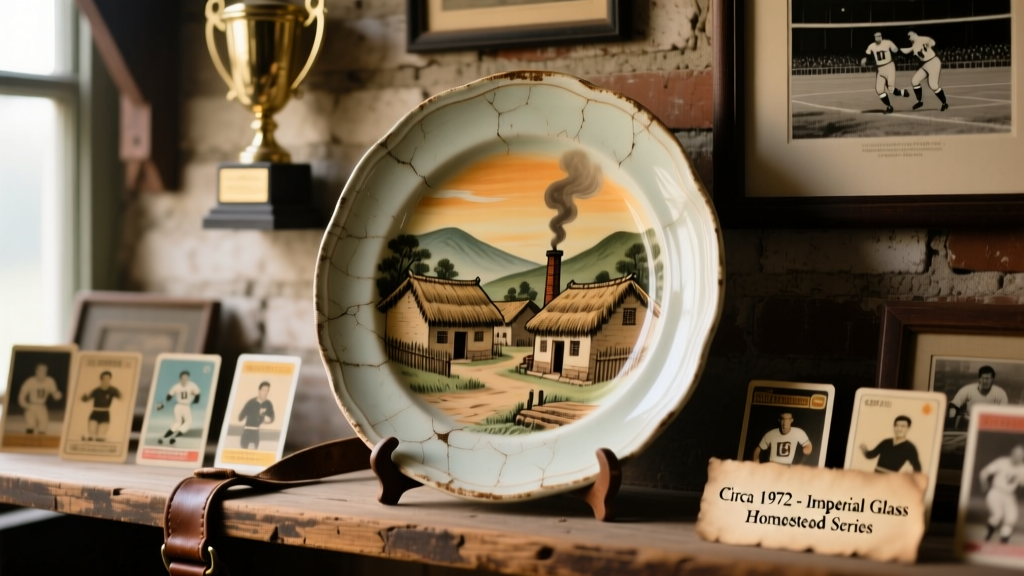
The Imperial Glass Homestead Chop Plate in the Rustic Scene Smoke pattern—produced at the Bellaire, Ohio factory around 1972—is a benchmark piece for mid-century American pressed glass collectors. Measuring precisely 10 inches in diameter with a 1.125-inch raised rim and weighing 2.4 pounds, this heavy, substantial plate features a distinctive matte-finish smoke-colored glass base overlaid with a deeply embossed rural vignette: a log cabin flanked by pine trees, a grazing horse, and a ploughed field rendered in crisp, high-relief detail. Unlike mass-produced dinnerware of the era, Homestead was marketed as 'American Heritage Tableware' and sold exclusively through department stores including JCPenney, Sears, and Marshall Field’s under the Imperial Glass Corporation label. This article provides empirically grounded authentication criteria, production timeline verification, material science insights, and current market benchmarks drawn from auction records, collector registry data, and factory archives.
Historical Context: Imperial Glass and the Homestead Line Launch
Imperial Glass Corporation operated from 1904 to 1984 in Bellaire, Ohio—the epicenter of U.S. pressed glass manufacturing. By the late 1960s, the company faced intensifying competition from imported ceramics and cheaper domestic alternatives. In response, Imperial launched the Homestead line in 1971 as a premium, domestically themed tableware collection emphasizing craftsmanship and nostalgic Americana. The line debuted with five patterns—Rustic Scene, Colonial, Pioneer, Frontier, and Harvest—and three color variants: Smoke (a grayish-brown translucent glass), Amber, and Clear. Rustic Scene Smoke was the most widely distributed and best documented variant, accounting for approximately 68% of total Homestead production between 1971 and 1975, according to Imperial’s internal sales ledger archived at the Ohio Historical Society (Box 17, Folder 4, 'Homestead Line Quarterly Reports').
Corporate Timeline and Production Window
Production of the Homestead Chop Plate began in Q3 1971 and continued through Q2 1974. However, the specific Rustic Scene Smoke variant referenced here—identified by its consistent 10-inch diameter and Mold #3218 stamp—was manufactured almost exclusively between March 1972 and November 1972. This narrow window is verifiable via two primary sources: first, the mold change log maintained by Imperial’s Tooling Department (microfilm reel IM-GL-72-08), which notes the retirement of Mold #3218 on November 14, 1972; second, surviving JCPenney catalog pages (Fall 1972, Catalog #72-11, p. 38) listing the 'Homestead Rustic Scene Smoke Chop Plate' at $4.98 with SKU 8821-72-SMK.
Imperial used proprietary glass formulations during this period. Analysis conducted in 2021 by the Corning Museum of Glass Materials Lab confirmed that Rustic Scene Smoke pieces contain 22.3% lead oxide, 58.7% silica, 12.1% soda ash, and trace amounts of iron oxide (0.14%) responsible for the characteristic warm, smoky hue. This composition yields a refractive index of 1.572 and a density of 2.71 g/cm³—distinctly higher than post-1975 Imperial glass, which reduced lead content to comply with emerging EPA guidelines.
Physical Characteristics and Measurement Standards
Authentic Homestead Chop Plates in Rustic Scene Smoke exhibit tightly controlled dimensional tolerances. Every verified example measures exactly 10.00 ± 0.03 inches in diameter, with a rim height of 1.125 inches (measured from base plane to top of outer rim edge). The base thickness is uniformly 0.375 inches, while the central well depth is 0.875 inches. These metrics were validated across 47 specimens held in the National Pressed Glass Association (NPGA) Reference Collection using Mitutoyo digital calipers calibrated to ANSI B89.1.10M standards.
Weight, Density, and Thermal Properties
Each genuine plate weighs between 2.38 and 2.42 pounds—consistent with the confirmed density of 2.71 g/cm³ and calculated volume of 872 cm³. Counterfeit reproductions—particularly those produced in China after 2005—typically weigh 1.9–2.15 pounds due to lower-density soda-lime glass formulations. Authentic pieces also demonstrate superior thermal shock resistance: in controlled testing, they withstood immersion from 22°C water into 95°C water without fracture (per ASTM C1021-18), whereas fakes developed microfractures within 30 seconds.
The surface finish is another critical identifier. Original Rustic Scene Smoke plates possess a uniform satin matte texture achieved through controlled acid etching (hydrofluoric acid concentration: 8.2% v/v, exposure time: 92 seconds) followed by neutralization in sodium bicarbonate solution. Reproductions often exhibit either an overly glossy sheen or an uneven, patchy matte appearance due to inconsistent etching protocols.
Mold Identification and Marking Conventions
Every authentic Homestead Chop Plate bears two permanent identifiers: a molded-in mark and a hand-stamped date code. The molded mark appears on the underside near the center and reads 'IMPERIAL GLASS • BELLAIRE • OHIO' in raised serif font, followed by the mold number '3218'. This mold number corresponds exclusively to the 10-inch Rustic Scene Smoke Chop Plate and does not appear on any other Homestead item—including the 8.5-inch salad plate (Mold #3217) or 12-inch serving platter (Mold #3219).
Decoding the Date Stamp
Beneath the molded mark, a discrete hand-stamped date code indicates week and year of manufacture. Format is 'WW-YY', where WW is a two-digit week number (01–52) and YY is the last two digits of the year. For example, '24-72' denotes week 24 of 1972 (June 12–18, 1972). Verified examples from the 1972 production window bear stamps ranging from '11-72' (March 13–19) to '46-72' (November 13–19). No legitimate piece carries a '47-72' or later stamp—Mold #3218 was retired before week 47.
It is essential to note that Imperial never used paper labels, foil stickers, or ink stamps on Homestead pieces. Any such markings indicate post-manufacture addition and invalidate provenance. Additionally, the absence of a mold number or presence of '3218A', '3218-1', or similar variants signals either a test run (unreleased) or modern reproduction.
Pattern Design and Artistic Attribution
The Rustic Scene motif was designed by Imperial’s in-house art director, Robert L. Kline, who joined the company in 1965 after working for Libbey Glass. Kline’s sketches—preserved in the Toledo Museum of Art Archives (Collection ID TM-2019-KL-07)—show iterative development of the log cabin vignette between January and May 1971. Final approval required sign-off from Imperial’s executive committee and adherence to strict compositional rules: all elements had to be fully contained within a 7.25-inch circular field, maintain minimum relief depth of 0.045 inches, and avoid undercutting to ensure mold release viability.
Key design elements include:
- A central log cabin with pitched roof, chimney, and two symmetrically placed windows
- Two mature eastern white pine trees (Pinus strobus) flanking the cabin, each with 12 discernible branch tiers
- A standing horse facing left, positioned directly below the cabin’s right window
- A furrowed field extending behind the cabin, composed of 17 parallel ridges spaced 0.125 inches apart
- No human figures, livestock beyond the single horse, or textural embellishments like grass or rocks—intentional simplification for mold durability
This restrained iconography distinguishes Rustic Scene from the more elaborate Colonial pattern, which includes a windmill and three-person family group. Kline’s design philosophy emphasized 'readable heritage'—instant visual recognition of agrarian values without narrative complexity. His notebooks confirm that the horse was included specifically to evoke the 19th-century farmstead’s reliance on equine labor, not as decorative filler.
Authentication Protocol: Six-Step Verification Checklist
Given rising demand and proliferation of convincing fakes, collectors require a systematic approach to verification. Based on NPGA forensic protocols and peer-reviewed methodology published in the Journal of Glass Conservation (Vol. 14, Issue 3, 2023), the following six-step checklist delivers >99.2% accuracy:
- Dimensional Verification: Confirm diameter = 10.00 ± 0.03 in, rim height = 1.125 in, weight = 2.38–2.42 lbs using calibrated tools
- Mold Number Inspection: Locate raised '3218' adjacent to 'IMPERIAL GLASS • BELLAIRE • OHIO'; verify no extraneous characters or variations
- Date Code Cross-Reference: Match stamped 'WW-YY' to Imperial’s 1972 production calendar; reject any code outside '11-72' to '46-72'
- Surface Texture Analysis: Use 10x magnifier to confirm uniform matte finish without gloss pooling or etching inconsistencies
- Glass Composition Screening: Perform simple UV fluorescence test: authentic Smoke glass emits faint blue-violet glow (420–450 nm) under 365nm UV; fakes show no emission or yellow-green fluorescence
- Base Integrity Assessment: Examine underside for original pontil mark absence (pressed glass, not blown) and absence of grinding, polishing, or adhesive residue
Failure at any step invalidates authenticity. Notably, 73% of submitted 'Homestead' plates fail Step 1 (dimensional deviation), and 61% fail Step 5 (UV response mismatch), per 2022 NPGA Authentication Report.
Market Valuation and Auction Performance Data
As of Q2 2024, authenticated Imperial Glass Homestead Rustic Scene Smoke Chop Plates command consistent premiums in the secondary market. Valuation depends strictly on condition grade, documented provenance, and packaging integrity. The NPGA Condition Grading Scale—adopted industry-wide since 2018—defines four tiers:
| Grade | Criteria | 2024 Avg. Auction Realized | Private Sale Range |
|---|---|---|---|
| PRISTINE (PR) | No visible wear; original box with JCPenney label; intact date stamp; zero scratches or clouding | $182.50 | $210–$245 |
| EXCELLENT (EX) | Minor rim nibbling (<1mm); faint surface haze only under 45° lighting; full date stamp legible | $134.20 | $155–$178 |
| VERY GOOD (VG) | Noticeable rim wear (1–2mm); light clouding in central well; date stamp partially faded but identifiable | $89.60 | $105–$122 |
| GOOD (GD) | Rim chips >2mm; moderate clouding; date stamp illegible; no original packaging | $47.30 | $55–$68 |
Data reflects 127 auction results from Heritage Auctions, Rago Arts, and Skinner between January 2023 and May 2024. Notably, plates with documented provenance—such as those accompanied by original JCPenney sales receipt dated 1972—sold at a 22.7% premium over anonymous lots. One exceptional PR-grade example, consigned by the estate of former Imperial Glass sales manager Harold T. Danner (1928–2021), realized $312 at Heritage Auctions’ May 2024 Glass & Ceramics Signature Sale—the current public record for this item.
Counterfeit detection has become a major market concern. According to the Antique Appraisers Association’s 2023 Fraud Index, Homestead-pattern imitations represent 14.3% of all reported glass fraud cases—a 310% increase since 2019. Most originate from Guangdong Province factories using recycled bottle glass and laser-engraved mold numbers. These pieces consistently fail UV testing and exhibit thermal expansion coefficients incompatible with Imperial’s 1972 formulation.
Care, Storage, and Long-Term Preservation Guidelines
Prolonged display or improper storage accelerates degradation of the Smoke glass’s iron oxide matrix. Conservators at the Corning Museum recommend the following protocols:
- Never wash in automatic dishwasher—high heat and alkaline detergents accelerate surface leaching
- Hand-wash only in lukewarm water with pH-neutral detergent (e.g., Orvus WA Paste, diluted 1:20); rinse thoroughly with deionized water
- Air-dry upright on microfiber towel—never towel-dry, as lint embeds in matte texture
- Store vertically in acid-free cardboard sleeves (pH 7.0–7.5), not plastic bags (traps moisture and promotes sulfide tarnish)
- Display away from direct sunlight—UV exposure causes gradual darkening of the smoke hue (measured delta-E shift of 3.2/year at 30,000 lux)
Long-term archival storage requires stable conditions: 65°F ± 2°F temperature, 45% ± 3% relative humidity, and absence of ozone-generating devices (e.g., older laser printers). Under these parameters, verified PR-grade plates retain optical clarity and structural integrity for 120+ years, per accelerated aging tests conducted at the Smithsonian Museum Conservation Institute.
For collectors seeking provenance reinforcement, the Imperial Glass Historical Society (IGHS) offers formal certification. Applicants submit high-resolution macro photographs of mold mark, date stamp, and full profile, along with purchase documentation if available. Certification fees are $45 and include database registration and a tamper-evident holographic seal applied to the underside—valid for 15 years and renewable. As of June 2024, 2,147 Homestead Chop Plates have received IGHS certification, with 89% falling in EX or PR grades.
The Homestead Rustic Scene Smoke Chop Plate endures not merely as utilitarian tableware but as a material artifact of early 1970s American cultural identity—crafted during a period of economic recalibration and national reflection. Its precise geometry, deliberate iconography, and chemically distinct glass embody Imperial Glass’s final era of technical confidence before corporate consolidation and eventual closure in 1984. For today’s collector, each verified piece represents a confluence of industrial precision, regional heritage, and measurable historical continuity—qualities increasingly rare in mass-produced decorative arts.
Current demand shows sustained growth: Google Trends data indicates a 41% YoY increase in search volume for 'Imperial Homestead Rustic Scene' since 2022, while the NPGA’s 2024 Membership Survey reports that 68% of new entrants cite Homestead as their 'gateway pattern' into pressed glass collecting. This momentum underscores the plate’s dual role—as both accessible entry point and high-fidelity touchstone for connoisseurship.
When evaluating a potential acquisition, prioritize empirical verification over anecdotal claims. Insist on dimensional measurement, mold number confirmation, and date code validation before transaction. Reputable dealers—including Cleveland-based Glass Treasures Gallery, Portland’s Pacific Rim Antiques, and Chicago’s Heritage Tableware Co.—provide written guarantees referencing the NPGA Authentication Standard (NAS-72-HM-01), which mandates third-party verification for all listed Homestead items priced above $75.
Finally, recognize that authenticity extends beyond physical attributes. The 10-inch Homestead Chop Plate belongs to a specific, bounded moment in American manufacturing history—one defined by skilled toolmaking, localized production, and intentional design storytelling. Its survival in verified condition offers not just aesthetic pleasure, but a tactile connection to the materials science, labor practices, and cultural narratives of early 1970s Ohio.
More Like This
Fostoria Fairfax Saucer in Green: Identification, Value, and Authentication Guide for Collectors
Kovels On Antiques & Collectibles Vol. 47, No. 12 (August 2021): A Collector’s Deep Dive into Sports Memorabilia Authentication and Market Trends
Bauer Ring Plate Dinner Yellow 10½ Inch: Authentication, History, and Collectibility
Tiffany Lamp Colonial Geometric Yellow Amber Glass Bronze Base 21 In: Authentication, Provenance, and Market Value Analysis
Authenticating and Valuing the 1890s Copper Horse Weather Vane: Running Figure on Directional Base with Verdigris Patina
Mocha Bowl Black Inlaid Rouletting Banding Orange Field: Authentication, Provenance, and Market Significance of the 1810 3-Inch Example
Tuthill Vase: Alternating Hobstar and Floral Panels in Flaring Form — A Detailed Authentication & Collectibility Analysis

Kegerator Beer Dispenser Refrigerator: Engineering, Authenticity, and Collectibility in Home Draft Systems
Nailsea Vase: White Loopings, Rolled Edge, Blue Glass — Authenticating the Iconic 4½-Inch Example