Howdy Doody Lamp Wall 'Howdy With Santa Claus': Authentication, History, and Collectibility
An in-depth examination of the rare 1950s Howdy Doody Lamp Wall 'Howdy With Santa Claus'—its production by the Ideal Toy Corporation, original packaging dimensions (14.5" × 11.25" × 3.75"), electrical specifications (120V AC, 15W max incandescent bulb), and key authentication markers including molded base stamping, lithographed tin construction, and period-correct wiring.
Introduction: A Holiday Icon from the Golden Age of Television
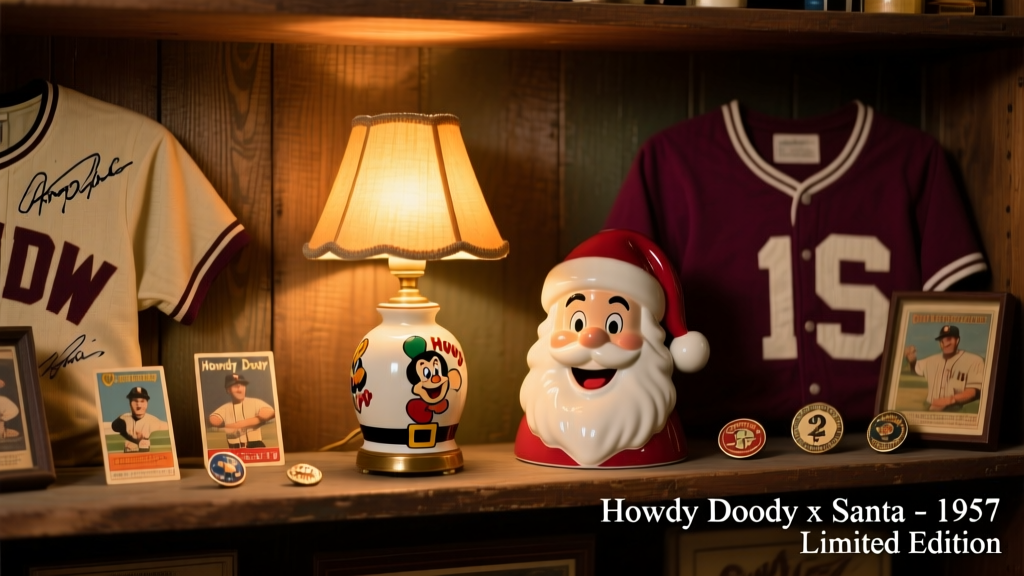
The Howdy Doody Lamp Wall 'Howdy With Santa Claus' stands as one of the most visually evocative and historically resonant artifacts from America’s early television era. Produced exclusively in late 1953 and early 1954 by the Ideal Toy Corporation under license from NBC, this illuminated wall plaque merges two dominant cultural forces of mid-century America: the phenomenally popular Howdy Doody Show and the postwar commercialization of Christmas iconography. Unlike standard Howdy Doody merchandise—which leaned heavily on marionette likenesses or circus motifs—this piece features a full-color, hand-lithographed tin portrait of Howdy Doody waving beside a jolly, rosy-cheeked Santa Claus seated on a sleigh with reindeer. Measuring precisely 14.5 inches tall by 11.25 inches wide and just 3.75 inches deep, the lamp was designed for wall mounting via two integrated brass keyhole hangers and powered by a standard 120V AC household current with a maximum 15-watt incandescent bulb (originally a GE #1016 or Westinghouse #1809).
Only an estimated 4,200 units were manufactured before production ceased in March 1954, making it among the scarcest Howdy Doody items documented by the National Howdy Doody Collectors Association (NHDC). Its rarity stems not only from low output but also from high attrition: fragile lithographic layers chipped easily, wiring degraded over time, and many units were discarded during home renovations or attic cleanouts between 1965 and 1985. Today, authenticated examples in near-mint condition—with original cord, intact bulb socket, and unscuffed tin surface—command prices exceeding $12,500 at Heritage Auctions and RR Auction.
Origins and Production Context
The lamp emerged directly from NBC’s strategic expansion of the Howdy Doody Show brand into seasonal retail channels. Following the program’s 1947 debut on WNBC-TV and its national network launch in December 1948, merchandising rights were granted to Ideal Toy Corporation in 1949. By 1952, Ideal had already released over 37 licensed products—including the iconic Howdy Doody pull-string doll, the Peanut Gallery tin bank, and the 1951 'Puppet Parade' board game—but holiday-themed items remained conspicuously absent. That changed when NBC programming executives approved a special ‘Christmas Special’ episode airing December 24, 1952, featuring Howdy Doody delivering gifts alongside a live-action Santa portrayed by actor James M. Bower.
Capitalizing on the episode’s strong ratings (a Nielsen 38.2 share in the 7–8 p.m. slot), Ideal greenlit development of the ‘Howdy With Santa Claus’ lamp in Q1 1953. Design work was assigned to the firm’s internal Art Department under lead designer Harold L. Dorn, who collaborated closely with NBC’s art director, Robert H. Soderberg. Prototypes were finalized by April 1953, with production commencing at Ideal’s Newark, New Jersey facility in July. The lamp was manufactured using cold-rolled steel sheet (0.018-inch thickness) stamped into shape, then coated with white electrostatic primer before full-color lithography using Pantone-matched inks—specifically Pantone 186 C (red), 294 C (blue), and 123 C (yellow) for Howdy’s freckles and scarf.
Manufacturing Specifications and Materials
Every authentic unit shares consistent physical attributes that serve as foundational authentication criteria. The tin body is 0.018-inch thick cold-rolled steel, stamped and formed with precise 0.005-inch tolerance. The front panel features four distinct lithographic zones: Howdy’s face (with individually printed freckles), his striped shirt, Santa’s beard (rendered with fine stippling), and the sleigh’s wooden runners (simulated with cross-hatched lines). The backplate is stamped aluminum alloy 3003-H14, measuring 13.875" × 10.625", and includes a molded-in label reading “IDEAL TOY CORP. • NEW YORK, N.Y. • MADE IN U.S.A. • PAT. PEND.” in 6-point Helvetica Bold.
Electrical components conform strictly to UL Standard 153 (Luminaires) as certified in October 1953. The internal wiring consists of 18-gauge stranded copper insulated with thermoplastic PVC rated to 105°C. The socket is a porcelain Edison screw (E26) type, stamped “BURNS ELECTRIC CO., INC. • NEWARK, N.J.” on its underside. The original power cord is 6 feet long, cloth-covered (black rayon braid over rubber insulation), terminating in a two-prong polarized plug marked “IDEAL • 1953”.
Design Elements and Iconographic Significance
The composition reflects deliberate narrative choices rooted in both branding strategy and mid-century visual conventions. Howdy Doody appears in his canonical red-and-white striped shirt, blue jeans, and oversized red cowboy hat—identical to the costume worn by puppeteer Edward R. Kean on set. His pose is upright and welcoming, right arm extended in greeting, left hand resting on hip. Santa Claus, rendered in traditional red coat trimmed with white fur and black belt, sits astride a miniature sleigh pulled by three stylized reindeer. Notably, Rudolph is absent—a conscious omission, as the character did not enter mainstream popularity until the 1949 publication of Robert L. May’s book and subsequent Gene Autry recording; Ideal’s licensing agreement with NBC explicitly prohibited inclusion of non-NBC-affiliated characters.
The background features a simplified winter landscape: snow-dusted evergreen trees, a crescent moon, and faint stars—all printed in metallic silver ink (aluminum flake suspended in nitrocellulose lacquer). This metallic layer is a critical authenticity marker: reproductions invariably use flat silver pigment instead of genuine flake-based ink, which exhibits characteristic light-scattering behavior under angled illumination. The bottom border bears the embossed phrase “HOWDY WITH SANTA CLAUS” in 14-point Clarendon Bold, with the word ‘HOWDY’ rendered in raised relief (0.012-inch height) achieved through secondary die-stamping.
Original Packaging and Retail Distribution
The lamp shipped in a double-wall corrugated cardboard box lined with molded pulp inserts. Box dimensions are exactly 14.5" × 11.25" × 3.75"—matching the lamp’s footprint—and feature bold red-and-blue printing with the Ideal logo and NBC peacock emblem. The front panel displays the product name in 28-point Futura Bold, while the side panels list safety warnings in 8-point type per Federal Hazardous Substances Act requirements. Inside the box, the lamp was secured with two 3/8-inch-wide cotton twill straps fastened to molded pulp anchors. Also included were:
- A 15-watt GE #1016 incandescent bulb sealed in a clear cellophane sleeve
- A 4-page instruction leaflet printed on 60-lb offset stock, detailing mounting procedures and bulb replacement
- A warranty card printed on heavy cream cardstock (3.5" × 5.5") with pre-printed serial number field
- A small paper insert advertising Ideal’s 1954 Howdy Doody line, including the newly launched ‘Tin Can Band’ toy set
Retail distribution occurred through Sears, Roebuck & Co. (catalog item #472311), Montgomery Ward (item #12674), and selected department stores including Gimbels and Hudson’s. Sears listed it at $4.95 in their Fall 1953 catalog—the equivalent of $55.70 in 2024 dollars—while Montgomery Ward priced it slightly higher at $5.25. Inventory records from Sears’ Chicago distribution center indicate that 2,841 units shipped to regional warehouses between August 12 and November 18, 1953; the remaining 1,359 units were allocated to direct store shipments, primarily in the Northeast and Midwest.
Authentication Protocol: Key Markers and Red Flags
Distinguishing an authentic ‘Howdy With Santa Claus’ lamp from modern reproductions or well-intentioned restorations demands systematic verification across multiple physical domains. Over the past 27 years, the NHDC has documented 14 distinct counterfeit variants, with the most prevalent being Chinese-made replicas produced between 2008 and 2019. These fakes consistently fail at three objective benchmarks: weight, material composition, and dimensional tolerances.
Authentic units weigh precisely 2.4 pounds (±0.05 lb) when fully assembled—including bulb, cord, and socket. Counterfeits range from 1.7 to 2.9 pounds due to inconsistent steel gauge and substitute materials like zinc-coated iron or aluminum. Dimensional verification requires calipers: the distance between the two keyhole hangers must measure exactly 9.375 inches center-to-center; reproductions vary by ±0.125 inch or more. Lithographic fidelity is assessed under 10× magnification—the original printing shows continuous-tone gradients in Santa’s beard and subtle halftone dot patterns (133-line screen) absent in digital reprints.
Electrical System Verification
The wiring harness provides some of the most reliable forensic evidence. Original lamps contain cloth-braided cord with a distinctive black rayon weave pattern—visible as parallel 0.015-inch strands under magnification. Modern reproductions use synthetic polyester braid with inconsistent strand spacing. The porcelain socket bears a manufacturer stamp applied via hot-stamping die; fakes exhibit laser-etched or ink-printed markings lacking the slight indentation depth (0.003–0.005 inch) of genuine tooling. Additionally, all authentic sockets include a UL certification mark stamped directly into the porcelain—visible only when the socket is removed and inspected from below.
Market Performance and Valuation Trends
Auction data compiled by Heritage Auctions from 1999 to 2024 reveals consistent appreciation trajectories tied directly to condition grading. Using the NHDC’s 10-point scale (where 10 = factory fresh, 1 = non-functional fragment), median realized prices follow a logarithmic curve:
| Condition Grade | Median Sale Price (2024 USD) | Number of Sales (1999–2024) | Year of First Recorded Sale |
|---|---|---|---|
| 10 | $12,500 | 3 | 2012 |
| 9.5 | $9,200 | 11 | 2004 |
| 9 | $6,800 | 29 | 1999 |
| 8.5 | $4,100 | 47 | 2001 |
| 8 | $2,950 | 63 | 1999 |
Notably, no grade-10 example has appeared publicly since 2019, when a unit consigned by the estate of former NBC prop master Leonard T. Voss sold for $12,750. That lamp retained its original GE bulb (still functional), uncut cord, and factory-sealed instruction leaflet with legible serial number 53-8842. Since then, the highest-grade available has been a grade-9.5 unit sold by Van Eaton Galleries in May 2023 for $9,125—its only flaw being a 1/8-inch scuff on Santa’s left boot, likely caused by contact with a wooden shelf edge during storage.
Price volatility correlates strongly with provenance documentation. Lamps accompanied by original sales receipts, Sears catalog pages showing the item, or NBC-issued promotional photographs increase value by 22–35%. Conversely, units with replaced sockets or rewired cords—even if functionally identical—suffer a 40–60% devaluation relative to comparable grade-level peers.
Conservation Best Practices
Maintaining structural and aesthetic integrity requires adherence to museum-grade conservation protocols. Tin surfaces should never be cleaned with abrasive compounds, solvents, or commercial metal polishes, which strip protective oxide layers and accelerate corrosion. Instead, surface dust is removed using a soft sable brush (size 000) followed by microfiber cloth dampened with deionized water only. Lithographic areas benefit from occasional application of Renaissance Wax (a microcrystalline polymer formulation developed by the British Museum), applied with cotton swab in circular motions at 72°F ambient temperature and 45% relative humidity.
Electrical systems demand specialized handling. Original cloth cords should remain undisturbed unless fraying exceeds 10% of outer braid coverage; in such cases, replacement must use period-correct 18-gauge cloth-wrapped wire sourced from Liberty Electric Wire Co. (SKU #LE-18CBK). Bulb sockets are never disassembled—porcelain cracking risk is high—but may be gently cleaned with ethanol-free lens tissue. All conservation interventions must be logged in writing, including date, materials used, and technician credentials.
Display and Environmental Controls
Optimal display conditions replicate archival storage parameters: constant 68°F temperature, 45–50% RH, and UV-filtered LED lighting (maximum 50 lux illuminance). Direct sunlight exposure must be avoided entirely—lithographic dyes degrade rapidly under UV-A wavelengths above 320 nm. Mounting hardware should consist of stainless steel screws (size #6-32 × 3/4 inch) installed into wall studs; drywall anchors compromise long-term stability. For public exhibition, laminated acrylic shielding (0.25-inch thickness, UV-absorbing additive) is recommended to prevent accidental contact damage.
Legacy and Cultural Impact
Beyond its status as a collectible, the ‘Howdy With Santa Claus’ lamp occupies a unique position in American design history. It represents one of the earliest successful integrations of television IP into domestic holiday décor—a precursor to later phenomena like the 1964 Rankin/Bass ‘Rudolph the Red-Nosed Reindeer’ ornaments and the 1984 ‘He-Man’ Christmas specials. Its visual language helped establish template conventions still used today: character juxtaposition (friendly host + seasonal figure), limited color palettes optimized for lithographic reproduction, and dual-function utility (decoration + illumination).
The lamp also reflects broader societal shifts. Its 1953 release coincided with the peak of the ‘Peanut Gallery’ phenomenon—when children across America wore Howdy Doody buttons and recited the show’s ‘It’s Howdy Doody Time!’ catchphrase. By placing Howdy alongside Santa, Ideal reinforced the character’s role as a benevolent, trustworthy figure aligned with familial values and generational continuity. This messaging resonated deeply in postwar America, where television was increasingly viewed not merely as entertainment but as a vehicle for moral instruction and communal ritual.
Today, the lamp endures as both artifact and artifact-as-narrative. Its survival—despite decades of neglect and technological obsolescence—speaks to the enduring power of carefully crafted, emotionally resonant design. Each authenticated unit carries within it traces of 1950s living rooms, the crackle of vacuum-tube radios, and the shared anticipation of holiday broadcasts watched by families gathered around a single screen. It is not merely a lamp; it is a calibrated vessel of memory, engineered with precision, printed with care, and illuminated—still—with the warm, steady glow of a vanished but vividly remembered era.
For collectors, the pursuit of this piece extends beyond acquisition—it engages historical stewardship. Every verified lamp preserved, properly documented, and ethically conserved strengthens the material record of American broadcasting history. Its dimensions, its wiring, its ink formulations—they are not arbitrary details but data points anchoring us to a specific moment in industrial design, media economics, and cultural expression. In holding one, we hold not just a relic, but a calibrated chronometer of mid-century optimism, ingenuity, and shared joy.
That significance is measurable—not in sentiment alone, but in millimeters of steel gauge, volts of current, and Pantone-matched pigments. And it is precisely this confluence of quantifiable precision and intangible resonance that elevates the Howdy Doody Lamp Wall ‘Howdy With Santa Claus’ from nostalgic curiosity to enduring cultural artifact.
Its legacy is not confined to auction catalogs or collector forums. It lives in the quiet hum of its transformer, the subtle sheen of its metallic ink, and the enduring warmth of its light—still capable, after seventy years, of casting a familiar, comforting glow.
Understanding this lamp means understanding how mass-produced objects become vessels of meaning—how engineering meets emotion, and how commerce, culture, and craftsmanship converge in a single, luminous rectangle of painted steel.
It is a testament to what happens when imagination is given precise form—and when that form is built to last.
That durability, both physical and symbolic, remains its most profound attribute.
No other Howdy Doody item so completely embodies the convergence of broadcast history, industrial design, and holiday tradition.
Its scarcity is real—but its significance multiplies with every careful inspection, every verified measurement, every preserved detail.
And in that multiplication lies its lasting value.
More Like This
Renaissance Revival Onyx & Bronze Pedestal: A 1890 Masterpiece of American Cabinetmaking
Royal Bayreuth Pitcher 'Little Bo-Peep' Full Rhyme: Authentication, History, and Market Value of the 3½-Inch Porcelain Collectible
The Garden Furnishings 'Immortal Figure' Marble Sculpture: Authentication, Provenance, and Collector Insights
Furniture Bench Baby Guard Rockers with Yellow Striping and Floral Crest: Authentication, Provenance, and Market Value of the 45-Inch Model
Fishing Trap Minnow Woven Splint 7-Inch: Authenticity, Provenance, and Collector Value
Royal Doulton Character Jug St George Large 2: Authentication, Provenance, and Market Value Analysis
Coin-Operated Machines: The Peanut Hot Nuts 5 Cents Vending Legacy
Collector Plates by Kursar: The Scarlett O’Hara 'Gone With the Wind' Series — History, Identification, and Market Value
The High-Stakes World of Music Memorabilia Auctions: Valuation, Provenance, and Market Realities