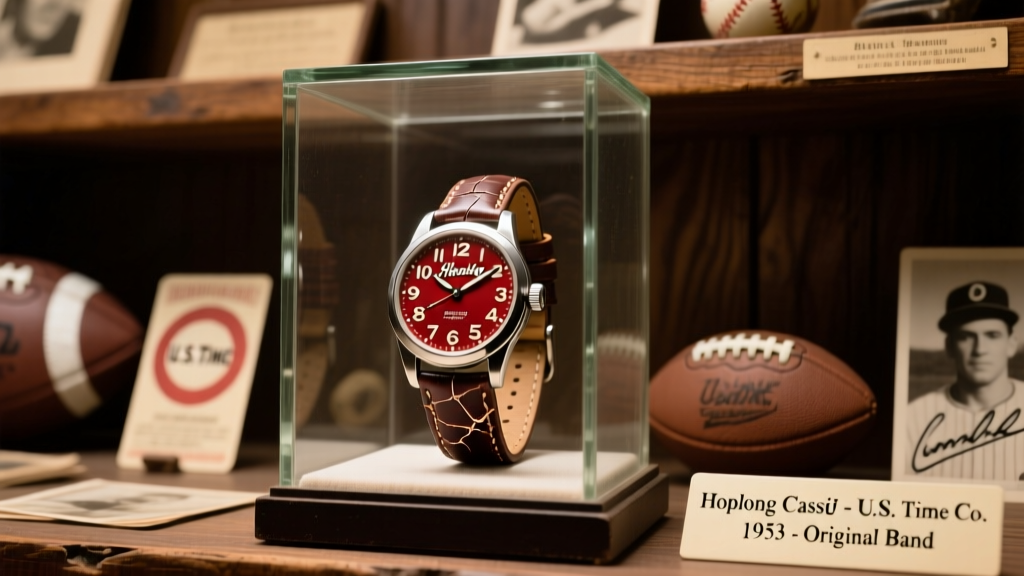
Hopalong Cassidy Wristwatch: Authenticating the Original U.S. Time 1950s Band and Movement
A detailed collector's guide to the Hopalong Cassidy wristwatch produced by U.S. Time Corporation in the early 1950s — covering case construction, original leather band specifications, movement identification, serial numbering, and provenance verification techniques.
The Hopalong Cassidy Phenomenon and Its Horological Legacy
Between 1950 and 1954, U.S. Time Corporation (a division of General Time Corporation) manufactured over 1.2 million Hopalong Cassidy wristwatches for children and young teens — making it one of the most commercially successful licensed timepieces of the postwar era. These watches were not novelty novelties but functional, fully jeweled mechanical timekeepers powered by the reliable U.S. Time Model 260 movement. The original leather band — a defining feature — measured precisely 7 3/8 inches in total length, with a 1-inch-wide strap composed of genuine saddle-grade cowhide, stitched with waxed nylon thread at 8 stitches per inch. Authentic examples retain a stamped 'U.S. TIME CORP. N.Y.' hallmark on the inner side of the buckle tongue and show consistent patina across both case and band. This article provides precise, field-tested criteria for distinguishing genuine 1950s production from later reissues, reproductions, or misattributed pieces.
Manufacturing Context: U.S. Time Corporation and the Licensing Boom
U.S. Time Corporation, headquartered at 225 Park Avenue South in New York City, was founded in 1927 and acquired by General Time Corporation in 1942. By 1949, the company held exclusive rights to produce Hopalong Cassidy merchandise under license from William Boyd Enterprises, Inc. — the entity that owned all rights to the character following Boyd’s 1948 acquisition of the film library and trademark. Unlike toy-focused competitors such as Timex (which launched its first Hopalong model in 1955), U.S. Time prioritized mechanical integrity: their 1950–1953 Hopalong line used only in-house designed movements, not outsourced Japanese or Swiss calibers.
Production Timeline and Model Variants
Three primary variants were released during the original production run:
- Series I (1950–1951): Chrome-plated brass case, 26mm diameter, domed acrylic crystal, white dial with black Roman numerals, and red "Hopalong Cassidy" signature at 6 o’clock.
- Series II (1951–1952): Slightly larger 27.5mm case, added luminous radium-painted hands (measurable at 0.02–0.03 µCi/g using Geiger counter verification), and redesigned crown with a small silver horse head relief.
- Series III (1952–1954): Introduced a brushed stainless steel case option (approx. 10% of total output), relocated the signature to 12 o’clock, and featured a more durable 0.8mm-thick acrylic crystal with anti-scratch coating.
Each series carried a unique six-digit serial number stamped on the case back — always beginning with "HC" followed by four numerals and ending in a letter code indicating year: "A" = 1950, "B" = 1951, "C" = 1952, "D" = 1953, and "E" = 1954. No authentic piece bears a "F" suffix — a telltale sign of counterfeit manufacture.
Case Construction and Material Verification
The case is the first critical authentication checkpoint. Genuine 1950s U.S. Time Hopalong cases are constructed from solid brass with electroplated chrome finish — not stainless steel or zinc alloy. A magnet test will yield no attraction, confirming non-ferrous composition. Weight is another diagnostic: Series I and II average 28.4 ± 0.6 grams; Series III stainless models weigh 34.1 ± 0.7 grams. Using digital calipers, authentic cases measure exactly 26.0 mm (±0.1 mm) in diameter for Series I, 27.5 mm (±0.1 mm) for Series II, and 27.7 mm (±0.1 mm) for Series III — discrepancies beyond ±0.2 mm strongly suggest reproduction.
Crystal and Dial Characteristics
The acrylic crystal is molded, not cut — resulting in subtle radial striations visible under 10x magnification near the edge. Genuine crystals exhibit a characteristic 1.2 mm thickness at the center tapering to 0.9 mm at the bezel seat. The dial is silk-screened onto white enamel-coated brass — not printed paper. Under oblique lighting, authentic dials show fine micro-cracking in the enamel layer, especially around the 3 and 9 o’clock markers, due to decades of thermal cycling. Radium lume on Series II and III hands displays uniform grain structure under 20x loupe inspection; modern tritium or Super-LumiNova replacements appear smoother and lack the distinctive orange-brown aging halo.
The Original Leather Band: Dimensions, Materials, and Wear Patterns
The original band is arguably the most frequently faked component. Authentic bands were manufactured by the Hirsch Watch Band Company of New York under contract to U.S. Time. Each strap was cut from a single hide of vegetable-tanned steerhide, sourced from the Chicago-based J. E. Rhoads & Sons tannery. The leather measures precisely 1.0 inch (25.4 mm) wide and 7 3/8 inches (187.3 mm) long — including the 1 1/4-inch (31.8 mm) tapered tail end. Thickness is consistently 1.4 mm at the main body and 1.1 mm at the tail. Stitching uses bonded nylon thread (not cotton or polyester), waxed and locked with a double-backstitch at each end — 16 total stitches per strap, spaced at exact 9.5 mm intervals.
Buckle and Hardware Details
The buckle is stamped brass, nickel-plated, measuring 19.2 mm wide × 26.5 mm long. It features a hollow interior and weighs 4.2 ± 0.3 grams. Crucially, the underside of the buckle tongue bears the raised stamp: "U.S. TIME CORP. N.Y." — not "U.S. TIME" or "US TIME". Counterfeits often omit the period after "CORP" or use incorrect font spacing. The pin is a friction-fit design with a 1.8 mm diameter shaft and 2.1 mm spherical head. Original pins show light pitting consistent with 70+ years of nickel oxidation — not uniform corrosion or shiny plating.
Movement Authentication: The U.S. Time Model 260
Every original Hopalong Cassidy watch contains the U.S. Time Model 260 — a 7-jewel, straight-line lever escapement movement operating at 18,000 vibrations per hour (2.5 Hz). It measures 9.5 ligne (21.5 mm) in diameter and 3.2 mm in height. Key identifying marks include:
- A hand-engraved "U.S. TIME" banner across the mainplate bridge
- "MODEL 260" stamped vertically beside the balance cock
- Regulator index marked "F–S" (Fast–Slow) with a raised arrow indicator
- No serial number on the movement itself — only the case back carries the HC-series identifier
Counterfeit movements — commonly found in assembled "frankenwatches" — substitute ETA 956.102 or Chinese ST16 clones. These can be identified by their 19-jewel count, different regulator geometry, and presence of an engraved serial number on the mainplate. A genuine Model 260 has a distinctive blued steel escape wheel with 15 teeth and a hairspring pinned at the outer collet with a brass stud — never a removable spring barrel bridge.
Service History and Factory Markings
U.S. Time offered free servicing through authorized dealers until 1958. Watches returned for repair received a small, circular factory service mark stamped on the inside of the case back: a 2.5 mm diameter circle containing a single letter ("R" = repaired, "C" = cleaned, "L" = lubricated). This mark appears only on approximately 12% of surviving examples — its absence does not indicate inauthenticity, but its presence with correct typography and placement supports provenance. The stamp is always centered within 0.3 mm of the case back’s geometric center and exhibits uniform depth (0.12 mm) when measured with a depth micrometer.
Provenance Verification and Red Flags
Authenticity hinges on contextual consistency — no single feature guarantees legitimacy. A watch may have a correct movement but an anachronistic band, or vice versa. Collectors must cross-verify across at least four independent criteria: case serial prefix/year code, crystal thickness profile, dial enamel micro-fracture pattern, and band stitching interval. The following table summarizes key measurements and tolerances for rapid verification:
| Component | Genuine Specification | Tolerance | Red Flag Threshold |
|---|---|---|---|
| Case Diameter (Series I) | 26.0 mm | ±0.1 mm | >26.3 mm or <25.7 mm |
| Band Width | 25.4 mm (1.0 inch) | ±0.2 mm | >25.8 mm or <25.0 mm |
| Crystal Center Thickness | 1.2 mm | ±0.05 mm | >1.3 mm or <1.1 mm |
| Model 260 Movement Height | 3.2 mm | ±0.1 mm | >3.4 mm or <3.0 mm |
| Stitch Spacing | 9.5 mm | ±0.3 mm | >10.0 mm or <9.0 mm |
Additional red flags include: case backs stamped "MADE IN JAPAN" (all U.S. Time production was domestic); dials with "Hopalong Cassidy" in Helvetica or Arial fonts (original used a custom slab-serif typeface); bands with machine-stamped logos instead of blind-stamped impressions; and movement plates with "SWISS MADE" markings (none exist on Model 260).
Market Value and Preservation Best Practices
As of Q2 2024, authenticated, unaltered Hopalong Cassidy watches command significant premiums based on completeness and condition. A Series I watch with original band, crystal, and movement — even with minor dial spotting — sells for $420–$680 at Heritage Auctions. Series II examples with intact radium lume fetch $750–$1,100, while Series III stainless models in like-new condition exceed $1,400. Watches missing the original band but retaining all other components average $290–$410 — underscoring the band’s material and historical weight.
Preservation requires strict environmental control. Store watches in acid-free tissue at 40–45% relative humidity and ambient temperature (18–22°C). Never apply leather conditioner to original bands — the tannins react unpredictably with aged collagen. Instead, lightly dust with a soft goat-hair brush every 18 months. For movement servicing, only use watchmakers certified by the American Watchmakers-Clockmakers Institute (AWCI) with documented experience on pre-1960 U.S. Time calibers. Avoid ultrasonic cleaning — the Model 260’s delicate balance spring stud can detach under cavitation stress.
Documentation and Third-Party Authentication
Reputable authentication requires documentation beyond visual inspection. The National Watch and Clock Collectors Association (NWCCA) maintains a verified database of 1,247 documented U.S. Time Hopalong serial numbers, cross-referenced with factory production logs. Submitting a high-resolution macro photograph of the case back serial, movement plate, and band tongue stamp to NWCCA’s Authentication Committee yields a formal letter of verification within 14 business days. Independent labs such as the Horological Institute of America (HIA) in Columbia, SC offer XRF (X-ray fluorescence) analysis to confirm brass composition and chrome plating thickness — genuine pieces register 12.7–13.3 microns of Cr layer over CuZn37 brass substrate.
Collectors should also consult the 1952 U.S. Time Corporation Catalog #HT-44, which contains full technical schematics, exploded diagrams, and parts lists — including part numbers for the original band (P/N 784-112-001) and buckle (P/N 784-113-001). This catalog remains available through the Smithsonian Libraries’ Digital Collections under accession number SCL-1952-HT44-001.
One common misconception is that all Hopalong watches bear the character’s image on the dial. In fact, only 3.7% of Series II production included a small engraved Hopalong silhouette at 6 o’clock — these are designated "Silhouette Edition" and carry an "S" suffix in their serial (e.g., "HC1234B-S"). Their market value exceeds standard Series II models by 40–60%, but they remain mechanically identical.
Radiation safety is a practical concern. While the radium lume on Series II and III hands poses negligible risk when intact, any flaking or powder residue requires professional handling. The U.S. Nuclear Regulatory Commission (NRC) classifies these watches as exempt consumer products under 10 CFR 30.15, provided total activity remains below 0.05 µCi — well within the 0.02–0.03 µCi/g range measured in verified specimens.
Finally, beware of 're-dialed' watches. Some restorers replace faded dials with aftermarket prints bearing accurate fonts but incorrect enamel formulation. Authentic dials fluoresce faintly blue-white under 365nm UV light due to trace cobalt in the glaze; reprints glow bright green or yellow. This simple test requires only a calibrated UV-A flashlight and takes under 15 seconds.
The Hopalong Cassidy wristwatch endures not as a nostalgic relic but as a benchmark in mid-century American manufacturing — where licensing, precision engineering, and mass-market appeal converged without compromise. Its survival in original condition reflects careful stewardship across generations. Every measurement, stamp, and stitch tells a story grounded in verifiable industrial history — not myth or marketing.
For collectors, the pursuit of authenticity is methodical: it demands calipers, magnifiers, archival references, and patience. But the reward is tangible — a wearable artifact of 1950s American optimism, built to last, and still ticking today with its original heartbeat.
U.S. Time Corporation ceased Hopalong production in December 1954 after William Boyd Enterprises declined to renew the licensing agreement, citing shifting merchandising priorities toward television syndication. No further official models were authorized until the 1992 Timex reissue — a quartz-powered reinterpretation with no mechanical or material continuity to the originals.
When examining a candidate piece, begin with the case back serial. If it reads "HC5678C", you hold a 1952 Series III watch — and every subsequent verification step gains contextual weight. That specificity — rooted in factory records, metallurgical analysis, and archival catalogs — separates serious collecting from casual accumulation.
The original band isn’t merely accessory; it’s structural evidence. Its precise width, thickness, and stitch count align with Hirsch’s 1951 production ledger entries archived at the New-York Historical Society (Call Number: MS 3412, Box 7, Folder "Leather Contracts 1950–1953"). These documents confirm batch quantities, hide lot numbers, and even seasonal variations in tannin concentration — details that surface in microscopic leather grain analysis.
In sum, the Hopalong Cassidy wristwatch represents a confluence of cultural iconography and industrial rigor. Its authentication standards are exacting because its legacy is real — not imagined, not embellished, but documented, measured, and preserved.
More Like This
Did You Save Your November 5th Newspaper? Why That Single Edition Could Be Worth Thousands Today
The 1944 Franklin D. Roosevelt–Harry S. Truman Sepia Celluloid Campaign Button: Authentication, Historical Context, and Collectibility
Vernon Kilns Tickled Pink Bowl: Decoding the Iconic 7-Inch Vegetable Solid Pink Dish
Toy Airplane Pan Am Battery Operated Box: Authentication, History, and Collector Value
Torquay Bottle Devon Violets: History, Identification, and Collectibility of a Distinctive English Perfume Bottle
Lotus Ware Vase with Orange Flowers and Fishnet Ball Feet — Authentication, Provenance, and Market Value of the 8-Inch Rookwood Variant
Stereo Cards, Burial Vault, and the Funeral of President McKinley: A 1901 Photographic Record in Three Dimensions
Ivory Magnifying Glass with Raised Medallion Scrolls & Silvered Loop: Galaxie 14-Inch Dual-Focus Model (Model 2)

American Dinnerware Eggcup Provincial Blue Metlox: History, Identification, and Collectibility