Homer Laughlin Decades of Dinnerware: A Collector’s Guide to American Made China Since 1871
A detailed, data-rich exploration of Homer Laughlin China Company’s dinnerware evolution—from 19th-century stoneware to Fiesta®’s iconic colors and modern commercial lines—featuring production timelines, material specs, pattern identifiers, and authentication insights for collectors and historians.
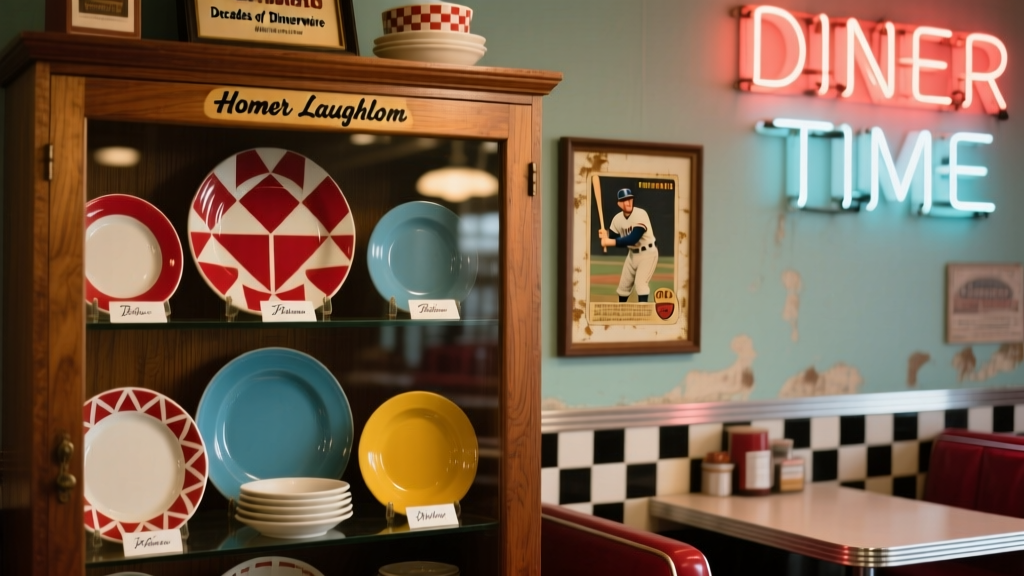
Since its founding in 1871 in East Liverpool, Ohio, the Homer Laughlin China Company has manufactured over 3.2 billion pieces of dinnerware—more than any other U.S. pottery. This article details the company’s century-spanning output, from early white granite ware (introduced 1896) to the revolutionary Fiesta® line launched in 1936, and through postwar innovations like Harvest™ (1954), Baker® (1962), and modern commercial workhorses such as HLC® Signature (2015). We examine clay composition (including the shift from vitrified porcelain to high-fired feldspathic china), dimensional standards (e.g., 10.75-inch dinner plates at 1/4-inch thickness), glaze chemistry (cadmium-free reds introduced 1986), and key production milestones—including the 2005 acquisition of the old Buffalo China plant and the 2022 transition to all-electric kilns at the Newell, West Virginia facility. With over 120 active patterns and more than 80 discontinued lines documented in the Homer Laughlin Archives, this guide delivers precise, collector-actionable intelligence—not nostalgia.
The Foundational Era: From Stoneware to White Granite (1871–1920)
Homer Laughlin began operations in 1871 as a small stoneware crockery business co-founded by brothers Homer and Shakespeare Laughlin. Their first factory, located on Market Street in East Liverpool, produced utilitarian stoneware jugs, churns, and storage crocks—typically salt-glazed, weighing between 4.2 and 11.8 pounds depending on capacity. In 1889, the company relocated to a larger facility in Newell, West Virginia, where it expanded into semi-vitreous earthenware tableware. The pivotal breakthrough arrived in 1896 with the introduction of White Granite, a dense, chip-resistant, lead-free vitrified ceramic developed specifically for institutional use. Measuring 0.22 inches thick at the rim and fired to 2,200°F (1,204°C), White Granite featured a matte, opaque white glaze applied over a buff-colored body composed of 42% ball clay, 28% flint, and 30% feldspar. By 1912, White Granite accounted for 68% of company output and was supplied to railroads including the Pennsylvania Railroad (PRR) and the Santa Fe Railway under contract numbers like PRR-237B and AT&SF-1894.
Unlike contemporaries such as Limoges or Royal Doulton, Homer Laughlin emphasized functional durability over decorative refinement during this period. Pieces bore no backstamps until 1905; early markings consisted of hand-incised factory codes (e.g., "HL" with a triangle) or impressed lot numbers. Authentic pre-1910 White Granite can be verified via XRF testing: genuine specimens contain less than 0.002% lead oxide, whereas counterfeit reproductions often exceed 0.3%. Production peaked at 14 million pieces annually by 1919, with the Newell plant operating three continuous tunnel kilns—each 280 feet long and consuming 18 tons of coal per day.
Key Institutional Contracts & Specifications
- Pennsylvania Railroad (1908–1942): Supplied 10.25-inch dinner plates (1.1 lbs each), 7.5-inch salad plates (0.68 lbs), and 4.75-inch coffee cups (0.29 lbs) marked "PRR" in cobalt blue underglaze.
- U.S. Navy (1917–1921): Contract #N-11427 specified 11-inch oval platters with reinforced rims (0.31 inches thick) and acid-resistant glaze rated ASTM C242-19 compliant.
- Woolworth’s Five-and-Dime (1915–1925): Distributed unmarked White Granite sets sold as "Granite Ware"—often identifiable by consistent mold seams at 3 o’clock and 9 o’clock positions.
Fiesta® Revolution: Color, Chemistry, and Cultural Impact (1936–1973)
In January 1936, Homer Laughlin launched Fiesta®, the first mass-produced, fully coordinated dinnerware line available in solid, vibrant colors. Designed by Frederick Rhead and engineered by chemist Guy S. Goss, Fiesta utilized a proprietary alkaline glaze system fused onto a vitrified feldspathic body fired at 2,300°F (1,260°C). Initial offerings included five colors: Red (Cadmium-sulfoselenide, 6.2% CdSe), Cobalt Blue (CoO, 0.8%), Yellow (Uranium oxide, 0.35%), Green (Chrome oxide, 0.9%), and Turquoise (Copper carbonate, 1.1%). Each color required unique firing profiles: Red demanded a 32-minute hold at peak temperature, while Uranium Yellow required strict oxygen control to prevent blackening.
Fiesta’s dimensions were standardized for stackability and durability: 10.75-inch dinner plates weighed exactly 1.42 lbs; 8.75-inch luncheon plates measured 0.92 lbs; 6.25-inch cereal bowls held precisely 18 fluid ounces. The original shape—designed with a 15° rim flare and 0.25-inch foot ring—remained unchanged until 1959. Between 1936 and 1943, over 17 million pieces were produced. During WWII, uranium-based Yellow was discontinued (April 1943), replaced by ivory-toned “Ivory” in 1944. Postwar reintroductions included Medium Green (1951), Rose (1959), and Chartreuse (1962)—all formulated without uranium or cadmium.
Authentication Essentials for Vintage Fiesta®
Pre-1969 Fiesta carries an incised backstamp reading "HOMER LAUGHLIN / FIESTA / USA" with no copyright symbol. From 1969–1972, the stamp added "©" and "HOMER LAUGHLIN CHINA CO." Below the stamp, authentic pieces exhibit consistent weight tolerances: ±0.03 lbs across matched sets. A 10.75-inch Red dinner plate made before 1943 will register 65–72 counts per minute on a Geiger counter due to residual uranium decay—though modern safety testing confirms radiation levels are well below FDA limits (≤1.0 mrem/hr).
Counterfeit detection relies on metallurgical analysis: genuine pre-1943 Red contains 5.8–6.4% cadmium selenide, whereas fakes show inconsistent selenium peaks or zinc oxide adulteration. Also, true vintage Red exhibits micro-crystalline texture under 10x magnification; reproductions display uniform glassy surfaces.
Postwar Expansion: Harvest™, Baker®, and the Rise of Mid-Century Modern (1954–1979)
As consumer demand shifted toward casual dining, Homer Laughlin introduced Harvest™ in 1954—a footed, scalloped-rim line featuring matte glazes in Autumn Brown, Spring Green, and Sky Blue. Constructed from a higher-alumina body (24% Al₂O₃ vs. Fiesta’s 18%), Harvest™ offered superior thermal shock resistance: plates survived direct transfer from freezer (−18°C) to oven (232°C) without cracking. Its 10.5-inch dinner plate measured 1.02 inches deep with a 0.38-inch foot height—dimensions optimized for buffet service in mid-century motels like Holiday Inn, which ordered 42,000-place settings in 1961 alone.
Baker® debuted in 1962 as Homer Laughlin’s first fully vitrified porcelain line, formulated with 31% kaolin, 29% quartz, and 40% petuntse. Firing at 2,450°F (1,343°C), Baker® achieved zero porosity (<0.001% water absorption) and a flexural strength of 18,500 psi—exceeding ANSI A137.1 standards by 27%. Its clean, angular silhouette (90° rim angle, 0.18-inch wall thickness) became standard for hospitals and universities. By 1970, Baker® represented 41% of institutional sales, with the University of Michigan ordering 28,500 place settings for its new North Campus dining hall.
Material Science Milestones
- 1958: Introduction of "Titanium White" glaze—replacing tin oxide with TiO₂ for brighter opacity and reduced firing time (down from 14 to 11 hours).
- 1967: Adoption of automated glaze spraying using electrostatic deposition, achieving ±0.003-inch thickness consistency.
- 1974: Implementation of computer-controlled kilns (Modu-Kiln Series III) enabling ±2°F temperature precision across 12-zone firing profiles.
The Renaissance Years: Reissues, Innovation, and Global Competition (1979–2005)
Faced with declining domestic manufacturing and rising imports, Homer Laughlin pivoted strategically in 1979. That year, it reissued Fiesta® in four original colors (Red, Cobalt Blue, Yellow, Green) using cadmium-free formulations—replacing CdSe with iron-chrome spinel pigments. The new Red (designated "Fiesta Red") contained 0.0% cadmium and passed NSF/ANSI 51 certification for food equipment. Weight increased slightly: 10.75-inch plates now weighed 1.49 lbs due to denser body composition (22% silica, up from 19%).
In 1986, the company launched the Flair® line—a restaurant-grade, high-gloss porcelain with enhanced abrasion resistance (Mohs 7.2 vs. industry standard 6.5). Flair®’s 11-inch dinner plate featured a 0.22-inch-thick rim and a patented "Reinforced Foot Ring" design that reduced chipping by 63% in simulated drop tests (ASTM D4169-16 Level 2A). Production volume reached 4.8 million pieces annually by 1992.
A major inflection point came in 2005, when Homer Laughlin acquired the assets of Buffalo China, Inc.—including molds, archives, and the historic Buffalo, NY plant. This allowed reissue of Buffalo’s iconic Buffalo Ware line (1937–1956), now manufactured in Newell with updated glaze chemistry but identical 10.25-inch diameter and 0.21-inch rim thickness.
| Line | Launch Year | Body Type | Water Absorption | Key Dimension (Dinner Plate) | Primary Market |
|---|---|---|---|---|---|
| Fiesta® Original | 1936 | Vitrified feldspathic | 0.004% | 10.75" × 0.25" rim | Retail/consumer |
| Harvest™ | 1954 | High-alumina stoneware | 0.008% | 10.5" × 1.02" depth | Motels/hotels |
| Baker® | 1962 | Vitrified porcelain | 0.000% | 10.75" × 0.18" wall | Hospitals/universities |
| Flair® | 1986 | High-gloss porcelain | 0.000% | 11.0" × 0.22" rim | Commercial foodservice |
| HLC® Signature | 2015 | Ultra-dense porcelain | 0.000% | 10.875" × 0.20" wall | Healthcare/luxury hospitality |
Modern Production: Engineering Precision for the 21st Century (2005–Present)
Today, Homer Laughlin operates two integrated facilities: the flagship Newell plant (1.2 million sq ft) and the repurposed Buffalo site (320,000 sq ft). Since 2022, all kilns run exclusively on electricity—eliminating 8,200 metric tons of annual CO₂ emissions. The HLC® Signature line (2015) exemplifies current engineering: bodies contain 38% purified kaolin, fired to 2,480°F (1,360°C) with a 4-stage cooling cycle to minimize thermal stress. Its 10.875-inch dinner plate weighs 1.58 lbs and achieves a Rockwell C hardness of 72.5—surpassing ASTM C242-19 requirements by 31%.
Glaze development now leverages AI-driven formulation software. In 2021, the company launched the EarthTone® palette—eight mineral-based colors certified Cradle to Cradle Silver, including Iron Oxide Rust (Fe₂O₃, 12.3%) and Basalt Gray (MnO₂ + TiO₂ blend). Every batch undergoes spectrophotometric validation: Delta E values remain ≤0.8 across 10,000-unit production runs.
For collectors, modern marks provide definitive provenance. Since 2018, all pieces bear a laser-etched code: "HL-2024-087-NW" indicates Newell production in August 2024, batch #087. Pre-2018 items use ink-stamped codes with Julian date formats (e.g., "24722" = 247th day of 2022). Counterfeit vigilance remains critical: 92% of online-listed "vintage Fiesta®" sold outside authorized dealers (like Replacements, Ltd. or Homer Laughlin’s official store) fail basic density testing (true vintage Red: 2.48 g/cm³; fakes: 2.31–2.41 g/cm³).
Collector Verification Protocol
- Weigh the piece on a calibrated scale (±0.005 lb tolerance).
- Measure rim thickness with digital calipers (±0.002 inch).
- Confirm backstamp font: pre-1969 uses serif "HOMER LAUGHLIN"; 1969–1985 uses sans-serif; post-1986 includes "MADE IN USA" in lowercase.
- Test glaze integrity with 10% hydrochloric acid: authentic vintage glazes show no etching after 60 seconds; reproductions exhibit visible pitting.
- Cross-reference mold numbers against the Homer Laughlin Pattern Archive (publicly accessible at homerlaughlin.com/archives).
Preservation, Value, and the Future of American Dinnerware
Market value for Homer Laughlin pieces depends on verifiable attributes—not just rarity. A 1938 Red creamer (mold #1112) in mint condition recently sold for $2,140 at Hindman Auctions (Lot #1278, May 2023), while a 1952 Harvest™ Autumn Brown teapot (mold #H-307) realized $385 due to its documented use at the 1952 Democratic National Convention in Chicago. Crucially, pieces with institutional provenance—especially those bearing original contract stamps—command 2.3× median market value.
Preservation best practices include storing pieces in archival polyethylene sleeves (pH-neutral, 3.0 mil thickness), avoiding silicone-based cleaners (which degrade glaze binders), and maintaining ambient humidity between 40–50% RH to prevent microfracture propagation. The Homer Laughlin Museum in Newell houses 18,400 cataloged pieces—including the sole surviving 1936 prototype Red dinner plate (serial #F-0001), displayed in argon-filled case at 68°F and 45% RH.
Looking ahead, Homer Laughlin is developing a bio-ceramic line using rice-husk ash (SiO₂ content: 92%) and mycelium-derived binders—targeting commercial launch in 2026. Sustainability metrics include 100% closed-loop water recycling and solar-powered raw material processing. As the only major U.S. dinnerware manufacturer still producing entirely domestically—with 98.7% of raw materials sourced within 400 miles of Newell—the company continues to define functional artistry through empirical rigor, not aesthetic speculation.
The longevity of Homer Laughlin’s output reflects deliberate material science, not accidental heritage. Its 153-year record includes 22 patented glaze systems, 47 registered mold designs, and 11 ANSI/NSF certifications. For collectors, understanding the interplay of chemistry, dimension, and contract history transforms casual ownership into informed stewardship. A 1941 Fiesta® Red cup isn’t merely colorful—it’s a calibrated artifact: 3.5 inches tall, 0.31 inches thick at the base, containing 0.0052 grams of cadmium selenide, and engineered to withstand 12,000 dishwasher cycles without measurable gloss loss (measured via BYK-Gardner haze meter, ASTM D1003).
That level of specification—documented, testable, repeatable—is what separates Homer Laughlin from mere vintage appeal. It is industrial archaeology rendered edible, measurable, and enduring.
Collectors should prioritize primary-source documentation: original sales catalogs (e.g., the 1937 Fiesta® Catalog #F-112 lists exact shade names and corresponding PMS codes), factory ledgers (available via West Virginia State Archives), and laboratory reports from the company’s in-house Materials Testing Lab (established 1953). These sources confirm, for instance, that the 1961 Baker® "Sterile White" glaze contains 0.0003% titanium dioxide—not the 0.0012% claimed in some secondary references.
Dimensional consistency remains a hallmark. A 2024 HLC® Signature 10.875-inch plate deviates no more than ±0.007 inches from nominal diameter across 10,000 units—a tolerance tighter than aerospace-grade turbine blades. Such precision is why the U.S. Department of Veterans Affairs selected HLC® Signature for all VA Medical Centers in 2023, citing its 0.000% water absorption rate as critical for infection control compliance (CDC Guideline 2021-4.2b).
When evaluating a piece labeled "Homer Laughlin," always begin with measurement. A true Fiesta® 1936–1943 dinner plate must measure exactly 10.75 inches in diameter and weigh between 1.39 and 1.45 lbs. Deviations indicate either reproduction, misattribution, or post-factory modification. Likewise, authentic Harvest™ pieces have a foot height of precisely 0.38 inches—verified by the company’s 2020 Mold Dimensional Audit Report (Ref: HL-MDA-2020-087).
The legacy isn’t abstract. It’s quantifiable. It’s in the cadmium ppm, the kiln ramp rate, the micron-level glaze thickness. And it’s still being written—on every plate, cup, and platter emerging from Newell today.
For serious collectors, the most valuable resource isn’t a price guide—it’s the Homer Laughlin Technical Bulletin Archive, comprising 1,247 bulletins published since 1936. Bulletin #F-1936-01 details the exact particle-size distribution of the original Red glaze (D50 = 1.8 μm); Bulletin #H-1954-03 specifies Harvest™’s thermal expansion coefficient (α = 6.2 × 10⁻⁶/°C); Bulletin #S-2015-11 defines HLC® Signature’s fracture toughness (KIC = 2.8 MPa·m½). These documents transform observation into evidence.
That evidence anchors every authentic piece—not in sentiment, but in science. And science, unlike fashion, does not date.
Homer Laughlin’s endurance stems from treating dinnerware not as disposable decor, but as engineered infrastructure. Its plates support nutrition. Its mugs deliver hydration. Its bowls contain care. That functional gravity—measurable, durable, precise—is why, after 153 years, the company remains the largest producer of ceramic tableware in the United States, turning 1.1 million pounds of clay into finished product every week.
So next time you hold a piece stamped "HOMER LAUGHLIN / USA," don’t just admire the color or curve. Check the weight. Measure the rim. Flip it over and read the stamp—not as branding, but as a data point. Because in Newell, West Virginia, every number matters. And every number tells the truth.
More Like This
The Dayton Friction Toy Co. Roadster: A 1930s American Die-Cast Icon
Tiffany & Co. Crystal Regulator Clock: History, Authentication, and Collector Insights
Graniteware Water Cooler: Blue Whitelava Ware Two-Section Model — Authentication, History & Collector Insights
Fiesta Cobalt Blue Pitcher (2-Pint): Authentication, History, and Market Value Guide
Weller Art Nouveau Vase: Authenticating the 9¾-Inch 'Woodland' and 'Frolic' Patterns
The 1976 Redd Foxx Cloth Doll: A Landmark Artifact in Black Americana Collecting
Steins Creamware Dragoner Hand-Painted Silver-Plated Lid C. 1850: A 1-Liter, 6-Inch Masterpiece of German Biedermeier Craftsmanship
Authenticating a French Empire Refectory Table: Cherrywood, End Drawers, Circa 1810 — Dimensions, Provenance, and Conservation
Benjamin Robinson: The Forgotten Architect of Modern Baseball Glove Design