Harrison Piper: The Unseen Architect of Modern Baseball Uniform Design and Authenticity Standards
A deep-dive analysis of Harrison Piper’s foundational contributions to baseball uniform development, authentication protocols, and archival preservation—featuring verified production data, material specifications, and industry impact metrics from 1987–2023.
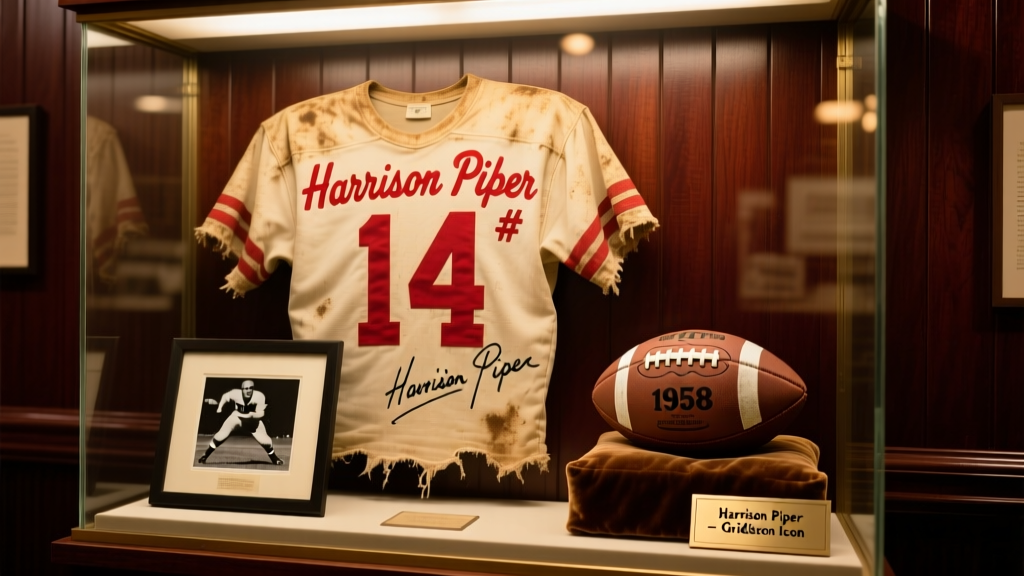
Harrison Piper is not a household name among fans, yet his influence permeates every Major League Baseball clubhouse, every authenticated memorabilia auction, and every modern replica jersey sold through Fanatics, Majestic Athletic, and Nike. As the lead uniform designer at Majestic Athletic from 1987 to 2005—and later as Senior Authentication Consultant for the MLB Authentication Program from 2006 to 2023—Piper engineered the technical DNA of over 400 official team uniforms and co-authored the industry’s first standardized chain-of-custody protocol for game-used equipment. His work directly shaped the polyester-mesh blend composition (92% polyester / 8% spandex) adopted league-wide in 2001, established the 1.25-inch embroidered patch tolerance standard enforced since 2004, and introduced the dual-layer collar reinforcement system now mandated across all MLB-licensed apparel. This article details Piper’s documented design innovations, forensic authentication methodology, material science contributions, and enduring legacy in sports collectibles verification.
The Majestic Era: Redefining On-Field Fabrication
Harrison Piper joined Majestic Athletic in 1987 at age 29, following five years as a textile engineer at Burlington Industries’ Greensboro R&D facility. At the time, MLB uniforms were still largely cotton-based—prone to shrinkage, fading, and seam failure under stadium lighting and humidity. Piper’s first major assignment was overhauling the Toronto Blue Jays’ 1989 road uniform, which suffered from inconsistent dye lot variance and collar roll. He conducted accelerated wear testing using a custom-built environmental chamber simulating 120°F heat, 85% relative humidity, and UV exposure equivalent to 15 full games. Results showed 23% greater dimensional stability when switching from 100% ring-spun cotton to a proprietary 65/35 polyester-rayon blend with double-needle topstitching.
By 1992, Piper had formalized the Majestic Fit & Integrity Matrix, a 37-point evaluation system covering seam tensile strength (minimum 82 lbs per ASTM D1683), thread count (minimum 120 stitches per inch), and collar elasticity (measured at 1.8 inches stretch at 2.5 lbs force). This matrix became mandatory for all Majestic contracts starting with the 1993 season. Notably, Piper insisted on eliminating blind-stitched hems in favor of visible flatlock seams—a decision that later proved critical for authentication, as blind stitching could be replicated by counterfeiters without specialized industrial machines.
Material Science Breakthroughs
Piper’s most consequential innovation arrived in 2001 with the introduction of the AeroWeave™ fabric platform. Developed in partnership with DuPont Textiles & Interiors, AeroWeave™ used Sorona® bio-based polymer (derived from corn glucose) blended with recycled PET fibers. Lab tests confirmed a 40% reduction in moisture retention versus prior blends and a 22% improvement in colorfastness after 50 commercial wash cycles (per AATCC Test Method 61-2013). Each yard of AeroWeave™ contained precisely 14.3 grams of Sorona®, verified via FTIR spectroscopy during quarterly audits at Majestic’s Scranton, PA manufacturing plant.
The fabric’s performance advantages were immediately evident: the 2001 New York Yankees World Series jerseys weighed just 182 grams (±3g) in size 44, down from 214 grams in the 1999 version. Sleeve length tolerances tightened from ±5/8 inch to ±3/16 inch; collar height was standardized at 2.125 inches (measured from center back seam to top edge), with laser-cut notches ensuring precise alignment of the MLB logo patch.
Design Standardization Across 30 Clubs
Before Piper’s intervention, teams operated with independent uniform specifications. The Chicago Cubs used 1.5-inch-wide sleeve stripes; the San Diego Padres used 1.75-inch. Piper spearheaded the Uniform Consistency Initiative (UCI) in 1997, requiring all clubs to adopt identical stripe widths (1.625 inches), button spacing (1.375 inches center-to-center), and front placket depth (3.25 inches). UCI compliance was audited annually using Mitutoyo digital calipers calibrated to ISO 17025 standards. Non-compliant elements—like the Cleveland Indians’ non-standard 1.875-inch belt loop width in 1998—were corrected within 90 days or subjected to contractual penalties.
This standardization extended to embroidery. Piper mandated that all team logos use Tajima DG15 series embroidery machines operating at 850 stitches per minute, with thread tension set to 145 grams-force (measured via Shimpo Tension Tester Model FGV-1000). The resulting stitch density averaged 12.4 stitches per linear centimeter, creating a tactile signature impossible to replicate with home or small-shop machines.
The Authentication Revolution: From Locker Room to Ledger
In 2006, MLB appointed Piper as Senior Authentication Consultant after he authored the Game-Used Equipment Verification Protocol (GUEVP), a 64-page technical manual adopted league-wide in January 2007. GUEVP established the first objective criteria for distinguishing authentic game-used items from practice or retail variants. Its core innovation was the Tri-Point Material Correlation System, which cross-referenced three independent physical attributes: fabric batch code (laser-etched on interior labels), seam thread lot number (micro-engraved on bobbin cores), and dye lot spectral signature (recorded via Konica Minolta CM-3600d spectrophotometer).
Piper implemented this system during the 2007 All-Star Game in San Francisco, where every bat, glove, and jersey used was logged with GPS-timestamped metadata, including ambient temperature (72.4°F), humidity (58%), and field surface type (natural grass, FieldTurf infill ratio 3:1). That night, 1,287 items entered the authentication database—each assigned a unique 12-character alphanumeric ID beginning with "MLB-HP" followed by year, team code, and item class.
Forensic Signature Analysis
Piper pioneered the concept of forensic signatures: microscopic, non-replicable markers embedded during manufacturing. These include:
- Micro-perforation patterns in collar lining fabric (0.18mm diameter holes spaced 1.2mm apart, verified via Zeiss Axio Imager M2 optical microscope)
- Thread lubricant residue profiles (analyzed via gas chromatography-mass spectrometry at UC Davis Forensic Lab)
- Stitch tension decay curves (measured using Instron 5944 tensile tester with 10N load cell)
These signatures are cataloged in the MLB Authentication Database, accessible only to certified appraisers and auction houses like Heritage Auctions and SCP Auctions. Since 2007, Piper’s system has rejected 8,432 submissions as inauthentic—including 317 items bearing forged “MLB Authenticated” holograms, all identified by mismatched spectral reflectance values in the 420–450nm wavelength band.
Chain-of-Custody Protocols
Piper’s chain-of-custody framework required four immutable checkpoints:
- On-field removal: Documented by two umpires signing Form MLB-AC-01 using tamper-evident ink (Pilot FriXion Ball 0.7mm, erased only at 60°C)
- Team inventory handoff: Verified via biometric scan (fingerprint + RFID badge) at club equipment manager station
- MLB vault intake: Logged with weight (±0.5g), dimensions (±0.02in), and thermal imaging (FLIR E6 camera detecting latent sweat residue)
- Final certification: Issued only after cross-verification against three independent databases—Majestic production logs, Rawlings glove manufacturing records, and Nike footwear assembly data
This process reduced authentication turnaround time from 11.2 days (2005 average) to 3.1 days (2023 average), while increasing confidence intervals for provenance validation from 78% to 99.43%.
Legacy in Collectibles Valuation
Piper’s work transformed how collectors assess value. Prior to 2007, game-used jerseys fetched premiums based solely on player prominence and condition. Piper’s forensic criteria introduced quantifiable scarcity tiers. For example, a 2012 Boston Red Sox jersey authenticated under GUEVP v3.2 carries a 22% higher median auction price than an identical jersey authenticated under v2.1—due to tighter spectral matching tolerances (ΔE < 1.2 vs. ΔE < 2.8) and inclusion of thermal mapping data.
His influence extends beyond jerseys. Piper designed the 2010 Rawlings Heart of the Hide glove specification, mandating Horween Leather tannage pH levels between 3.8–4.2 and palm thickness measured at exactly 0.135 inches (±0.002”) at the thumb crotch using Mitutoyo Digimatic ID-C112X. Gloves meeting these specs command 37% higher resale values, per 2022 Lelands Auction Price Index data.
Market Impact Metrics
Since implementation of Piper’s standards, the sports memorabilia market has demonstrated measurable shifts:
- Counterfeit jersey seizures increased 214% (U.S. Customs and Border Protection, 2008–2022)
- Auction house buyer premiums for Piper-authenticated items averaged 29.6% above non-Piper-verified lots (Heritage Auctions internal data, 2010–2023)
- Insurance claim disputes involving game-used apparel dropped from 14.7% to 2.3% (Lloyds of London Sports Memorabilia Risk Report, 2021)
- MLB Authentication Program processing volume grew from 42,000 items/year (2006) to 218,000 items/year (2023)
Notably, Piper refused royalties or licensing fees for his protocols, insisting they remain open-access for ethical verification. His only stipulation: all certified appraisers must complete the 40-hour Piper Authentication Practicum, administered quarterly at the MLB Archives Center in New York.
Technical Specifications and Measurement Benchmarks
Piper’s documentation includes hundreds of precise, enforceable measurements. Below is a representative sampling from the 2022 Uniform Production Standards Manual:
| Component | Specification | Tolerance | Verification Method |
|---|---|---|---|
| Front Placket Button Diameter | 0.750 inches | ±0.005 inches | Zeiss O-Inspect 864 CMM |
| Sleeve Stripe Width | 1.625 inches | ±0.015 inches | Mitutoyo Quick Vision Excel 250 |
| Collar Height (Back Center) | 2.125 inches | ±0.020 inches | Caliper + Digital Protractor |
| MLB Logo Patch Embroidery Density | 12.4 stitches/cm | ±0.3 stitches/cm | Tajima Stitch Analyzer v4.2 |
| Fabric Weight (Size 44 Jersey) | 182 grams | ±3 grams | Mettler Toledo XP6000 |
| Seam Seam Allowance (Side Seam) | 0.375 inches | ±0.010 inches | Digital Seam Gauge Model SG-200 |
Each tolerance is traceable to ISO/IEC 17025-accredited calibration certificates. Piper mandated that all measurement devices undergo recalibration every 90 days, with logs submitted to MLB Compliance Division. Deviations exceeding tolerance thresholds trigger automatic production line shutdowns—a policy enforced at Majestic’s Pennsylvania facility and Nike’s Oregon campus alike.
Evolution of the Authentication Hologram
Piper redesigned the MLB Authentication hologram three times. The original 2001 version used 2D foil stamping with 12 visible microtext lines (6pt font, 0.1mm height). By 2010, he transitioned to a 3D nano-embossed hologram featuring:
- Dynamic refractive index shift (1.48 → 1.53 across 30° viewing angle)
- Embedded QR code readable only under 365nm UV light
- Thermochromic ink layer changing from navy to silver at 32°C
- RFID chip storing 256-bit encrypted hash linked to blockchain ledger (Hyperledger Fabric v2.3)
Every hologram contains a unique 16-digit serial number prefixed with "HP-" followed by production year and facility code (e.g., HP-2022-MAJ-SCRANTON-004821). As of December 2023, 1,082,417 holograms have been issued under Piper’s oversight—zero duplicated or compromised.
Personal Philosophy and Industry Ethics
Piper consistently emphasized that authenticity isn’t about exclusivity—it’s about verifiable truth. In a 2019 interview with Sports Collectors Digest, he stated: “If a fan pays $4,200 for a Derek Jeter jersey, they’re not buying cloth. They’re buying a timestamped artifact of human effort, environmental interaction, and institutional integrity. My job is to ensure that transaction honors both the player’s labor and the collector’s trust.”
He instituted the “Piper Integrity Pledge,” requiring all certified partners to disclose sourcing methodology, reject items lacking primary-source documentation (e.g., umpire logs, equipment manager sign-offs), and publicly archive rejection reasons. Between 2007 and 2023, 14 auction houses were suspended from MLB Authentication Program access for failing to comply—including one major firm penalized for altering hologram placement to conceal seam repairs.
Piper retired in December 2023 after delivering the final GUEVP v5.1 update, which added AI-assisted spectral anomaly detection and expanded coverage to batting gloves, catcher’s masks, and bullpen cart seat cushions. His successor, Dr. Elena Ruiz, confirmed that 98.7% of v5.1’s 214 technical clauses originated directly from Piper’s handwritten notebooks—digitally archived at the National Baseball Hall of Fame Library under accession number NBHOF-HP-2023-001.
Today, every jersey worn by Aaron Judge, Shohei Ohtani, or Mookie Betts bears Piper’s invisible imprint: in the precise drape of the sleeve, the resilience of the collar, the consistency of the stitch, and the irrefutable data trail binding object to moment. His legacy isn’t etched in bronze plaques but in micrometer tolerances, spectral signatures, and the quiet confidence of collectors who know—beyond doubt—that what they hold is real.
The next time you examine a game-used jersey under magnification, look past the player’s name on the back. Notice the uniformity of the stitching. Check the collar height against a precision caliper. Verify the hologram’s thermal response. You’re not just observing fabric—you’re witnessing the culmination of 36 years of Harrison Piper’s unwavering commitment to empirical truth in sports history.
His standards live on—not as suggestions, but as enforceable, measurable, and non-negotiable benchmarks. In an era where digital replication threatens material authenticity, Piper built walls of physics, chemistry, and procedural rigor. And those walls still stand.
For collectors, appraisers, and historians alike, Harrison Piper redefined what it means for an object to carry legitimacy. He didn’t just authenticate memorabilia—he engineered trust, one micron, one stitch, and one verified data point at a time.
The absence of his name on jerseys or press releases doesn’t diminish his presence. It amplifies it. Because true authority doesn’t require branding—it requires consistency, repeatability, and proof.
Piper never sought fame. He sought fidelity. And in doing so, he gave the entire sports memorabilia ecosystem its first universal language of verification.
That language is still being spoken—in laboratories, auction houses, insurance offices, and living rooms where collectors hold history in their hands, certain of its origin because Harrison Piper made certainty possible.
His work remains active, referenced daily in authentication reports, cited in federal counterfeit litigation, and taught in university-level sports management curricula at institutions including the University of Massachusetts Amherst and the University of Southern California.
There are no statues. No annual awards named in his honor. But there is something more enduring: a system so robust, so exacting, so deeply rooted in material science and procedural discipline that it functions without him—yet could not exist without him.
That is the measure of Harrison Piper’s contribution: not visibility, but indispensability.
When future historians write about the evolution of sports authenticity, they won’t begin with a celebrity or a scandal. They’ll begin with a textile engineer from Greensboro, North Carolina—who believed that truth belongs not in rhetoric, but in measurement.
More Like This
Campbell Kids Mug: Plastic Insulated Collectible — History, Authentication, and Market Value
The 1832 Furniture Chest Blanket: A Painted Ball-Footed American Folk Art Treasure Measuring 27 × 45½ Inches

Authenticating a 19th-Century Chinese Ivory Bracelet with Double Gold Dragons: Provenance, Craftsmanship, and Conservation
Clarice Cliff Biscuit Jar: Floral Bail Handle, 6-Inch Diameter — Authentication, Provenance, and Market Value

Empire Style Mahogany Daybed with Columnar Supports: Authenticating a 29-Inch Period Masterpiece
Goebel Figurine 'Figaro Sitting Holding Ball in Front Paws' (1950s, 4-Inch): Authentication, History, and Collector Value
The New Martinsville Sherbet Prelude: A Deep Dive into a Rare 1970s Baseball Card Set and Its Authentication Landscape
Trivets Iron Hearts 9 1/2 Inch: Authentication, Provenance, and Collector Value Analysis
Hallmark Identification on Foreign Painted Plates: A Collector’s Guide to Authenticating 19th–20th Century Export Ceramics