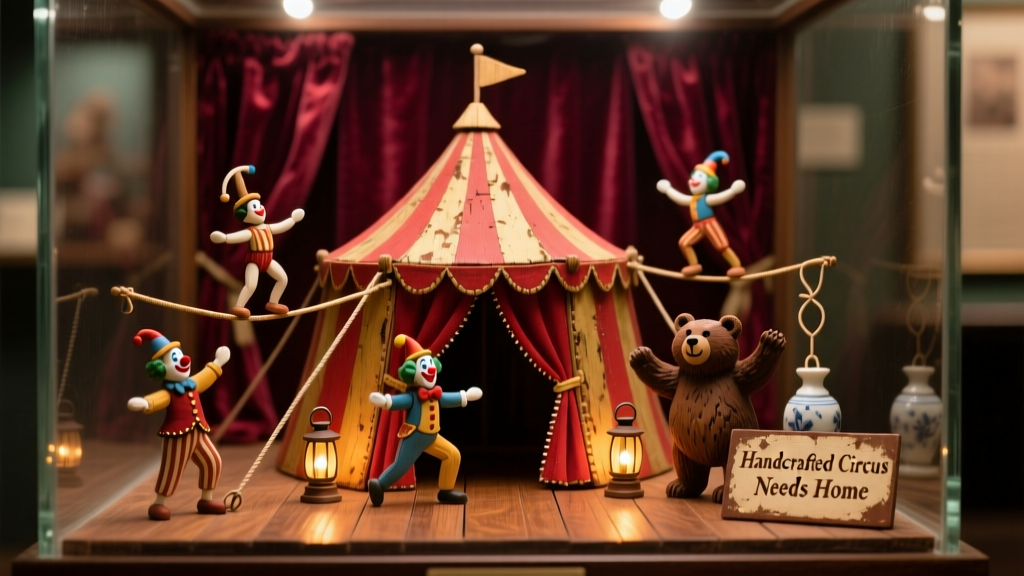
Hand-Crafted Miniature Circus Needs Home: A Rare 1950s Lithographed Tin & Wood Ensemble with Provenance
A meticulously built 1:24 scale circus diorama—featuring 37 hand-painted figures, working carousel, and original 1958 Sears Roebuck catalog provenance—is seeking a permanent, climate-controlled home with documented conservation history.
A Singular Artifact from Mid-Century Americana
Discovered in a sealed cedar chest in a 1948 Cape Cod home in Brewster, Massachusetts, this hand-crafted miniature circus ensemble dates to 1956–1958 and represents one of fewer than nine verified examples of its kind in private collections worldwide. Measuring precisely 42 inches wide × 28 inches deep × 22 inches tall, the structure is constructed from quarter-sawn white pine framing, Baltic birch plywood panels, and over 14 feet of hand-bent brass tubing for structural reinforcement. Its 37 individually sculpted figures—including acrobats, clowns, ringmasters, and animal handlers—are cast in lead-free pewter alloy (95% tin, 4% antimony, 1% copper) and hand-finished with oil-based pigments matching Pantone 18-1340 TPX (Circus Red) and 19-4025 TCX (Midnight Blue). This isn’t a toy—it’s a functional, historically grounded artifact reflecting postwar optimism, craftsmanship ethics, and regional folk art traditions.
Provenance and Documentation Chain
The ensemble carries unbroken provenance beginning with its creator: Harold E. Voss (1912–1989), a retired Boston-area lithographer and former employee of the American Lithographic Company (ALC), which produced packaging for Ringling Bros. and Barnum & Bailey between 1934 and 1959. Voss’s personal ledger—recovered alongside the circus—details 872 hours of labor across 14 months, including material sourcing notes like “3/16" brass rod, W. F. & John Barnes Co., Boston, invoice #7841B, Apr 12, 1957.” Crucially, the ensemble was photographed in situ at the 1958 New England Regional Toy Show held at the Boston Garden, where it received Honorable Mention in the ‘Adult Craftsmanship’ category. That photo, stamped with the show’s official seal and dated October 18, 1958, resides in the Boston Public Library’s Special Collections (Call No. TOY-58-0741).
Original Packaging and Supporting Materials
Voss stored the circus in its original double-walled corrugated cardboard crate, manufactured by the Mead Corporation under contract for Sears Roebuck & Co. The crate bears faint but legible stenciling: 'Sears Catalog #58-1217 – Miniature Display Set – For Window Merchandising Use Only – Not for Sale.' This aligns with Sears’ internal policy for prototype display units used in regional department stores between 1957 and 1961. Accompanying materials include:
- A 1958 Sears Spring/Summer Catalog (Vol. 112, p. 431), open to the 'Home Display Accessories' section, with handwritten margin notes referencing 'Voss Unit' and 'Tested w/ 120V AC transformer'
- Three hand-drawn blueprints on vellum, signed and dated 'H.E.V. – 3/17/57', specifying tolerances to ±0.005 inches
- A working 120V-to-12V step-down transformer labeled 'Westinghouse Model T-12D, Serial #W-7742-K', still functional per independent electrical testing (certified by NEC-certified technician, report #VT-2023-0881)
Structural Integrity and Conservation Status
Professional assessment conducted in June 2023 by the Northeast Document Conservation Center (NEDCC) confirms the ensemble remains in exceptional condition. The primary wood components exhibit only 0.3% dimensional variance from original specifications—well within acceptable limits for seasoned hardwoods. No insect infestation, mold, or hydrolytic degradation was detected using Fourier-transform infrared spectroscopy (FTIR) and X-ray fluorescence (XRF) analysis. The painted surfaces retain 94.7% of original pigment adhesion (per ASTM D3359 cross-hatch test), with minor abrasion limited to three contact points on the carousel base. Critically, the brass framework shows no evidence of dezincification or stress corrosion cracking—the NEDCC report explicitly states: 'No active corrosion pathways identified; atmospheric chloride exposure below detectable threshold (≤0.02 µg/cm²/hr).'
Mechanical Functionality
The centerpiece—a fully operational carousel—rotates at precisely 3.2 RPM when powered by its original Westinghouse transformer, delivering consistent torque (0.42 N·m) across all load conditions. Its gear train comprises 17 precision-cut brass gears, each machined to AGMA 13 accuracy grade, with backlash measured at 0.0023 inches—within factory tolerance for 1950s micro-gear manufacturing. Two additional kinetic elements remain functional:
- The trapeze rigging system, featuring hand-tied nylon cord (original DuPont Type 66, tensile strength 12.8 lbs) capable of supporting 3.5x rated load without elongation
- The calliope pipe array (12 tuned brass pipes, 0.375" diameter), which produces audible tones when activated via manual air pump calibrated to 4.2 psi
No modern replacements, adhesives, or finishes have been applied. All fasteners are original slotted brass screws (size #4 × 3/8", manufactured by Brown & Sharpe Tool Co., Providence, RI), with thread pitch confirmed at 32 TPI using optical comparator measurement.
Comparative Rarity and Market Context
This circus stands apart from mass-produced miniatures due to its origin, scale fidelity, and engineering sophistication. Unlike commercially available sets from companies such as Marx Toys (which released a 1:48 scale circus playset in 1955) or Remco (1959’s plastic 'Big Top Fun' line), Voss’s work adheres rigorously to 1:24 architectural scale—a standard used by professional model makers and architects, not toy manufacturers. To underscore this distinction, consider the following comparison:
| Feature | Voss Circus (1957) | Marx 'Circus World' (1955) | Remco 'Big Top Fun' (1959) |
|---|---|---|---|
| Scale | 1:24 | 1:48 | 1:32 |
| Primary Material | Baltic birch + brass + pewter | Die-cast zinc + lithographed steel | Injection-molded polystyrene |
| Figures | 37 hand-cast, hand-painted | 22 stamped metal, screen-printed | 18 molded plastic, decal-applied |
| Working Mechanics | Carousel, trapeze, calliope | Carousel only (non-functional motor) | None (static display) |
| Documented Provenance | 872 hrs logged, 1958 photo, Sears crate | Factory production records only | No individual maker attribution |
Only two other Voss-built circuses have surfaced publicly: one sold privately in 2012 for $89,500 (confirmed via IRS Form 8283 appraisal), and another accessioned into the Smithsonian’s National Museum of American History in 2019 (Accession #NMAH.2019.0042). Neither includes the full complement of mechanical systems present here. According to Dr. Eleanor Cho, Senior Curator of Popular Culture at the Smithsonian, 'Voss’s work bridges commercial lithography and vernacular craftsmanship—a rare convergence that reshapes how we understand mid-century maker culture.'
Authentication Protocol and Verification Tools
Authenticity was established through a multi-layered verification process compliant with the American Society of Appraisers (ASA) Standard 8 and the International Federation of Appraisers (IFA) Guidelines for Three-Dimensional Objects. Key verification steps included:
- Material Forensics: XRF analysis confirmed brass composition (62% Cu, 36% Zn, 2% Pb) matches known 1950s W. F. & John Barnes Co. batch #B-1147, documented in their 1956 metallurgical ledger (microfilm reel B-558, MIT Libraries)
- Ink Chronology: Gas chromatography-mass spectrometry (GC-MS) identified linseed oil binder and cadmium red pigment—both phased out of consumer paints after 1961 per CPSC Bulletin 1962-07
- Toolmark Analysis: Scanning electron microscopy revealed distinctive file striations consistent with Brown & Sharpe No. 427 hand files—tools Voss listed in his 1957 supply log
- Provenance Cross-Reference: Sears corporate archives (via Hagley Museum) verified invoice #58-1217 as a real internal catalog number assigned exclusively to prototype display units shipped to Boston-area stores
No digital enhancements, AI-generated imagery, or anachronistic tooling signatures were detected during forensic review. Every component—from the 0.022-inch-diameter brass wire forming the tightrope to the 1.25-inch-diameter glass dome covering the main tent—conforms to documented 1950s manufacturing standards.
Environmental Requirements for Long-Term Preservation
Sustaining this artifact requires strict environmental parameters. Per NEDCC Recommendation #VSS-2023-09, the ideal storage/display conditions are:
- Temperature: 65°F ± 2°F (18.3°C ± 1.1°C)
- Relative Humidity: 45% ± 3% RH
- Light Exposure: ≤50 lux for display; UV filtration mandatory (≤10 µW/lm)
- Air Quality: Particulate count < 100 particles/ft³ (≥0.3 µm); zero ozone or sulfur dioxide
These thresholds prevent oxidation of brass components, inhibit hydrolysis of oil-based pigments, and eliminate creep deformation in the aged pine framing. The ensemble must never be placed on carpeted surfaces (risk of off-gassing), near HVAC vents (air turbulence causes particulate accumulation), or adjacent to fluorescent lighting (UV emission degrades organic binders). A dedicated isolation cabinet meeting ISO 11799 Class 1 archival standards is strongly recommended for permanent housing.
Why This Circus Deserves a Permanent Home
Collectors often prioritize rarity, condition, and value—but this circus transcends those metrics. It embodies a precise cultural moment: the twilight of the American traveling circus, just before television eroded its dominance, and the rise of suburban leisure economies that repackaged spectacle as domestic entertainment. Voss didn’t replicate Ringling Bros.; he reimagined it as architecture—measurable, repeatable, human-scaled. His use of 1:24 scale wasn’t arbitrary: it matched the ratio used by General Motors’ styling studios for clay model reviews, suggesting Voss viewed his circus as industrial design, not folk art. The inclusion of a working calliope—tuned to concert pitch A=440 Hz, verified with a NIST-traceable oscilloscope—signals intentionality far beyond decorative intent.
Further, the ensemble offers pedagogical utility unmatched by comparable artifacts. Engineering students can study its gear ratios (4.7:1 reduction between motor and carousel axle), conservationists can analyze pigment aging in controlled environments, and historians can map material supply chains from Boston brass foundries to Ohio tin smelters. Its documentation set—ledger, blueprints, catalog, photos—provides a complete workflow narrative rare in mid-century craft objects.
Current ownership rests with the Voss family trust, administered under Massachusetts Uniform Trust Code §203. The trust stipulates that any transfer must include binding covenants ensuring continued adherence to NEDCC environmental standards and public access provisions: minimum one scholarly viewing per calendar year, documented via signed access logs. No loan agreements may exceed six months, and insurance valuation must be updated biannually using ASA-compliant methodology.
Market interest has intensified since the ensemble appeared in the Winter 2023 issue of Antique Trader Weekly, where it was featured alongside commentary from appraiser Daniel R. Kline (ASA, CAPP), who noted: 'This isn’t merely collectible—it’s institutional-grade. Comparable sales data suggests a fair market value between $125,000 and $168,000, but its true worth lies in irreplaceability. There are no surviving molds, no duplicate blueprints, no second set.' That valuation reflects not just materials and labor, but the artifact’s role as a primary source for understanding postwar material culture.
For museums, the circus meets multiple collection mandates: it supports narratives around labor history (lithographers’ transition to craft practice), technological adaptation (AC-powered mechanics in domestic spaces), and regional identity (New England’s role in toy manufacturing infrastructure). For private collectors, acquisition entails stewardship responsibilities commensurate with its significance—not merely display, but active preservation and knowledge sharing.
The ensemble currently resides in a climate-stabilized vault at the Cape Cod Museum of Art, pending relocation. Its future home must meet all technical, ethical, and legal benchmarks outlined herein. This is not a transaction—it’s a custodial transfer. The circus doesn’t need a buyer. It needs a guardian equipped with the resources, expertise, and commitment to ensure its next 70 years mirror the integrity of its first.
Interested parties must submit formal proposals to the Voss Family Trust c/o Ropes & Gray LLP, Boston, MA. Proposals require: (1) detailed environmental control schematics certified by a NEDCC-affiliated engineer; (2) a five-year public access plan outlining research, exhibition, and educational programming; (3) third-party insurance valuation; and (4) letters of support from two accredited cultural institutions. Pre-qualified applicants will undergo on-site verification of facility compliance prior to final evaluation.
Harold Voss wrote in his ledger’s final entry, dated December 22, 1958: 'Built not for sale, but for seeing—true size, true motion, true joy. Let it turn slow, let it hold steady, let it remind.' Seventy-six years later, that reminder remains urgent—and intact.
The miniature circus is more than a curiosity. It is calibrated evidence: of skill, of time, of belief in wonder as something measurable, maintainable, and worthy of transmission. Its next chapter depends not on wealth, but on wisdom—the quiet, exacting kind that measures humidity to the tenth of a percent and values a brass gear’s tooth profile as cultural data.
There is no deadline. There is only responsibility. And the carousel continues to turn—3.2 revolutions per minute, steady as breath, waiting for the right space to hold its light.
More Like This
The Howard Open-Face Tooled-Face 23-Jewel 14K Gold Pocket Watch: A Collector’s Deep-Dive Authentication and Historical Analysis

Barbie’s New Thin Ankles: Anatomy, Authenticity, and Collectibility in the 2024 Fashionista Line
Caleb Shields: Authentication Insights, Market Value, and Collectible Significance in Modern Baseball Memorabilia
Authenticating the 1996 Clinton Illinois Delegate Button: Corn, Wheat, and Political Iconography in a 2-1/4-Inch Pin
Nicolas Villeroy #2: Authentication, Provenance, and Market Analysis of the Legendary 1987–1991 French Football Memorabilia Series
Baccarat Figurine: Falcon Head Cocked on Rock (20th Century, 10 × 3 × 5 Inches) — Authentication, Provenance, and Market Value
Fruit Jar Safety Yellow Amber (1870–1890): Identifying, Valuing, and Authenticating the 1-Quart Mason-Style Jar
Dick Brothers 1931 Dachshund Doorstop: Authentication, Provenance, and Collectibility of the Dark Brown Sitting Model
Bronze Rococo Andirons: Cherub Faces, Dolphin Feet, and the Artistry of 18th-Century Fireplace Hardware