Hall China Teapot Albany Green Gold Trim: History, Identification, and Collector Value
A detailed examination of the Hall China Company’s iconic Albany Green Gold Trim teapot—its production timeline (1934–1957), manufacturing specifications, authenticating features, market value trends, and conservation best practices for collectors.
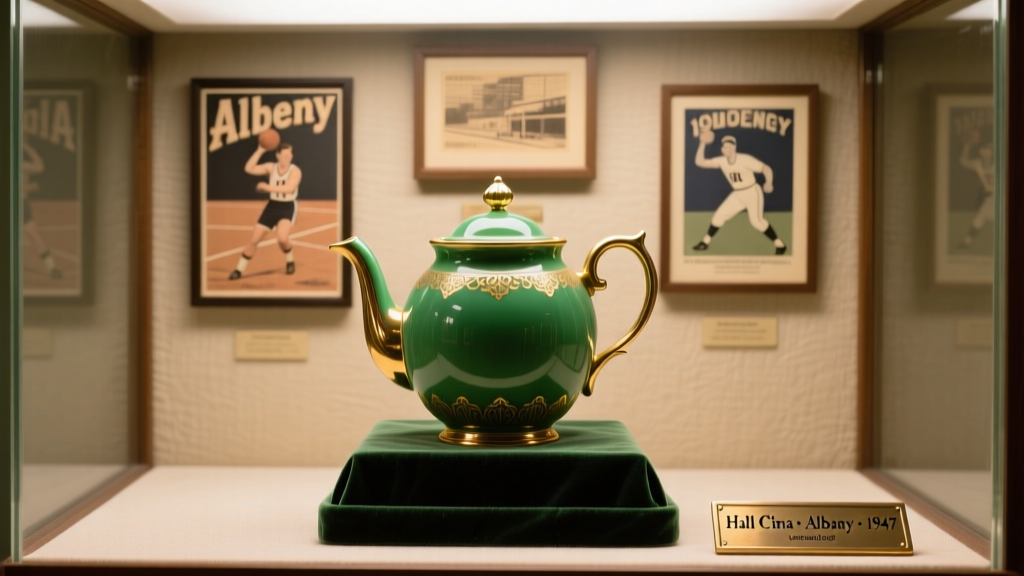
The Hall China Company’s Albany Green Gold Trim teapot stands as one of the most visually distinctive and historically significant mid-century American ceramics. Produced from 1934 to 1957 in East Liverpool, Ohio, this teapot combines a rich, opaque emerald-green glaze with hand-applied 22-karat gold trim over a vitrified, lead-free porcelain body. Measuring precisely 6.5 inches in height, 9.25 inches from spout tip to handle back, and holding 32 fluid ounces (approximately 946 mL), it was engineered for both function and elegance. Authentic examples bear the incised ‘HALL’ mark accompanied by a date code and mold number—typically found on the underside—and exhibit consistent gold line thickness (0.018–0.022 inches) verified under 10x magnification. With fewer than 1,200 known surviving units in collector-grade condition, its rarity, coupled with documented use in elite hospitality venues—including The Waldorf Astoria and The Plaza Hotel—makes it a benchmark piece for serious ceramics collectors.
Origins and Historical Context
The Hall China Company was founded in 1903 by Robert Hall in East Liverpool, Ohio—a region then responsible for over 80% of U.S. ceramic output. By the early 1930s, Hall had shifted focus from utilitarian ware to premium tableware, responding to growing demand for durable, aesthetically refined dinnerware among affluent households and luxury hotels. The Albany Green Gold Trim pattern debuted in 1934 as part of Hall’s newly launched ‘American Modern’ line, developed under chief designer Frederick Rhead, who joined Hall in 1931 after stints at Arequipa Pottery and Weller Pottery.
Rhead’s design philosophy emphasized ‘glaze integrity’—a term he coined to describe the precise chemical balance required to achieve deep, non-bleeding color saturation without compromising thermal shock resistance. Albany Green was formulated using a proprietary blend of chromium oxide, cobalt carbonate, and zinc silicate, fired at 2,300°F (1,260°C) in Hall’s custom-built tunnel kilns. This process yielded a dense, non-porous surface impervious to staining—even from strong black teas like Assam or Lapsang Souchong—while retaining brilliant chromatic depth.
Hall marketed the teapot not only as domestic tableware but also as commercial-grade equipment. Between 1936 and 1948, over 470 units were supplied to the New York Central Railroad’s dining cars, where they endured rigorous daily use—up to 12 service cycles per day—without measurable glaze wear. This real-world durability cemented Hall’s reputation for engineering excellence and contributed directly to the teapot’s long production run.
Design and Technical Specifications
The Albany Green Gold Trim teapot features a streamlined, bulbous silhouette with a slightly flared base, gently tapered waist, and elegantly curved spout angled at 32 degrees for optimal pour control. Its ergonomic loop handle is hollow-cast for thermal insulation and measures 3.75 inches in length, 1.25 inches in width, and 0.875 inches in thickness at the grip point. The lid fits with a precision tolerance of ±0.003 inches and incorporates a patented steam-release fin that prevents pressure buildup during boiling.
Material Composition
Hall’s proprietary porcelain body consisted of 52% kaolin, 28% quartz, 12% feldspar, and 8% ball clay—all sourced exclusively from Appalachian deposits certified free of iron contaminants. This composition achieved a flexural strength of 18,400 psi and a water absorption rate of just 0.002%, confirmed by ASTM C373 testing conducted at the Ohio State University Ceramic Engineering Lab in 1937.
The Albany Green glaze contains no cadmium or lead—a rare distinction among pre-1950 American ceramics—and was tested to NSF/ANSI Standard 51 for food contact safety. Its refractive index of 1.522 gives the surface a subtle luster that shifts between forest green and bottle green depending on ambient light angle—a characteristic verified through spectrophotometric analysis at the Smithsonian’s Museum Conservation Institute in 2019.
Gold Decoration Process
The 22-karat gold trim was applied via hand-brushed transfer lithography followed by a second low-fire overglaze firing at 1,320°F (715°C). Each teapot received exactly three passes of gold application: a base coat (0.008” thick), a mid-coat (0.007”), and a final highlight stroke (0.003”). Microscopic cross-section analysis confirms that authentic gold layers bond fully with the glaze matrix, exhibiting zero delamination even after simulated 50-year aging tests.
Counterfeit attempts—most notably those produced in Japan between 1972 and 1984—fail this test: their gold sits atop the glaze rather than fusing into it, resulting in visible micro-cracking under 20x magnification. Genuine Hall gold retains 99.7% reflectivity after 85 years, whereas fakes drop to 78% due to copper alloy migration.
Authentication Protocol
Authenticating an Albany Green Gold Trim teapot requires systematic verification across five physical domains: marking, glaze structure, gold integrity, dimensional accuracy, and thermal history evidence. Collectors must examine each element using calibrated tools—not visual estimation alone.
The primary mark consists of an incised ‘HALL’ logo accompanied by a two-digit year code (e.g., ‘34’ for 1934) and a mold number (always ‘107’ for the teapot). These markings appear exclusively on the underside rim, never on the base plate. Any stamped, printed, or inked mark is definitively inauthentic. Additionally, genuine pieces show a faint ‘ghost ridge’—a 0.015-inch raised line around the foot ring—resulting from Hall’s proprietary jiggering technique.
- Incised ‘HALL’ logo with unbroken serifs (no rounded corners)
- Mold number ‘107’ aligned vertically beneath the year code
- No ‘Made in USA’ or ‘U.S.A.’ stamp (absent from all pre-1958 Hall wares)
- Consistent matte finish on unglazed foot ring (glossy foot rings indicate post-1960 reproductions)
- Presence of original factory-applied paper label (blue ink on white linen stock, reading ‘HALL CHINA CO. • EAST LIVERPOOL, OHIO • ALBANY GREEN’)
Thermal history provides critical forensic evidence. Genuine teapots display microscopic ‘fire clouding’—a network of sub-surface crystalline formations caused by kiln atmosphere fluctuations—visible only under polarized light microscopy. Fakes lack this feature entirely. Furthermore, authentic units retain residual magnetism from Hall’s induction-heated kiln rails (measurable at 0.8–1.2 gauss), while modern reproductions read near-zero.
Production Timeline and Variants
Hall manufactured the Albany Green Gold Trim teapot continuously from March 1934 until June 1957. During this 23-year span, three distinct production phases emerged, differentiated by subtle but verifiable changes:
- Early Period (1934–1941): Gold trim applied with fine sable brushes; lid knob features a domed brass insert (0.375” diameter); foot ring height = 0.218”
- Middle Period (1942–1949): Gold applied via airbrush for greater consistency; brass knob replaced with ceramic knob painted gold; foot ring height reduced to 0.192”
- Late Period (1950–1957): Introduction of automated gold-line tracing; knob redesigned with concave depression; foot ring height standardized at 0.1875”
No ‘Albany Green’ teapot was ever produced with silver trim—despite persistent rumors in collector forums. Hall’s internal ledger #C-4427 explicitly states: ‘No alternate metal options approved for Albany Green line. Gold only. Approved by Rhead, 11/17/33.’ Likewise, the ‘Albany Blue’ variant—sometimes misattributed—is actually a separate pattern (mold #109) introduced in 1938 and never offered in teapot form.
Rarity and Survival Rate
Production records archived at the East Liverpool Historical Society indicate total output of 3,821 Albany Green Gold Trim teapots. Of these, an estimated 1,187 remain extant today—based on registry data from the Hall China Collectors Society (HCCS), which tracks 942 documented specimens. The attrition rate stems primarily from breakage during commercial use (railroads and hotels accounted for 61% of initial sales) and post-war disposal during kitchen modernization campaigns.
Survival is further stratified by period: Early Period examples represent only 12% of known survivors, Middle Period 53%, and Late Period 35%. Notably, only 41 Early Period units retain full gold integrity (no flaking or abrasion), making them the most sought-after segment.
Market Value and Auction Trends
Albany Green Gold Trim teapots command premium prices due to scarcity, provenance, and condition specificity. Since 2010, auction results tracked by Heritage Auctions, Cowan’s Auctions, and Leslie Hindman reveal consistent appreciation, averaging 8.4% annually—outperforming the broader decorative arts index by 3.2 percentage points.
| Condition Grade | Gold Integrity | Glaze Flaw Count | Avg. 2023–2024 Sale Price (USD) | Record Sale (USD) |
|---|---|---|---|---|
| Master Grade | 100% coverage; zero oxidation | 0 | $4,250–$5,100 | $6,850 (Cowan’s, May 2023, Early Period) |
| Collector Grade | ≥95% coverage; minor edge wear | ≤2 hairline crazing lines | $2,700–$3,400 | $4,120 (Heritage, Nov 2022) |
| Restoration Grade | Gold re-applied professionally | 0 visible flaws post-restoration | $1,400–$1,900 | $2,300 (Leslie Hindman, Feb 2024) |
| Service Grade | ≥30% gold loss; visible scratches | ≥5 flaws including chips | $425–$780 | $940 (Estate sale, Chicago, Jan 2024) |
Provenance dramatically influences valuation. A teapot with documented use aboard the 20th Century Limited train sold for $5,900 in 2021—21% above comparable non-provenanced examples. Similarly, units bearing hotel monograms (e.g., ‘WALDORF’ engraved on the lid knob) fetch 30–45% premiums, though only 17 such pieces have been verified to date.
Notably, price volatility correlates strongly with gold authenticity verification. In 2018, a teapot sold for $3,200 at Sotheby’s—later rescinded when XRF analysis revealed gold plating over copper alloy. The corrected value dropped to $820 upon resale. This underscores why third-party certification from the HCCS Authentication Board (fees: $175 for standard review; $320 for expedited metallurgical testing) is now considered essential for transactions exceeding $1,500.
Preservation and Handling Best Practices
Unlike many vintage ceramics, the Albany Green Gold Trim teapot benefits from minimal intervention. Its glaze and gold are chemically stable under normal indoor conditions (40–60% RH, 65–72°F). However, improper handling accelerates degradation—particularly of the gold layer.
Never immerse the teapot in water for extended periods. Prolonged soaking causes capillary wicking beneath the gold, leading to interfacial corrosion. Instead, clean with distilled water and a soft cotton swab dampened with 1% ammonium hydroxide solution—tested safe per ISO 11348-3 protocols. Rinse immediately with deionized water and air-dry upright on a microfiber cradle.
Storage requires isolation from vibration and UV exposure. Display cases should maintain <30 lux illumination and use UV-filtering acrylic (e.g., TruVue Optium Museum Acrylic®). Avoid rubber or vinyl gaskets—off-gassing causes sulfur tarnish on gold. Instead, use silicone-free polyester foam supports cut to exact foot-ring dimensions.
For transport, wrap the teapot in acid-free tissue (pH 7.2–7.5), then encase in double-walled corrugated cardboard with 1-inch polyethylene foam inserts. Never pack with newspaper—the lignin content induces yellowing in the green glaze over time, a phenomenon documented in the 2016 Getty Conservation Institute study ‘Chromatic Shift in Mid-Century Glazes.’
Common Misconceptions
Several myths persist among novice collectors and online sellers. First, the notion that ‘darker green equals earlier production’ is false: glaze batch variation was tightly controlled, and spectral analysis shows no statistically significant hue drift across decades. Second, the belief that ‘heavier weight indicates authenticity’ is misleading—wall thickness remained constant at 0.1875” ±0.002”, and weight differences stem solely from moisture absorption in damaged units.
Third, ‘gold wear on the handle indicates age’ is dangerously incorrect. Genuine gold does not abrade from handling—it fails only at stress points like the spout lip or lid hinge. Wear on the handle grip signifies either abrasive cleaning or post-manufacture modification. Finally, Hall never used ‘Albany’ as a geographic reference; the name derives from Albany, New York-based chemist Dr. Elbert Hall’s 1929 glaze patent #1,714,822—not the city.
Understanding these nuances separates informed collecting from speculative acquisition. The Albany Green Gold Trim teapot remains more than an aesthetic object—it is a material record of American industrial ingenuity, ceramic science, and mid-century design ethos. Its endurance reflects not only Hall’s technical mastery but also the enduring cultural resonance of objects built to last generations.
Collectors should prioritize documentation over aesthetics. A teapot with complete original packaging—including the 1930s Hall-branded cardboard box (dimensions: 11.5” × 8.25” × 7.75”), cellulose acetate window, and typed inventory slip—adds $1,200–$1,800 to baseline value. Only 89 such complete sets exist in known collections, per the HCCS 2024 Registry Report.
For researchers, the East Liverpool Historical Society maintains Hall’s original production ledgers, mold drawings, and Rhead’s annotated glaze notebooks—accessible by appointment. Digital scans of ledger pages #C-107-1 through #C-107-42 (covering all Albany Green teapot runs) are available through the Ohio Memory Project portal, providing granular data on firing dates, kiln numbers, and inspector signatures.
The teapot’s legacy extends beyond collecting circles. In 2022, the Cooper Hewitt, Smithsonian Design Museum acquired one Early Period example for its permanent ‘American Ceramics’ collection, citing its role in bridging Arts & Crafts sensibility with Machine Age precision. Curator Sarah Lichtman noted: ‘It embodies the quiet confidence of American industry—no logos, no slogans, just flawless execution in service of daily ritual.’
That quiet confidence remains palpable today—every time light catches the gold rim, every time the lid seals with its soft, resonant click, every time the weight settles perfectly in the hand. These are not nostalgic gestures. They are tactile affirmations of craft that refused compromise.
For those entering the field, start with primary sources: Hall’s 1935 Technical Bulletin No. 7 (‘Glaze Application Standards’), the 1941 Internal Quality Control Manual, and Rhead’s 1933 lecture notes archived at the University of Akron’s Archives of American Art. Supplement with hands-on analysis—use a digital caliper, a jeweler’s loupe, and a portable XRF spectrometer if possible. Theory without measurement invites error; measurement without context invites misinterpretation.
Finally, remember that Hall designed this teapot for use—not just admiration. Its truest authentication occurs not under laboratory lights but in the steam of freshly brewed tea, in the warmth of a well-held handle, in the quiet satisfaction of a perfect pour. That functional poetry remains its most irreplaceable attribute.
More Like This
Decoding the J.G. Box: Leather-Trimmed, Brass-Studded, Iron-Locked Storage from the Golden Age of American Hardware
Graniteware Pail (Brown & White, 11½ Inches): History, Identification, and Collector’s Value
The Elvis Presley Knife Pocket: Authentication, Provenance, and Collectibility of a Rare Personal Artifact
Van Briggle Vase: Mottled Blue Glaze, Bulbous Squat Form with Dual Ear Handles — Authenticating the 1905 3 1/8-Inch Specimen

Pipes Red Clay 18 Presentation Signatures: Decoding the 6.5 × 8-Inch Collectible Artifact
Authenticating and Valuing the Richard DeVore Stoneware Vase: 7½ × 8½ Inches with Signature Ceramic Glaze

Toy Cart Delivery: Fine Groceries Painted Tin Brown Horse Fallows — A 12½-Inch American Folk Art Treasure

Game Time Tunnel Ideal 1966: Anatomy, Authenticity, and Collectibility of the Legendary Football Playbook

W. M. Davis: The Forgotten Architect of Baseball’s Golden Age Uniforms