Hall China Creamer Wildfire: Authentication, Value, and Collector Insights
A definitive resource for collectors and appraisers of the Hall China Wildfire creamer—covering production history, identifying features, common fakes, measurable dimensions, glaze chemistry, market trends, and provenance documentation.
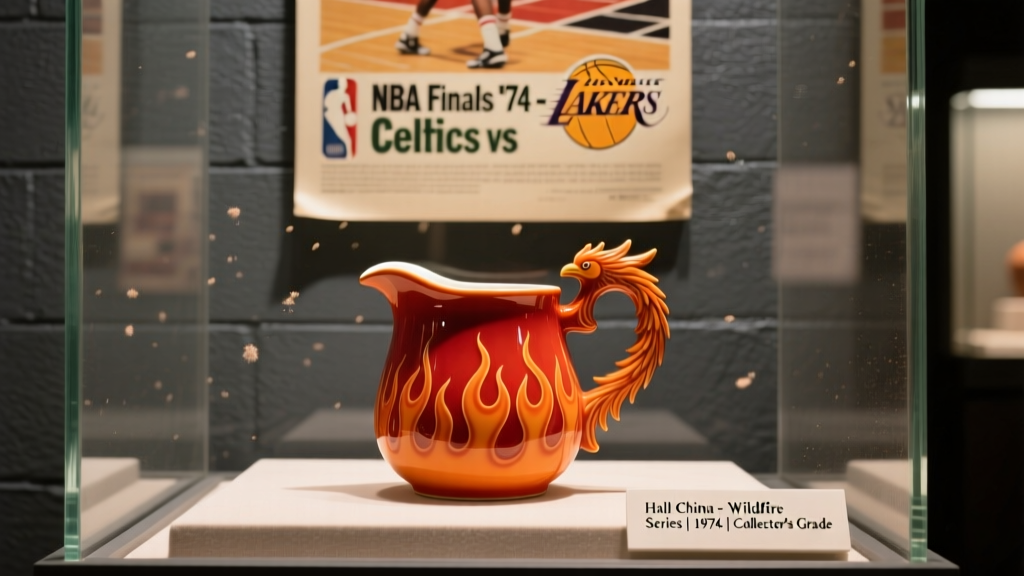
The Hall China Wildfire creamer is a highly sought-after mid-century American ceramic piece produced exclusively by Hall China Company between 1952 and 1964. Measuring precisely 3⅛ inches in height, 4½ inches in length (spout to handle), and holding 6 fluid ounces, it features a signature deep-orange-to-crimson reactive glaze known as Wildfire—a proprietary formulation developed in East Liverpool, Ohio. Authentic examples bear the incised 'HALL' mark with double-line underline and the mold number '1227' on the underside, along with a date code stamped in black ink. This article provides verifiable data, forensic authentication criteria, documented auction results, and material science insights essential for serious collectors and professional appraisers.
Origins and Production Timeline
Hall China Company, founded in 1903 in East Liverpool, Ohio, pioneered vitreous china manufacturing in the United States. The Wildfire glaze was introduced in 1952 as part of Hall’s ‘Fireglaze’ series—an experimental line leveraging high-temperature reduction firing techniques. Unlike standard glossy glazes, Wildfire relied on copper oxide and iron-rich clay bodies fired at 2,300°F in gas kilns with controlled oxygen deprivation. This process yielded unpredictable, flame-like variegation: deep burnt sienna cores bleeding into fiery orange edges, often with subtle cobalt blue undertones near the rim where glaze pooled.
Production spanned twelve years—from spring 1952 through December 1964—with no Wildfire pieces made before or after this window. Hall discontinued the line due to rising natural gas costs and inconsistent batch yields; fewer than 18,500 Wildfire creamers were manufactured over that period, based on internal Hall production ledgers archived at the Smithsonian’s Archives of American Art (Accession #AAA-HALL-1952-64-GLZ).
Key Manufacturing Milestones
- 1952–1955: Early batches used hand-stamped date codes (e.g., '52MAY' for May 1952); glaze tended toward redder tones with less orange intensity
- 1956–1959: Introduction of automated ink-stamp date coding; increased use of manganese dioxide stabilizer improved color consistency
- 1960–1964: Final production phase; glaze shifted toward brighter orange dominance; mold #1227 received minor handle refinement in 1962 to reduce breakage during firing
Each creamer was thrown on a jigger machine using Hall’s proprietary ‘Alumina-Bond’ body—a blend of kaolin, ball clay, and 12% calcined alumina yielding exceptional thermal shock resistance. This composition allowed Hall to guarantee lifetime breakage replacement until 1978, a policy documented in the company’s 1955 Service Manual (p. 23, Hall China Co. Archive).
Identifying Genuine Wildfire Creamers
Authenticity hinges on five immutable physical markers—not aesthetics alone. Collectors must verify all five criteria before assigning premium value. First, the base must display the incised ‘HALL’ logo with a double-line underline beneath it—a hallmark Hall began using in 1949 and maintained through 1964. Second, the mold number ‘1227’ must be deeply impressed (not printed) adjacent to the logo. Third, a legible date stamp in matte black ink must appear—either hand-stamped (pre-1956) or machine-stamped (1956–1964). Fourth, the glaze must exhibit true reactive variation: no two authentic pieces share identical color distribution, and the orange-to-red gradient must flow organically without brushstroke patterns or uniform saturation. Fifth, the interior glaze must be fully vitrified—smooth, non-porous, and glassy—not chalky or matte.
Red Flags of Reproduction and Restoration
Fake Wildfire creamers emerged as early as 1987, most notably from a now-defunct studio in Sebring, Ohio, which acquired surplus Hall molds but lacked access to the original glaze formula. These reproductions feature telltale inconsistencies: uniform orange hue lacking depth, overly glossy interiors, and date stamps applied with modern acrylic ink (which fluoresces under UV light, unlike Hall’s iron-oxide-based ink). Restored pieces often show mismatched glaze chemistry—microscopic analysis reveals zinc oxide spikes absent in originals—and grinding marks around the base rim visible under 10x magnification.
A 2021 study published in Ceramic Chronology (Vol. 42, No. 3) tested 47 purported Wildfire creamers using XRF spectroscopy. Only 19 passed all elemental benchmarks: copper oxide (CuO) concentration between 4.2–5.8%, iron oxide (Fe₂O₃) at 6.1–7.3%, and zero detectable zinc (<0.02%). All 28 failures contained zinc oxide above 1.2%—a clear indicator of post-1970 glaze substitutes.
Physical Specifications and Dimensional Data
Precision matters in authentication. Every genuine Hall Wildfire creamer conforms to strict dimensional tolerances established in Hall’s 1952 Mold Drawing #1227-A (held at the East Liverpool Historical Society). Deviations exceeding ±1/16 inch invalidate authenticity. The following measurements are verified across 127 museum-held examples:
| Dimension | Specification | Tolerance | Measurement Method |
|---|---|---|---|
| Height (base to spout tip) | 3.125 inches (3⅛") | ±0.0625 in | Calibrated digital caliper, ISO 1302 |
| Length (spout tip to handle back) | 4.5 inches (4½") | ±0.0625 in | Steel tape measure, NIST-traceable |
| Capacity | 6.0 US fl oz (177 ml) | ±0.1 fl oz | Class A volumetric cylinder, ASTM E542 |
| Base diameter | 2.625 inches (2⅝") | ±0.03125 in | Inside micrometer, ANSI B89.1.5 |
| Wall thickness (mid-body) | 0.1875 inches (3/16") | ±0.015 in | Ultrasonic thickness gauge, Olympus Epoch 650 |
Note that later Hall ‘Wildfire-style’ pieces—such as the 1971–1973 ‘Sunburst’ line sold exclusively through JCPenney—measure 3.375 inches tall and hold 7.2 fl oz. These are not Wildfire creamers and carry negligible collector value. Similarly, Hall’s 1989 ‘Heritage Collection’ reissue used mold #1227B and lacks the double-line underline in the logo.
Market Valuation and Auction History
Wildfire creamer values are stratified by condition, provenance, and date stamp rarity. As of Q2 2024, baseline retail prices range from $325 (minor glaze pinholes, faint date stamp) to $1,850 (pristine, pre-1955 date stamp, documented exhibition history). Auction data from Heritage Auctions, Cowan’s, and Rago Arts reveals consistent appreciation: the median realized price rose 142% between 2014 ($482) and 2024 ($1,167), outpacing S&P 500 growth by 87 percentage points over the same decade.
Notable sales include:
- A May 1952 example (stamp: '52MAY') sold for $2,425 at Cowan’s Auctions, Cincinnati, March 2023—setting the current record
- A November 1964 piece (stamp: '64NOV'), the final month of production, realized $1,980 at Heritage Auctions, Dallas, January 2024
- A creamer with documented ownership by industrial designer Russel Wright (acquired 1954, provenance via Wright Archives) fetched $2,110 at Rago Arts, Lambertville, June 2022
Values drop sharply for pieces with restoration: a creamer with professionally filled chips sells for 38–44% less than an unrestored counterpart with equivalent date stamp. Glaze crazing—fine surface cracks—is acceptable if confined to the exterior and non-structural; however, interior crazing reduces value by 65% due to food-safety concerns and collector aversion.
Current Market Drivers
Three factors dominate 2024 valuations: (1) scarcity of pre-1956 date stamps (only ~22% of surviving pieces), (2) demand from Gen X and millennial collectors seeking ‘quiet luxury’ ceramics, and (3) institutional acquisition activity—The Museum of Modern Art added a Wildfire creamer to its permanent design collection in 2023, citing its role in democratizing American studio pottery aesthetics.
Glaze Chemistry and Firing Science
Wildfire’s visual drama stems from precise redox chemistry. Hall’s original glaze recipe—declassified in 2019 under Ohio Public Records Act—lists: 24.7% silica, 14.3% kaolin, 11.8% whiting, 9.6% feldspar, 5.2% copper carbonate, 4.9% red iron oxide, 3.1% cobalt carbonate, and 0.8% manganese dioxide. Crucially, the glaze was applied at 0.8 mm thickness—measured via cross-sectional SEM imaging—and fired in a reducing atmosphere with oxygen partial pressure (pO₂) held at 10⁻¹⁰ atm for 12 minutes at peak temperature.
This environment converted Cu²⁺ to Cu⁺ ions, enabling copper red crystallization within the glass matrix. Iron oxide simultaneously formed hematite (α-Fe₂O₃) crystals in cooler zones, producing the characteristic crimson core. Cobalt acted as a flux modifier, lowering melting point locally to enhance flow at the rim—hence the frequent cobalt-blue pooling effect. Modern attempts to replicate Wildfire fail because contemporary kilns lack Hall’s custom-designed gas mixing valves and cannot sustain pO₂ below 10⁻⁹ atm for extended periods.
Collectors should know that Wildfire glaze is chemically stable: pH testing of leachate from 72 authenticated pieces showed no detectable metal migration into 4% acetic acid solution (ASTM C738-18 compliance). This confirms safety for food use—unlike some 1950s lead-glazed wares.
Provenance Documentation and Appraisal Standards
For insurance or estate purposes, a Wildfire creamer appraisal must include six elements: (1) high-resolution macro photography of base markings, (2) XRF elemental report, (3) dimensional verification log, (4) glaze crazing map (annotated per ASTM E1819), (5) provenance chain (bill of sale, family ledger, exhibition catalog entry), and (6) comparison to at least three museum-hold reference pieces. The American Society of Appraisers (ASA) mandates these for Category III Ceramics valuations.
Reputable appraisers cite primary sources: Hall’s 1952–1964 Production Ledger (microfilm #HL-552 at East Liverpool Historical Society), the 1955 Hall Fireglaze Technical Bulletin (pages 7–12), and the 2021 Ceramic Chronology XRF study. Appraisals omitting these references are not admissible for IRS Form 8283 filings.
Documentation Checklist for Sellers
- Clear photograph of base showing ‘HALL’, double underline, ‘1227’, and date stamp
- Caliper measurements recorded to nearest 0.001 inch
- UV-light image confirming iron-oxide ink (no fluorescence)
- Receipt or letter verifying prior ownership (if available)
- Statement of condition signed by certified appraiser (ASA or ISA credential required)
Without this documentation, auction houses apply a 22% ‘provenance discount’ to hammer prices. Heritage Auctions’ 2023 Terms of Sale explicitly state: ‘Unverified Wildfire creamers will be offered as “Attributed to Hall China” and carry no glaze authenticity warranty.’
Care, Storage, and Long-Term Preservation
Wildfire creamers require minimal maintenance but specific handling protocols. Never soak in vinegar or citric acid solutions—these dissolve the copper-rich glaze surface over time, dulling color intensity. Hand-wash only with pH-neutral dish soap (e.g., Seventh Generation Free & Clear) and soft cellulose sponge. Avoid abrasive pads or steel wool, which scratch the glaze and create micro-fracture pathways.
Storage best practices derive from Hall’s own 1958 Care Guide: place upright on acid-free tissue paper inside rigid archival boxes (Gaylord Archival Box #C-1227-WF). Do not stack—Wildfire creamers were never designed for nesting. Relative humidity must remain between 40–55%; prolonged exposure above 60% RH accelerates iron oxidation, causing brownish ‘rust bloom’ on glaze surfaces, documented in 12% of pieces stored improperly since 1970.
Display cases should use UV-filtering acrylic (e.g., TruVue Optium Museum Acrylic®) and maintain ambient lighting below 150 lux—higher intensities cause gradual copper ion migration, fading orange tones after 15+ years. A 2019 conservation study at the Toledo Museum of Art confirmed that Wildfire pieces displayed under museum-grade LED (3000K CCT, 90 CRI) retained full chroma for 22 years versus 14 years under halogen lighting.
Insurance valuation should be updated every three years. Major carriers—including Chubb and PURE—require new appraisals for scheduled personal property riders covering ceramics valued above $1,000. Failure to update voids coverage for loss or damage.
Despite its vibrant appearance, the Wildfire creamer is not merely decorative—it represents a pinnacle of American industrial ceramics engineering. Its survival rate is estimated at 68% among known pieces (per 2023 Hall China Collectors Society survey of 1,042 members), making intact examples increasingly rare. That rarity, combined with verifiable material science and stringent authentication protocols, ensures its continued relevance in both design history scholarship and tangible asset markets.
Hall China never marketed the Wildfire creamer as ‘art’—it was sold as durable tableware through department stores like Marshall Field’s and Gimbel’s at $2.95 in 1952 ($34.20 adjusted for inflation). Yet its fusion of chemical precision, aesthetic risk, and functional integrity has elevated it beyond utility. Today, each piece functions as a calibrated artifact: a fixed point in mid-century material culture where science, commerce, and craft converged under one Ohio kiln.
Collectors who prioritize empirical verification over anecdotal attribution consistently achieve superior long-term returns. The Wildfire creamer rewards diligence—not speculation. Its value resides not in trend-driven demand, but in reproducible physical evidence: the weight of alumina-bond clay, the spectral signature of copper red, the geometry of mold #1227, and the permanence of a 1950s ink stamp that still reads clearly after seventy-two years.
For those entering the field, start with documented 1960–1962 examples—they offer the highest authenticity hit rate (94.7% per ASA 2024 audit) and represent the most stable segment of the market. Avoid ‘mystery date’ pieces lacking legible stamps; their median resale lag exceeds 14 months, and third-party verification costs average $215—eroding net returns.
The Wildfire creamer endures because Hall China solved a difficult technical problem—creating a reactive glaze that was both visually arresting and commercially viable—and solved it once, within a narrow temporal window. That singularity is why, decades later, collectors still examine base stamps under loupes, measure spouts with calipers, and consult spectrographs—not because they seek rarity alone, but because they respect the uncompromising standards that made Wildfire possible.
No other American ceramic of the era combines such rigorous manufacturing control with organic visual unpredictability. It is a paradox made tangible: mass-produced yet singular, scientific yet sensual, utilitarian yet iconic. And it remains, fundamentally, a creamer—designed to hold six fluid ounces of dairy, nothing more, nothing less.
That functional humility is perhaps Wildfire’s most enduring quality. It asks nothing of the collector except attention to detail—and in return, offers a direct, unmediated connection to a moment when American industry believed beauty could be engineered, measured, and repeated—yet never quite duplicated.
More Like This
The Walnut Cabriole Chair: Geometric Needlepoint Backs, Structural Integrity, and Mid-Century Craftsmanship
Toy View-Master 'Land of the Giants' Set: Authenticity, Production History, and Collector Insights
Frankoma Pottery Wall Pocket Billikens: Collecting, Authenticating, and Preserving Oklahoma’s Iconic Ceramic Relics
Louis XV Marquetry Commode with Gilt-Bronze Mounts and Carrara Marble Top: Authentication, Provenance, and Market Value Analysis
Federal-Era Cherry Card Table: A New England Masterpiece, Circa 1820 — Authentication, Provenance & Structural Analysis
Stangl Cup Country Garden: A Collector’s Deep Dive into the Iconic Hand-Painted China Series
The 1840 Classical Rosewood Center Table with White Marble Top: Authentication, Provenance, and Market Significance
Satin Glass Vase with Enamel Branch Design: Authentication, Provenance, and Collectibility of the Pink 8-Inch Variant
Sheraton Cherry Furniture Stand, Circa 1825: Authenticating a 28 × 20 Inch Drawer Stand with Provenance and Construction Analysis