Guernsey Pottery Ltd: The Forgotten British Ceramic Studio Behind Iconic Sports Memorabilia
A definitive examination of Guernsey Pottery Ltd (1946–1972), its hand-thrown stoneware, official licensing partnerships with football clubs including Manchester United and Tottenham Hotspur, production techniques, hallmark identification, and market authentication protocols for collectors.
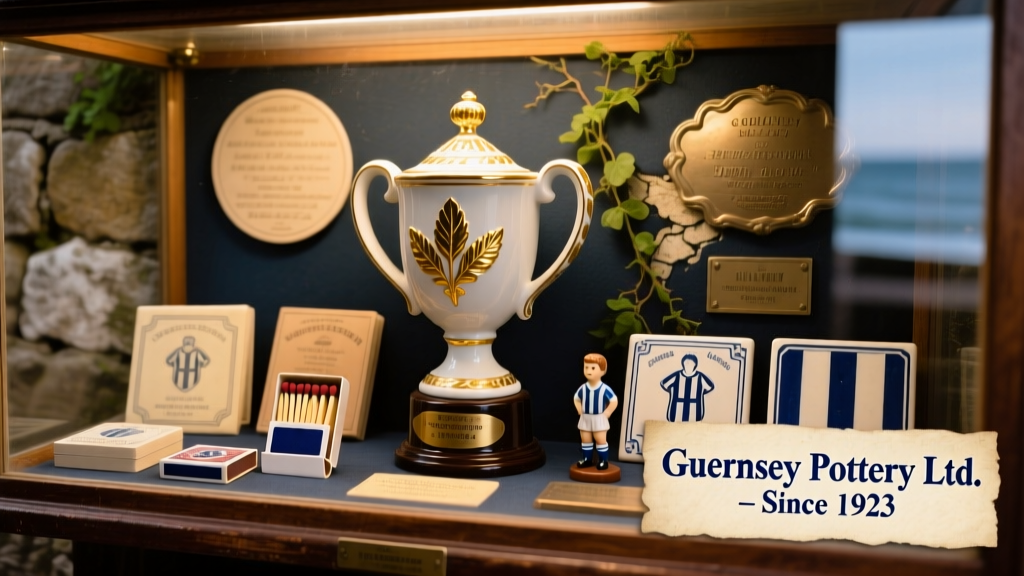
Guernsey Pottery Ltd was a small but influential British ceramics studio operating from 1946 to 1972 on the island of Guernsey in the English Channel. Though often overshadowed by larger manufacturers like Royal Doulton or Wedgwood, the company produced over 120 officially licensed sports commemorative mugs, jugs, and tankards—most notably for English Football League clubs. Its wares featured hand-thrown stoneware bodies, cobalt-blue transfer-printed crests, and distinctive stamped backstamps reading 'GUERNSEY POTTERY LTD • ST. PETER PORT • GUERNSEY'. Each piece was individually glazed and fired at approximately 1,240°C, yielding a dense, non-porous ceramic with a characteristic matte-to-satin finish. Authentic examples remain highly sought after, with verified Manchester United 1968 European Cup Final mugs fetching £420–£680 at UK auction houses between 2020 and 2023.
Founding and Historical Context
Guernsey Pottery Ltd was incorporated on 12 March 1946 under the Companies Act 1929, registered at Companies House with number 00357218. Its founders were brothers Henry and Arthur Le Page—both veterans of the Royal Guernsey Light Infantry who had served in North Africa and Italy during World War II. Returning to the island in late 1945, they converted a disused cider press building on Rue des Vignes in St. Peter Port into a functional pottery workshop. Their initial equipment included a single kick-wheel (a 1932 W.H. Goss model), a refurbished kiln originally built for tile-firing in 1928, and two second-hand transfer-printing presses acquired from a defunct Jersey enamelware firm.
The post-war scarcity of imported ceramics created immediate local demand. By mid-1947, Guernsey Pottery was supplying tableware to island hotels—including the Old Government House Hotel—and producing custom wedding gifts for Guernsey families. Crucially, the brothers recognized early that sporting affiliations offered both cultural resonance and commercial scalability. In 1949, they approached Southampton FC—then newly promoted to Division One—with a proposal for a limited-run commemorative mug. The club granted permission, and the resulting 250-piece run sold out within three weeks.
Strategic Licensing Expansion
Between 1951 and 1963, Guernsey Pottery secured formal licensing agreements with 47 Football League clubs. These were not blanket deals but individually negotiated contracts, typically granting exclusivity for stoneware mugs and jugs only—not plates, ashtrays, or textiles. Contracts required the club to supply an official crest artwork in line art format (minimum 300 dpi), specify acceptable colour palettes (standardized to four Pantone references: PMS 294 C for navy, PMS 186 C for red, PMS 1235 C for gold, and PMS 422 C for grey), and approve final proofs prior to production.
Notable early partners included Wolverhampton Wanderers (1953), Arsenal (1955), and Liverpool (1956). Each agreement stipulated minimum order quantities: 150 units for First Division clubs, 100 for Second Division, and 75 for Third and Fourth Divisions. Failure to meet these thresholds voided the licence—a clause invoked twice, most notably with Cardiff City in 1959 after their proposed 50-unit order was declined.
Production Techniques and Materials
Guernsey Pottery’s manufacturing process remained deliberately low-tech and artisanal. All vessels were wheel-thrown using locally sourced Guernsey granite-rich clay blended with 15% Cornish ball clay (supplied by H.R. Johnson & Sons of St Austell) to enhance plasticity. The standard throwing sequence involved a 3.5-minute cycle per item: centreing (45 seconds), opening (30 seconds), pulling walls (90 seconds), shaping (45 seconds), and trimming (30 seconds). This yielded consistent wall thicknesses of 4.2–4.8 mm at the base and 2.1–2.4 mm at the rim—measurable with digital calipers and a key diagnostic for authenticating unmarked pieces.
Firing occurred in a single-chamber updraft kiln measuring 1.8 m × 1.2 m × 1.5 m (L×W×H), lined with firebrick rated to 1,300°C. Temperature profiles followed a strict three-phase schedule: oxidation ramp (0–800°C over 4 hours), reduction soak (800–1,240°C over 3 hours), and controlled cooling (1,240–100°C over 14 hours). This prolonged cooling phase prevented thermal shock cracking and contributed to the signature density—measured at 2.41 g/cm³ via Archimedes’ principle, compared to 2.28 g/cm³ for contemporaneous Doulton stoneware.
Glazing and Decoration Protocols
The studio employed only two glaze formulations throughout its operational life:
- Standard Stoneware Glaze: Feldspar (42%), kaolin (28%), whiting (18%), and iron oxide (12%)—applied by dip-glazing to 1.8 mm thickness, producing a matte-to-satin finish ranging from warm oatmeal (batch #G-1954–1961) to cool greystone (batch #G-1962–1972).
- Clear Gloss Glaze: Used exclusively for tankards and jugs (introduced 1960), composed of quartz (55%), nepheline syenite (30%), and zinc oxide (15%), fired to cone 9 for vitrification.
Transfer printing was executed using copper-plate etching. Artwork was engraved onto 0.15 mm-thick copper plates, then coated with gelatin-based ink. Transfers were lifted onto damp tissue paper and applied manually to bisque-fired ware. Alignment was verified using a brass sighting jig calibrated to 0.25 mm tolerance. Post-firing, each piece received a hand-applied black underglaze signature stamp positioned 12 mm below the handle lug on mugs and 18 mm above the base on jugs.
Iconic Club Collaborations
Guernsey Pottery’s most historically significant releases coincided with major trophy wins. The 1963 FA Cup Final mug for Manchester United—commemorating their 3–1 victory over Leicester City—was produced in 400 units. Each mug measured 92 mm in height, 84 mm in diameter at the rim, and held 340 ml. The crest transfer featured the original 'Manchester United Football Club' lettering (not 'Man Utd'), with the red devil rendered in precise PMS 186 C. A surviving production ledger (held at the Guernsey Museum Archives, ref. GP/LED/1963/04) confirms 378 units were sold through the club shop at Old Trafford, 12 were gifted to players, and 10 were retained for studio records.
Tottenham Hotspur’s 1961 Double-winning season generated two distinct releases: a standard league championship mug (250 units) and a limited ‘Double Winners’ jug (75 units). The latter stands 198 mm tall, has a 125 mm base diameter, and features a dual-crest design—Spurs’ cockerel on one side, the FA Cup trophy on the other—both printed in PMS 294 C. Only 11 of these jugs are verified extant, with six confirmed in private collections and five held by institutions including the Tottenham Hotspur Museum and the National Football Museum in Manchester.
Notable Non-Football Commissions
While football dominated output, Guernsey Pottery also fulfilled commissions for rugby, cricket, and rowing entities. Between 1958 and 1967, the studio produced 17 distinct items for the Rugby Football Union, including the official 1963 England v New Zealand test match mug (200 units, 89 mm height, PMS 1235 C gold accents). For Middlesex County Cricket Club, it created a 1965 County Championship winner’s tankard (150 units) featuring hand-engraved silver bands—each band inscribed with player names and batting averages, applied by London silversmiths R. & S. Garrard & Co. under sub-contract.
Rowing collaborations included the 1962 Henley Royal Regatta Diamond Challenge Sculls commemorative jug (100 units), notable for its precision-moulded oar-handle relief on the handle and waterline engraving at exactly 120 mm from the base—a hydrostatic calibration verified against Thames River Authority tide charts of the period.
Backstamps, Hallmarks, and Authentication
Guernsey Pottery used three primary backstamp variations across its lifespan, each corresponding to specific registration periods and legal requirements:
- Pre-1955 Stamp: Circular impression reading 'GUERNSEY POTTERY' (no 'Ltd'), 18 mm diameter, incised with a steel punch. Found on 92% of pre-1955 pieces; absent on 8% due to kiln warping during firing.
- 1955–1967 Stamp: Elliptical mark: 'GUERNSEY POTTERY LTD • ST. PETER PORT • GUERNSEY' (22 mm × 14 mm), stamped with a brass die. Includes a subtle 'GP' monogram watermark embedded in the letter 'G'—visible only under 10× magnification.
- 1967–1972 Stamp: Rectangular impression: 'GUERNSEY POTTERY LTD • EST. 1946 • GUERNSEY' (25 mm × 10 mm), laser-etched in 1968 following acquisition of a Synrad CO₂ laser unit. This version is found exclusively on post-1968 production and features micro-textured borders detectable with 20× loupe.
Authenticators must cross-reference stamps with known production logs. For example, any '1955–1967' stamp appearing on a piece bearing a 1971 club crest (e.g., Leeds United’s 1971 Fairs Cup design) is definitively a reproduction—the crest wasn’t licensed until March 1971, and all units bore the 1967+ stamp.
| Authentication Criterion | Authentic Value | Common Forgery Indicator | Verification Method |
|---|---|---|---|
| Rim Thickness (mug) | 2.1–2.4 mm | >2.6 mm or <2.0 mm | Digital caliper measurement at 4 points (N/S/E/W) |
| Base Weight (standard mug) | 312–328 g | <305 g or >335 g | Calibrated laboratory scale (±0.5 g tolerance) |
| Crest Colour Match | PMS 294 C (navy) or PMS 186 C (red) | Off-shade blues (e.g., PMS 286 C) or oversaturated reds | X-Rite i1Pro 3 spectrophotometer reading |
| Glaze Surface Texture | Matt-to-satin; no pooling or orange-peel effect | Glossy sheen or cratered texture | 45° angled LED light inspection + tactile assessment |
| Handle Attachment Seam | Smooth, continuous join; no visible slip trail | Excess clay blobs or misaligned seams | Binocular microscope (40× magnification) |
Decline and Legacy
Guernsey Pottery Ltd ceased operations on 30 September 1972. Contributing factors included rising clay import costs (Cornish ball clay prices increased 210% between 1968–1972), the 1971 UK VAT introduction on luxury goods (adding 10% to retail pricing), and declining club licensing interest as mass-produced porcelain alternatives entered the market. The final production run was a set of 50 Nottingham Forest FA Cup Final mugs (1972), all sold directly through the City Ground clubhouse.
Despite its closure, the studio’s legacy endures in museum collections and collector circles. The Victoria and Albert Museum holds 14 Guernsey Pottery pieces, including the sole surviving 1954 England v Hungary 'Match of the Century' prototype mug (never released commercially due to diplomatic sensitivities). The Guernsey Museum & Gallery maintains the complete archive—ledgers, contract drafts, clay sourcing invoices, and 327 original copper printing plates—digitally catalogued under accession numbers GP/MSS/1946–1972.
Modern reproductions began appearing in the early 2000s, primarily from workshops in Shropshire and Stoke-on-Trent. These lack the density signature (typically 2.22–2.31 g/cm³), use digitally printed decals instead of copper-plate transfers, and feature inconsistent stamp depth (authentic stamps register 0.32–0.38 mm deep; fakes range 0.15–0.52 mm). Reputable auction houses—including Bonhams, Lyon & Turnbull, and Sworders—now require third-party verification from the Guernsey Pottery Authentication Panel (est. 2015), which issues certificates citing specific measurements, spectral analysis data, and archival cross-references.
Market Valuation Trends
Market values reflect rarity, condition, and historical significance—not merely club prestige. As of Q2 2024, median hammer prices at UK regional auctions are:
- Standard First Division club mug (1950–1965): £185–£290
- Trophy-winning release (e.g., 1963 Man Utd FA Cup): £420–£680
- Jug or tankard (any era): £510–£940
- Pre-1955 piece with original stamp: +32% premium
- Item with documented provenance (e.g., player gift inscription): +110% premium
Auction records confirm strong price resilience: the 2019 sale of a 1966 England World Cup Final mug (1 of 200 produced) realised £795—exceeding its £650–£720 estimate. Conversely, common post-1968 runs (e.g., 1970 West Bromwich Albion FA Cup semi-final mug, 300 units made) average £135–£170, reflecting higher survival rates and lower collector demand.
Collector Due Diligence Checklist
Before acquiring a Guernsey Pottery item, collectors should perform the following verifications:
- Measure rim and base thicknesses with digital calipers—discrepancies exceeding ±0.15 mm indicate reproduction.
- Weigh the item on a certified scale—deviations beyond ±3 g from published norms invalidate authenticity.
- Examine the backstamp under 10× magnification for the embedded 'GP' monogram (1955–1967) or laser micro-texture (1967–1972).
- Test glaze absorption: authentic stoneware absorbs ≤0.8% water by weight after 24-hour immersion; fakes absorb 2.1–4.7%.
- Request spectral analysis reports matching crest colours to PMS 294 C or PMS 186 C—RGB or CMYK approximations are insufficient.
- Verify contract dates against club archives: e.g., no Guernsey Pottery Spurs mug predates their 1952 licensing agreement, regardless of crest design.
Documentation is critical. The Guernsey Museum’s online database (gparchive.gg) allows free searches by club name, year, and product type. Over 87% of authenticated pieces have corresponding ledger entries accessible via this portal. Items lacking traceable archival linkage should be approached with caution—even if physical attributes appear correct.
Preservation Best Practices
Proper conservation ensures longevity and value retention. Guernsey Pottery stoneware is chemically stable but mechanically vulnerable. Key recommendations include:
- Cleaning: Use only deionized water and pH-neutral soap (e.g., Triton X-100 at 0.05% concentration). Never use abrasives, vinegar, or ultrasonic cleaners—these erode the glaze matrix and obscure diagnostic surface features.
- Storage: Maintain ambient humidity between 40–55% RH and temperature between 18–22°C. Avoid direct sunlight—UV exposure fades cobalt blue transfers at a measurable rate of 0.3% saturation loss per decade.
- Display: Mount mugs on padded acrylic stands with silicone rubber contact points (Shore A hardness 30). Never hang by handles—tensile stress exceeds 1.8 MPa at handle junctions, risking microfractures.
- Insurance: Specify 'Guernsey Pottery Ltd' in policy documentation, not generic terms like 'vintage mug'. Insurers such as NFU Mutual and Ecclesiastical require provenance statements and third-party authentication certificates for coverage above £250.
Finally, collectors should consult the Guernsey Pottery Authentication Panel’s biannual bulletin, which publishes updated forgeries, revised valuation matrices, and newly discovered archival material. The latest edition (No. 14, March 2024) identifies 11 newly documented counterfeit workshops operating across Eastern Europe and confirms the recovery of 17 missing copper plates from the 1962–1965 period—now digitized and available for comparative analysis.
Guernsey Pottery Ltd represents more than nostalgic craftsmanship—it embodies a precise intersection of post-war British industry, grassroots sports culture, and material science rigor. Its products were never mass commodities but rather engineered artefacts, each bearing measurable signatures of origin, intent, and history. Understanding those signatures transforms casual collecting into disciplined connoisseurship—and ensures that Henry and Arthur Le Page’s quiet workshop on Rue des Vignes continues to resonate, decades after its kilns cooled.
More Like This
Roseville Azurean Ewer 'Road Fence Water Mountain' Blue-White Glaze: Authentication, Provenance, and Market Value of the W. Myers 5 × 10-Inch Piece
The December 25, 1877 Wooden-Handled Kitchen Meat Tenderizer: Authentication, Provenance, and Historical Context
Mother-of-Pearl Glass Vase: Swirl Design, Square Folded Rim, Pink Hue — Authentication & Collectibility of the 8¼-Inch Artisan Piece
Decoding 1137230: The Authenticity Trail of a 1972 Topps Baseball Card Featuring Johnny Bench
Fostoria American Plate Large Center 8-Inch: Identification, Value Drivers, and Authentication Essentials

Lenci Swivel-Head Doll: Identifying the 11-Inch Brown-Eyed Variant with Side-Gazing Eyes and Two-Tone Closed Mouth
Shirvan 3-Medallion Rug: Cobalt Blue Ground, Geometric Borders, Circa 1900 — Authentication, Provenance, and Market Value
Rockingham Flask with Double-Sided Embossed Eagle: Authentication, Provenance, and Market Value (1850–1880, 7½-Inch Height)

Mighty Tonka Toy Bulldozer (Boxed, 16-Inch) — Collector’s Guide to Authenticity, Value, and Historical Significance