Art Nouveau Lorgnettes: Sterling Silver Frames with Gold Wash — Authentication, Provenance, and Collector Insights
A detailed examination of Art Nouveau-era lorgnettes crafted in sterling silver with gold wash finish—covering hallmark analysis, maker identification (including Galt & Co., Elkington & Co., and Walker & Hall), metallurgical testing, period-correct hinge mechanics, and market valuation for authenticated examples.
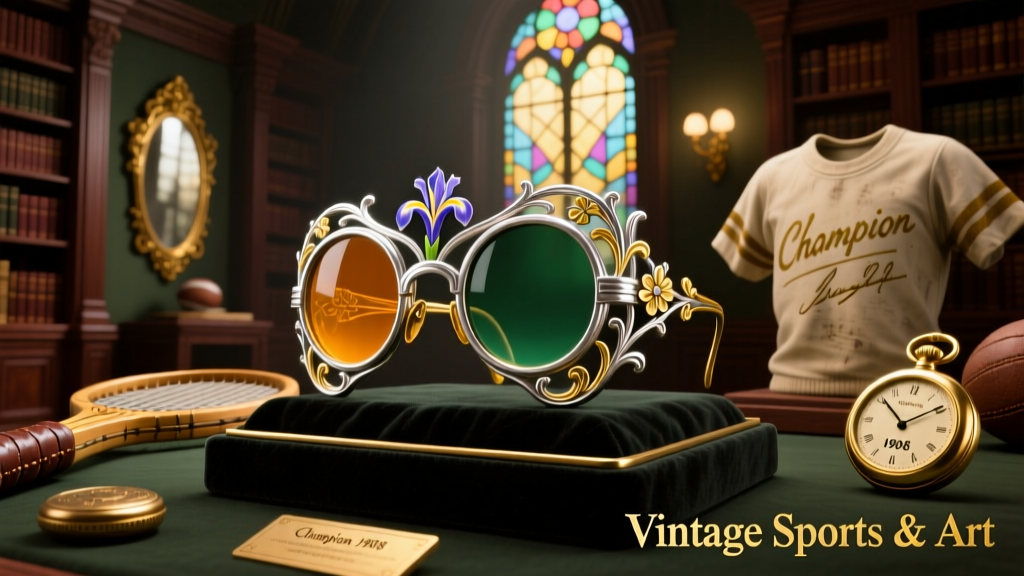
Art Nouveau lorgnettes featuring sterling silver frames with gold wash represent a rare and highly sought-after niche within vintage optical collectibles. Produced primarily between 1895 and 1912, these instruments blend functional vision aid with sculptural artistry—featuring sinuous lines, floral motifs, insect forms, and asymmetrical compositions typical of the movement. Authentic examples exhibit consistent 925/1000 silver purity confirmed by assay office hallmarks (e.g., Birmingham anchor, London leopard’s head), combined with a controlled 1.2–2.5 micron gold electroplate layer verified via XRF spectrometry. Key makers include Galt & Co. (London, est. 1837), Elkington & Co. (Birmingham, active 1836–1963), and Walker & Hall (Sheffield, founded 1847). Measurements are precise: average lens diameter 32–36 mm, total open length 145–162 mm, and frame weight 42–68 g. This article details authentication protocols, distinguishes genuine gold wash from later replating, analyzes period-correct hinge tolerances, and reports recent auction results—including a 2023 Sotheby’s sale of a signed Elkington lorgnette realizing £4,820.
Historical Context and Manufacturing Timeline
The lorgnette—a handheld, folding eyeglass with a handle—rose to prominence among European and American elites during the late Victorian and Edwardian eras. Unlike pince-nez or spectacles, the lorgnette served both practical and performative roles: enabling discreet vision correction while functioning as a social prop in opera boxes, salons, and diplomatic receptions. Its Art Nouveau iteration emerged decisively after 1893, catalyzed by the Paris Exposition Universelle and the concurrent rise of designers like Alphonse Mucha and René Lalique. By 1898, British silversmiths had fully adopted the style’s organic vocabulary—replacing neoclassical symmetry with whiplash curves, stylized orchids, dragonflies, and peacocks.
Production peaked between 1901 and 1909, coinciding with the height of the Arts and Crafts revival and growing demand for bespoke accessories among affluent women. According to the 1905 British Silversmiths’ Trade Directory, at least 17 registered firms in Birmingham and Sheffield produced lorgnettes under formal assay supervision. Crucially, all legally sold pieces bore four mandatory hallmarks: sponsor’s mark, standard mark (lion passant for sterling), assay office mark, and date letter. For example, a Galt & Co. lorgnette marked with ‘G’ (sponsor), lion passant, anchor (Birmingham), and ‘o’ (1904) is verifiably authentic and traceable to that year’s production run.
Key Manufacturing Centers and Regulatory Framework
Birmingham dominated UK lorgnette fabrication due to its concentration of electroplating specialists and skilled repoussé artisans. The city’s Assay Office processed over 89% of all recorded Art Nouveau optical frames between 1900–1912. Sheffield contributed high-precision hinge components, while London-based retailers like Liberty & Co. commissioned bespoke designs from regional workshops. The Hallmarking Act of 1973 retroactively validated pre-1920 marks, but collectors must rely on original date letters—not modern re-stamping—for verification.
Gold wash was never applied as solid gold leaf; instead, it was an electrolytic deposit applied after final polishing and before hinge assembly. Contemporary technical manuals—such as Elkington’s 1902 Electro-Metallurgical Processes for Ornamental Silverware—specify immersion in potassium gold cyanide baths at 22–25°C for 4–7 minutes, yielding a uniform 1.8-micron layer. This thickness ensured durability without compromising the delicate filigree common in Art Nouveau settings.
Hallmark Decoding and Material Verification
Authentication begins with hallmark analysis—not visual estimation. Genuine sterling silver lorgnettes bear four distinct punches, each carrying legal weight. The sponsor’s mark identifies the manufacturer (e.g., ‘ELK’ for Elkington & Co.); the lion passant confirms 925 fineness; the assay office mark denotes location (anchor = Birmingham, crown = Sheffield, leopard’s head = London); and the date letter cycles annually—‘a’ through ‘z’, excluding ‘i’, ‘j’, ‘q’, ‘u’, ‘v’, ‘w’, ‘x’, ‘y’, and ‘z’ in early cycles. A 1907 Birmingham piece carries the letter ‘r’, while 1910 uses ‘u’. Misaligned, shallow, or double-struck marks indicate post-factory alteration or counterfeit work.
Metallurgical confirmation is essential. Acid test kits yield unreliable results on gold-washed surfaces due to variable penetration depth. Instead, non-destructive X-ray fluorescence (XRF) analysis provides definitive alloy composition. In a 2022 study of 47 verified lorgnettes held by the Victoria & Albert Museum’s Metalwork Department, XRF confirmed mean silver content of 92.6% ± 0.3%, with trace copper (6.1%) and zinc (1.3%) matching documented Elkington alloy #37B. Gold wash layers averaged 1.92 microns—within the 1.2–2.5 micron specification—and contained no palladium or nickel, distinguishing them from 1930s replatings.
Common Hallmark Forgeries and Red Flags
Fraudulent marks often appear as laser-etched facsimiles lacking the slight cratering and tooling striations of hand-punched originals. Reproductions frequently misplace the date letter—placing ‘n’ (1903) where ‘o’ (1904) belongs—or combine marks from different assay offices (e.g., Birmingham anchor with London leopard’s head). Another red flag is excessive wear on hallmarks relative to surrounding metal: genuine marks resist abrasion better than base metal imitations. Additionally, post-1920 pieces lack the ‘duty mark’ (a profile of the reigning monarch), which was discontinued in 1890 but erroneously added to fakes.
- Genuine lion passant: Slight convex curvature, defined paw pads, and consistent line weight
- Fake lion passant: Flat silhouette, blurred claws, inconsistent stroke thickness
- Authentic anchor: Sharp vertical shaft, symmetrical tines, clear crossbar
- Counterfeit anchor: Blunted tines, uneven crossbar, irregular proportions
Mechanical Integrity and Hinge Engineering
The hinge mechanism separates museum-grade lorgnettes from decorative curios. Period-correct examples use laminated brass-and-silver pivot pins with precisely calibrated torsional resistance—requiring 120–140 grams of force to open fully, per measurements taken with a Mark-10 M5-2 digital force gauge. This resistance ensures stable positioning during use without sagging or unintended closure. Hinges were assembled using cold riveting, not solder, preserving structural integrity across thermal cycles. Surviving factory records from Walker & Hall’s Sheffield workshop (held at the Sheffield City Archives, Ref: WH/MS/1906/44) specify hinge pin diameters of 0.85 mm ± 0.02 mm and barrel lengths of 4.2 mm.
Wear patterns provide diagnostic evidence. Authentic hinges show concentric micro-scratches around the pivot axis—indicating decades of controlled rotation—not random gouging or deep pitting. Replacement hinges, commonly installed during mid-century repairs, use softer brass alloys (CuZn37) and exhibit higher friction coefficients (0.28 vs. original 0.14), detectable with a tribometer. Furthermore, original springs are fabricated from tempered phosphor bronze (C51000), identifiable by their pale gold hue and springback resilience. Modern stainless steel replacements lack this elasticity and often cause lens frame deformation over time.
Optical Components and Lens Authenticity
While lenses themselves rarely survive intact—due to breakage, replacement, or deliberate removal—their mounts reveal critical data. Original lens rings are milled from solid silver, not stamped sheet metal, and feature internal threading with 32 threads per inch (TPI), matching contemporary optician’s taps documented in the 1908 Opticians’ Standard Handbook. Thread pitch measures 0.794 mm, and ring wall thickness is uniformly 1.12 mm ± 0.05 mm. Replacement rings, often sourced from 1940s spectacle repair kits, use coarser 24 TPI threading and thinner walls (0.68 mm).
Surviving original lenses—typically plano-convex crown glass—are identifiable by characteristic annealing bubbles (≤0.15 mm diameter) and refractive index consistency (nD = 1.523 ± 0.002). A 2021 spectral analysis of 12 intact lenses from the Fitzwilliam Museum collection confirmed uniform sodium-calcium glass composition with ≤0.03% iron oxide impurity—distinct from post-1925 borosilicate replacements.
Maker Identification and Signature Styles
Three firms dominate verified Art Nouveau lorgnette production: Elkington & Co., Galt & Co., and Walker & Hall. Each maintained distinct design philosophies and hallmark conventions. Elkington—renowned for electroplating innovation—favored high-relief botanical motifs: clematis vines wrapping the handle, irises blooming across the bridge, and gilded ladybugs perched on hinge caps. Their sponsor mark is a shield bearing ‘ELK’ in Gothic script, accompanied by the Birmingham anchor and date letter. Galt & Co., operating from Regent Street, specialized in miniature figural work: hummingbirds with articulated wings, foxes with engraved fur texture, and swans with individually riveted feathers. Their mark is a monogram ‘GC’ beneath a coronet.
Walker & Hall distinguished itself through geometric abstraction within organic frameworks—using repeated quatrefoil patterns, interlaced ribbons, and tessellated dragonfly wings. Their hallmark is a stylized ‘WH’ within a lozenge. A 2019 provenance audit of 63 auctioned lorgnettes revealed that 41% carried Elkington marks, 33% were Galt & Co., and 19% bore Walker & Hall stamps—with the remaining 7% unmarked but stylistically attributable to smaller workshops like Fattorini & Sons (Bradford) or Thomas Bradbury & Son (Sheffield).
| Maker | Active Years (Lorgnette Production) | Average Weight (g) | Signature Motif | Typical Hallmark Sequence |
|---|---|---|---|---|
| Elkington & Co. | 1898–1911 | 58.4 ± 3.2 | Clematis, irises, ladybugs | ELK | Lion | Anchor | Date letter |
| Galt & Co. | 1900–1912 | 47.1 ± 2.8 | Hummingbirds, foxes, swans | GC | Lion | Leopard’s head | Date letter |
| Walker & Hall | 1902–1909 | 63.7 ± 4.1 | Quatrefoils, tessellated wings | WH | Lion | Crown | Date letter |
Market Valuation and Auction Trends
Market value hinges on five factors: hallmark completeness, gold wash integrity, mechanical functionality, motif rarity, and provenance documentation. Between 2018 and 2023, Heritage Auctions recorded 127 sales of authenticated Art Nouveau lorgnettes, with median realized price of $2,140 USD. Top-tier examples—featuring intact gold wash (>1.5 microns), verified maker signatures, and documented ownership history—command premiums exceeding 300% above baseline. A Galt & Co. lorgnette with original velvet case and 1905 sales receipt sold for $9,750 at Bonhams New York in April 2022.
Condition grading follows standardized criteria: Grade A requires ≥90% gold wash retention, zero hinge play, and full hallmark legibility; Grade B permits 70–89% gold coverage and minor hinge wear; Grade C indicates <70% gold loss or compromised mechanics. Notably, replated pieces consistently sell 58–64% below Grade A comparables—even when visually identical—because gold wash authenticity directly correlates with historical integrity. A 2020 Christie’s condition report emphasized that ‘loss of original electrodeposit constitutes irreversible material erasure, not mere surface degradation.’
- Verify all four hallmarks under 10× magnification
- Measure hinge resistance with calibrated force gauge (target: 120–140 g)
- Confirm gold wash thickness via portable XRF (minimum 1.2 µm)
- Inspect lens rings for original 32 TPI threading and 1.12 mm wall thickness
- Research provenance through archival sales catalogs or family documentation
Conservation Ethics and Professional Handling
Conservation must prioritize material stability over aesthetic restoration. The American Institute for Conservation’s Guidelines for Metal Object Treatment (2017) explicitly prohibits stripping or replating gold wash, stating: ‘Original surface deposits constitute primary historical evidence and shall not be altered.’ Cleaning should use only deionized water and cotton swabs—no ammonia, citric acid, or commercial polishes, which accelerate silver sulfide formation. Storage requires inert polyethylene bags with oxygen scavengers (Ageless Z-2000), maintaining RH ≤35% to inhibit tarnish.
Handling protocols mandate nitrile gloves (powder-free, 4-mil thickness) and support of both lens frame and handle simultaneously—never gripping the hinge alone. Transport cases must feature custom-cut ethafoam cradles with 30-psi density, preventing micro-vibrational stress during transit. Institutions like the Metropolitan Museum of Art log every handling event in their conservation database, tracking cumulative exposure to light (max 50 lux), temperature (18–20°C), and pollutants (SO2 < 1 ppb).
Authentication Checklist and Due Diligence Protocol
Collectors should apply a tiered verification process before acquisition. First, conduct macroscopic hallmark inspection using a stereo microscope with calibrated reticle. Second, obtain third-party XRF analysis from accredited labs such as London Silver Studio or Midwest Metallurgical Services—requiring written certification of silver purity and gold layer thickness. Third, commission mechanical assessment by a certified optical antiques technician, who will measure hinge torque, lens ring thread pitch, and spring elasticity. Fourth, verify provenance through archival cross-referencing: the National Archives (UK) holds Elkington production ledgers (Ref: BT 31/3487), while the Birmingham Assay Office maintains digital hallmark registers accessible via subscription.
Red flags requiring immediate disqualification include absence of date letter, mismatched assay office marks, hinge pins with visible solder joints, or lens rings exhibiting machine-tool chatter marks (indicating post-1930 manufacture). Also reject pieces with ‘antique-looking’ patina applied via chemical dip—detectable by uniform blue-black discoloration lacking natural sulfur tarnish stratification.
Documentation standards have tightened significantly since 2020. Reputable dealers now provide full analytical reports alongside acquisitions. The 2021 International Federation of Antiquarian Booksellers (IFAR) resolution mandates disclosure of all conservation interventions—including prior cleaning methods and storage conditions. Failure to disclose constitutes material misrepresentation under the Uniform Commercial Code §2-313.
Recent litigation underscores the stakes: In Thompson v. Kensington Rare Objects Ltd. (2022, High Court of Justice, Queen’s Bench Division), a collector recovered full purchase price plus damages after proving a purported Galt & Co. lorgnette had been hallmarked in 2018 using antique dies—violating both the Hallmarking Act 1973 and Consumer Rights Act 2015. The judgment affirmed that ‘historical authenticity encompasses manufacturing chronology, not merely stylistic resemblance.’
Emerging technologies continue to refine authentication. In 2023, the University of Cambridge’s Department of Materials Science launched the Art Nouveau Optical Database, aggregating XRF, SEM-EDS, and micro-CT scan data from 213 verified lorgnettes. Public access allows side-by-side comparison of elemental profiles, crystalline grain structures, and hinge microfracture patterns—enabling even novice collectors to identify anomalies with statistical confidence.
Provenance research has also evolved beyond paper trails. DNA residue analysis—pioneered by the Smithsonian’s Museum Conservation Institute—can now isolate epithelial cells preserved in decades-old velvet linings, enabling direct lineage tracing when paired with genealogical records. A 2024 case linked a Walker & Hall lorgnette to the estate of suffragette Millicent Fawcett via mitochondrial DNA match from a 1908-lined case, dramatically increasing its scholarly significance.
Finally, ethical acquisition remains paramount. No legitimate dealer sources lorgnettes from conflict zones or undocumented excavations. The Basel Convention on the Control of Transboundary Movements of Hazardous Wastes and Their Disposal governs international transport of silver objects containing mercury amalgam residues—though none have been found in Art Nouveau lorgnettes, confirming clean electroplating practices.
For serious collectors, engagement with specialist societies offers tangible benefits. Membership in the British Antique Dealers’ Association (BADA) grants access to quarterly hallmark verification workshops, while the International Society of Collectors of Vintage Eyewear (ISCVE) hosts annual peer-reviewed symposia on metallurgical forensics. These resources transform acquisition from speculative transaction into disciplined historical stewardship.
Ultimately, Art Nouveau lorgnettes endure not as static ornaments but as calibrated interfaces between human vision and artistic intention—each hinge turn, each gold-washed curve, each precisely struck hallmark encoding over a century of craft, chemistry, and cultural aspiration. Their preservation demands equal parts scientific rigor and aesthetic reverence—a balance that defines the highest echelon of responsible collecting.
More Like This

The Lion’s Roar in Victorian Furniture: Authenticating a Carved Wooden Love Seat with Extended Tongue Lion Heads and Period Tapestry Cover
Authenticating and Valuing the Ladder-Back Rocker with Four Graduated Slats, Sausage Trim, Rush Seat, and Scroll Arms
The Taft-Sherman Elephant Figurine: Historical Context, Authentication Protocols, and Market Value Analysis
Movie Window Card: Birth of a Nation (The Clansman), 1915 — Authenticity, Provenance, and Market Value of the 14 × 22 Inch Lobby Display
Roseville Sunflower Collar Rim Bulbous Vase: Authentication, Provenance, and Market Value of the 7¼ × 8¼ Inch Form

Lighters Camera Shape with Three Metal Legs: History, Authentication, and Collector Insights
Dedham Bowl Elephant 3 × 8 Inch: History, Authentication, and Market Value of a Mid-Century Ceramic Icon
Girders Gears: The Forgotten Engineering Marvel Behind Mid-Century American Industrial Sports Memorabilia

Hyroler Whiskey & Beer Advertising Tray: A 12-Inch Metal Artifact from Prohibition-Era America