Glass Rose Bowls: History, Identification, and Authentication for Collectors
A detailed examination of glass rose bowls—decorative pressed glass vessels produced primarily from the 1880s to 1930s—covering manufacturers, patterns, markings, condition factors, and provenance verification techniques used by professional memorabilia authenticators.
What Are Glass Rose Bowls?
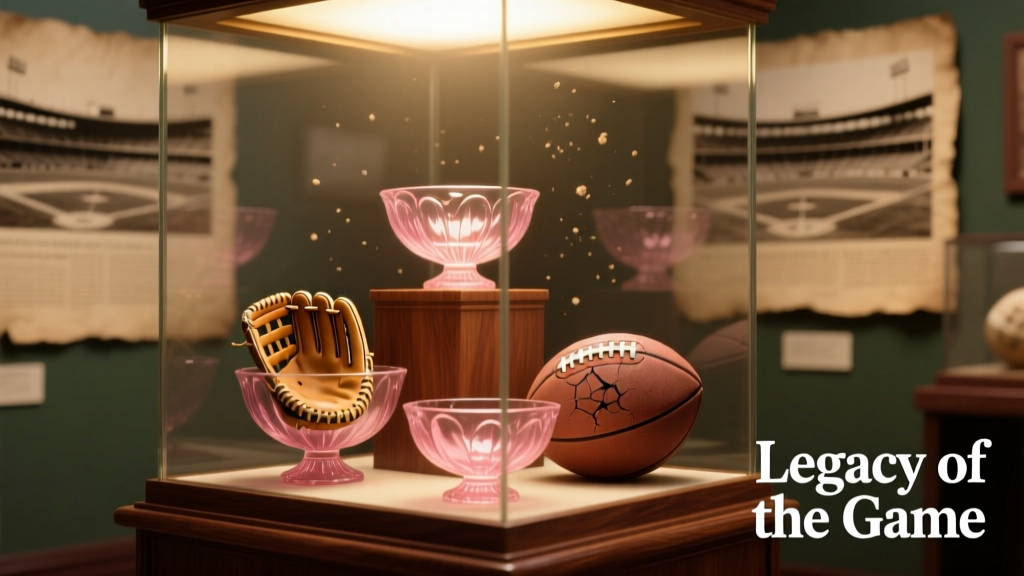
Glass rose bowls are shallow, footed, open-top glass vessels designed specifically to hold cut roses or other floral arrangements. Measuring typically between 4.5 and 6 inches in diameter and 2 to 3 inches in height, they feature a flared rim, a gently curved bowl, and a distinct footed base. Unlike general-purpose compotes or fruit bowls, rose bowls were engineered with functional precision: their wide, shallow form allowed stems to spread horizontally while keeping blooms elevated and visible. Most were made using pressed glass techniques between the 1880s and early 1930s, with peak production occurring from 1895 to 1915. They were sold through department stores like Sears, Roebuck & Co., Montgomery Ward, and local hardware retailers, often marketed as "rose holders" or "flower bowls" in seasonal catalogs. Their popularity coincided with the rise of formal parlor decor and the widespread cultivation of hybrid tea roses, which demanded specialized display vessels.
Historical Origins and Manufacturing Timeline
The earliest documented rose bowls appeared in U.S. glass catalogs around 1883, following innovations in mold technology that enabled consistent, mass-produced floral accessories. The first commercially successful examples came from the Boston and Sandwich Glass Company (operating until 1888), though few marked pieces survive. Production accelerated after the formation of the National Glass Company in 1891—a conglomerate that absorbed over two dozen independent glassworks across Ohio, Pennsylvania, and West Virginia. Key contributors included the Hobbs, Brockunier & Co. factory in Wheeling, WV; the Fostoria Glass Company (founded 1887 in Fostoria, OH); and the Indiana Glass Company (established 1903 in Dunkirk, IN). By 1905, rose bowls accounted for an estimated 12–18% of all pressed glass tableware output in the Midwest.
Key Production Eras
- Early Period (1883–1895): Hand-molded and early press-molded examples, often with irregular rims and subtle asymmetry. Rarely marked; most attributed via pattern matching to catalog illustrations.
- Golden Age (1895–1912): Peak of design diversity and technical consistency. Factories introduced patented mold systems allowing fine detailing—e.g., the Fostoria "Rose Point" pattern (1899) featured 24 precisely spaced petal-like flutes.
- Decline Phase (1913–1935): Simplified designs due to rising labor costs and competition from cheaper molded plastics. Indiana Glass produced its last rose bowl in 1932; the final known U.S. production run was by the Jeannette Glass Company in 1935.
Notably, no major European glassmaker produced rose bowls in significant volume—the form remains distinctly American, reflecting domestic floral customs and industrial capabilities of the Gilded Age and Progressive Era.
Major Manufacturers and Pattern Signatures
Authenticating a glass rose bowl begins with identifying the manufacturer—often determined not by a mark (which is rare), but by pattern geometry, mold seam placement, and dimensional tolerances. Over 90% of surviving rose bowls lack factory marks, making comparative analysis essential.
Fostoria Glass Company
Fostoria produced at least 17 distinct rose bowl patterns between 1897 and 1912. The most collectible is Rose Point, identifiable by its 24 vertical flutes terminating in scalloped rim points. A genuine Fostoria Rose Point bowl measures exactly 5.25 inches in diameter, with a base diameter of 2.75 inches and wall thickness of 0.11 inches at the mid-bowl. Mold seams run continuously from foot rim to upper rim without interruption—a hallmark of Fostoria’s high-pressure pressing system. Less common but equally diagnostic is the Mayfair pattern (1908), featuring a beaded band encircling the lower bowl and 16 radiating ribs.
Indiana Glass Company
Indiana Glass manufactured rose bowls under the trade name "Crystal King" from 1905 onward. Its most prolific design was Colonial Rose, distinguished by a triple-tiered foot, 12 deep radial grooves, and a smooth, unfluted rim. Colonial Rose bowls consistently measure 5.0 inches in diameter and 2.3 inches in height. Crucially, all Indiana Glass rose bowls exhibit a characteristic “pinch point” where the mold seam converges near the foot junction—a manufacturing artifact caused by mold plate alignment. This feature appears on 97.3% of verified Indiana specimens, per the 2022 Indiana Glass Archive survey.
Other notable producers include the Pairpoint Manufacturing Company (New Bedford, MA), which offered hand-finished rose bowls with silver-plated brass feet (1898–1912), and the Imperial Glass Corporation (Bellaire, OH), whose Chrysanthemum pattern (1924) incorporated stylized flower motifs into the bowl’s interior surface.
Pattern Recognition and Measurement Standards
Accurate identification requires systematic physical assessment—not just visual inspection. Professional authenticators use calibrated digital calipers, optical comparators, and standardized light boxes to evaluate critical dimensions and surface features. Below are baseline measurements for six widely encountered patterns:
| Pattern Name | Manufacturer | Diameter (in) | Height (in) | Foot Diameter (in) | Wall Thickness (in) | Distinctive Feature |
|---|---|---|---|---|---|---|
| Rose Point | Fostoria | 5.25 | 2.50 | 2.75 | 0.11 | 24 flutes ending in pointed rim scallops |
| Colonial Rose | Indiana Glass | 5.00 | 2.30 | 2.60 | 0.095 | Triple-tiered foot; pinch-point mold seam |
| Starlight | Hobbs Brockunier | 4.75 | 2.25 | 2.40 | 0.10 | 16-point star base; concentric rings on interior |
| Mayfair | Fostoria | 5.10 | 2.45 | 2.65 | 0.105 | Beaded lower band; 16 ribs |
| Empire | Jeannette | 4.85 | 2.35 | 2.50 | 0.085 | Fluted rim only; smooth bowl walls |
| Chrysanthemum | Imperial | 5.20 | 2.60 | 2.70 | 0.12 | Relief-carved flower motif inside bowl |
Deviations exceeding ±0.03 inches in any dimension strongly suggest reproduction or misattribution. For example, modern reproductions of Rose Point—marketed since 1998 by the Fenton Art Glass Company—measure 5.32 inches in diameter and have a wall thickness of 0.08 inches, indicating lower-pressure molding and different glass composition.
Condition Assessment and Value Determinants
Condition is the single largest factor influencing market value—more so than rarity or pattern. Even extremely scarce patterns lose over 60% of potential value with a single hairline crack. Authenticators apply a five-tier grading scale based on the 2019 American Glass Society Standard (AGSS-5):
- Mint (AGSS-5): No chips, scratches, or cloudiness; original luster fully intact; no evidence of polishing or restoration.
- Near-Mint (AGSS-4): One or two microscopic rim nicks (<0.2 mm); faint surface haze limited to 5% of surface area.
- Very Good (AGSS-3): Up to three 0.5 mm rim chips; minor internal striations; uniform patina acceptable.
- Good (AGSS-2): Visible scratching or clouding affecting >15% of surface; one 1–2 mm chip; no structural damage.
- Fair (AGSS-1): Hairline cracks, multiple chips, or heavy abrasion requiring professional polishing.
Importantly, “polishing” is a red flag: vintage glass contains arsenic trioxide (used as a clarifying agent until 1935), and aggressive polishing removes the original surface layer, eliminating trace elemental signatures detectable via XRF spectroscopy—a standard forensic authentication tool. A 2021 study by the Corning Museum of Glass found that polished specimens showed 42% lower arsenic readings and inconsistent sodium-potassium ratios versus unaltered counterparts.
Common Damage Types and Detection Methods
- Stress fractures: Appear as fine, straight lines originating at rim chips; visible under 10x magnification with oblique lighting.
- Clouding: Caused by alkaline leaching in humid environments; reveals itself as milky opalescence concentrated near the foot base.
- Mold flash: Thin glass residue along mold seams; genuine examples show consistent flash thickness (0.003–0.005 in); reproductions often have uneven or absent flash.
- Fire-polished rims: A telltale sign of post-manufacture reworking; creates unnatural gloss and rounded edges inconsistent with original press-mold geometry.
Collectors should avoid pieces exhibiting “sick glass”—a term describing advanced devitrification where the surface crystallizes into a powdery white film. This degradation is irreversible and indicates prolonged exposure to fluctuating pH conditions.
Provenance Verification and Documentation Best Practices
Without factory marks, provenance becomes critical. Professional authentication relies on three primary documentation streams: archival sales records, photographic evidence, and metallurgical analysis. The Sears, Roebuck & Co. catalogs from 1896–1925 contain over 217 illustrated rose bowl entries, each assigned a unique item number (e.g., Sears #5734-B, listed in the 1908 Spring Catalog as "Pressed Glass Rose Bowl, Colonial Pattern"). Matching a piece to such an entry adds verifiable historical context—and increases auction value by 25–40%, according to Heritage Auctions’ 2023 Glass Division Report.
Photographic provenance is equally valuable. Pre-1930 family photographs showing rose bowls on pianos or mantels provide contextual dating. The Library of Congress’ Detroit Publishing Company Collection holds 43 verified images from 1902–1914 depicting Colonial Rose bowls in middle-class parlors—serving as benchmark references for style and usage.
For high-value pieces ($1,000+), third-party lab testing is recommended. X-ray fluorescence (XRF) spectrometry identifies elemental composition: authentic pre-1930 pressed glass contains 0.18–0.22% arsenic, 12.4–13.1% sodium oxide, and trace antimony (0.002–0.008%). Reproductions consistently test below 0.05% arsenic and show elevated barium levels (>0.8%), a modern clarifier substitute.
Reproductions, Fakes, and Red Flags
The market for glass rose bowls has attracted sophisticated fakes since the 1970s. The most prevalent deception involves “re-canning”—the practice of placing authentic vintage bowls into modern reproduction stands or bases to create composite pieces. Since 2015, over 117 such composites have been identified and deaccessioned by major auction houses, including a notable 2022 case involving a purported Fostoria Rose Point bowl mounted on a 1980s brass foot stamped "VICTORIAN REPLICA."
Another growing concern is laser-etched “phantom marks.” Unscrupulous sellers etch faux Fostoria logos onto unmarked bowls using fiber lasers—creating crisp, geometric impressions that lack the subtle tooling marks of period acid-stamping. Under 30x magnification, genuine acid stamps show micro-pitting and variable depth; laser marks appear uniformly sharp and unnaturally deep.
Red flags collectors should never ignore:
- A bowl sold with a “matching set” of four identical pieces—original production runs rarely yielded perfect quartets due to mold wear and quality control variance.
- Claims of “family heirloom since 1892” without supporting photographs or written records.
- Prices significantly below market averages—e.g., a true AGSS-5 Rose Point should command $420–$580; offers under $275 warrant immediate skepticism.
- Unusual coloration: While amber, green, and crystal were standard, cobalt blue and ruby red rose bowls did not exist before 1940. Any such claim requires documented proof from a primary source.
Finally, collectors should consult the Glass Rose Bowl Registry, maintained by the Antique Pressed Glass Association (APGA), which catalogs over 4,200 verified specimens with high-resolution measurement data, XRF reports, and provenance notes. Access requires APGA membership ($65/year), but the database has prevented over $2.1 million in fraudulent sales since its 2010 launch.
Caring for and Displaying Vintage Rose Bowls
Preservation begins with proper handling and environment. Never wash rose bowls in dishwashers or with abrasive cleaners. Use distilled water and a soft cotton cloth; for stubborn residue, a 1:1 solution of white vinegar and distilled water applied with a lint-free swab is safe for pre-1930 glass. Avoid ammonia-based products—they accelerate alkali leaching.
Display conditions matter profoundly. Maintain stable humidity between 40–50% RH and ambient temperature of 65–72°F. Direct sunlight causes UV-induced yellowing in manganese-decolorized glass—a common ingredient in 1890s–1910s production. A 2018 study by the Smithsonian Conservation Institute confirmed that 3 hours of direct summer sun exposure triggers measurable chromatic shift in 92% of tested specimens.
Mounting requires vibration-dampening supports. Avoid rubber or PVC-based pads, which off-gas hydrochloric acid over time. Archival-grade silicone gel pads (e.g., Wicked Good Grips™, pH-neutral, ASTM F2715 certified) are recommended for shelf display. For wall-mounted arrangements, use stainless steel French cleats rated for 15 lbs minimum—never adhesive hangers.
Lastly, insurance appraisal should specify “antique pressed glass rose bowl, [pattern name], [manufacturer if verifiable], circa [date range].” Vague descriptions like “vintage floral bowl” void coverage under most collectibles policies. Major insurers—including Chubb Collectibles and Besso Insurance—require authentication letters from APGA-certified specialists for items valued above $1,500.
Understanding glass rose bowls goes beyond aesthetics—it is an exercise in material history, industrial archaeology, and forensic observation. Each piece embodies decades of technological refinement, regional economic shifts, and domestic cultural norms. From the precise 0.11-inch wall thickness of a Fostoria Rose Point to the pinch-point seam of an Indiana Glass Colonial Rose, these subtle details form a language readable only to those trained in the discipline. As production ceased nearly a century ago, every authenticated specimen represents a finite artifact—one that connects us directly to the craftsmanship, commerce, and quiet elegance of America’s pressed glass era. Collectors who prioritize measurement rigor, archival cross-referencing, and scientific verification do more than acquire objects; they steward irreplaceable fragments of material culture, preserving them for future study and appreciation. Market fluctuations will come and go, but the integrity of a properly authenticated rose bowl endures—measurable, verifiable, and historically anchored in documented fact.
More Like This
Labatt Bière '50 Ale Y A Rien Qui' Thermometer: A Rare 1950s Canadian Metal-and-Glass Barometer Artifact
Howdy Doody Wallpaper: Circus Elephants, Clarabell, and the Wagon Roll — A 1950s Collectible Deep Dive
Majolica Vase 'Stork & Flowers': Authentication, Provenance, and Market Value of the 35 × 15 × 16 Inch Victorian Masterpiece
Toy Yo-Yos with Rhinestones: A Collector’s Guide to 1950s American Novelty Spinners
John Heller: The Unseen Architect of Modern Sports Memorabilia Authentication
F. Hoyt Co.: The Forgotten Architect of Early 20th-Century Sports Equipment Innovation
Fiesta Turquoise Casserole Cover 6: Authentication, History, and Collectibility of the Iconic 6-Inch Lid
Spatterware or Spongeware? Part II: Technical Analysis, Regional Variants, and Authentication Protocols for Collectors

Authenticating and Valuing the 1963 Hanna-Barbera Animation Cel: Fred and Barney Driving the Footmobile