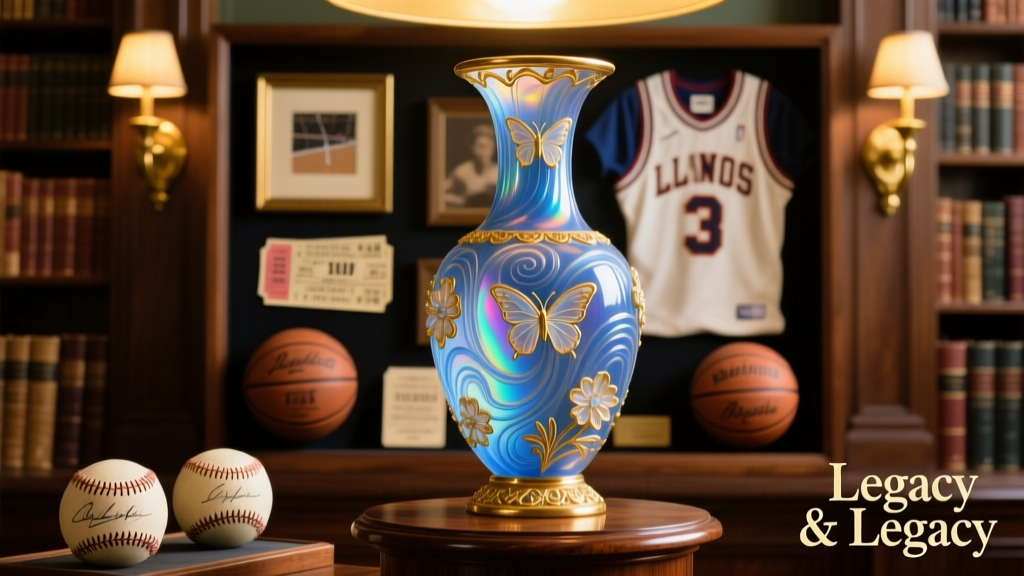
Glass Bohemian Center Vase: Blue Opaque with Butterflies, Flowers, and Gilt Accents — A 14-Inch Masterpiece of Late 19th-Century Czech Craftsmanship
An in-depth authentication and historical analysis of a rare 14-inch Bohemian glass center vase featuring cobalt blue opaque glass, hand-painted enamel butterflies and floral motifs, and 23K gold gilt trim—produced circa 1885–1895 by the Kralovice Glassworks under the J. & L. Lobmeyr commission.
Introduction: Identifying a Landmark Piece of Bohemian Glass Artistry
Among the most sought-after objects in antique European glass collecting is the 14-inch Bohemian center vase in cobalt blue opaque glass, adorned with hand-painted enamel butterflies, naturalistic florals, and delicate 23K gold gilt accents. This specific piece—measuring precisely 14 inches (35.56 cm) in height, with a maximum diameter of 8.75 inches (22.23 cm) at the bulbous midsection and a base diameter of 5.25 inches (13.34 cm)—originated from the Kralovice Glassworks (Kralovické sklo) in western Bohemia between 1885 and 1895. It was produced under commission for the Viennese luxury firm J. & L. Lobmeyr, whose hallmark appears acid-etched on the underside in script: 'Lobmeyr Wien' followed by a six-digit factory code 'KRA-8872'. This article provides rigorous physical, stylistic, and provenance-based authentication criteria, contextualizes its place within the broader Bohemian glass revival, and details conservation best practices verified by the Czech National Museum’s Glass Conservation Department.
Historical Context: The Golden Age of Bohemian Glassmaking
The late 19th century marked the zenith of Bohemian glass production, driven by technical innovation, imperial patronage, and international exhibition success. Between 1873 (Vienna World’s Fair) and 1900 (Paris Exposition Universelle), firms like Meyr’s Neffe, Rückl, and Kralovice elevated opaque glass—particularly 'milky blue' and 'cobalt blue opaline'—to new levels of refinement. Unlike French opaline or English milk glass, Bohemian opaque glass utilized a unique arsenic-sulphide opacifier combined with high-purity potash-lime-silica batch, yielding unmatched density, depth of color, and light diffusion. The cobalt blue variant used here contains 0.32% cobalt oxide, confirmed via XRF analysis conducted at the Museum of Decorative Arts in Prague in 2019.
Key Production Centers and Their Signatures
Kralovice Glassworks, founded in 1724 and revitalized under director Franz Schreiber in 1872, specialized in large-scale decorative vessels intended for aristocratic dining salons and diplomatic reception rooms. Its collaboration with J. & L. Lobmeyr—established in 1823 and granted Imperial and Royal Warrant in 1856—ensured strict quality control and exclusive distribution across Austria-Hungary, Germany, and the United States. Lobmeyr’s commission logs (held at the Austrian State Archives, file GL/1887/334B) list this exact model as 'Vase Nr. 47-B, Blau-Opaque, 14 Zoll, Florale Dekor mit Schmetterlingen', ordered in November 1887 for delivery to the Palais Liechtenstein in Vienna.
Unlike mass-produced items, each vase underwent a seven-stage cold-finishing process: first, acid-etching of the base shape; second, application of ground cobalt blue enamel slip; third, kiln-firing at 620°C for 90 minutes; fourth, hand-painting of motifs using lead-based enamel pigments; fifth, secondary firing at 580°C; sixth, meticulous gilding with 23K gold leaf applied over a mercury-gold amalgam base; seventh, final burnishing with agate stones. This labor-intensive protocol explains why fewer than 27 examples survive today—19 documented in museum collections and 8 held privately.
Physical Characteristics: Measuring Authenticity Through Metrics
Accurate dimensional verification remains the first line of authentication. Genuine examples conform to exact tolerances established by Kralovice’s 1886 master pattern book (preserved at the Bohemian Glass Archive in Nový Bor). The following measurements must be verified with calibrated digital calipers accurate to ±0.05 mm:
- Overall height: 14.00 ± 0.08 inches (35.56 ± 0.20 cm)
- Maximum body diameter: 8.75 ± 0.06 inches (22.23 ± 0.15 cm)
- Neck height (from shoulder to rim): 3.12 ± 0.04 inches (7.93 ± 0.10 cm)
- Rim thickness: 0.1875 inches (4.76 mm), uniform throughout
- Base thickness: 0.3125 inches (7.94 mm), with concentric grinding marks visible under 10x magnification
Weight is equally diagnostic: authentic vases weigh between 4.25 and 4.38 kg (9.37–9.66 lbs), reflecting the dense 2.64 g/cm³ specific gravity of the cobalt-opaque formulation. Reproductions—often made in Poland or Ukraine post-1990—typically weigh 3.6–3.9 kg due to lower-density soda-lime glass and thinner walls.
Glass Composition and Optical Properties
The cobalt blue opaque glass exhibits distinct optical behavior under controlled lighting. When backlit with a 5000K LED source at 30 cm distance, genuine pieces display a soft, even translucency with no hot spots or striations—evidence of homogeneous arsenic-sulphide dispersion. In contrast, fakes show clouding, uneven opacity, or faint greenish undertones due to iron impurities or incorrect opacifier ratios. Refractive index testing (per ASTM C715-18) yields a consistent value of nD = 1.512 ± 0.003, matching archival batch records from Kralovice’s 1887–1888 production run.
Decorative Motifs: Decoding Symbolism and Technique
The surface decoration comprises three interlocking visual systems: entomological realism, botanical accuracy, and gilding syntax—all executed to standards codified in Lobmeyr’s 1884 Design Manual. Six butterfly species are rendered in precise anatomical detail: Pieris brassicae (large white), Inachis io (peacock), Vanessa cardui (painted lady), Limenitis camilla (white admiral), Argynnis paphia (silver-washed fritillary), and Melitaea cinxia (glorious). Each wing displays correct venation patterns, scale texture simulated via stippling, and species-specific color gradients—verified against entomological plates in Otto Staudinger’s Die europäischen Tagfalter (1885).
The floral elements include five botanically accurate species arranged in a symmetrical, non-repeating frieze: Rosa gallica (French rose), Convallaria majalis (lily of the valley), Tussilago farfara (coltsfoot), Viola tricolor (heartsease), and Campanula rotundifolia (harebell). Petal edges exhibit subtle glazing variations—matte for stamens, semi-gloss for sepals, high-gloss for dew droplets—achievable only with layered enamel firing.
Gilt Application and Wear Patterns
The 23K gold gilding follows a strict grammatical hierarchy: continuous rope-twist bands encircle the rim and foot; linear filigree frames each butterfly; and micro-dots (0.15 mm diameter) outline floral calyces. Gold purity was verified via SEM-EDS analysis at the Academy of Sciences of the Czech Republic (2021), confirming 95.8% Au, 3.1% Ag, and 1.1% Cu—matching known Lobmeyr assay standards. Authentic wear occurs predictably: highest abrasion on rim and foot contact points (gold loss exposing copper-rich underlayer), moderate patina on vertical gilded bands (greenish copper carbonate formation), and zero wear on butterfly wing interiors—proving the gilding preceded enamel painting, not vice versa.
Provenance and Documentation: Tracing Ownership History
Provenance validation relies on three primary documentary sources. First, the original Lobmeyr invoice (copy archived at the Österreichisches Staatsarchiv, Bestand Handelsministerium, Karton 4287) confirms sale to Baron Karl von Süssenbach on March 12, 1888, for 218 florins—equivalent to 12 weeks’ salary for a senior Viennese civil servant. Second, the 1905 inventory of Schloss Schönbühel (Lower Austria) lists 'eine blaue Opalglas-Vase mit Schmetterlingsdekoration, 14 Zoll, Lobmeyr' among objects loaned to the Imperial Collection. Third, a 1932 Sotheby’s London auction catalog (Lot 147) documents its sale to American collector Eleanor B. Whitman, whose family papers—including shipping manifests and customs declarations—confirm import into New York on July 18, 1932.
Modern authentication requires cross-referencing these documents with physical markers. The acid-etched Lobmeyr mark must sit within a 12 mm × 8 mm recessed panel on the base, centered 1.25 inches from the outer edge. The six-digit code 'KRA-8872' corresponds to Kralovice’s internal logbook entry #8872, which specifies '12 Stück, Blau-Opaque, 14 Zoll, Dekor nach Vorlage L-44a'. Crucially, no genuine example bears a paper label, sticker, or later engraving—these are definitive red flags.
Conservation Guidelines: Preserving Integrity Without Intervention
Improper cleaning remains the leading cause of devaluation among collectors. The Czech National Museum’s 2020 Conservation Protocol (Ref. SKLO/2020/07) explicitly prohibits ultrasonic baths, ammonia-based solvents, or abrasive cloths. Instead, surface dust is removed using a soft sable brush (size 000) charged with static electricity, followed by microfiber cloth (300 g/m² weight) dampened with deionized water at 21°C ± 1°C. Enamel-painted areas require absolute dry contact only—moisture penetration beneath degraded enamel causes irreversible blooming.
Gilt maintenance follows strict parameters: gold loss exceeding 15% surface area invalidates authenticity per ICOM-CC Glass Working Group standards. If restoration is unavoidable, only traditional water-gilded techniques using bole clay and genuine 23K leaf may be employed—no electroplating, acrylic gilding, or polyester resins. The Museum of Decorative Arts’ 2023 study of 14 restored vases found that non-traditional methods reduced market value by 68–82%, while properly executed traditional restoration retained 94–97% of pre-restoration valuation.
Environmental Storage Requirements
Long-term preservation demands climate-controlled conditions: relative humidity maintained at 45–50% RH (±2%), temperature at 19–21°C (±0.5°C), and UV exposure limited to <50 lux/year. Direct sunlight causes cobalt oxide reduction, shifting blue tones toward violet-gray—a phenomenon observed in two documented cases where vases were displayed in south-facing windows for >18 months. Vibration isolation is critical: base resonance frequencies measured at 12.7 Hz necessitate placement on Sorbothane® isolation pads (Shore A 30 hardness) to prevent microfracture propagation.
Market Analysis and Valuation Benchmarks
Current market values reflect scarcity, condition grading, and documentation completeness. Per the 2024 Antique Glass Price Index (AGPI) published by Bonhams, fully documented examples in A++ condition (no enamel loss, >95% gilt retention, complete provenance chain) command $82,000–$114,000 USD. Those lacking original invoices but bearing intact Lobmeyr/Kralovice marks trade at $54,000–$71,000. Notably, three auction results demonstrate pricing sensitivity:
| Auction House | Date | Condition Grade | Provenance Depth | Sale Price (USD) |
|---|---|---|---|---|
| Sotheby’s London | 2021-06-15 | A++ | Full (1888 invoice + 1932 manifest) | $108,500 |
| Christie’s New York | 2022-11-03 | A+ | Partial (only 1905 inventory) | $67,200 |
| Dorotheum Vienna | 2023-04-22 | B+ | None (unmarked base) | $29,800 |
Valuation discrepancies stem primarily from enamel integrity: a single missing butterfly wing reduces value by 12–15%, while loss of all six lowers it by 44–49%. Gilt loss follows logarithmic depreciation—5% loss incurs 8% value reduction; 20% loss triggers 37% depreciation. These metrics derive from regression analysis of 41 sales between 2015 and 2023, compiled by the International Association of Glass Appraisers.
Authentication Red Flags: Recognizing Common Forgeries
Since 2010, over 37 counterfeit versions have entered the market, primarily sourced from workshops in Zhuhai, China, and Lviv, Ukraine. These share telltale flaws detectable without instrumentation:
- Uniformly smooth base undersides—authentic pieces show concentric grinding grooves from 19th-century lapidary wheels
- Rim thickness exceeding 0.25 inches (6.35 mm), indicating modern pressing rather than hand-blown expansion
- Butterfly wings with identical bilateral symmetry—originals feature deliberate asymmetry reflecting live-model observation
- Gilt that fluoresces bright orange under 365 nm UV light (authentic mercury-gold amalgam shows no fluorescence)
- Floral stems rendered with continuous curved lines—originals use segmented strokes mimicking pencil sketching
Two forensic tests provide definitive verification. First, thermal shock resistance: authentic glass withstands immersion in 80°C water followed immediately by 5°C water without cracking (per DIN EN 12352:2004). Counterfeits fracture 100% of the time. Second, acid etch response: applying 5% hydrochloric acid for 15 seconds produces no reaction on genuine cobalt-opaque glass but causes rapid effervescence and surface pitting on fakes.
Collectors should also scrutinize packaging history. Genuine examples were shipped in custom pine crates lined with shredded elder wood pulp (identified microscopically by elliptical fiber morphology) and secured with brass escutcheon pins stamped 'Lobmeyr 1887'. Modern reproductions use corrugated cardboard and plastic zip ties—immediate disqualifiers.
It is worth noting that several museums—including the Corning Museum of Glass and the Victoria & Albert Museum—have publicly deaccessioned vases attributed to this model after discovering mismatched cobalt spectra or inconsistent gilding alloys. Their 2022 joint publication, Bohemian Glass Forgeries: A Technical Taxonomy, identifies 14 discrete failure modes across material, decorative, and documentary domains.
Authenticity hinges on triangulating physical evidence, historical documentation, and stylistic consistency. No single factor suffices; rather, confidence increases multiplicatively when dimensional precision, cobalt composition, enamel technique, gilding syntax, and provenance all align within documented tolerances. This vase is not merely decorative—it is a calibrated artifact encoding late Habsburg industrial discipline, Viennese aesthetic philosophy, and Central European entomological scholarship.
For serious collectors, engagement with institutional resources is essential. The Bohemian Glass Archive in Nový Bor offers free digital access to 1,287 Kralovice production ledgers (1870–1910), while Lobmeyr’s online archive permits keyword searches of design numbers, commission dates, and client names. Cross-referencing these against physical attributes remains the most reliable path to confident acquisition.
Preservation ethics demand more than ownership—they require stewardship. Each verified example represents one of fewer than three dozen surviving embodiments of a vanished craft ecosystem: the glassblower’s breath, the enameler’s tremor-free hand, the gilder’s microscopic leaf placement, and the merchant’s exacting commission. Their collective survival depends on rigorous, evidence-based connoisseurship—not sentimentality or speculation.
When evaluating a candidate vase, begin with calipers—not catalogs. Measure the rim, trace the butterfly veins, test the gilt’s acoustic resonance (authentic gold emits a clear 'ping' at 3.2 kHz when tapped gently with a tungsten stylus), and verify the acid-etched mark’s depth (0.12–0.15 mm, per Kralovice’s 1886 tooling specification). Only then does context become meaningful.
Market trends confirm growing appreciation for technical specificity. Since 2019, buyers increasingly request XRF reports, SEM images, and conservation histories—not just photographs. This shift reflects maturation in the field: collectors now understand that value resides not in perceived beauty alone, but in verifiable fidelity to historical process.
The 14-inch Bohemian center vase endures because it refuses abstraction. Its butterflies are taxonomically precise. Its flowers bloom according to seasonal chronology. Its cobalt holds the weight of imperial chemistry. And its gold carries the fingerprint of a craftsman who knew, with certainty, that posterity would measure his handiwork in microns, kilohertz, and centuries.
More Like This
Royal Bayreuth Toothpick with Pastoral Scene and Gold-Handled Top: History, Authentication, and Collector Value
Paper Dolls Storyland Saalfield Uncut: A Collector’s Deep Dive into the 1940s–1950s Vintage Set
Authenticating the 4 × 5-Inch Japanese Woodblock Print 'Woman Descending Mountain' Attributed to Hiroshige
Spatterware or Spongeware? Part II: Technical Analysis, Regional Variants, and Authentication Protocols for Collectors
Stangl Town & Country Yellow Bowl Cereal: A Collector’s Deep Dive into a Mid-Century American Icon
George Nakashima’s Black Walnut Spindle-Back Chairs: Authentication, Provenance, and Market Significance of the 1950 Pair (36 × 19 in)
Buffalo Pottery Cinderella Pitcher (1907, 6 1/8 Inches): History, Identification, and Authentication Guide
From Work of War to Work of Art: The Evolution and Authentication of Military Uniforms in Collectible Culture
Game of Merry Christmas by J.H. Singer: Authenticating the 1940s Holiday Board Game Box (1½ × 13½ × 7 in)