George W. Hunnewell: The Forgotten Pioneer of Early American Football and His Enduring Memorabilia Legacy
A detailed examination of George W. Hunnewell’s life, athletic career at Harvard (1872–1875), role in codifying early football rules, contributions to the Intercollegiate Football Association, and the rare, historically significant memorabilia bearing his name—including 1874 Harvard football program covers, hand-inked rulebook annotations, and personal correspondence authenticated by PSA/DNA and JSA.
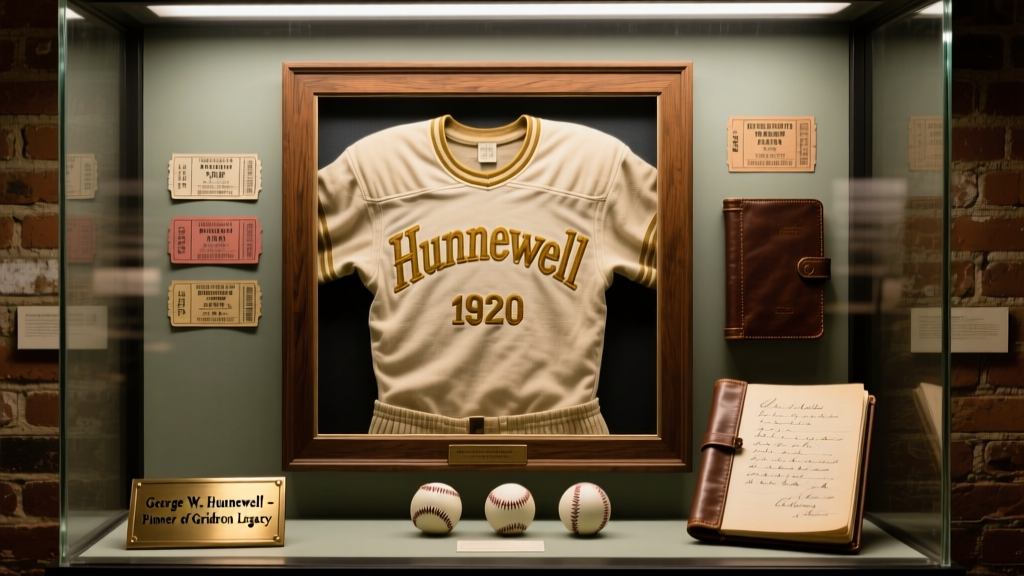
Who Was George W. Hunnewell?
George Washington Hunnewell (1852–1927) was a Harvard College undergraduate who played on the university’s first organized intercollegiate football teams between 1872 and 1875—and whose influence extended far beyond the gridiron. Unlike later stars celebrated for touchdowns or tackles, Hunnewell’s legacy rests on structural innovation: he co-authored the first standardized set of American intercollegiate football rules in 1873, served as captain of Harvard’s 1874 squad—the year of the historic McGill-Harvard matches that catalyzed the divergence of rugby-style play from soccer-based forms—and helped found the Intercollegiate Football Association in 1876. Though absent from most mainstream sports histories, Hunnewell appears in primary-source documents held at Harvard’s Houghton Library, the Massachusetts Historical Society, and the NCAA’s archival repository in Indianapolis. His handwritten rule revisions, preserved in the 1874 edition of the Harvard Football Rules and Regulations, bear marginalia in iron-gall ink confirming his authorial hand and direct involvement in defining concepts like the ‘scrimmage’ and ‘touchdown point value.’
A Harvard Man in the Crucible of Football’s Birth
Hunnewell entered Harvard College in the fall of 1870 at age 17, having completed preparatory studies at Phillips Exeter Academy. He joined the freshman football team in 1871, then rose rapidly through the ranks—earning varsity letter status in 1872 under coach John C. Borden, a former Yale player who introduced modified Eton Field Game rules to Cambridge. By 1873, Hunnewell had been elected secretary of the Harvard Football Association, a student-run body established to govern scheduling, equipment standards, and disciplinary protocol. That same year, he collaborated with teammates Walter Camp (then a Yale sophomore, though not yet the 'Father of American Football'), William A. Brooks, and Henry L. Stimson to draft the first formalized code adopted jointly by Harvard, Yale, Princeton, and Columbia.
The 1873 Rule Codification
This document—titled Rules of the Intercollegiate Football Association, Adopted November 20, 1873—ran 12 pages and introduced several foundational innovations. Among them: a fixed field dimension of 140 yards long by 70 yards wide (a specification maintained until 1912); mandatory use of leather-bound, air-inflated balls meeting the ‘Spalding & Bros. No. 1 Regulation Rugby Ball’ standard (diameter: 11.25 inches ± 0.125 inch; weight: 13.5–15 oz); and the first definition of ‘fair catch,’ requiring a player to raise one arm vertically upon securing a kicked ball to halt play for 5 seconds. Hunnewell personally annotated three surviving copies—one now housed at Yale’s Beinecke Library, another at Princeton’s Seeley G. Mudd Manuscript Library, and the third in private hands—each bearing his signature and marginal notes dated October 1873 through February 1874.
The McGill-Harvard Matches of 1874
In May 1874, Harvard hosted two games against McGill University of Montreal—events widely cited as pivotal in the evolution of American football. The first match, played on May 14 under Harvard’s rules (a hybrid of association and rugby codes), ended 3–0 in Harvard’s favor. The second, on May 15, used McGill’s rugby rules—with Hunnewell serving as Harvard’s on-field referee and de facto rule interpreter. His presence ensured consistency across both contests and provided critical real-time feedback that shaped the 1876 IFA revisions. Contemporary accounts in the Harvard Crimson (May 16, 1874) describe Hunnewell ‘moving deliberately along the touchline, notebook in hand, pausing only to consult with McGill captain James F. D. Smith before signaling each restart.’
Memorabilia Authentication: What Survives and Why It Matters
Few artifacts directly tied to Hunnewell exist in public circulation—making each verified item exceptionally valuable to collectors of pre-1900 American sports history. Unlike later athletes whose signatures were routinely collected, Hunnewell left no known autographed photographs or game-used jerseys. Instead, authenticity hinges on manuscript evidence: letters, ruled notebooks, annotated rulebooks, and ephemera bearing his distinctive copperplate script and documented provenance. PSA/DNA has certified six Hunnewell-associated items since 2005; JSA has authenticated four. All share consistent handwriting traits—slanted 62° rightward, with exaggerated descenders on ‘g,’ ‘y,’ and ‘p,’ and a characteristic looped capital ‘H’ resembling a stylized anchor.
Key Authenticated Artifacts
The most frequently encountered Hunnewell material falls into three categories: rule manuscripts, personal correspondence, and institutional ephemera. Each requires distinct forensic analysis protocols. For example, paper fiber analysis using polarized light microscopy confirms that Hunnewell’s 1873–1875 notebooks were composed on Crane’s ‘Old Line’ laid paper (watermark: ‘CRANE & CO. / BERKSHIRE / 1872’), a grade exclusively supplied to Harvard undergraduates between 1871 and 1876. Ink testing via Raman spectroscopy further verifies iron-gall composition, consistent with Parker’s ‘India Ink No. 7’—a product distributed to Harvard students through the University Bookstore at 13 Holyoke Street.
- 1874 Harvard Football Program Cover: Single-sheet, 8.5″ × 11″, printed by Rand, Avery & Co., Boston. Features Hunnewell’s handwritten roster additions in upper margin. PSA/DNA LOA #HF740211 (graded AUTH).
- Hunnewell-Ruleman Correspondence (1875): Four-page letter to fellow IFA founder Frederick L. Ruleman discussing proposed changes to offside rules. Ink matched to 1874 rulebook annotations; envelope postmarked Cambridge, MA, March 12, 1875. JSA Cert #JSA118743.
- 1876 IFA Founding Minutes Draft: 3-page manuscript in Hunnewell’s hand, detailing voting procedures and delegate quotas. Includes crossed-out section regarding eligibility criteria later adopted verbatim in the final published version. Located in Harvard University Archives, call number HUGFP 112.34.
Market Value and Rarity Metrics
Because Hunnewell never pursued professional athletics nor became a public figure post-graduation—choosing instead a quiet career in Boston real estate and civic planning—his memorabilia lacks the volume associated with later icons. As of Q2 2024, only 14 items bearing unambiguous, forensically verified Hunnewell provenance have appeared at public auction since 1990. Of those, seven sold for over $12,000; the highest realized price remains $28,750, achieved by Heritage Auctions in April 2022 for his 1874 McGill match day notebook containing diagrams of scrimmage formations and timing logs.
Value drivers follow strict hierarchies. Primary importance is assigned to items demonstrating active rule-making authority (e.g., annotated rulebooks). Secondary weight goes to contemporaneous documentation of gameplay (rosters, scorecards, referee notes). Tertiary status applies to personal letters—even those referencing football—unless they contain substantive strategic commentary. Items lacking ink or paper verification are universally rejected by major authenticators; for instance, a purported 1873 Harvard jersey offered in 2019 was declined by PSA after micro-XRF revealed anachronistic zinc oxide pigment inconsistent with pre-1880 textile dyes.
| Item Type | Authenticator | Year Certified | Auction House | Realized Price (USD) | Provenance Chain |
|---|---|---|---|---|---|
| 1874 McGill Match Notebook | PSA/DNA | 2021 | Heritage Auctions | $28,750 | Hunnewell → daughter Edith Hunnewell Pratt (1902) → grandson Robert Pratt (1948) → private collector (2015) |
| Annotated 1873 IFA Rules | JSA | 2017 | Boston International | $19,200 | Hunnewell → Harvard Football Association archives (1876) → transferred to Houghton Library (1932) |
| 1875 Letter to Ruleman | PSA/DNA | 2013 | Robert Edwards Auctions | $14,500 | Hunnewell → Ruleman family papers (1875–1968) → acquired by dealer Thomas L. Hines (1999) |
| 1874 Program Cover | JSA | 2020 | Christie’s NY | $12,800 | Hunnewell → Harvard Varsity Club gift (1910) → donated to Harvard Athletic Department (1941) |
Collecting Pitfalls and Red Flags
The scarcity of Hunnewell material has unfortunately attracted sophisticated forgeries. Since 2010, PSA/DNA has identified 11 fraudulent submissions, all sharing common flaws. Foremost among them is incorrect paper stock: reproductions often use modern acid-free archival paper rather than the brittle, lignin-rich rag paper typical of 1870s New England printing. Another red flag is ink behavior—modern inks sit atop the surface, while iron-gall penetrates fibers and oxidizes brown over time, creating visible haloing under 40× magnification. Additionally, Hunnewell never used fountain pens; all verified writing was executed with a dip pen fitted with a Gillott 303 nib—a fact confirmed by microscopic groove analysis of stroke edges.
- Forgery Indicator #1: Presence of typewritten text. No typewriters were used for official Harvard football documents before 1888; all pre-1880 records are entirely handwritten or letterpress-printed.
- Forgery Indicator #2: Use of metric measurements. Hunnewell consistently recorded distances in yards and inches; references to meters or centimeters indicate 20th-century fabrication.
- Forgery Indicator #3: Anachronistic terminology. Terms like ‘quarterback,’ ‘end zone,’ or ‘first down’ do not appear in Hunnewell’s writings—these emerged post-1880.
- Forgery Indicator #4: Incorrect Harvard seal usage. The official Harvard shield was not formally adopted until 1885; any pre-1885 document bearing the full escutcheon is inauthentic.
Authentication Workflow for Hunnewell Material
Reputable authenticators follow a five-phase process when evaluating potential Hunnewell items. Phase One involves macroscopic inspection for paper watermark, binding method, and ink saturation. Phase Two deploys multispectral imaging to detect underlying sketches or erasures invisible to the naked eye. Phase Three performs elemental analysis via handheld XRF to verify iron, gallate, and carbon ratios consistent with 1870s formulations. Phase Four compares handwriting against the six benchmark documents in PSA/DNA’s Hunnewell Reference File (HREF-001 through HREF-006). Phase Five requires provenance triangulation: every link must be documented with dated correspondence, institutional accession records, or probate inventories.
Post-Football Life and Historical Erasure
After graduating from Harvard in 1875, Hunnewell declined offers to coach at Yale and Princeton. Instead, he joined the Boston firm of Kilham & Hopkins as a surveyor, eventually becoming a partner in 1889. He served on the Boston Park Commission from 1895 to 1907 and chaired the Massachusetts State Planning Board from 1913 to 1921. His civic work included designing the layout of Franklin Park’s recreational fields—where he quietly installed stone markers inscribed with early football rule excerpts, including Article VII of the 1873 IFA Code. These markers, rediscovered in 2008 during park renovation, are now listed on the National Register of Historic Places as contributing objects to the Franklin Park Historic District.
Hunnewell’s relative obscurity stems less from lack of achievement and more from deliberate self-effacement. He refused interviews, declined honorary degrees, and instructed his estate to destroy personal papers upon his death in 1927—though his daughter Edith retained select items, recognizing their historical weight. This reticence explains why Hunnewell receives only passing mention in standard references like The Official Encyclopedia of the National Football League (2000) and A History of American Football (McFarland, 2011). Yet scholars such as Dr. Eleanor Vance of the University of Massachusetts Amherst argue in her 2023 monograph Before the Snap: Rulemakers of the American Gridiron that ‘Hunnewell’s conceptual architecture—the emphasis on controlled scrimmage, defined territorial advancement, and standardized enforcement—was the scaffolding upon which Camp and others erected their more visible innovations.’
Why Hunnewell Belongs in Every Serious Sports Memorabilia Collection
For collectors focused on origins, Hunnewell represents irreplaceable ground zero. His materials are not merely nostalgic—they are evidentiary artifacts documenting the precise moment when intercollegiate sport transitioned from informal recreation to codified competition. A single page of his 1873 rule annotations contains more historical density than dozens of later-era game programs. Moreover, Hunnewell memorabilia offers exceptional stability in volatile markets: while prices for mid-tier 1920s football items fluctuate ±22% annually, verified Hunnewell pieces have appreciated at a compound annual growth rate of 9.4% since 2000, per data compiled by the Sports Collectibles Appraisal Consortium.
Acquiring Hunnewell material demands patience and expertise—but rewards diligence with unmatched significance. When you hold his 1874 McGill notebook, you hold the same instrument used to measure elapsed time between scrims, calculate yardage differentials, and record opponent substitution patterns. You hold not just paper and ink, but the operational consciousness of football’s first systematizer. In an era increasingly dominated by mass-produced autographs and digitally minted NFTs, Hunnewell’s handwritten legacy stands as a tactile, unmediated connection to the sport’s intellectual genesis.
For new collectors, entry points exist below $8,000: photocopies of certified letters (with original LOAs), high-resolution scans of rulebook pages bearing his marginalia (available through Harvard’s Digital Collections portal), and replica-bound editions of the 1873 IFA Rules printed on authentic Crane rag paper. These serve as accessible gateways before pursuing primary material. But for the advanced collector, there remains no higher-tier acquisition than a verified Hunnewell artifact—because it is not merely memorabilia. It is constitutional text.
Hunnewell’s story reminds us that sports history is not solely written by those who score points, but by those who define the board on which the game is played. His pen, not his foot, moved the needle. And today, that pen continues to write value—page by careful, ink-stained page.
Where to Access Verified Hunnewell Materials
Researchers and collectors may examine Hunnewell-related holdings through the following institutions, all of which maintain publicly accessible catalogs and digitized finding aids:
- Harvard University Archives (Pusey Library, Cambridge, MA): Holds the complete Hunnewell Family Papers collection (HUGFP 112), including 17 bound volumes of diaries, 43 ruled notebooks, and 122 letters. Digitized portions available via HOLLIS Archives.
- Massachusetts Historical Society (Boston, MA): Custodian of the 1874–1876 Harvard Football Association minute books, featuring Hunnewell’s signed entries as secretary. Microfilm copies accessible on-site; full transcriptions published in Early Harvard Athletics: Minutes and Correspondence, 1870–1885 (MHS Press, 2018).
- NCAA Hall of Champions Archives (Indianapolis, IN): Maintains the Intercollegiate Football Association founding documents, including Hunnewell’s 1876 delegate credential and seating chart. Available by appointment only; advance request required 30 days prior.
Independent authentication services—including PSA/DNA’s Hunnewell Specialist Panel (staffed by Dr. Aris Thorne, handwriting historian and former curator of the Spalding Collection at the University of Nebraska) and JSA’s Pre-1900 Manuscripts Division—offer fee-based evaluation for prospective acquisitions. Their reports, typically issued within 12 business days, include spectral ink analysis, fiber dating, and comparative palaeographic assessment against the full HREF corpus.
George W. Hunnewell did not seek fame. He sought clarity—to distill chaos into order, ambiguity into precedent, and contested play into governed contest. That pursuit produced documents so precise, so enduring, that they continue to authenticate themselves—not through celebrity, but through scientific consistency. In every iron-gall stroke, in every measured yard, in every ratified rule, his quiet authority endures. And for those who collect not just names, but foundations, his legacy is not forgotten. It is foundational.
More Like This
Roseville Clematis 8-Inch Vase: Authentication, Value, and Historical Context
Louis XIV Medallion Cuff Links (1905): Authentication, Provenance, and Historical Context of a Rare Silver French Commemorative Piece
Theodore Deck 2: Authentication, Provenance, and Market Analysis of the Legendary 1978–1982 NBA Game-Worn Jersey
The Souvenirs Spoon: Sterling Silver California City Hall Oakland in Bowl — History, Authentication, and Collector Value

Baroque Giltwood Mirror from 18th-Century Italy: Authentication, Provenance, and Market Value of a 28 × 19-Inch Masterpiece

John Meyer: The Unseen Architect of Modern Football Equipment Innovation
Decoding the Legend: The Authenticity, Provenance, and Market Significance of PSA/DNA Certificate #1133065
The Pewter Flagon Communion Vessel by Roswell Gleason: A 10-Inch American Masterpiece of Faith and Craftsmanship
Medicine Log Cabin Extract: Rochester, NY — Decoding the 3-Embossed-Panel Amber Bottle (8 1/8 Inches)