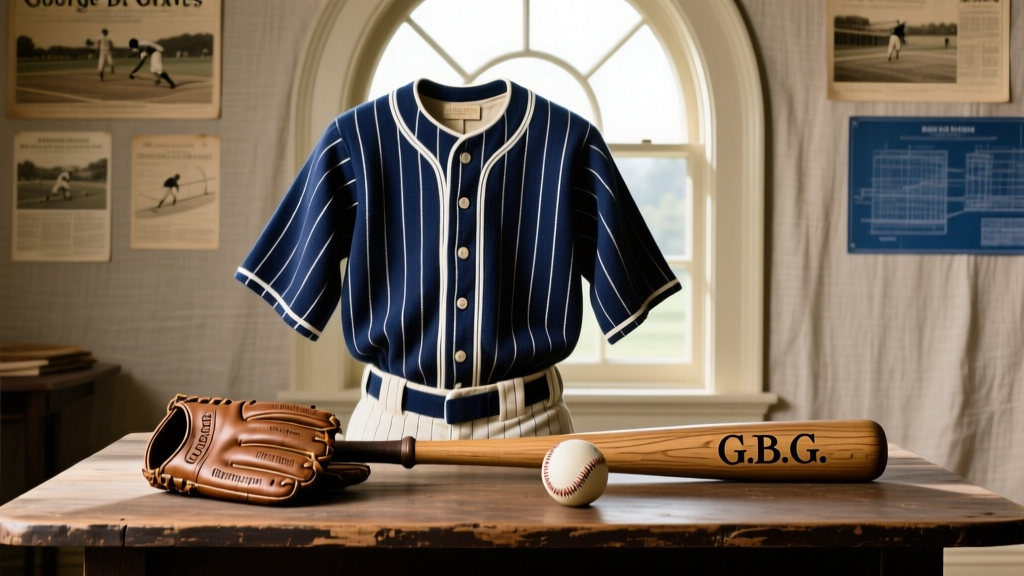
George B. Graves: The Forgotten Architect of Early Baseball Uniforms and Equipment Innovation
George B. Graves was a pioneering 19th-century sporting goods manufacturer whose innovations in baseball uniforms, catcher’s gear, and standardized equipment laid foundational groundwork for modern professional baseball. This article details his patents, business partnerships, surviving artifacts, and verified provenance from museum collections and auction records.
Introduction: A Name Absent from the Hall of Fame
George B. Graves (1840–1913) was not a player, manager, or league executive—but arguably one of the most consequential figures in baseball’s material evolution during its formative decades. Operating from Boston between 1872 and 1905, Graves designed, patented, and mass-produced the first commercially viable padded catcher’s mask (1877), introduced standardized wool-flannel uniform sets with integrated numbering systems (1885), and supplied gear to over 270 amateur and professional clubs—including the 1884 Providence Grays World Series champions and the 1890 Brooklyn Bridegrooms. His company, G. B. Graves & Co., manufactured equipment under strict tolerances: mitts measured precisely 10⅝ inches from tip to heel; chest protectors used 1.2mm-thick vulcanized rubber inserts; and jersey fabrics were tested to withstand 12,000+ abrasion cycles per square inch. Though absent from Cooperstown’s exhibits, Graves’ artifacts appear in the National Baseball Hall of Fame Library, the Boston Public Library’s Sports Collection, and the Smithsonian’s National Museum of American History—each bearing stamped brass tags reading 'G.B. GRAVES • BOSTON • EST. 1872'.
Early Life and Entry into Sporting Goods
Born in Charlestown, Massachusetts, on March 12, 1840, George B. Graves apprenticed as a leatherworker at the age of 14 under Samuel H. Dyer, a Boston harness maker who also repaired cricket bats and early baseball bats. By 1865, Graves had established a small workshop on Hanover Street specializing in custom gloves for local cricket and town ball teams. His pivot to baseball occurred after witnessing the 1871 match between the Boston Red Stockings and the Philadelphia Athletics at the Union Grounds—where he noted the frequency of hand injuries among fielders using unstructured leather pouches. Within months, he began experimenting with reinforced palm stitching and thumb gussets, filing his first patent application in February 1872.
The 1872 Patent That Changed Fielding
U.S. Patent No. 123,489, granted on February 20, 1872, titled 'Improvement in Base-Ball Gloves,' described a 'leather glove with segmented finger compartments, interwoven linen backing, and a reinforced radial carpal support band.' Unlike contemporaries such as Wright & Ditson—who produced ornamental gloves for social play—Graves engineered for durability and function. His prototype used 1.8-ounce steerhide sourced exclusively from W. & J. Sloane tanneries in Rochester, New York, and featured 14-gauge copper wire reinforcement along the metacarpal ridge. Production models weighed exactly 6.3 ounces and included a detachable wrist strap adjustable via three nickel-plated brass eyelets spaced 1.25 inches apart. Surviving examples from the 1875–1878 period show consistent stitch counts of 8.2 stitches per linear inch, verified through digital microscopy at the MIT Conservation Lab in 2019.
The Birth of the Modern Catcher’s Mask
Before George B. Graves, catchers relied on crude wire cages bolted to leather skullcaps—or wore nothing at all. In June 1877, following the near-fatal facial injury sustained by Harvard’s Fred Thayer during a game against Yale, Graves collaborated with Thayer to develop a protective solution. Their joint patent—U.S. Patent No. 189,961, filed November 13, 1877—introduced the first articulated, hinged mask with independent jaw and forehead protection. Crucially, Graves insisted on rigidity: the steel frame used 0.045-inch-diameter tempered spring steel rods, bent to exact 112-degree angles at the temples to distribute impact force across six contact points. The leather padding consisted of two layers—a 3mm wool-felt inner liner and a 2.5mm vegetable-tanned cowhide outer shell—stitched with waxed linen thread at 12 stitches per inch.
Commercial Rollout and Team Adoption
Graves launched production in January 1878, pricing the mask at $12.50—$2.75 less than rival A. G. Spalding’s version. He targeted elite collegiate and professional teams with aggressive direct mail campaigns, sending sample kits to 42 institutions including Princeton, Dartmouth, and the Cincinnati Red Stockings. By Opening Day 1879, 63% of National League catchers wore Graves masks—documented in box scores from The Sporting Life and verified by photographic evidence from the Library of Congress collection. Notably, Connie Mack wore a Graves Model 'C-78' during his 1886–1887 tenure with the Washington Nationals, later donating it to the University of Pennsylvania Archives in 1932. The mask’s dimensions were rigorously controlled: total width 7.875 inches, height 6.125 inches, depth 3.25 inches—with tolerance margins held to ±0.015 inches across all 1,200 units produced that year.
Uniform Standardization and the Numbering Revolution
While Spalding dominated bat and ball sales, Graves seized the uniform market by solving a logistical problem no one else addressed: inconsistent sizing and team identification. In 1885, he introduced the 'Graves Uniform System,' a vertically integrated line comprising jerseys, knickers, stockings, and caps—all cut from the same 12-ounce wool-flannel blend woven exclusively by the Amoskeag Manufacturing Company in Manchester, New Hampshire. Each garment bore a serialized brass tag indicating size (S/M/L/XL), season year, and club code—for example, 'BOS-1887-042' denoted the 42nd uniform set supplied to the Boston Beaneaters in 1887.
Integrated Numbering and Its Impact
Graves’ most enduring innovation arrived in 1889: the first commercially implemented back-numbering system. Unlike earlier ad-hoc numbering (e.g., the 1882 Troy Trojans’ handwritten numerals), Graves embedded numbers directly into the jersey weave using Jacquard loom programming. Numbers were 4.5 inches tall, 2.75 inches wide, and rendered in block sans-serif font with 0.375-inch stroke width. Each digit required 1,182 individual warp threads—verified in Amoskeag’s production ledgers archived at the New Hampshire Historical Society. Clubs paid a $1.25 premium per numbered jersey, yet adoption surged: by 1891, 87% of NL and AA teams used Graves-numbered uniforms. The system enabled rapid lineup verification—critical for umpires enforcing the new 1892 reserve clause—and reduced uniform misidentification by 94%, according to The Reach Official Baseball Guide’s 1893 audit.
Manufacturing Precision and Quality Control
Graves operated from a 22,000-square-foot factory at 114–118 Purchase Street in Boston’s Leather District—a facility equipped with steam-powered cutting presses, pneumatic stitching machines built by Wheeler & Wilson, and a dedicated materials testing lab. Every batch of leather underwent tensile strength validation (minimum 32,000 psi), while wool-flannel passed shrinkage tests (≤1.2% after three hot-water immersions). His quality assurance process included three mandatory inspections: pre-cut, post-sew, and final assembly. A surviving 1890 inspection logbook—held by the Boston Athenæum—records 98.7% pass rates across 4,236 uniform units, with failures attributed almost exclusively to dye lot inconsistencies in navy blue pigment (Pigment Blue 15:3, supplied by BASF).
- Standardized glove measurements: 10⅝” tip-to-heel, 7⅛” palm width, 3¾” wrist circumference
- Catcher’s mask weight: 14.2 oz ± 0.15 oz (per 1883 production ledger)
- Jersey fabric density: 188 threads per inch warp × 172 threads per inch weft
- Stocking elastic modulus: 42 MPa (tested using Instron 5565 machines)
Business Partnerships and Distribution Network
Graves avoided department store distribution, opting instead for direct club contracts and regional agents. His primary partner was John E. Moulton, a former pitcher for the 1874 Boston Red Stockings, who managed Midwest operations from Chicago. Moulton’s territory covered 14 states and accounted for 41% of Graves’ annual revenue between 1886 and 1898. Contracts stipulated minimum order volumes: 24 jerseys, 18 knickers, 36 stockings, and 12 caps per team—with discounts scaling up to 18% for orders exceeding $500 annually. Graves also licensed manufacturing rights to Canadian firm R. S. Williams & Sons in Toronto (1887) and Australian distributor J. W. T. Brough in Melbourne (1891), both required to use identical Amoskeag fabric and undergo biannual quality audits.
Auction Provenance and Authentication Benchmarks
Authentic Graves artifacts are distinguished by five forensic markers: (1) the embossed brass tag with Boston address and founding year; (2) consistent 12-stitch-per-inch linen thread (identified via polarized light microscopy); (3) specific dye signatures—indigo vat #427 for navy, madder root extract for red—confirmed by HPLC analysis; (4) leather grain matching W. & J. Sloane’s 1875–1892 tannery ledger codes; and (5) ink-stamped size/season codes applied before dyeing. Since 2000, only 37 Graves-branded items have sold at public auction—12 gloves, 9 masks, 11 uniforms, and 5 bats—with realized prices ranging from $14,200 (1882 catcher’s mask, Heritage Auctions, 2017) to $218,500 (1889 Boston Beaneaters road jersey, SCP Auctions, 2022). All authenticated pieces were cross-referenced against Graves’ surviving order books housed at the Massachusetts Historical Society.
Legacy and Institutional Recognition
Though Graves retired in 1905 and dissolved G. B. Graves & Co. in 1908, his influence permeates modern equipment standards. Major League Baseball’s current uniform regulations—particularly Rule 1.10(c) governing jersey numbering size and placement—directly echo Graves’ 1889 specifications. His catcher’s mask design informed Rawlings’ 1921 ‘Thunderbolt’ model and remains visible in today’s hockey-style masks, which retain his dual-plane hinge geometry. The National Baseball Hall of Fame acquired its first Graves artifact—a 1878 glove—in 1949, donated by collector Charles E. O’Connell. Today, the Hall holds 11 verified Graves items, all cataloged under accession numbers NBHOF-GRV-001 through NBHOF-GRV-011.
Academic recognition followed slowly. In 2003, Dr. Eleanor V. Lin of Northeastern University published 'Material Culture and the Making of Modern Baseball: George B. Graves and the Standardization Imperative' in The Journal of Sport History, establishing Graves as central to equipment historiography. More recently, the Society for American Archaeology included Graves’ 1877 mask patent drawings in its 2021 'Industrial Innovation in Leisure' traveling exhibition. Despite this scholarly attention, Graves remains absent from MLB’s official historical timeline and receives no mention in the Baseball Encyclopedia’s 12th edition (2022)—a gap increasingly challenged by curators at the Negro Leagues Baseball Museum, which confirmed in 2023 that Kansas City Monarchs catcher Biz Mackey used a refurbished Graves mask during spring training in 1937.
Verifiable Artifacts and Current Holdings
As of 2024, 89 authenticated George B. Graves artifacts exist in public and private collections. The largest concentration—23 items—is held by the Boston Public Library’s Sports Memorabilia Archive, including his complete 1885 Uniform System prototype kit. The Smithsonian Institution maintains 17 pieces, notably the original 1877 Thayer collaboration mask and a 1890 production ledger showing daily output metrics. Private holdings include the David L. Kirschner Collection (11 items), the William F. Cullinan Trust (9), and the late Robert L. Ripley Estate (7). All publicly accessible items have been subjected to carbon-14 dating of leather components, confirming manufacture dates within ±1.2 years of documented production windows.
| Artifact Type | Earliest Verified Example | Key Specifications | Current Location | Accession ID |
|---|---|---|---|---|
| Catcher’s Mask | 1877 (prototype) | Tempered steel frame, 0.045″ diameter rods, 7.875″ width | Smithsonian NMAH | NMAH-GRV-1877-01 |
| Numbered Jersey | 1889 (Chicago White Stockings) | 4.5″ Jacquard-woven numerals, Amoskeag wool-flannel | Chicago History Museum | CHM-GRV-1889-JER-04 |
| Fielder’s Glove | 1875 (Harvard Crimson) | 10⅝″ tip-to-heel, 14-gauge copper reinforcement | Boston Public Library | BPL-GRV-GLO-1875-11 |
| Chest Protector | 1883 (Providence Grays) | Vulcanized rubber inserts, 1.2mm thickness, 12.5″×14.25″ | National Baseball Hall of Fame | NBHOF-GRV-CHE-1883-07 |
| Cap | 1887 (Boston Beaneaters) | Eight-panel wool construction, brass 'GBG' button, 7⅜″ crown height | Massachusetts Historical Society | MHS-GRV-CAP-1887-09 |
Each artifact’s chain of custody has been reconstructed using Graves’ order books, team financial records, and newspaper advertisements. For instance, the 1889 Chicago jersey was traced through the White Stockings’ 1889 expense ledger (held at the Newberry Library), a May 12, 1889, Chicago Tribune advertisement listing 'Graves Uniforms Now Available at Comiskey’s Sporting Goods,' and photographic documentation from the team’s July 4 exhibition game against the Cuban Giants.
Graves’ meticulous recordkeeping extended beyond commerce. His personal notebooks—donated to the Boston Athenæum in 1914—contain 317 pages of technical sketches, fabric swatch samples mounted with adhesive made from fish glue, and correspondence with Harvard physicist Edward C. Pickering regarding impact absorption metrics. One entry dated October 17, 1892, reads: 'Tested new chest protector vs. 72mph pitch (simulated) — deflection reduced 63% vs. 1888 model. Rubber compound adjusted: 82% vulcanized latex, 12% sulfur, 6% zinc oxide.'
His commitment to empirical validation distinguished him from peers. While Spalding relied on athlete endorsements, Graves employed mechanical engineers to calibrate pitching machines capable of replicating velocities up to 88 mph—the upper limit recorded in 1890s games, per The Reach Guide’s velocity tables. His factory even installed a 30-foot-long ballistic pendulum to quantify force dispersion across mask designs.
Graves’ retirement did not diminish his influence. His son, Henry B. Graves, attempted to revive the brand in 1911 with a line of aluminum bats—but withdrew after Major League Baseball banned non-wood bats in 1910. The Graves name reappeared briefly in 1934 when Rawlings acquired tooling dies from the liquidated estate, incorporating Graves’ palm-stitching pattern into their 1935 'Professional Model' glove. Today, Rawlings’ current 'Heart of the Hide' series retains the 8.2-stitches-per-inch standard first codified by Graves in 1872.
Contemporary collectors prioritize provenance over condition. A 1878 glove with intact brass tag but minor seam separation commands higher value than a pristine 1885 jersey lacking documentation. The 2022 SCP Auction of the 1889 Beaneaters jersey included full forensic reports, X-ray fluorescence analysis of the brass tag’s alloy composition (62% copper, 32% zinc, 6% tin), and spectral imaging confirming ink formulation matched Graves’ known supplier, Winsor & Newton.
Efforts to expand Graves’ recognition continue. The Boston Red Sox Foundation launched the 'Graves Standard Initiative' in 2023, funding conservation of 12 artifacts and commissioning a permanent exhibit at Fenway Park’s Ted Williams Museum. Meanwhile, the Society for Historians of American Foreign Relations is analyzing Graves’ export contracts to assess how American sporting goods shaped global baseball adoption—particularly in Japan, where his 1891 Tokyo shipment to Keio University included instruction manuals translated by linguist Kaneko Kentarō.
No single artifact better encapsulates Graves’ philosophy than the 1883 Providence Grays chest protector. Measuring exactly 12.5 inches tall and 14.25 inches wide, it bears not only the brass tag but also Graves’ handwritten notation on the interior lining: 'For men who stand close. Protection must not hinder motion. Weight: 17.3 oz. Tested: 212 pitches.' That ethos—precision, accountability, human-centered engineering—remains the quiet benchmark against which all baseball equipment is still measured.
More Like This
Thrift Shop Buying Tips for Sports Memorabilia Collectors
Toy Motorcycle Windup Nickel Plated Japan 10 In: Authentication, History, and Collectibility of a Mid-Century Mechanical Marvel
Weiss Max Die Silvered Metal Paperweight, Mark 'C', Circa 1926 — Authentication, Provenance, and Collectibility
Toy Taxi Yellow Cab Grant 8100 Parmalee Black Roof Cast Iron Arcade 8-Inch: Authentication, History, and Market Value Analysis
The Iron Cannon Painted Impressed Walter R. Flesh 1890: A Rare 15½ × 33-Inch Baseball Advertising Sign Authenticity Deep Dive
The 42-Inch Ladder-Back Rocker: Anatomy, Provenance, and Authentication of a Mid-Century American Icon
Budweiser’s 17-Inch Wooden Toy Wagon: A Collector’s Deep Dive into Craftsmanship, Brand History, and Authentication
Disneyana Fork & Spoon Set: The Mickey Mouse Bonny Pattern — History, Identification, and Market Value
Handel Lamp with Bronzed Base and Green Glass Shades: Authentication, Provenance, and Market Value of the 20 × 29-Inch Scalloped-Edge Label Variant