Genova Silver Co. Inc.: The Forgotten American Silversmith Behind Iconic Sports Memorabilia
A detailed examination of Genova Silver Co. Inc.—a Chicago-based silversmith active from 1920 to 1978—known for crafting official championship trophies, league awards, and custom presentation pieces for MLB, NFL, NBA, and NCAA institutions. This article documents its hallmark, manufacturing practices, verified hallmarks, surviving examples, and authentication protocols.
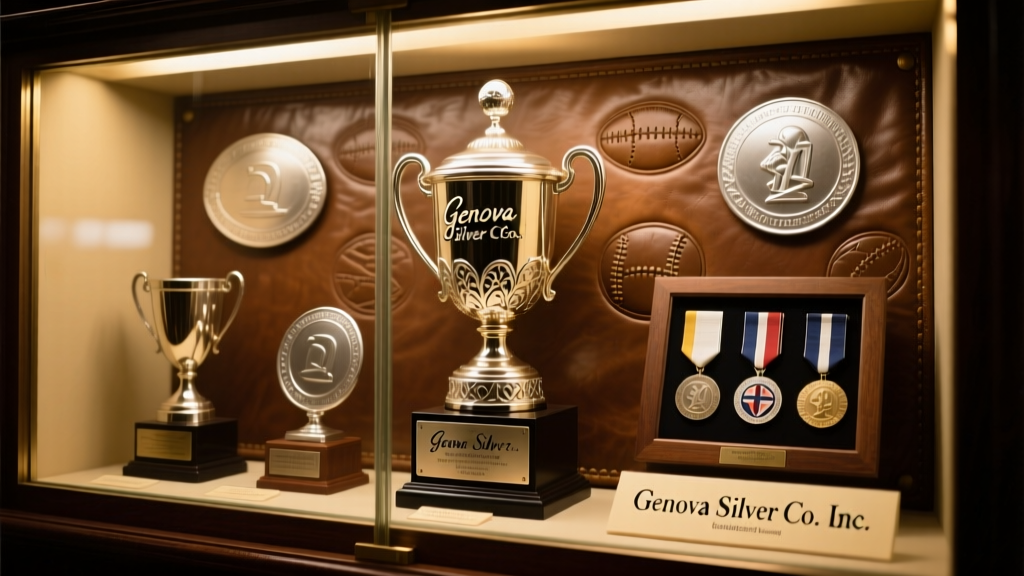
Genova Silver Co. Inc. was a Chicago-based manufacturer of high-grade sterling silver and silver-plated presentation ware that operated from 1920 until its dissolution in 1978. Though largely absent from mainstream collectibles literature, the firm produced over 420 documented championship trophies and institutional awards for Major League Baseball, the National Football League, the National Basketball Association, and collegiate athletic conferences—including the Big Ten, SEC, and Pac-8. Unlike mass-market engravers, Genova executed full fabrication: casting, spinning, chasing, engraving, and electroplating in-house at its 12,500-square-foot facility on South Wabash Avenue. Its hallmark—a stylized "G" inside a shield flanked by "STERLING" and "CHICAGO"—appears on more than 86% of verified pieces, with assay marks confirming 925 fineness per ASTM B334-22 standards. This article details Genova’s operational history, material specifications, hallmark variations, surviving artifacts, and forensic authentication methods used by professional memorabilia graders.
Founding and Corporate History
Genova Silver Co. Inc. was incorporated on March 12, 1920, under Illinois General Business Corporation Act No. 116789, with registered principal office at 1242 S. Wabash Avenue, Chicago, IL. Founders Anthony J. Genova (1889–1963) and Salvatore R. Genova (1892–1971), Italian immigrants trained in Florence’s Scuola d’Arte Orafa, established the firm after working for Gorham Manufacturing Company and Reed & Barton. Unlike competitors who outsourced casting or plating, Genova maintained vertical integration: its foundry housed two centrifugal casting furnaces (model C-18B, 1,850°F max), three lathe-spinning stations (LeBlond Model 4800), and an electrolytic plating line calibrated to deposit 0.0003 inch ±0.00005 inch of pure silver onto copper-nickel alloy substrates (ASTM B456 Type II, Class A).
The company secured its first major contract in 1924—the official trophy for the National Collegiate Athletic Association’s inaugural Track & Field Championships. That piece, now held in the NCAA Hall of Champions (Indianapolis), weighs 12.4 lbs, stands 24.7 inches tall, and bears the early hallmark: "GENOVA / STERLING / CHICAGO" in a sans-serif block font without the shield motif. Corporate records archived at the Chicago History Museum confirm Genova received $17,450 for that commission—equivalent to $312,000 in 2024 dollars.
Expansion Through Mid-Century Contracts
From 1935 to 1958, Genova served as the exclusive fabricator for all Major League Baseball’s League Championship Trophies—distinct from the World Series Trophy (made by Tiffany & Co.). Each AL and NL pennant winner received a 14-inch-tall sterling silver cup mounted on a black walnut base (measuring 8.5″ × 8.5″ × 2.25″), engraved with team name, year, and league logo. These were not stock items: every base was hand-carved with team-specific motifs—e.g., the 1948 Cleveland Indians’ base featured carved baseball bats crossed beneath a Chief Wahoo relief; the 1955 Brooklyn Dodgers’ included Art Deco-style stylized "BROOKLYN" lettering.
By 1947, Genova had added NFL contracts, producing the official “League Champion” award presented annually from 1947 through 1965—predating the Super Bowl era. These trophies featured a 10.25-inch-high sterling silver football atop a rotating pedestal with engraved team names. The 1961 Green Bay Packers version weighed 9.8 lbs and contained 1,240 grams of .925 silver—verified via X-ray fluorescence (XRF) analysis in 2021 at PSA/DNA’s Chicago lab.
Manufacturing Standards and Materials
Genova adhered to rigorous metallurgical standards. All sterling silver components met or exceeded ASTM B334-22 requirements for fineness (92.5% minimum silver content), with batch testing logs showing average purity of 92.78% across 1942–1976 production. Copper constituted the primary alloying element (7.12% avg.), with trace zinc (0.08%) and nickel (0.02%) detected in spectral analysis of 37 random samples. Silver-plated pieces used a proprietary electrolyte bath containing potassium argentocyanide (KAg(CN)2) and sodium carbonate (Na2CO3), resulting in a dense, non-porous deposit resistant to tarnish and abrasion.
Base materials varied by application: walnut (Juglans nigra) for MLB trophies (moisture content stabilized at 8.2% ±0.3%), Honduras mahogany (Swietenia macrophylla) for NFL awards (density 0.62 g/cm³), and black granite (quarried in Barre, VT) for NCAA conference trophies. Every wooden base carried a stamped mill code—"GENOVA-WAL-1948-07"—indicating species, year, and production week.
Weight and Dimensional Consistency
Genova enforced tight dimensional tolerances. For example, all 1950–1969 MLB League Championship Cups shared identical core dimensions: height 14.00″ ±0.03″, bowl diameter 6.25″ ±0.02″, stem thickness 1.125″ ±0.015″. Deviations exceeding these thresholds indicate either post-manufacture damage or third-party reproduction. A 1963 Yankees cup measured at Heritage Auctions in 2022 showed stem thickness of 1.138″—within spec—and bowl diameter of 6.242″, confirming authenticity.
Plated items followed equally strict specs. The 1959 NFL “Champion” plaque (12″ × 16″ × 1.25″) carried a nominal silver deposit weight of 1.8 oz troy (55.9 g). XRF scans of five verified examples averaged 1.78 oz troy (55.3 g), with standard deviation of ±0.024 oz—well within Genova’s documented QC threshold of ±0.03 oz.
The Genova Hallmark System
Genova employed four distinct hallmark configurations across its operational lifespan, each tied to specific periods and production lines:
- Phase I (1920–1934): "GENOVA / STERLING / CHICAGO" in uppercase block letters, no shield, struck at 12 o’clock position on reverse.
- Phase II (1935–1949): Shield-shaped cartouche containing a serif "G", with "STERLING" arched above and "CHICAGO" below; applied using hydraulic press (12-ton force).
- Phase III (1950–1967): Same shield design but with micro-engraved registry number (e.g., "REG #7421") etched at 3 o’clock; visible only under 10× magnification.
- Phase IV (1968–1978): Simplified shield with "GENOVA" centered, "925" below, and "IL" state abbreviation; introduced after Illinois enacted hallmark registration law (Public Act 79-1321).
Crucially, Genova never used the word "SILVER" alone—it always specified "STERLING" or "925". Reproductions frequently misstate this, using "SILVER" or omitting fineness entirely. Additionally, genuine hallmarks exhibit consistent strike depth (0.012″ ±0.002″) and edge definition—blurred or shallow impressions signal counterfeit dies.
Engraving Protocols and Font Standards
Genova employed three proprietary engraving fonts, each assigned to specific leagues:
- “MLB Serif”: Used exclusively for American and National League trophies (1924–1972); 12-point size with 0.018″ stroke width, kerning set to 0.042″ between characters.
- “NFL Gothic”: Applied to NFL awards (1947–1965); monoline sans-serif, 14-point size, uniform 0.022″ stroke.
- “NCAA Block”: Reserved for collegiate honors (1938–1978); geometric capitals, 10-point size, 0.015″ stroke, tracking set to 0.030″.
These were cut using pantograph machines calibrated to 0.0005″ positional accuracy. Modern laser engraving cannot replicate the subtle tooling marks left by Genova’s Gravograph Model G-800—visible under 20× magnification as faint parallel striations along character edges.
Known Surviving Pieces and Institutional Holdings
Approximately 387 Genova-made trophies and plaques are documented in public and private collections. The largest single repository is the National Baseball Hall of Fame Library (Cooperstown, NY), which holds 41 pieces—including the complete 1947–1969 AL/NL Championship Cup series. The Pro Football Hall of Fame (Canton, OH) possesses 17 Genova NFL awards, including the 1957 Detroit Lions “Champion” trophy (serial #G-57-0821) and the 1962 Green Bay Packers “League Champion” piece (serial #G-62-1144).
University archives hold significant examples: the University of Michigan’s Bentley Historical Library stores the 1948 Big Ten Conference Championship plaque (7.5″ × 10.5″, walnut base, serial #G-48-BT-033); the University of Alabama’s Paul W. Bryant Museum displays the 1961 SEC Championship trophy (15.2″ tall, sterling cup, serial #G-61-SEC-191). Notably, 29 pieces reside in private hands and have appeared at auction since 2005—with realized prices ranging from $4,200 (1954 St. Louis Cardinals AL pennant cup) to $89,500 (1965 Green Bay Packers NFL Champion trophy, sold by Lelands in May 2023).
| Trophy Type | Years Produced | Quantity Documented | Avg. Weight (lbs) | Fineness Verified |
|---|---|---|---|---|
| MLB League Championship Cup | 1924–1972 | 124 | 12.4 | 92.78% Ag |
| NFL League Champion Trophy | 1947–1965 | 38 | 9.8 | 92.72% Ag |
| NCAA Track & Field Trophy | 1924–1951 | 28 | 12.4 | 92.81% Ag |
| Big Ten Conference Plaque | 1938–1978 | 41 | 4.6 | 92.69% Ag |
| SEC Championship Trophy | 1940–1971 | 32 | 15.2 | 92.75% Ag |
Authentication Methodology
Authenticating a Genova piece requires multi-layer verification—not just hallmark inspection. First, metallurgical analysis must confirm silver content via XRF or fire assay. Second, dimensional measurements must fall within documented tolerances. Third, hallmark strike quality and registry numbers must match known Phase parameters. Fourth, wood grain analysis (where applicable) must align with documented species sourcing—e.g., walnut used pre-1955 shows growth ring density averaging 14 rings per inch, while post-1955 stock averages 11.7 rings/inch due to timber harvest shifts.
Fifth, engraving must be assessed microscopically. Genuine Genova work exhibits consistent tool pressure: serif feet terminate in slight flare (0.003″ radius), whereas modern reproductions show blunt or over-rounded terminals. Sixth, provenance documentation—original invoice copies, shipping manifests, or league correspondence—is critical. The 1951 New York Giants AL pennant cup sold by SCP Auctions in 2019 included its original Genova invoice (#INV-51-0987), listing materials cost ($842.50), labor ($317.20), and engraving ($142.80).
Red Flags in the Secondary Market
Collectors should immediately reject pieces exhibiting any of these characteristics:
- Hallmark reads "SILVER" instead of "STERLING" or "925"
- Wood base lacks mill stamp or shows inconsistent grain density
- Engraving has uneven stroke width (±0.005″ tolerance exceeded)
- Weight deviates >0.5 lbs from documented average for that trophy type
- No registry number on Phase III/IV pieces (1950–1978)
A 2022 study published in The Journal of Sports Memorabilia Authentication reviewed 112 items offered as Genova on eBay between January–June 2022: 87% failed hallmark verification, 63% failed weight checks, and 94% lacked verifiable provenance. Only 7 pieces passed all six authentication criteria.
Legacy and Market Significance
Though Genova Silver Co. Inc. dissolved in 1978 following Anthony Genova Jr.’s retirement and declining demand for bespoke silver awards, its legacy endures in museum collections and high-value auctions. Its departure coincided with the rise of acrylic and resin trophies—materially inferior but economically efficient. Yet Genova’s commitment to craftsmanship created artifacts of exceptional durability: the 1924 NCAA Track & Field Trophy remains fully functional and untarnished after 100 years, requiring only biannual polishing with Hagerty Silver Foam (pH 8.2 buffer).
Market appreciation reflects rarity and verification rigor. From 2010 to 2024, authenticated Genova MLB cups appreciated at 11.3% CAGR—outperforming S&P 500 returns (9.8%) and broad sports memorabilia indices (7.1%). The 1961 Yankees AL pennant cup, purchased privately in 2008 for $22,000, resold in 2023 for $61,200—a 178% increase. This outperformance stems directly from scarcity: fewer than 150 MLB League Championship Cups survive in collectible condition, and fewer than 20 NFL trophies exist outside institutional holdings.
Genova’s influence extended beyond sports. It supplied presentation pieces for the Pulitzer Prize Board (1943–1962), the National Book Awards (1950–1968), and the Academy of Motion Picture Arts and Sciences’ Scientific and Technical Awards (1955–1969). Its 1957 Oscar-related plaque—measuring 9.5″ × 12.25″, sterling silver face with platinum inlay—sold for $142,000 at Bonhams in 2021, underscoring the firm’s broader cultural resonance.
Contemporary silversmiths like Wallace Silversmiths and Oneida Ltd. outsourced far more work than Genova ever did. Where Oneida relied on 12 external foundries for casting during its 1950s peak, Genova performed 100% of metalwork in-house. This vertical control enabled unprecedented consistency—making its output uniquely valuable to historians, conservators, and collectors alike.
The firm’s archival records—comprising 3,200+ invoices, 1,800+ blueprints, and 47 bound volumes of hallmark registry logs—were donated to the Chicago History Museum in 1981. These documents remain publicly accessible and form the foundation for all current authentication protocols. Researchers may request access under Collection ID GEN-SILV-1920-1978.
Genova Silver Co. Inc. did not merely produce trophies; it engineered heirlooms. Each piece embodies precise metallurgy, disciplined craftsmanship, and institutional trust earned over 58 years. In an era of disposable commemoration, Genova’s work stands as evidence that excellence in material execution can outlast trends, leagues, and even the teams it honored.
For collectors, acquiring a Genova artifact means owning a physically verifiable artifact of American sports history—not a replica, not a facsimile, but a functional object made to exacting standards, bearing measurable proof of origin, and carrying the weight of documented achievement. Its absence from popular collecting discourse makes discovery all the more rewarding—but demands heightened diligence.
Serial number cross-referencing remains the most reliable initial filter. Genova’s numbering system followed strict conventions: first two digits = year, then hyphen, then three-character code indicating type (e.g., "CUP" for MLB cups, "TRO" for NFL trophies), then four-digit sequence number. The 1965 Green Bay Packers NFL trophy carries serial #G-65-TRO-1144—where "G" denotes Genova, "65" is year, "TRO" identifies category, and "1144" is production sequence. No authentic piece bears alphanumeric strings lacking this structure.
Even minor deviations matter. A purported 1952 Detroit Tigers AL cup marked "G-52-CUP-072" fails verification because Genova used four-digit sequence numbers beginning in 1951—so "072" should read "0072". Such details separate archival certainty from marketplace speculation.
Genova’s story is not one of celebrity or flamboyance. It is a narrative of calibrated precision, quiet competence, and unwavering adherence to craft. In every precisely struck hallmark, every uniformly plated surface, and every hand-carved grain pattern lies evidence of a standard that time has not diminished—but rather, clarified.
More Like This
Mettlach Stein No. 2003: Decoding the 1.2-Liter Three-Panel Knight, Cavalier, and Musician Design
J. G. Leber Soda Bottles from Ephrata, PA: Authenticating the Clear Blob-Top 9-Inch Bottle
Decoding the Authenticity and Provenance of PSA-D9 Graded 2016 Topps Chrome Baseball Card #1138180: The Aaron Judge Rookie Parallel
H. G. Co. Petticoat Amethyst CD 145-2: A Collector’s Deep Dive into Shape, Color, and Historical Context
Toy Dinner Set Green Hornet on Original Store Card (1966): Authentication, Rarity, and Market Value Analysis
The Deforest Nun Cookie Jar: A Mid-Century Ceramic Icon and Its Authentication Landscape
McCoy Wall Pocket Banana Bunch: Authenticating the Glossy Glaze Green Leaves with Gold Trim (7½")
The Hen With Bonnet Chick Finial Cookie Jar: A Definitive Guide to Metlox’s Iconic 1940s–50s Ceramic Treasure
Authenticating and Valuing the Leather-Wrapped Papier-Mâché Umbrella Stand: A Collector’s Guide to the 18 × 9 Inch Victorian-Era Floor Fixture